Is GCSE Arabic Harder Than Before?
GCSE Arabic harder than before? Explore what changed in the reformed exam, why it may feel tougher and how to balance Arabic with GCSE maths revision.
A paper can feel harder for two very different reasons. The exam may genuinely have changed, or you may now be noticing demands that were always there. If you are wondering whether GCSE Arabic is harder than before, the fairest answer is: the qualification became more demanding in several identifiable ways when the reformed specification was first assessed in 2019, but there is no clear evidence that it has continued getting harder every year since then.
The current Pearson Edexcel course replaced controlled assessment with terminal assessment, introduced grades 999 to 111, added translation and authentic reading material, and gave listening, speaking, reading and writing equal weight. Those changes can make the exam feel less forgiving. Yet annual grade boundaries, unfamiliar questions and personal revision pressure can also create a sense of increasing difficulty without proving that the underlying standard has risen.
The short answer
Here is the essential checklist:
- Pearson Edexcel is currently the accredited exam board for GCSE Arabic in England.
- The present specification was introduced for teaching from September 2017 and first assessed in 2019.
- All four language skills are worth 25%25\%25% of the qualification.
- Students take either foundation or higher tier across the whole qualification.
- Translation, authentic texts and questions written in Arabic are part of the assessment.
- The qualification is linear, so the assessments are completed in the final exam series rather than through modular units.
- Recent changes to French, German and Spanish GCSEs do not automatically apply to Arabic.
- Changing grade boundaries do not, by themselves, show that GCSE Arabic is becoming harder.
That distinction matters. “Harder than the previous specification” and “harder every year” are not the same claim.
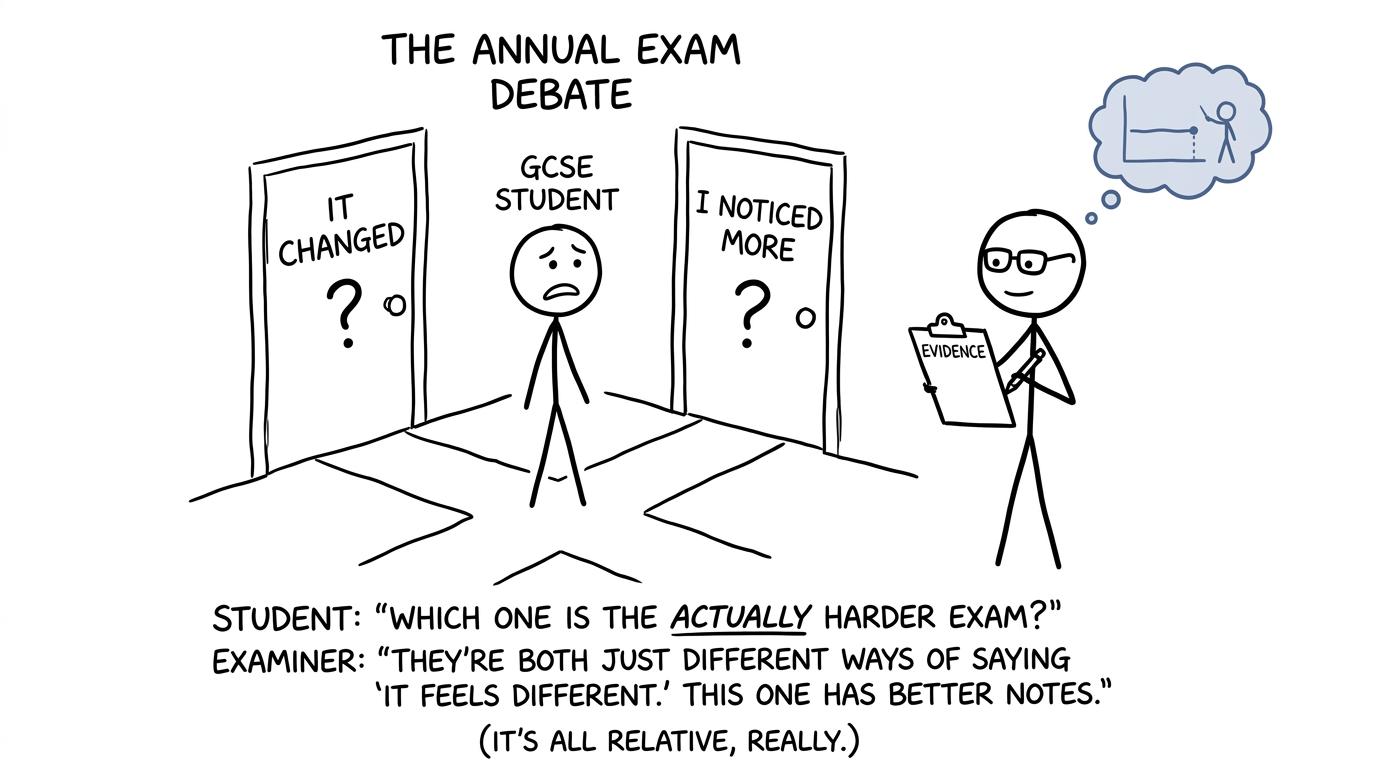 A student deciding whether the exam changed or they simply noticed more
What genuinely changed in GCSE Arabic?
The clearest break came between the former A* to G qualification and the reformed Pearson Edexcel GCSE graded 999 to 111. It was a change in structure as well as labels.
Assessment became fully terminal
The current GCSE Arabic qualification consists of four assessments: listening, speaking, reading and writing. They must all be taken at the same tier, and the qualification is completed in one terminal series.
Under the former specification, controlled assessment contributed to speaking and writing. That could give students more opportunity to prepare work over time. The reformed course removed that component. The speaking assessment is still conducted by a teacher at the centre, but Pearson supplies the tasks and marks the recording externally.
This can make performance feel more exposed. A difficult day, an unfamiliar prompt or weak time management may have a more immediate effect than under a course containing prepared controlled assessment.
The four skills now carry equal weight
Each assessment objective contributes:
14=25%\frac{1}{4}=25\%41=25%That balance is simple, but it removes the possibility of treating one skill as a minor part of the course. In the previous full-course specification, listening and reading each carried 23%23\%23%, while speaking and writing each carried 27%27\%27%. The difference was not enormous, yet the current structure makes the message unmistakable: every skill matters equally.
For a student who speaks Arabic confidently at home but has less experience reading formal standard Arabic, this balance may expose a genuine gap. Conversational fluency is valuable, but it is not identical to exam fluency.
Translation and authentic material increased the demand
The reformed specification introduced short translation from Arabic into English and from English into Arabic. Reading can also include authentic material and adapted or abridged literary texts. Some listening and reading questions are set in Arabic rather than English.
These tasks test more than whether a student understands the general topic. Translation rewards precision, while authentic texts may contain unfamiliar language that must be interpreted from context. Writing also requires accurate grammar and communication rather than a memorised paragraph that only loosely fits the prompt.
That is one strong reason why students may reasonably describe the current GCSE Arabic as harder than the qualification taken before 2019.
Why might GCSE Arabic feel harder now?
Difficulty is partly a feature of the paper and partly a feature of the situation surrounding it.
Spoken Arabic and standard written Arabic are different demands
Arabic is used across a wide range of regional varieties, while the examination assesses standard spoken and written Arabic. A student may communicate naturally with relatives and still find formal vocabulary, grammatical endings, extended reading or precise spelling challenging.
That does not mean home fluency is irrelevant. It provides an important foundation. But assuming that speaking one variety automatically guarantees high marks in every paper can lead to under-preparation.
Recognition is easier than production
Seeing a word and understanding it can create a strong sense of familiarity. Producing it accurately in writing or speech is a different skill. The writing and speaking papers require students to retrieve vocabulary, select structures and communicate under pressure.
This is similar to GCSE maths. Watching a solution to an algebra question may feel clear, but that feeling is not the same as solving an unseen question independently. MathsGenie’s guide to finding your weakest GCSE topics explains why testing and marking give better evidence than familiarity alone.
Students are balancing several terminal exams
GCSE Arabic does not exist in an empty timetable. Students may also be preparing for English, science and three GCSE maths papers, alongside other subjects. A linear course can feel harder because so much performance is concentrated into the final assessment period.
The solution is not to revise every subject for hours each evening. It is to make the next task specific. For maths, the free GCSE maths revision hub lets you choose your board, tier and topic instead of losing time deciding what to do.
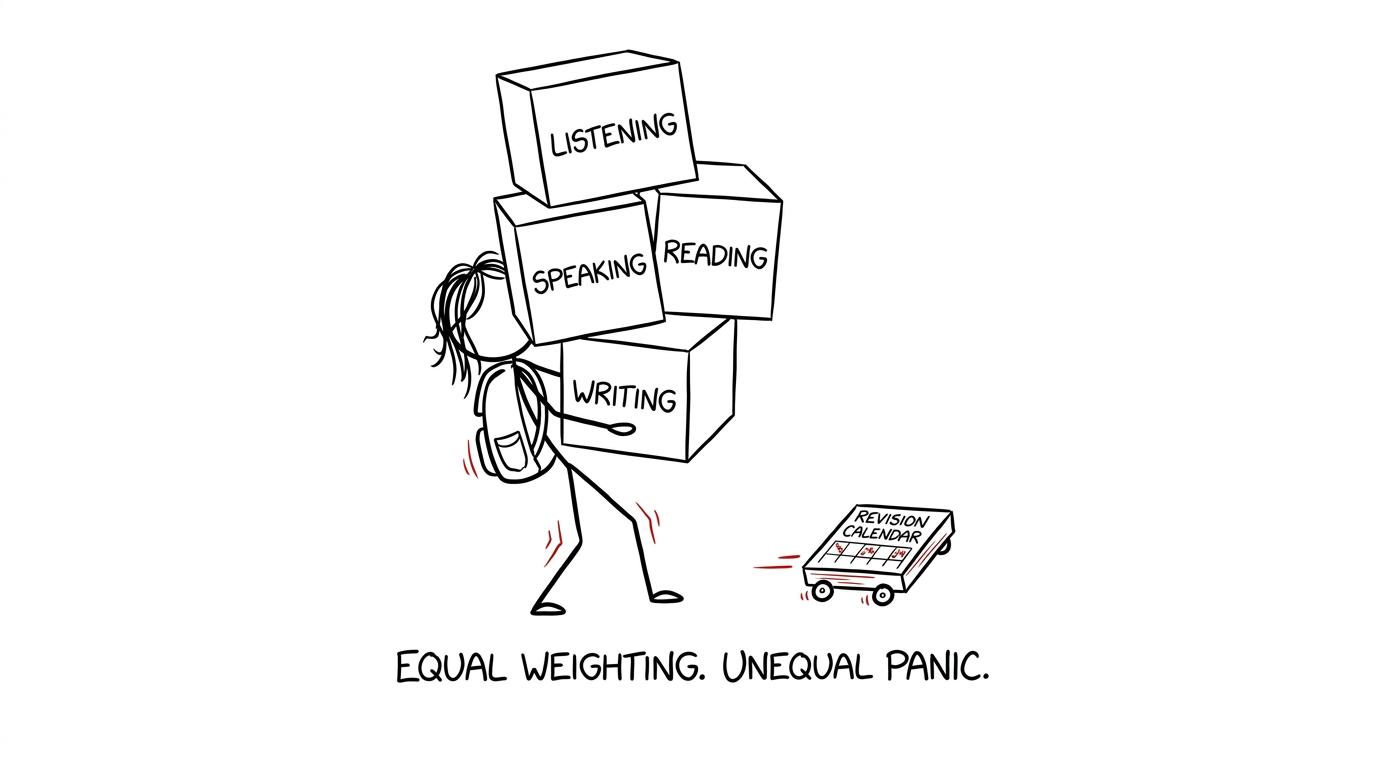 A student balancing four language skills while a revision calendar escapes
Do higher grade boundaries prove the exam is harder?
No. A grade boundary tells you the minimum raw mark required for a grade in a particular exam series. It does not measure difficulty on its own.
MathsGenie’s Edexcel GCSE Arabic grade boundaries show that the higher-tier grade 999 boundary was 235235235 out of 280280280 in 2019, 225225225 in 2024 and 237237237 in 2025. The foundation-tier grade 444 boundary was 130130130 in 2019, 136136136 in 2024 and 144144144 in 2025.
Those movements should be interpreted carefully. Exam boards set boundaries after the papers have been marked so that differences in paper demand can be taken into account. Cohort characteristics can matter too, particularly in subjects with smaller or less typical entry groups.
A higher boundary does not mean the paper was harder. It may indicate that students generally found it more accessible or performed more strongly. A lower boundary may compensate for a more demanding paper. Comparing raw boundaries across years therefore gives context, not a verdict.
The change from A* to G to grades 999 to 111 makes older comparisons even less direct. The specifications, assessment structures and grading scales are not identical.
 Students discovering that a tiny ruler cannot measure exam difficulty
Has GCSE Arabic changed again for 2026?
Students may have heard that language GCSEs are changing for exams from summer 2026. That is true for new GCSE specifications in French, German and Spanish, which began teaching in September 2024.
However, the Department for Education states that the earlier modern foreign language subject content remains current for other languages, including Arabic. Students should therefore avoid assuming that announcements about prescribed vocabulary sizes, dictation or revised assessment objectives for French, German and Spanish describe their Arabic paper.
For GCSE Arabic, follow the current Pearson Edexcel specification and the information supplied by your school. Do not revise from a generic “new language GCSE” checklist without checking which language and specification it covers.
A sensible revision response
Whether the exam is objectively harder matters less than knowing what the current paper requires. Turn the debate into an action plan.
Separate the four skills
Give listening, speaking, reading and writing their own place in your timetable. Record mistakes under headings such as vocabulary, grammar, misunderstanding, spelling and timing. This prevents a vague conclusion such as “Arabic is difficult” from becoming your entire diagnosis.
Use official-format material
Practise the role play, picture stimulus and conversation format for speaking. For reading and listening, include questions presented in Arabic as well as English. For writing, practise responding precisely to every bullet point and working without a dictionary, because dictionaries are not permitted in the assessment.
Protect your maths revision at the same time
A demanding language GCSE should not push maths into occasional last-minute sessions. Use short, repeatable blocks. The 20-minute GCSE maths revision routine is useful when several subjects are competing for attention.
Start with a revision lesson, complete questions without help, mark them and record one correction. Use Edexcel GCSE maths mini tests for quick checks, then build towards full papers. If planning is the main difficulty, follow the GCSE one-week maths revision plan rather than relying on mood.
Common mistakes when judging GCSE Arabic difficulty
Comparing one paper with an entire era
One unusually challenging listening paper cannot prove that the qualification becomes harder every year. Compare specifications, assessment methods and several exam series rather than one memorable experience.
Treating grade boundaries as difficulty scores
Boundaries are part of the awarding process. They respond to performance and paper demand; they are not a simple league table of how hard each year was.
Confusing GCSE Arabic with International GCSE Arabic
Pearson Edexcel GCSE Arabic and International GCSE Arabic (First Language) are different qualifications with different paper structures and intended demands. Check the qualification code and specification before using any resource.
Assuming spoken fluency covers every assessment
Everyday conversation may not prepare a student fully for formal reading, translation, accurate extended writing or standard spoken Arabic. Diagnose each skill separately.
Revising passively
Reading vocabulary lists and watching explanations can support revision, but improvement needs retrieval and correction. The same principle applies in maths: use past papers properly, mark them with the official scheme, then repair the precise topic that cost you marks.
The fairest conclusion
So, is GCSE Arabic harder now than it used to be? Compared with the pre-2019 qualification, there are sound reasons to say that parts of the current course are more demanding. Terminal assessment, translation, authentic texts, Arabic-language questions and equal weighting across four skills all contribute to that judgement.
But there is not enough evidence to claim that the exam simply gets harder each year. Recent boundary changes do not establish that, and reforms beginning in 2026 for French, German and Spanish should not be mistakenly applied to Arabic.
The useful response is calm and practical: learn the current specification, practise all four skills and judge progress through marked work rather than feeling alone. Then give maths the same disciplined treatment. Use MathsGenie’s free revision lessons and practice questions to repair weak topics, test yourself with GCSE predicted papers, and learn from mark schemes and video solutions. A difficult exam becomes more manageable when your next step is visible.