

GCSE Arabic Foundation Tier: Easier or Different?
GCSE Arabic Foundation tier easier? Compare the grade cap, paper demands and revision strategy to decide whether Foundation is the right route for you.
The word Foundation can sound reassuring. It suggests a gentler paper, simpler questions and a safer route through GCSE Arabic. Yet students often discover that the word does not remove the need to listen carefully, speak spontaneously, read Arabic script and write accurately.
So, is GCSE Arabic Foundation tier easier? In a specific sense, yes: its assessments target grades 111 to 555, use less demanding language than Higher tier and generally involve shorter or more accessible tasks. But it is better understood as a different route through the same four language skills, with a grade cap and its own pressures. It is not an easy version of the qualification.
This article considers the current Pearson Edexcel GCSE Arabic specification. Always confirm your qualification and tier with your school before making revision or entry decisions.
The short answer: easier in demand, not effortless
Foundation tier is less demanding than Higher tier by design. The language, structures, task lengths and expected depth are targeted at a lower grade range. However, you must still demonstrate competence across listening, speaking, reading and writing.
Your tier decision should therefore consider four things:
- Your target grade: Foundation offers grades 111 to 555.
- Your current evidence: use assessments and timed papers, not confidence alone.
- Your performance across all four skills: one strong skill cannot completely hide three weak ones.
- Your teacher's advice: your teacher can judge whether Higher offers a realistic opportunity or creates unnecessary risk.
The best tier is not the one with the most impressive name. It is the one that gives you the clearest route to the grade you need.
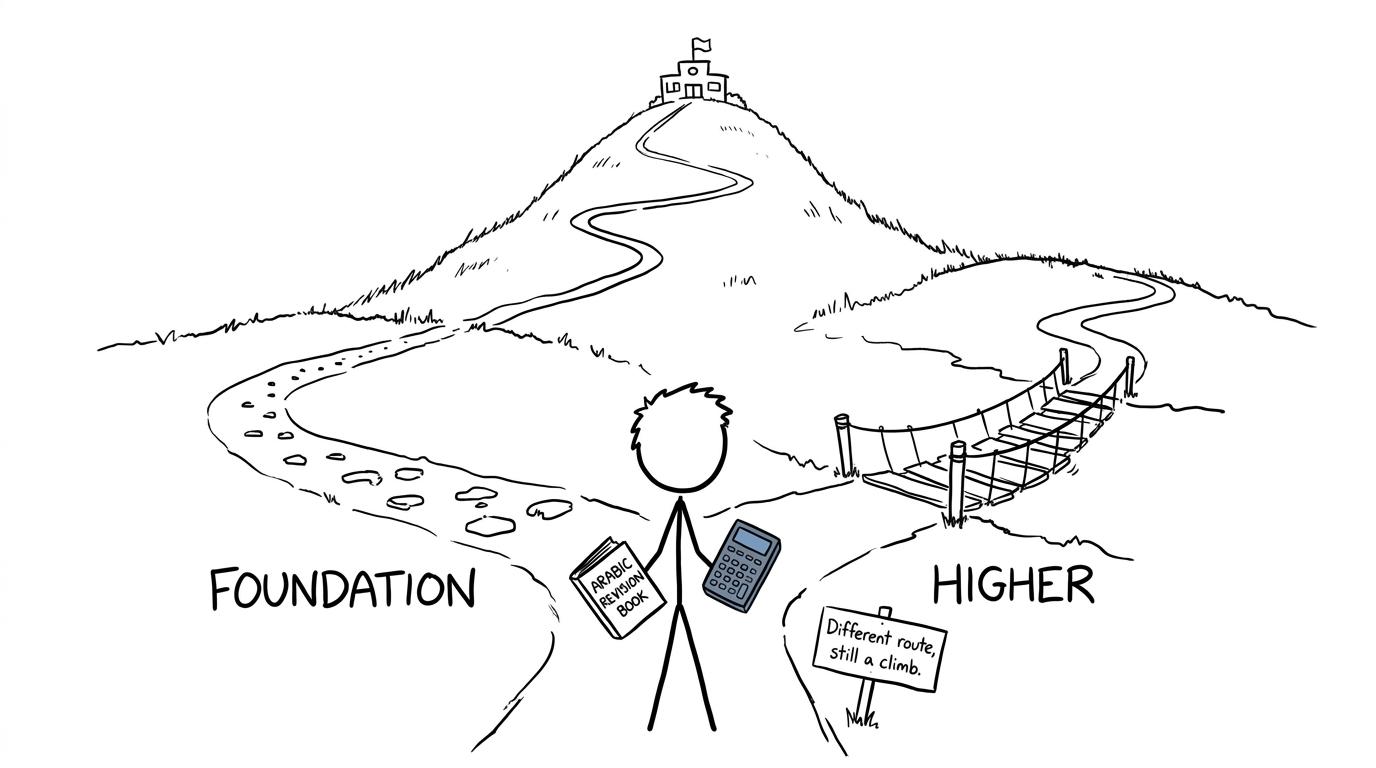 A student choosing between two different routes up the same revision hill
What GCSE Arabic Foundation tier actually assesses
Pearson Edexcel GCSE Arabic has four externally assessed papers covering listening, speaking, reading and writing. Each skill contributes 25%25\%25% of the qualification, so the overall weighting is:
25%+25%+25%+25%=100%.25\% + 25\% + 25\% + 25\% = 100\%.25%+25%+25%+25%=100%.Students must enter the same tier for every paper. You cannot, for example, take Foundation listening and Higher writing.
Listening
Foundation listening lasts 353535 minutes, including 555 minutes of reading time. It assesses your understanding of standard spoken Arabic in public and social contexts. Questions include selected responses and short answers, with sections using both English and Arabic.
The recordings may be more accessible than those used at Higher, but listening remains demanding because the language disappears as soon as it is spoken. Recognising a familiar word is not enough if you miss a negative, a time reference or the speaker's final opinion.
Speaking
The Foundation speaking assessment lasts between 777 and 999 minutes, with 121212 minutes of preparation. It contains a role play, a picture-based task and a conversation.
That structure rewards preparation, but not memorising one perfect speech. You need to answer questions, exchange information and keep communicating when the wording is not exactly what you expected.
Reading
The Foundation reading paper lasts 505050 minutes. It uses texts such as advertisements, emails, letters, articles and adapted literary material. It also includes translation from Arabic into English.
Foundation texts are targeted appropriately, but students still need to read for meaning rather than translate every word mechanically. Context, connectives and small grammatical details often decide which interpretation is correct.
Writing
The Foundation writing paper lasts 111 hour 202020 minutes and includes three open-response questions plus translation from English into Arabic. The specification sets approximate response lengths, progressing from a short response of around 202020 to 303030 words to longer pieces, including one of around 808080 to 909090 words.
This is one clear way in which Foundation differs from Higher: the tasks are structured for more concise communication. Yet concise does not mean careless. Content, communication, linguistic knowledge and accuracy still matter.
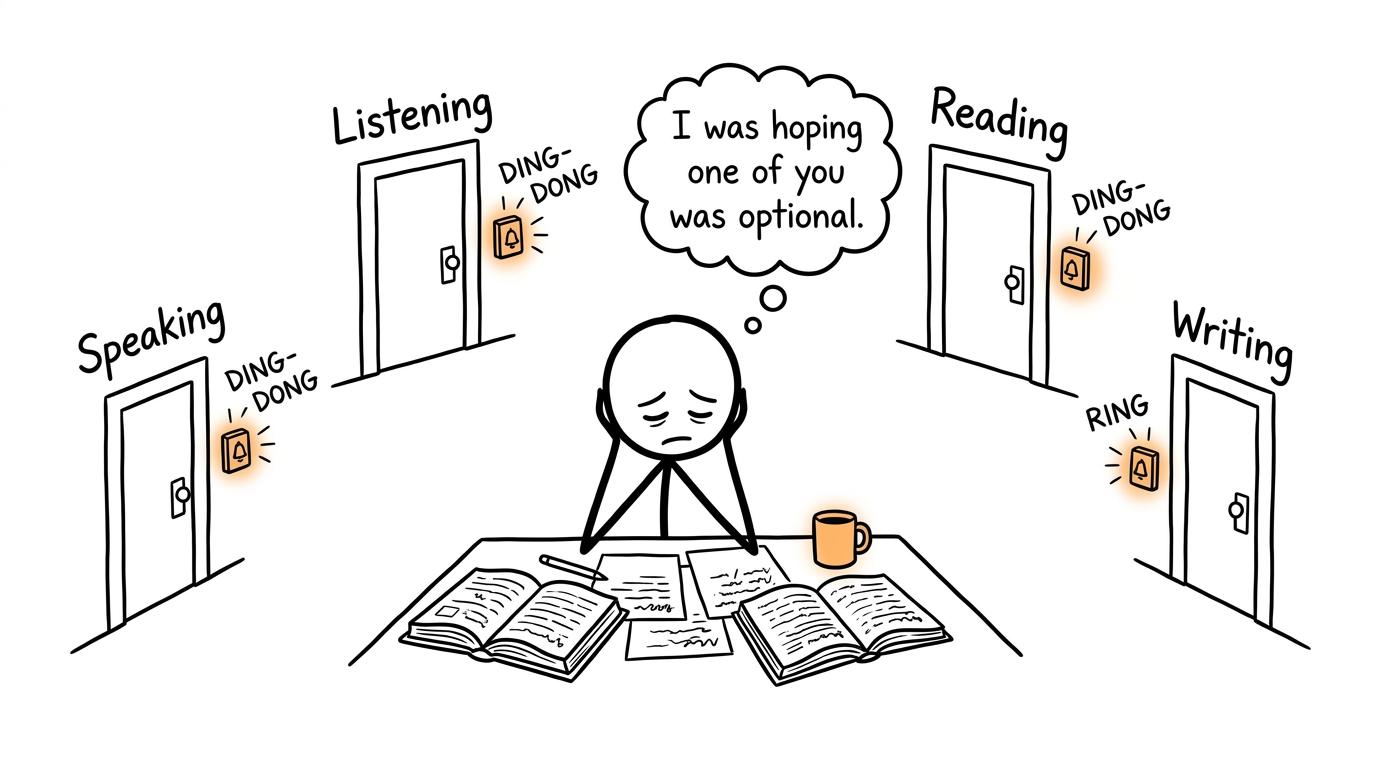 A student being visited by all four GCSE language skills at once
Why Foundation can genuinely feel easier
The most important difference is the level of demand. Foundation questions and tasks are designed around grades 111 to 555, while Higher is designed mainly for grades 444 to 999. Higher students are expected to handle the Foundation grammar and structures as well as additional Higher content.
Foundation can therefore feel more manageable because:
- listening and reading material is targeted at a more accessible level;
- writing demands are shorter and more structured;
- speaking tasks expect less linguistic complexity;
- the range of grammar is narrower;
- students can concentrate on secure communication rather than the sophistication needed for the top grades.
This is similar to tier choice in GCSE maths. Foundation maths is not simply Higher with the final questions removed; the balance and demand of the paper are different. The GCSE Maths topics by exam board and tier guide explains how tiering changes the route through a qualification.
Why Foundation may only be different, not easy
Difficulty is partly about the paper and partly about the student taking it. A shorter Arabic response can still feel difficult if recalling vocabulary under pressure is your main weakness. A supposedly accessible listening question can be hard if you have mostly revised from written notes.
Foundation also carries a trade-off: grade 555 is the highest available grade. Choosing it removes the Higher-only content, but it also removes the possibility of grades 666 to 999.
That makes Foundation appropriate when securing a grade up to 555 matters more than reaching the upper grades. It becomes less suitable if you consistently perform above grade 555 standard or need a higher grade for your next step.
Do not judge tier difficulty by one raw mark or an unofficial future boundary. Grade boundaries are set after assessments have been taken and can change between series. For context, MathsGenie's Edexcel GCSE Arabic grade boundaries page records previous published boundaries, but these should be used as historical evidence rather than predictions.
How to decide which Arabic tier is right for you
A useful decision begins with evidence. Complete recent papers or teacher assessments under realistic conditions, then separate the results by skill.
Ask:
- Am I working towards grade 555 or below, or do I need grade 666 or higher?
- Can I finish each paper within its time limit?
- Are my results stable across several assessments?
- Do I understand why I lose marks?
- Is Higher stretching me productively, or stopping me from showing what I know?
The distinction between cannot do yet and not entered for matters. Weaknesses can improve. A tier cap cannot.
Use the same diagnostic thinking that works in maths revision. The guide to finding your weakest GCSE topics shows how to turn lost marks into a specific repair list rather than a vague feeling that everything is difficult.
A revision strategy that works across Arabic and maths
Arabic and maths test different knowledge, but effective revision in both follows a similar cycle: learn, retrieve, practise, mark and revisit.
Build a four-skill revision plan
Because each Arabic skill carries 25%25\%25%, do not let writing vocabulary consume your entire timetable. Give listening, speaking, reading and writing regular attention. More time can go to a weaker area, but no skill should disappear for weeks.
A simple session might contain:
- a short vocabulary retrieval task;
- one focused listening, reading, speaking or writing activity;
- immediate checking against reliable feedback or a mark scheme;
- a note explaining the exact cause of each error;
- a brief re-test later in the week.
For organising revision alongside maths and other subjects, use the structure in MathsGenie's GCSE revision timetable guide. Its central lesson applies widely: a repeatable plan is more valuable than an ambitious plan that lasts three days.
Practise the assessment, not just the language
Knowing Arabic and performing well in GCSE Arabic overlap, but they are not identical. Exam performance also requires timing, command-word awareness, concise answers and familiarity with task formats.
The equivalent principle in maths is to move from lessons into questions and then timed papers. The GCSE Maths revision hub provides revision lessons, practice questions and board-specific resources for that progression. If you study Edexcel maths, its GCSE past papers can help you build the same habit of completing, marking and repairing.
Keep an error log
After Arabic practice, classify each lost mark or weak response:
- vocabulary gap;
- grammar or agreement error;
- misread question;
- missed listening detail;
- incomplete development;
- inaccurate spelling or script;
- poor timing.
Then revise the cause rather than repeating the whole paper. Maths students can apply precisely the same method with Edexcel GCSE Maths mini tests, which provide a shorter route from diagnosis to focused correction.
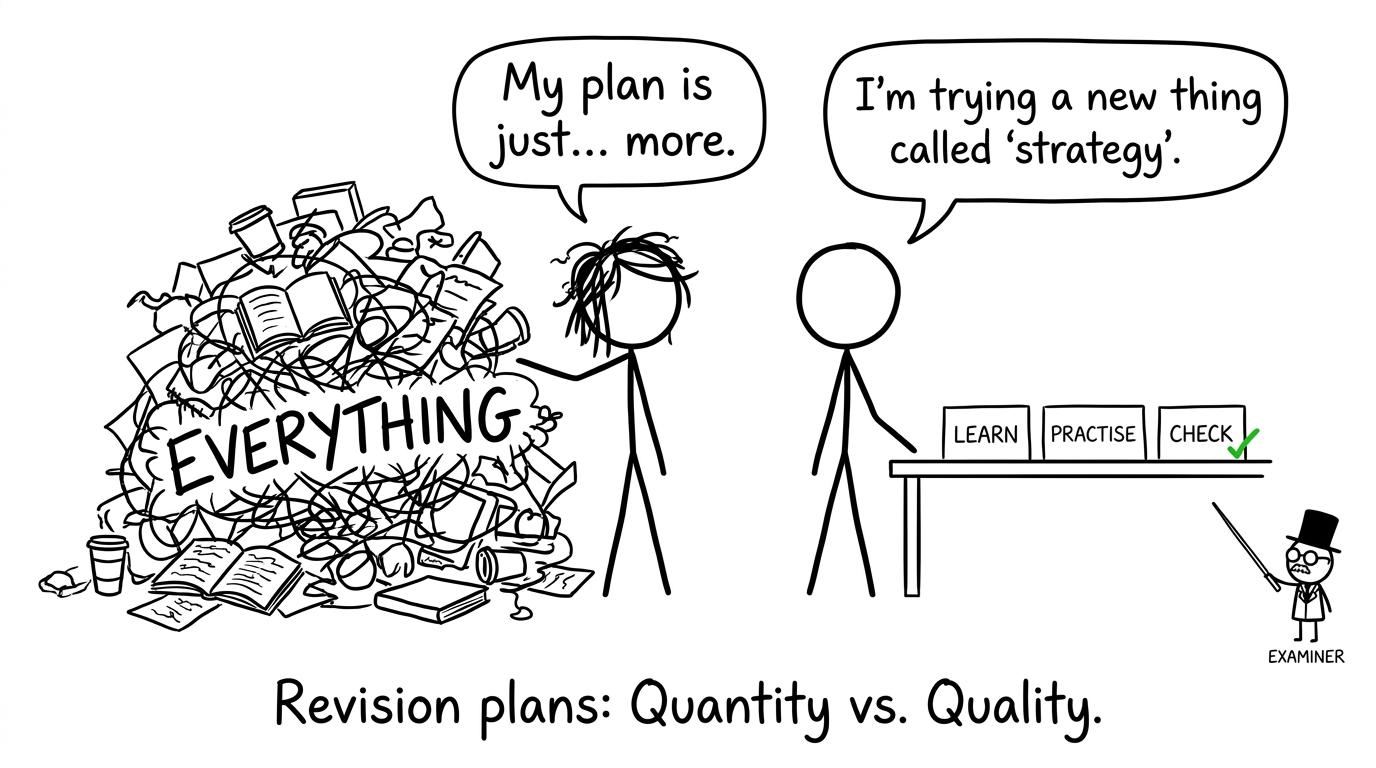 One student revising everything while another follows a simple practice cycle
Common mistakes when judging Foundation tier
Assuming Foundation means little revision is needed
The content is targeted at a lower grade range, but all four skills remain compulsory. Secure basics require repeated retrieval and realistic practice.
Choosing a tier from one mock result
One paper can be affected by nerves, absence, unfamiliar topics or poor timing. Look for a pattern across several assessments and discuss it with your teacher.
Revising only comfortable skills
Reading notes can feel productive while listening and speaking remain untouched. Revision should follow the assessment weighting, not your preferences.
Treating fluent conversation as complete exam preparation
Everyday fluency is valuable, but the qualification also assesses formal tasks, translation, accuracy, specified themes and responses under time pressure. Native or heritage speakers still need to learn the assessment format.
Comparing raw marks across tiers
Foundation and Higher papers have different demands, and grade boundaries vary by series. A raw score without its paper, tier and boundary gives an incomplete picture.
Forgetting the grade cap
Foundation can provide a sensible path to grade 555, but it cannot award grades 666 to 999. Make sure that ceiling fits your goals before entry decisions are finalised.
The right tier creates useful challenge
GCSE Arabic Foundation tier is genuinely less demanding than Higher in its intended language level, structures and tasks. But it is also different: it rewards secure communication across four equally weighted skills and limits the final grade to 555.
A good tier choice is not a judgement on intelligence. It is a practical decision about the assessment on which you can best demonstrate your current knowledge and reach your target grade. Use several pieces of evidence, study the specification and involve your teacher.
Then bring the same disciplined approach to your maths exams. Start with free AQA GCSE Maths revision or the board-specific area in the main revision hub. Learn through MathsGenie's revision lessons, strengthen each skill with practice questions and mini tests, and finish with past papers, mark schemes, video solutions and Edexcel predicted papers. The route matters, but what you repeatedly do on that route matters more.











