Can a GCSE Arabic Extracurricular Club Boost Grades?
GCSE Arabic extracurricular club advice: learn when a club can improve speaking, listening and confidence without disrupting your GCSE maths revision.
A club can feel productive without necessarily being useful. You spend an hour speaking Arabic, enjoy the conversation and leave more confident. But when the exam arrives, will that hour produce more marks?
A GCSE Arabic extracurricular club can help your grade when it provides regular, purposeful practice in the skills your specification assesses. It is particularly well suited to speaking and listening. However, membership alone changes nothing. The benefit depends on what happens in each session, how consistently you participate and whether the club complements rather than replaces focused exam practice.
For students also preparing for GCSE maths, the decision is partly about time. A strong club can be valuable. An unstructured one can quietly consume revision hours needed elsewhere.
The short answer
Joining an Arabic club is likely to be worthwhile if it:
- gives you frequent opportunities to speak and respond spontaneously
- uses Modern Standard Arabic where appropriate for your course
- includes listening, reading and writing rather than conversation alone
- practises specification themes and exam-style tasks
- provides accurate, constructive feedback
- fits into your timetable without displacing essential maths revision
A club is less likely to improve your grade if sessions are mostly passive, irregular or disconnected from the examination.
The best approach is not to choose between the club and formal revision. Use the club for interaction, confidence and retrieval; use individual study for vocabulary, grammar, timed writing and past-paper technique.
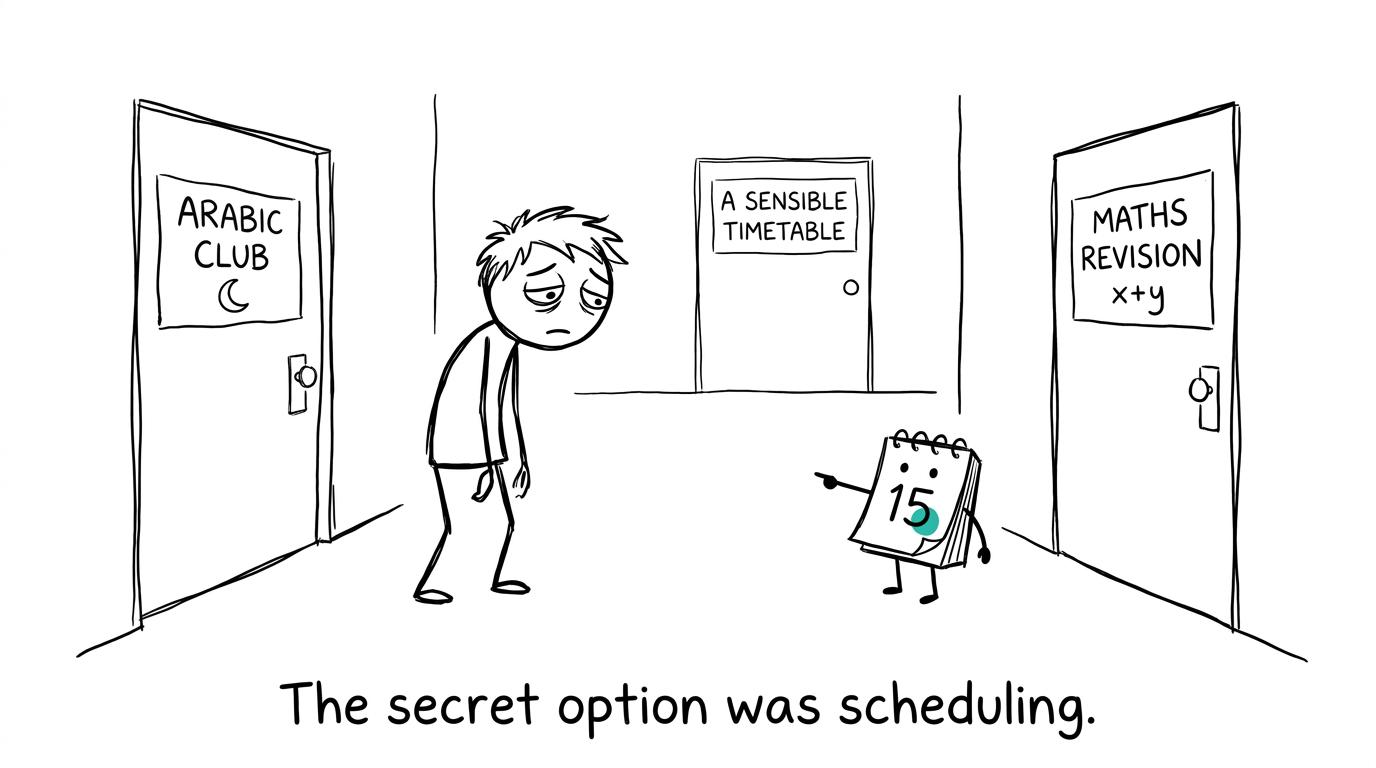 A student discovers that the secret to balancing Arabic club and maths revision is scheduling
Why an Arabic club can support your exam performance
GCSE language performance grows through use. Vocabulary sitting quietly in a notebook is not the same as vocabulary you can retrieve during a conversation. A club creates reasons to listen, decide what something means and respond before you have time to make every sentence perfect.
Research into extracurricular language learning, much of it involving English-language clubs in other educational settings, generally indicates that structured out-of-class activities can support speaking practice, confidence and willingness to communicate. That evidence is encouraging, but it should be applied cautiously. It does not prove that joining any particular Arabic club will automatically raise a UK GCSE grade.
The mechanism matters more than the label on the door.
It creates additional speaking practice
Speaking can be difficult to practise alone. You can learn model responses, but a real partner may ask an unexpected question or use unfamiliar phrasing. That forces active listening and spontaneous language production.
This matches the broad aims of GCSE modern foreign languages: students are expected to communicate confidently, express ideas and respond to spoken language. In the current Pearson Edexcel GCSE Arabic specification, listening, speaking, reading and writing each contribute 25%25\%25% of the qualification.
A well-run club therefore gives useful practice for two substantial areas of assessment. Role plays, picture discussions, short presentations and follow-up questions are especially valuable because they require interaction rather than recitation.
It can make mistakes feel less threatening
Students sometimes know enough Arabic to respond but hesitate because they want the sentence to be flawless. A supportive club provides repeated, lower-pressure attempts. Errors become information rather than a public verdict.
Confidence alone does not earn marks. Yet confidence can help you access what you know, particularly when you must answer promptly. The productive sequence is:
attempt→feedback→correction→new attempt\text{attempt} \rightarrow \text{feedback} \rightarrow \text{correction} \rightarrow \text{new attempt}attempt→feedback→correction→new attemptIf a club only offers encouragement without correction, accuracy may stall. If it corrects every syllable so aggressively that nobody wants to speak, fluency may stall. Good sessions protect participation while still improving grammar, pronunciation and precision.
It makes vocabulary more memorable
Words are easier to retrieve when they have been used for a real purpose. Discussing school, holidays, family, future plans or global issues connects vocabulary to ideas, questions and other people.
That context can support later reading and writing too. A phrase used in discussion may become easier to recognise in a listening extract or adapt in a written response. The gain comes from repeated retrieval, not simply hearing the word once.
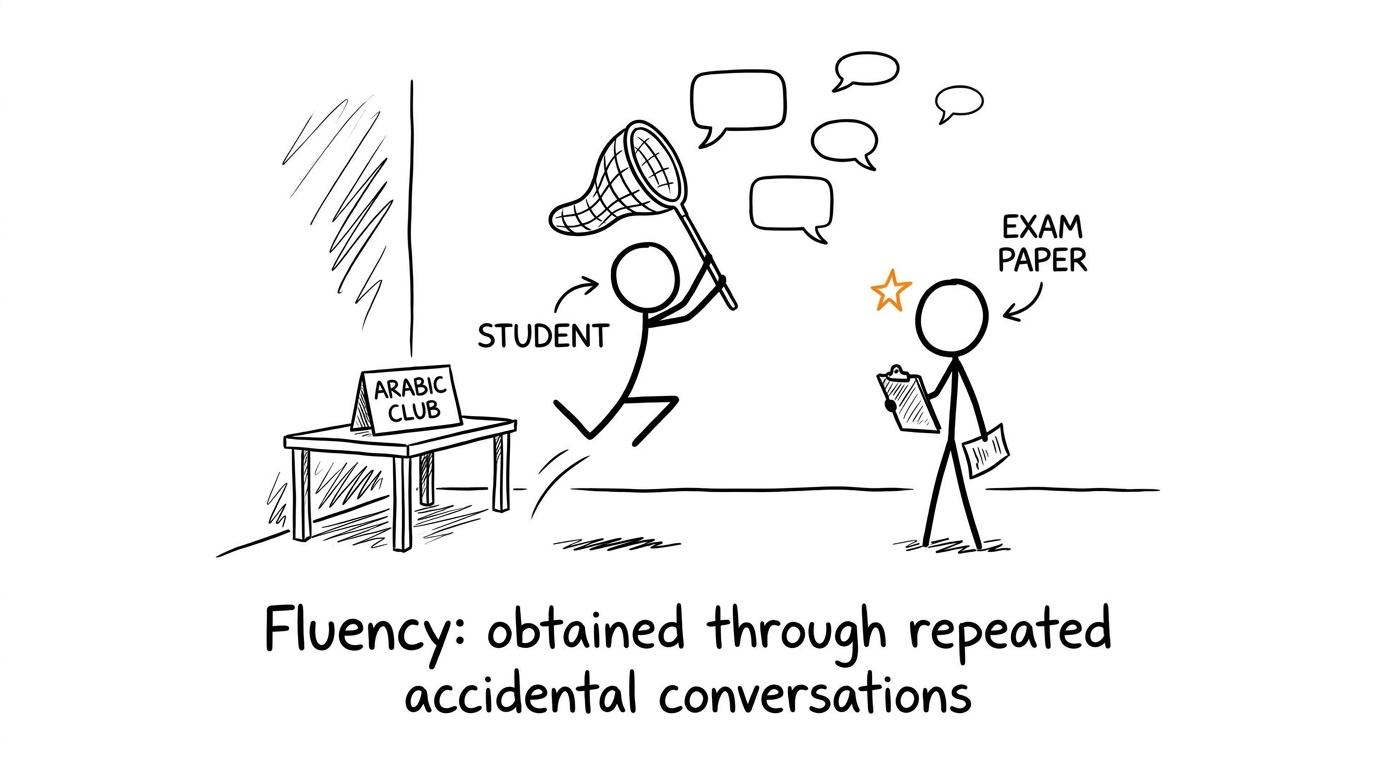 A student catches conversational speech bubbles during an Arabic club session
What the club must do to help your grade
Not every enjoyable language activity is equally useful for an examination. Before committing, compare the club with this checklist.
Sessions should connect to your specification
Find out exactly which qualification you are taking. The current Pearson Edexcel GCSE Arabic course assesses listening, speaking, reading and writing at either Foundation or Higher tier, with students entered at one tier across the papers.
A useful club should revisit the themes, vocabulary, grammatical structures and task types required by that specification. Cultural discussion can deepen understanding and motivation, but it should not consume every session if your immediate goal is exam improvement.
The club should also distinguish conversational dialects from Modern Standard Arabic. Dialect knowledge can be culturally and personally valuable, but examination responses must meet the language requirements in your specification. Ask your teacher which forms are expected in assessed work.
You need to participate actively
Attendance is not practice. A student who listens for an hour while two confident speakers dominate the room may gain less than a student who completes three focused exchanges and receives feedback.
Look for paired conversations, rotating roles and tasks in which everyone must contribute. Ideally, you should leave knowing:
- which language you successfully retrieved
- which mistake you need to correct
- which vocabulary you will revisit
- what you will attempt at the next session
Practice should cover more than speaking
Conversation is the obvious strength of a club, but balanced sessions are better. Activities might include short listening extracts, reading authentic or adapted material, vocabulary games, translation discussion and brief written responses.
The current assessment gives equal weight to all four skills, so a speaking-only club cannot prepare you fully. It should sit beside individual reading, writing and listening practice rather than pretending to replace them.
Feedback should be accurate and specific
Useful feedback identifies a manageable next step: an inaccurate verb form, unclear pronunciation, weak justification or limited range of vocabulary. Vague praise feels pleasant but offers little direction.
Peer feedback can be helpful when it follows a clear checklist. For technical questions about grammar or acceptable forms, guidance from a qualified teacher is more dependable.
Protecting your GCSE maths revision time
For the target student, the real question is not simply whether Arabic club is good. It is whether it is the best use of one particular hour within a crowded week.
Start with a time budget:
Tavailable=Tweek−Tschool−Tsleep−TcommitmentsT_{\text{available}} = T_{\text{week}} - T_{\text{school}} - T_{\text{sleep}} - T_{\text{commitments}}Tavailable=Tweek−Tschool−Tsleep−TcommitmentsThat remaining time must cover Arabic, maths, other subjects and rest. Do not treat rest as wasted time or pretend that every free hour can become intense revision.
A weekly club may be sustainable if it replaces unfocused scrolling or passive rereading. It is less sensible if it repeatedly removes your only opportunity for maths practice. Build a realistic GCSE maths revision timetable before deciding.
For maths, consistency matters. Use the GCSE Maths revision hub for short topic sessions on separate days, then check your coverage against the GCSE maths topics by exam board and tier. This keeps the club from becoming an excuse to avoid a difficult algebra or geometry topic.
A sensible weekly pattern might contain one Arabic club session, separate Arabic exam practice and several shorter maths blocks. The exact allocation depends on your current attainment, target grades and approaching assessments. If a maths mock is imminent, reducing club attendance temporarily may be reasonable. If your Arabic speaking assessment is approaching, the balance may shift the other way.
How to judge whether your GCSE Arabic extracurricular club is working
Do not judge the club only by whether you enjoy it. Enjoyment matters because it supports attendance, but progress needs evidence.
After several sessions, ask:
- Can I answer familiar questions with less preparation?
- Can I sustain an exchange instead of giving isolated sentences?
- Am I using a wider range of vocabulary and structures?
- Are the same grammatical errors becoming less frequent?
- Has my performance improved on timed or teacher-marked tasks?
- Is my maths revision still happening as planned?
Keep a short record after each meeting. Write down one useful phrase, one corrected error and one next action. Then test yourself later without looking at your notes.
The same principle applies to maths: activity is not the same as improvement. Use mini tests and topic questions to reveal weaknesses, then begin paper practice at an appropriate stage. The guide to when to start GCSE past papers can help you plan that progression.
Choosing between two clubs or evaluating your current one
If several options are available, ask the organiser what a typical session contains. A clear answer is a good sign. Look for a balance of interaction, specification relevance and feedback.
A simple evaluation can use four equally important criteria:
S=R+P+F+BS = R + P + F + BS=R+P+F+BHere, RRR represents relevance to the specification, PPP active participation, FFF useful feedback and BBB balance across language skills. This is a planning model, not a grade predictor. Its purpose is to stop the word “club” from doing all the persuasive work.
A friendly social gathering may still be worthwhile for enjoyment and cultural connection. Just be honest about its role. Social value and exam value can overlap, but they are not identical.
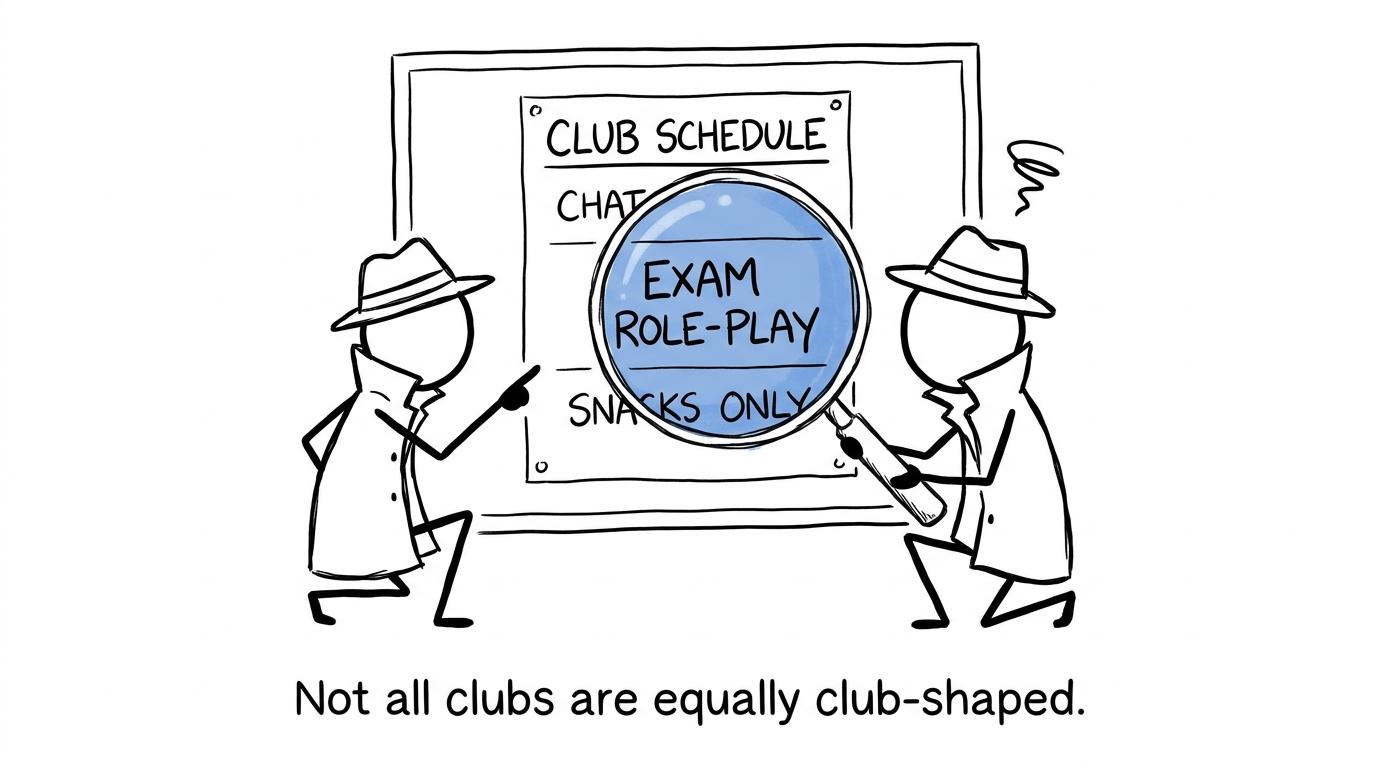 Students investigate which club activities genuinely resemble exam preparation
Common mistakes when using a club for GCSE revision
Assuming attendance guarantees progress
Simply appearing each week does not produce fluency. Volunteer answers, ask questions and attempt language that stretches you.
Replacing exam practice with club activities
Club work cannot fully reproduce timed papers, mark schemes or individual writing practice. Treat it as one part of preparation, not the whole system.
Memorising speeches without learning to adapt
A polished response may collapse when the question changes. Practise follow-up questions, alternative wording and spontaneous reactions.
Ignoring the required form of Arabic
Do not assume that every familiar dialect expression will receive credit in formal assessment. Follow your specification and your teacher's guidance on Modern Standard Arabic and acceptable responses.
Letting one subject consume the entire timetable
Arabic practice should not erase maths preparation. For Edexcel students, the routine in using GCSE maths past papers properly shows how to turn each paper into targeted follow-up work. Nearer the exams, GCSE predicted papers can provide fresh practice, but they should complement rather than replace past papers.
The verdict: a useful tool, not a grade guarantee
A GCSE Arabic club can genuinely support your grade. Its strongest contributions are likely to be extra speaking opportunities, responsive listening, vocabulary retrieval and greater willingness to communicate. Those benefits become exam-relevant when activities match the specification and include reliable feedback.
But the club is not magic. Your grade still depends on command of all assessed skills and your performance in the examination. Join if the sessions are purposeful and the timetable is sustainable. Then participate fully, track what improves and keep doing the less sociable work of grammar, writing and timed practice.
For maths, make the surrounding routine easy to follow. Start with MathsGenie's free GCSE maths revision resources, use revision lessons and practice questions to repair weak topics, and move into mini tests, past papers, predicted papers, mark schemes and video solutions as the exams approach. A good club expands your learning. A good plan ensures it does not crowd everything else out.