Gamify Revision GCSE History: Does It Really Help?
Gamify revision GCSE History with purpose. Learn when streaks, points and rewards support recall, and when they distract from effective exam practice instead.
Revision can look productive without producing much learning. A streak grows. Points accumulate. A digital badge flashes. Yet when you close the app and face a question about causation, significance or sources, the answer may still refuse to appear.
So, does it help to gamify revision GCSE History, or is gamification merely a pleasant distraction? The honest answer is that it can help you begin, persist and retrieve knowledge, but only when the game rewards the work that GCSE History exams require. Points cannot replace recall, feedback, source evaluation or timed writing.
That distinction matters for students balancing History with GCSE Maths. In both subjects, the visible reward should sit on top of genuine exam practice, not become the purpose of the session.
The short answer: gamification can help, with conditions
Gamification means adding game-like features to a non-game activity. These might include:
- points for completing useful tasks;
- streaks for revising consistently;
- levels representing increasing difficulty;
- badges for mastering topics or question types;
- timed challenges;
- progress bars or personal bests;
- small rewards after planned work.
Recent systematic reviews generally suggest that well-designed gamification can improve engagement, participation and motivation. Evidence for direct improvements in academic performance is less consistent, however. One recent controlled study of gamified retrieval practice found that points and progress displays improved reported enjoyment and task value but did not improve delayed recall.
That leads to a useful rule: gamification is a delivery system, not a revision method.
A strong system should pass this checklist:
- Does it make you retrieve information without notes?
- Does it include feedback and corrections?
- Does it reward difficult, relevant work?
- Does it cover knowledge and historical skills?
- Does it lead towards timed exam questions?
- Can you explain what has improved beyond your score or streak?
If most answers are yes, the game may be useful. If not, it is probably measuring activity rather than learning.
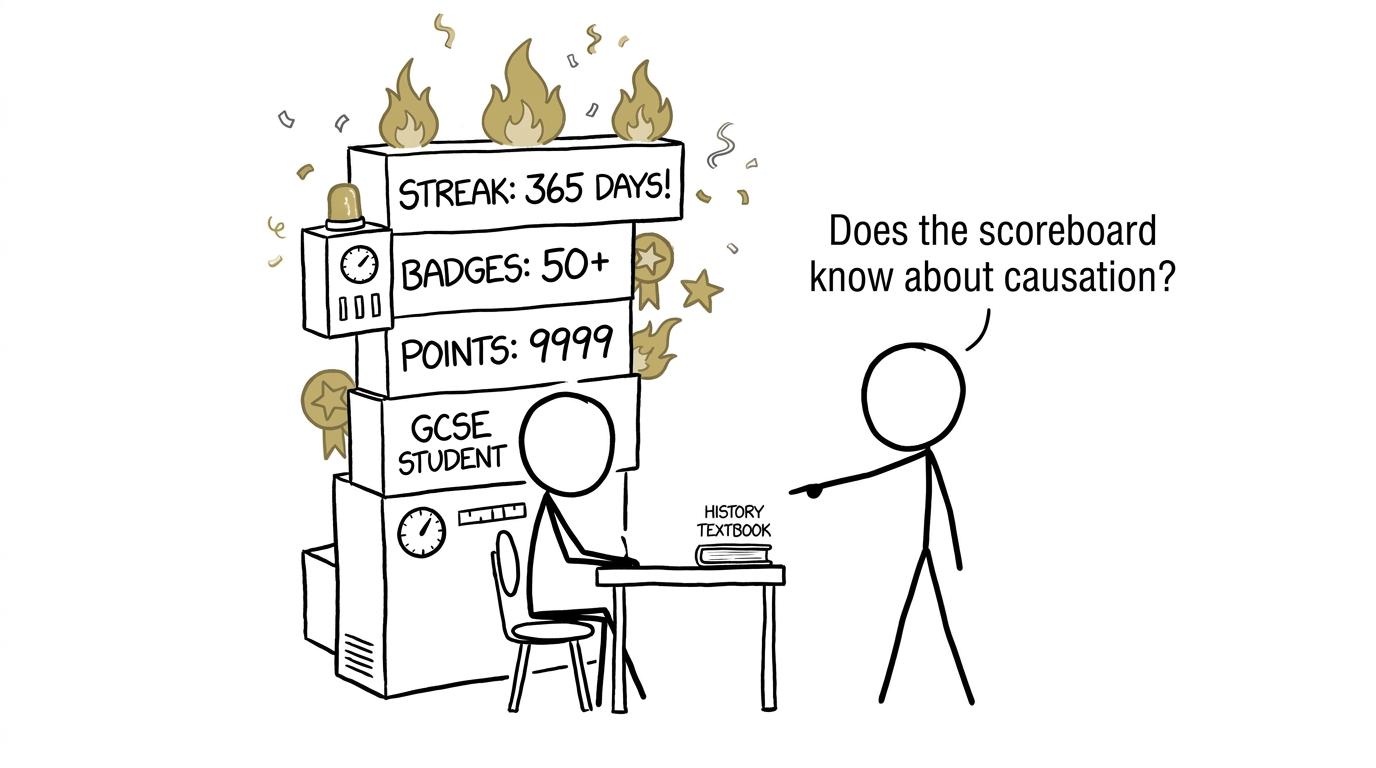 A student builds an impressive revision scoreboard while the History textbook remains unopened
Why points and streaks can improve revision
The hardest part of revision is sometimes not understanding the content. It is starting.
A small target lowers that barrier. Earning a point for a short retrieval quiz may be enough to move you from intending to revise to actually attempting questions. A streak can also make regular practice visible, which is helpful when progress otherwise feels slow.
Gamification is most useful in three areas.
It creates an immediate reason to begin
Exam results are delayed. The reward for today's revision might not arrive for months, whereas a completed mission or progress bar responds immediately. That short-term signal can support a longer-term goal.
This is particularly useful on busy school days. MathsGenie's twenty-minute GCSE maths revision routine uses a repeatable structure of recall, exam questions and marking. The same principle can support History: make the session small, predictable and easy to start.
It makes progress visible
A topic such as medicine through time can feel too large to finish. Levels allow you to divide it into smaller achievements: chronology, key individuals, causes of change, source questions and extended responses.
Progress should represent demonstrated learning, though. Unlocking a level because you opened a resource proves very little. Unlocking it after recalling key knowledge and correcting an exam response means something.
It can encourage retrieval practice
Retrieval practice means attempting to bring information to mind rather than rereading it. Research summarised by the Education Endowment Foundation emphasises the active attempt to remember, repeated recall after a delay and feedback that corrects errors.
A quiz becomes educationally useful when you answer from memory, check the response and revisit mistakes. Its usefulness does not come from colourful buttons.
What GCSE History revision must actually prepare you to do
Across GCSE History specifications, the common assessment objectives cover four broad demands:
- knowledge and understanding of the periods studied;
- explanation and analysis using concepts such as cause, consequence, change, continuity, similarity, difference and significance;
- analysis and evaluation of contemporary sources;
- analysis and evaluation of historical interpretations.
The precise papers, options and question formats vary between AQA, Edexcel, OCR and Eduqas. Check your current specification, teacher guidance and exam-board materials before building a game.
This means a system based entirely on rapid-fire factual questions is incomplete. Remembering dates, people and events supports strong answers, but examiners also require you to select knowledge, form connections and substantiate judgements.
A good revision game therefore has different mission types:
- Recall missions: retrieve events, chronology and terminology.
- Connection missions: explain why events happened or what changed.
- Source missions: examine content, provenance and historical context.
- Interpretation missions: compare claims and use knowledge to evaluate them.
- Exam missions: plan or complete timed responses, then apply the mark scheme.
The game should gradually move from short recall towards longer exam performance. That is similar to effective maths revision: learn a method, practise it, mark it and then test it under pressure. MathsGenie's GCSE maths revision hub organises revision lessons, questions, mini tests and papers around that progression.
How to gamify GCSE History without wasting time
Reward evidence, not appearance
Give points only for actions that leave evidence of learning. Suitable actions include completing a closed-book quiz, correcting an inaccurate answer, improving an essay paragraph or reattempting a weak question later.
Avoid awarding most points for decorating notes, opening an app or watching videos passively. Those actions may support revision, but they do not prove that you can retrieve or apply anything.
Make difficult work worth more
A weak point system creates an obvious loophole: repeat easy questions to increase the score. Students are good at discovering loopholes, especially when the loophole avoids source evaluation.
Give greater weight to tasks that demand explanation, judgement and sustained writing. You might classify missions as quick recall, applied explanation and exam practice. The exact scoring matters less than the principle: your game should not make shallow tasks more attractive than valuable ones.
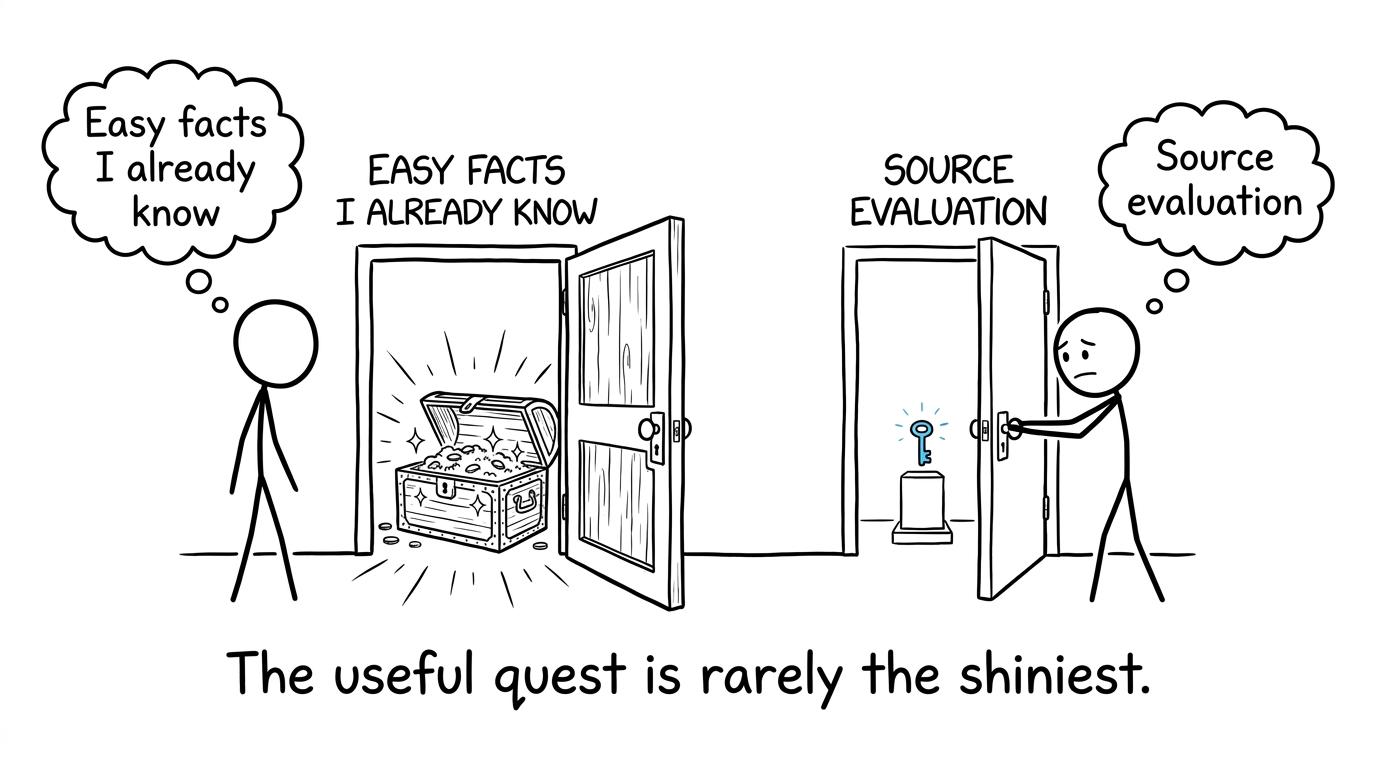 A revision game offers a shiny easy-facts door and a less glamorous source-evaluation challenge
Build feedback into every challenge
An incorrect answer repeated confidently is not progress. After each quiz or written response, compare your work with reliable notes, teacher feedback or the relevant mark scheme. Record the missing knowledge or skill, then schedule another attempt.
Maths students can see the same feedback loop in MathsGenie's guide to finding your weakest GCSE topics: diagnose, label errors, practise the weakest area and retest it. The subject changes, but the logic does not.
Use streaks carefully
A streak can protect consistency, but it can also become emotionally expensive. One missed day should not make the entire system feel ruined.
Define a valid day as one meaningful task, not an exhausting session. Consider tracking successful weeks rather than perfect daily attendance. More importantly, keep a second measure of quality: questions corrected, weak topics retested or timed answers completed.
Include spaced revisits
Do not award a topic's final badge immediately after learning it. Return to the material after a delay and test it without notes. A successful later retrieval provides better evidence than immediate familiarity.
You could use stages such as encountered, recalled, applied and exam-ready. A topic reaches the final stage only after successful delayed practice and an exam-style task.
Keep the system simple
If designing the game takes longer than doing the revision, simplify it. A sheet of paper with topic boxes, challenge levels and a weekly reward is enough. You do not need custom graphics, complicated rules or an elaborate digital dashboard.
Students who feel behind should start with the smallest workable loop. MathsGenie's guide to catching up on GCSE revision recommends using a diagnostic task, identifying precise weaknesses and returning to similar questions. That is a better foundation than constructing a perfect reward system.
When gamification becomes a pleasant distraction
Gamification stops helping when the game competes with the learning. Warning signs include:
- checking the leaderboard more often than checking corrections;
- selecting easy tasks to protect a success rate;
- feeling unable to revise without a reward;
- maintaining a streak through token activity;
- memorising isolated facts while avoiding written analysis;
- spending excessive time configuring apps;
- treating points as proof of exam readiness.
Leaderboards deserve particular caution. Competition can motivate some students, but it can discourage others or shift attention towards comparison. A personal best is often more useful: improve your recall, reduce repeated errors or produce a stronger judgement than last time.
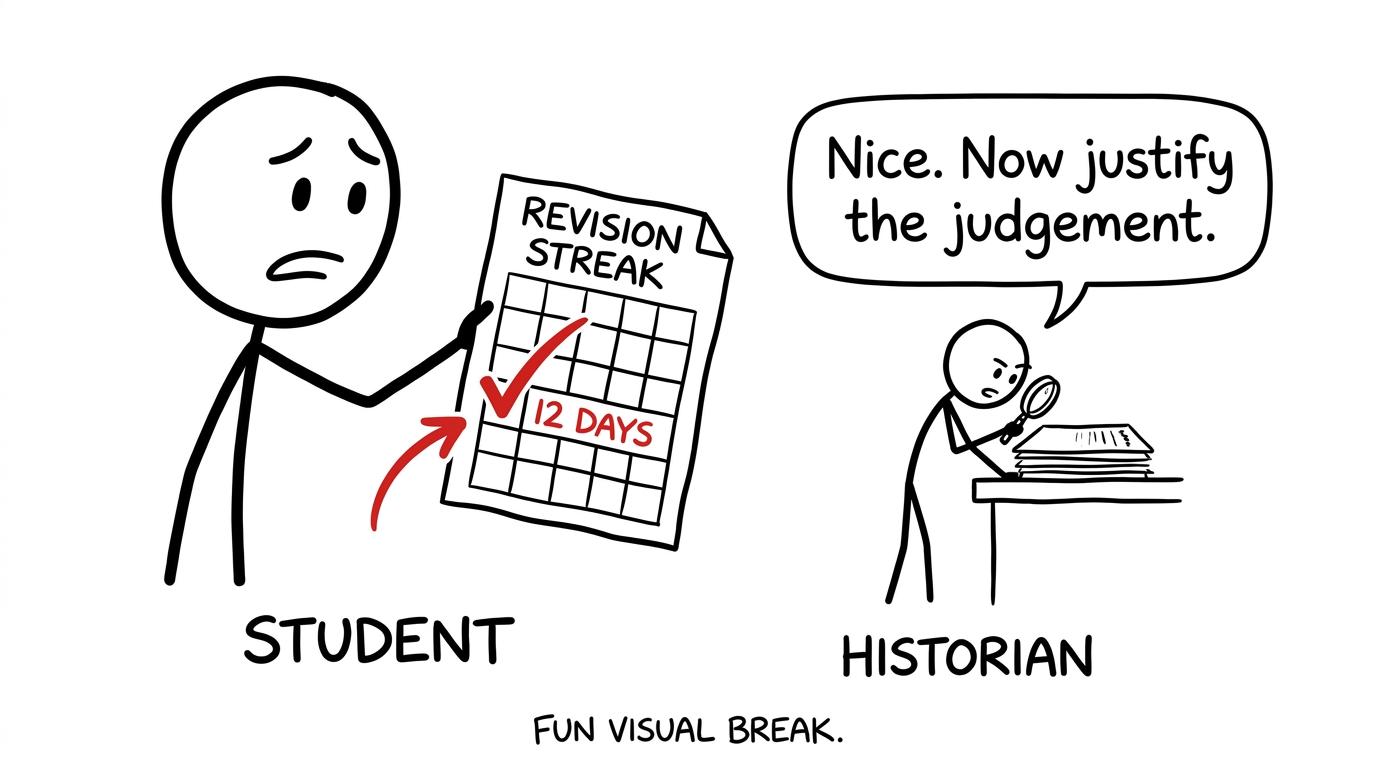 A long revision streak receives an awkward inspection from a tiny historian demanding a justified judgement
Common mistakes when gamifying revision
Confusing engagement with learning
Enjoyment matters because it may keep you working. But feeling engaged is not the same as remembering content later. Test yourself after a delay and complete exam questions to see whether the learning survived.
Rewarding completion rather than correction
Finishing a quiz is only half the process. The valuable moment often comes afterwards, when you identify why an answer was weak and repair it.
Revising only factual recall
Facts are essential, but History papers also assess explanation, sources and interpretations. Include missions that require connected reasoning and substantiated judgements.
Ignoring the exam format
A generic History game may not reflect your board's papers or your chosen options. Use the current specification and practise the question types your school teaches.
Replacing full exam practice with short games
Short challenges build momentum, but they cannot fully reproduce time pressure, extended writing or decision-making across a paper. As exams approach, combine them with timed sections and complete papers. Maths students should make the same transition through GCSE past-paper practice and, later, carefully chosen predicted papers.
The best game is one you eventually need less
A useful revision game changes your behaviour quietly. It gets you to start, makes weaknesses visible and encourages another attempt. Over time, the badges should matter less because the satisfaction comes from understanding more and writing better answers.
Use points and streaks as scaffolding. Keep retrieval, feedback, delayed practice and exam questions at the centre. If the system rewards genuine improvement, gamification can support GCSE History revision. If it rewards tapping, collecting and appearing busy, it is entertainment wearing a revision badge.
For the maths side of your timetable, start with MathsGenie's free GCSE maths resources. Use revision lessons and practice questions to rebuild weak topics, mini tests to check recall, mark schemes and video solutions to correct mistakes, and past papers or predicted papers to test performance. If you need a wider structure, follow the one-week GCSE maths revision plan.
Make revision enjoyable where you can. Just make sure the reward system always serves the learning, never the other way around.