

Gamify Revision GCSE Drama: Does It Really Help?
Gamify revision GCSE Drama with rewards that support recall, rehearsal and exam practice. Discover when points and streaks help, and when they distract.
Revision can look productive without producing much learning. A streak grows. A progress bar fills. You earn points for opening an app. Yet when you close the screen, can you explain how lighting created tension, evaluate an actor’s physical skills or recall the structure of your written paper?
If you want to gamify revision GCSE Drama, the short answer is yes: game elements can help you begin, persist and see progress. But they only improve revision when the rewarded action involves genuine recall, rehearsal, writing or feedback. Points attached to easy activity are a pleasant distraction. Points attached to useful practice can support a strong routine.
That distinction matters for students balancing Drama with demanding subjects such as GCSE maths. Your revision system should reduce hesitation, not create another hobby to manage.
The quick verdict on gamified Drama revision
A worthwhile system should:
- reward completed Drama tasks, not time spent looking busy;
- include active recall without notes;
- make room for practical rehearsal and written responses;
- provide prompt feedback or self-assessment;
- revisit material after a delay;
- measure knowledge and performance, not just attendance;
- remain simple enough to run without stealing revision time.
Points, badges and streaks are not learning methods by themselves. They are wrappers. The learning comes from what sits inside them.
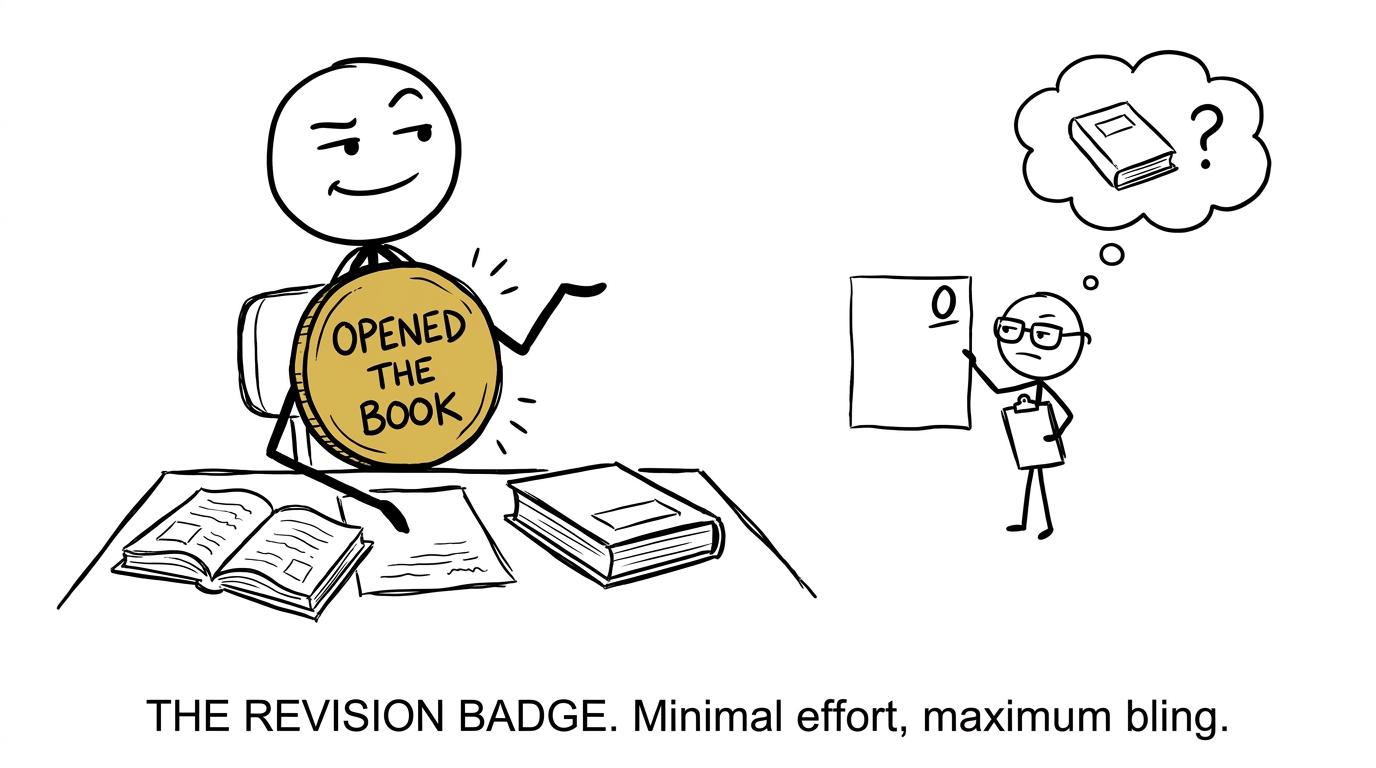 A student earns a huge badge for merely opening a revision book while an examiner waits for actual work
What the evidence says about gamification
Recent systematic reviews suggest that educational gamification can improve engagement and motivation, although results vary according to the design, subject, learner and length of the intervention. A 2024 meta-analysis found a small positive overall effect on intrinsic motivation, alongside stronger effects on learners’ feelings of autonomy and relatedness. Other reviews warn that motivation may decline when novelty fades or rewards become the main reason for working.
That is a measured conclusion rather than a promise. Gamification can make revision more inviting, but feeling motivated is not identical to learning more.
Research on retrieval practice gives the system firmer foundations. The Education Endowment Foundation emphasises that retrieval should involve a real attempt to remember, repeated recall after a delay and feedback that corrects errors. A quiz is useful because it makes you retrieve knowledge, not because confetti appears after the final question.
The most defensible approach is therefore to gamify evidence-informed revision:
useful task+clear feedback+small reward\text{useful task} + \text{clear feedback} + \text{small reward}useful task+clear feedback+small rewardnot:
easy activity+large reward=better learning\text{easy activity} + \text{large reward} = \text{better learning}easy activity+large reward=better learningThe second statement does not follow. A reward can change behaviour without improving what you know.
Why GCSE Drama needs more than one kind of game
Current GCSE Drama specifications from AQA, Edexcel, OCR and Eduqas combine practical or non-exam assessment with a written examination. The precise components, timings, set texts and permitted materials depend on your exam board, so always check the current specification and your teacher’s instructions. Across the major specifications, the written examination contributes 40%40\%40% of the qualification.
That mixed assessment creates an important design problem. A vocabulary quiz may help you retrieve theatre terminology, but it cannot show whether your vocal choices communicate a character’s intention. A rehearsal streak may encourage consistency, but it cannot prove that you can analyse live theatre under timed conditions.
Your system needs separate task types.
Recall challenges
Use short, closed-book prompts for:
- theatre roles and terminology;
- features of your set text;
- key moments from a live production;
- performance, staging and design vocabulary;
- dramatic intentions and contextual knowledge required by your course.
Award credit for accurate recall, then check your answer. Looking first and copying afterwards should earn nothing because no retrieval occurred.
Practical missions
Create missions involving vocal skills, physical skills, blocking, character intentions or design decisions. Record a rehearsal where appropriate, compare it with your success criteria and identify one change for the next attempt.
The mission must describe an observable action. “Revise acting” is too vague. “Rehearse one extract twice, changing pace and pause to clarify the character’s intention” gives you something meaningful to complete.
Written exam quests
Include timed planning, paragraph writing, set-text analysis and live theatre evaluation. These tasks should reflect the command words and assessment objectives used by your board.
A strong answer depends on precise theatrical evidence and explanation. Consequently, a written quest should reward quality after checking, rather than awarding full credit simply because a paragraph exists.
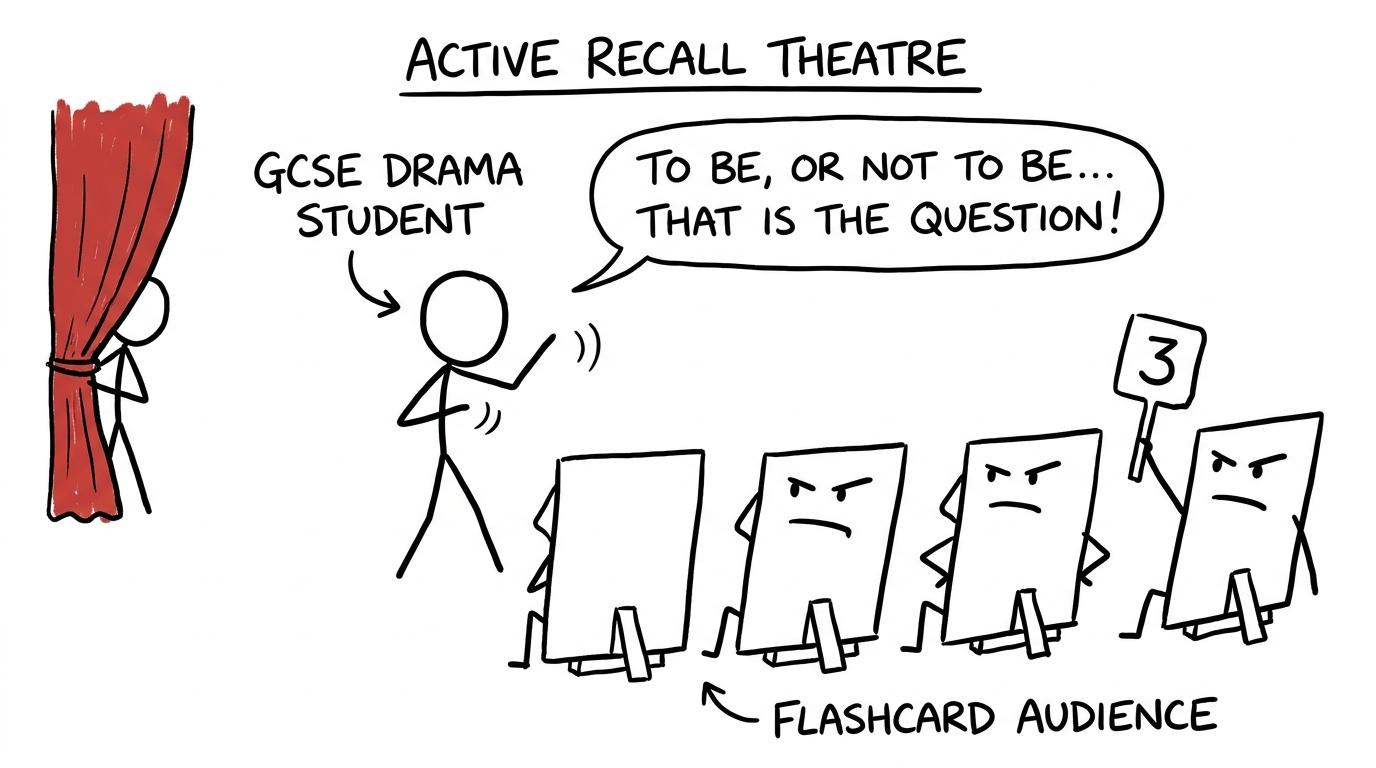 Drama flashcards form a stern theatre audience while a student rehearses
How to build a system that helps rather than distracts
Choose behaviours worth repeating
Begin with the result you need. Perhaps you must retrieve terminology more accurately, remember live theatre evidence or write faster. Design tasks backwards from that goal.
A simple scoring model could be:
S=2R+3A+2FS = 2R + 3A + 2FS=2R+3A+2Fwhere RRR represents a completed retrieval task, AAA an assessed exam or rehearsal task, and FFF a correction made after feedback. The exact values are not important. The principle is: harder activities and useful corrections should receive more credit than opening resources or decorating a tracker.
Use streaks gently
Streaks can lower the barrier to starting. They can also create anxiety or encourage a token action late at night merely to preserve a number.
Use a weekly consistency target instead. Completing revision on four suitable days may be more realistic than demanding an unbroken daily chain. Rest, illness and school commitments should not turn a helpful tool into a judgement.
A streak measures continuity, not mastery. If you cannot answer yesterday’s questions today, the streak has hidden the weakness rather than solved it.
Make progress visible through competence
Levels work best when they represent increasing independence:
- recognise a term;
- explain it accurately;
- apply it to a dramatic moment;
- analyse its effect;
- evaluate how successfully it communicated meaning.
This gives progression substance. It also mirrors the movement from basic knowledge towards the developed analysis expected in longer written responses.
Build feedback into every round
After a recall task, check accurate information. After writing, use the relevant mark scheme, teacher guidance or assessment criteria. After rehearsal, compare the performance with a clearly defined intention.
Keep an error log with three prompts:
- What was missing or inaccurate?
- What should the improved response include?
- When will I test this again?
Maths students can apply the same loop through the free GCSE maths revision hub: learn, practise, mark, correct and retest. The guide to finding your weakest GCSE topics explains why evidence from questions is more useful than choosing revision by mood.
A balanced weekly revision loop
Keep the game small enough that the subject remains central. A sensible loop includes:
- one short recall round;
- one practical or design mission;
- one written response or plan;
- one feedback and correction session;
- one delayed retest of material previously missed.
Set a limited number of weekly missions and place them in your wider timetable. The GCSE maths revision timetable guide offers a useful model for combining focused topic sessions, feedback and timed practice without trying to revise everything every day.
Rewards should be modest and immediate: choose the next scene, take a planned break or unlock a harder challenge. Avoid rewards so large that collecting them becomes more interesting than understanding the play.
If you are balancing several subjects, a repeatable short routine is often better than an elaborate dashboard. The 20-minute GCSE revision routine shows how recall, exam-style practice and marking can fit into a compact session. Adapt the structure for Drama rather than copying the maths tasks themselves.
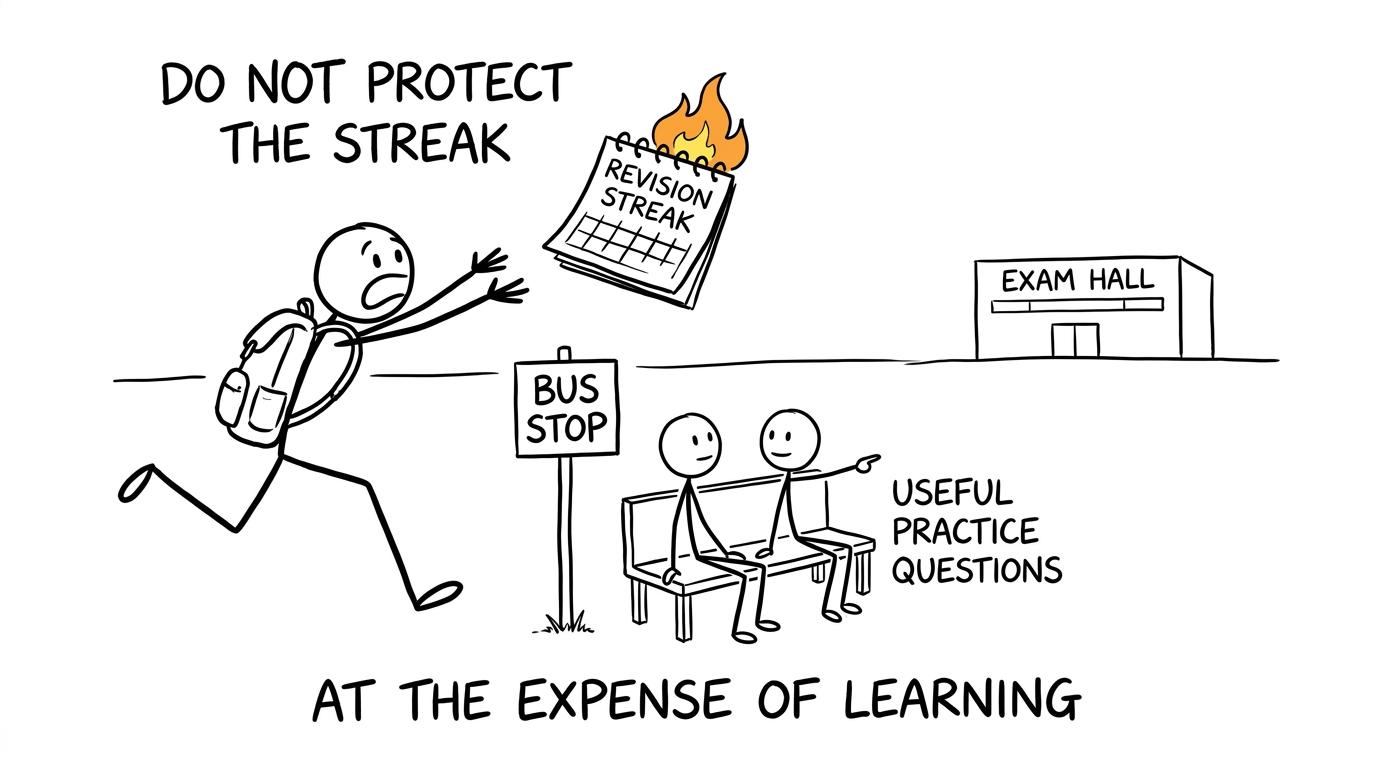 A student chases a flaming revision streak while useful practice waits calmly for the exam bus
How to tell whether your game is working
Do not ask only, “Did I enjoy it?” Ask whether performance improves away from the game.
Every week, check whether you can:
- retrieve more information without prompts;
- use more precise dramatic terminology;
- explain the effect of a performance or design choice;
- produce stronger responses within the available time;
- rehearse with clearer intentions and evaluate the result;
- correct an earlier weakness without looking at notes.
You can calculate a simple accuracy rate:
Accuracy rate=correct responsesresponses attempted×100%\text{Accuracy rate} = \frac{\text{correct responses}}{\text{responses attempted}} \times 100\%Accuracy rate=responses attemptedcorrect responses×100%Compare results from equivalent tasks over time. If points rise while accuracy, independence and response quality remain unchanged, simplify or abandon the game.
This is equally important in maths. A score should lead into authentic questions and papers. MathsGenie’s Edexcel GCSE maths past papers include mark schemes and worked support where available, while the guide to using Edexcel past papers properly explains how to convert mistakes into targeted practice.
Common mistakes when gamifying revision
Rewarding presence instead of progress
Opening an app, highlighting notes or running a timer may help you start, but none proves learning. Give most credit to retrieval, application, rehearsal, correction and retesting.
Making the rules too complicated
If maintaining scores, avatars and reward shops consumes much of the session, the system has failed. Revision is the product; the game is packaging.
Protecting a streak with easy tasks
A long streak can tempt you to repeat comfortable terminology questions while avoiding timed evaluation. Let challenge determine the task, not the desire to preserve a perfect record.
Using leaderboards carelessly
Competition motivates some students and discourages others. Private progress against your previous performance is usually more informative than comparison with classmates who may have different strengths, roles or starting points.
Skipping feedback
An unchecked answer may reinforce a misconception. Mark, correct and revisit. For maths, the one-month GCSE revision plan demonstrates how mini tests, mark schemes and repeated corrections can structure improvement.
Replacing realistic assessment with quizzes
Quick quizzes are useful for knowledge, but GCSE Drama also requires extended writing, practical choices and evaluation. Your revision must eventually resemble the task being assessed. Similarly, maths students should progress from short challenges to timed GCSE past-paper practice.
Gamification should make serious practice easier
The best revision game becomes almost invisible. It helps you begin, points you towards the right task and gives you a reason to return. Then the real work takes over: recalling, rehearsing, writing, checking and improving.
So, does gamifying GCSE Drama revision help? It can. Streaks and points may support motivation, but they are not substitutes for knowledge, feedback or realistic practice. Reward the behaviours that could earn marks or strengthen performance, and remove any feature that merely makes revision look busy.
Use the same principle across your timetable. Start with MathsGenie’s free GCSE maths revision resources, then combine revision lessons and practice questions with mini tests, past papers, predicted papers, mark schemes and video solutions. Make progress visible, but make learning the thing being measured.










