

Feeling Behind in GCSE Further Maths? You're Not Alone
Feeling behind GCSE Further Maths is common. Learn why the course feels fast, identify genuine gaps and build a calm, practical catch-up plan.
There is a particular kind of panic that appears in Further Maths. A classmate answers quickly. Another seems to understand differentiation before you have decoded the question. Suddenly, one difficult lesson becomes evidence that everyone else is ahead.
If you are feeling behind in GCSE Further Maths, the short answer is yes: it is normal, and it does not mean you cannot catch up. Further Maths deliberately extends demanding GCSE content, often at a faster pace. Students also arrive with different strengths, teaching schedules and amounts of prior practice. What feels like a verdict is usually a collection of specific, repairable gaps.
The goal is not to learn everything tonight. It is to discover your next useful step and repeat it calmly.
Your catch-up checklist
Start here rather than trying to revise the entire course at once:
- Confirm the exact qualification and specification you are taking.
- Separate weak prerequisite skills from genuinely new Further Maths topics.
- Complete a short diagnostic set without notes.
- Sort mistakes into knowledge, recognition, accuracy and exam-technique gaps.
- Repair one small topic using a lesson and focused questions.
- Mark your work immediately and record one precise correction.
- Revisit the skill after a short gap.
- Introduce mixed and timed papers only when the foundations are steadier.
MathsGenie's AQA GCSE Further Maths revision hub brings lessons, questions, papers and mark schemes together, so you can follow this cycle without searching across unrelated resources.
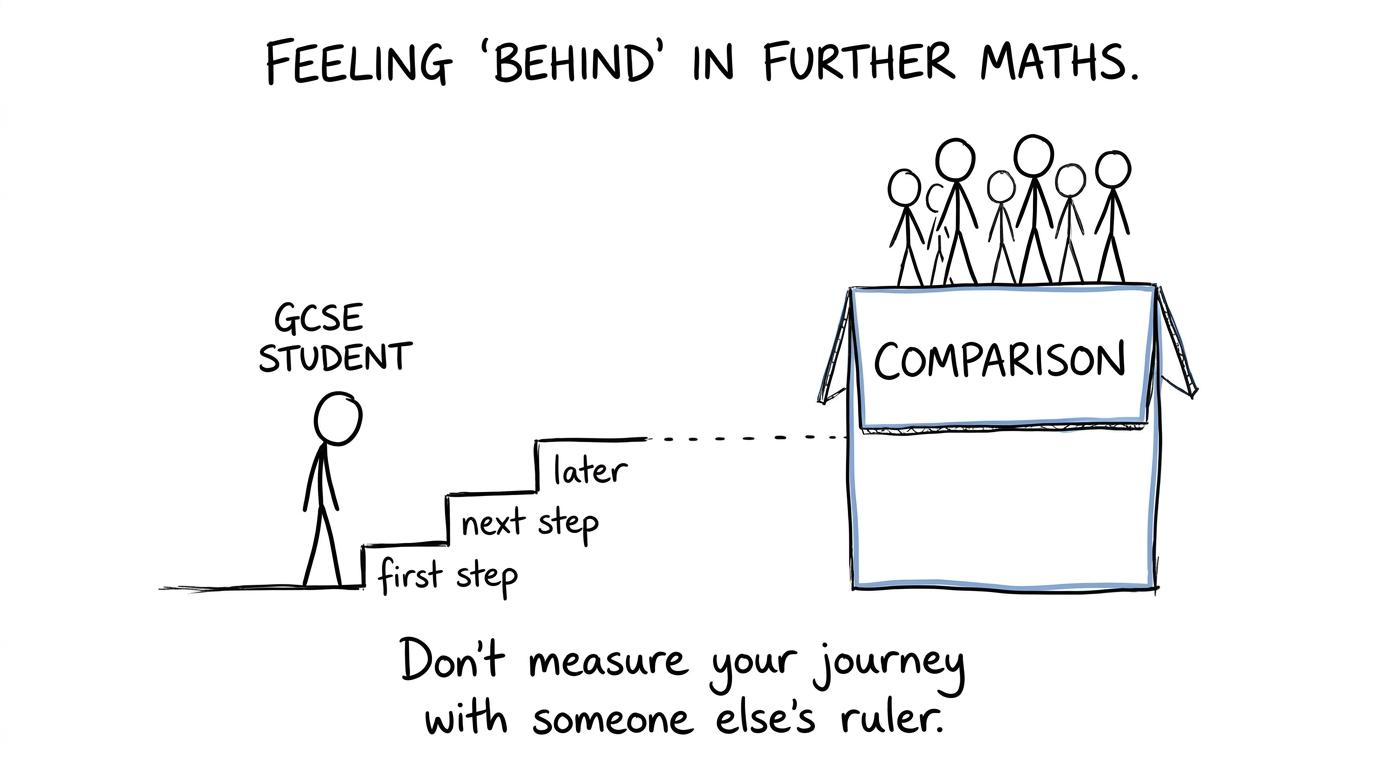 A student discovers that comparison is only a cardboard shortcut
Why feeling behind in GCSE Further Maths is so common
Further Maths is designed to feel like an extension, not a repeat. For example, the current AQA Level 222 Certificate in Further Mathematics assumes knowledge of Key Stage 444 maths and develops algebra, coordinate geometry and geometry further. It also introduces calculus and matrices.
That creates several reasons why progress can feel uneven.
The course depends on earlier skills
A new topic may be difficult because of an older weakness hiding underneath it. Struggling with differentiation might actually reveal uncertainty about indices or algebraic simplification. Difficulty with functions may begin with substitution, rearranging or graph notation.
This matters because repeating the newest lesson will not always solve the real problem. Sometimes the fastest route forward briefly goes backwards.
Use the GCSE Maths revision hub to repair those prerequisite skills. The full GCSE topics guide can also help you distinguish Higher-tier GCSE content from the extension material in your qualification.
Students do not begin from identical places
One student may be fluent with quadratics but uncertain about trigonometry. Another may have explored calculus independently but still make sign errors in routine algebra. A fast answer in one lesson tells you almost nothing about that person's understanding across the whole specification.
You also cannot see how much practice happens outside the classroom. Comparison uses incomplete information, then presents its conclusion as fact.
Further Maths questions connect several ideas
In ordinary topic practice, the required method is often obvious from the page heading. An examination question removes that clue. It may combine algebra, graph knowledge and geometric reasoning, making the difficulty feel larger than the individual skills involved.
This is why being able to complete isolated questions but struggling in a paper is not proof that revision has failed. It usually means you need more practice recognising when and how methods connect.
The qualification may not be what you assume
Schools use different extension qualifications. AQA offers an untiered Level 222 Certificate in Further Mathematics, assessed through two equally weighted papers: one non-calculator paper and one calculator paper. OCR's Additional Mathematics FSMQ is a different Level 333 qualification with its own content and assessment structure.
Do not build a revision plan from the label “Further Maths” alone. Ask your teacher for the board, qualification title and specification code. Edexcel, AQA, OCR and Eduqas resources are not automatically interchangeable, and ordinary GCSE Maths foundation and higher tiers should not be confused with a separate Further Maths qualification.
Are you genuinely behind or simply uncomfortable?
These are not the same thing.
You may have a knowledge gap if you cannot describe the method or begin a standard question. You may have an application gap if you know the method once prompted but cannot recognise when to use it. An accuracy gap appears when the approach is sound but signs, arithmetic or notation cost marks. An exam gap involves timing, interpretation or insufficient working.
Use a short test or part of a past paper and label every lost mark. Avoid descriptions such as “bad at algebra”. Write something actionable instead:
- uncertain when to factorise;
- confused by function notation;
- forgot an index law;
- could not identify the first step;
- correct method, but lost a negative sign;
- spent too long on one question.
This transforms a vague fear into a finite list. A finite list can become a plan.
MathsGenie's guide to the best order for learning GCSE Maths topics is useful when several prerequisite gaps appear at once. Begin with the earliest skill on which the others depend.
How to catch up without panicking
Panic encourages two unhelpful extremes: attempting an entire paper before you are ready or spending hours rewriting notes without testing yourself. A better approach alternates brief learning with active practice.
Make the target smaller
“Catch up with Further Maths” is too large to guide today's session. “Review factorising before practising polynomial questions” is usable.
Choose one micro-topic. Spend a short period recalling what you know, use a revision lesson if necessary, then answer a manageable set of questions without copying the solution. Mark them before moving on.
The twenty-minute GCSE revision routine offers a structure that can be adapted for Further Maths on crowded school days. A short session completed carefully is more valuable than an ambitious plan repeatedly postponed.
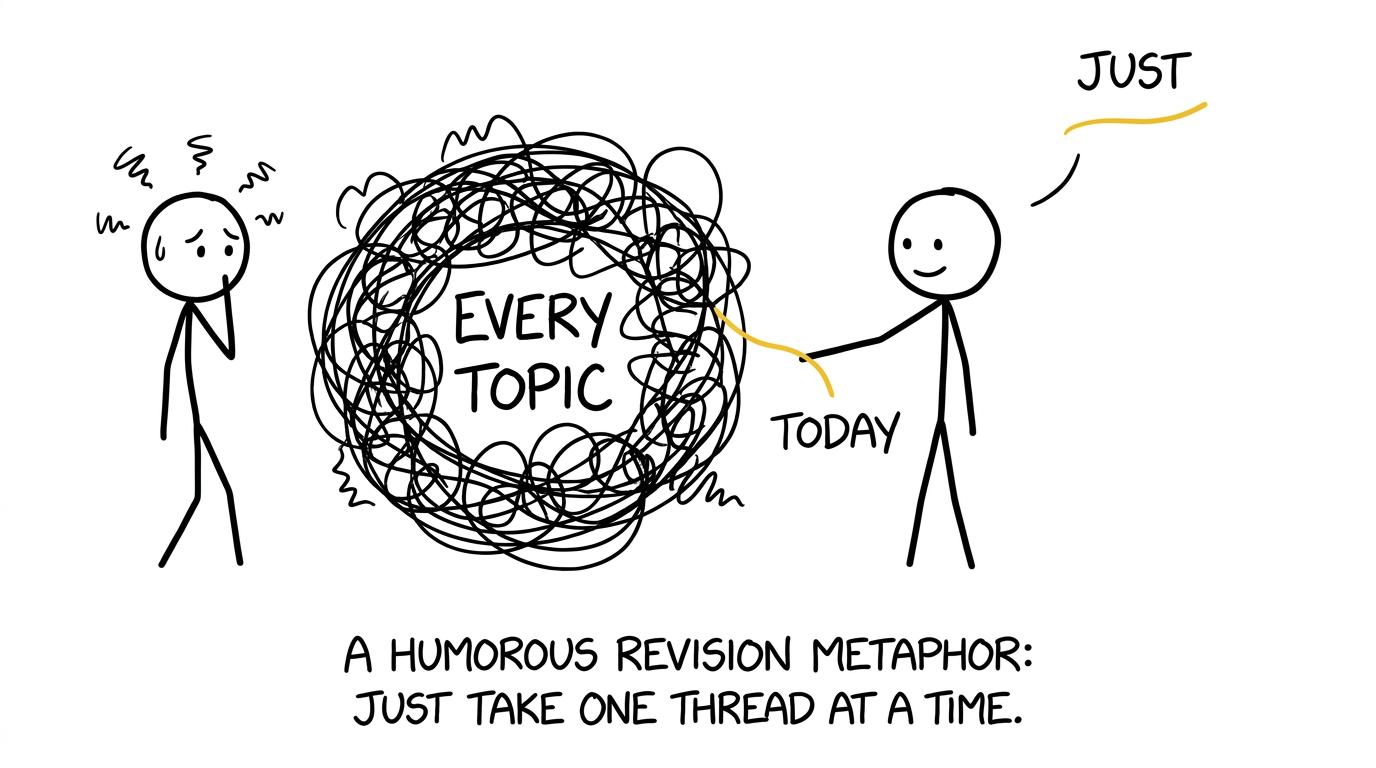 A calm student pulls today's task from the giant tangle of every topic
Build from prerequisites to extension topics
A sensible catch-up order is:
- core algebra fluency, including indices, surds, quadratics and rearranging;
- functions, graphs and coordinate geometry;
- advanced trigonometry and geometric reasoning;
- new or less familiar material such as calculus and matrices;
- mixed questions that combine several areas;
- timed examination practice.
This is not a universal teaching order. Your specification and teacher's scheme of work come first. It is a repair sequence: strengthen the tools that unlock the largest number of later questions.
Use the learn, practise, mark, fix cycle
A productive session has four parts:
- Learn: review one clearly defined method.
- Practise: answer questions without looking at the solution.
- Mark: use the mark scheme or video solution honestly.
- Fix: write one rule describing what you will change next time.
Then reattempt a similar question later. Recognition can feel like understanding, especially when watching a video. Independent recall is the stronger test.
Measure progress by evidence, not mood
Confidence often arrives after improvement rather than before it. Track evidence such as:
- questions you can now begin without help;
- mistakes that no longer repeat;
- topics moving from “unknown” to “needs practice”;
- more accurate notation and working;
- improved timing on short mixed sets.
A revision planner can schedule these return visits. Keep the plan light enough to survive busy weeks: several focused topic sessions plus one short mixed test is often more sustainable than daily full papers.
When to start Further Maths past papers
Past papers are valuable, but they should change as your knowledge changes.
Early in catch-up, use selected questions to diagnose gaps. During the middle phase, complete timed sections and study how topics are combined. Later, sit full papers under the correct calculator rules and time limit.
The guide to starting GCSE past papers explains this phased approach. Although you must use papers for your exact Further Maths qualification, the principle remains the same: a paper is a diagnostic tool before it becomes a rehearsal.
After marking, choose the two or three gaps responsible for the most lost marks. Return to lessons and practice questions, then reattempt the difficult questions. Nearer the examination, fresh GCSE predicted papers and resources can support broader exam practice, but they should complement specification-matched Further Maths papers rather than replace them.
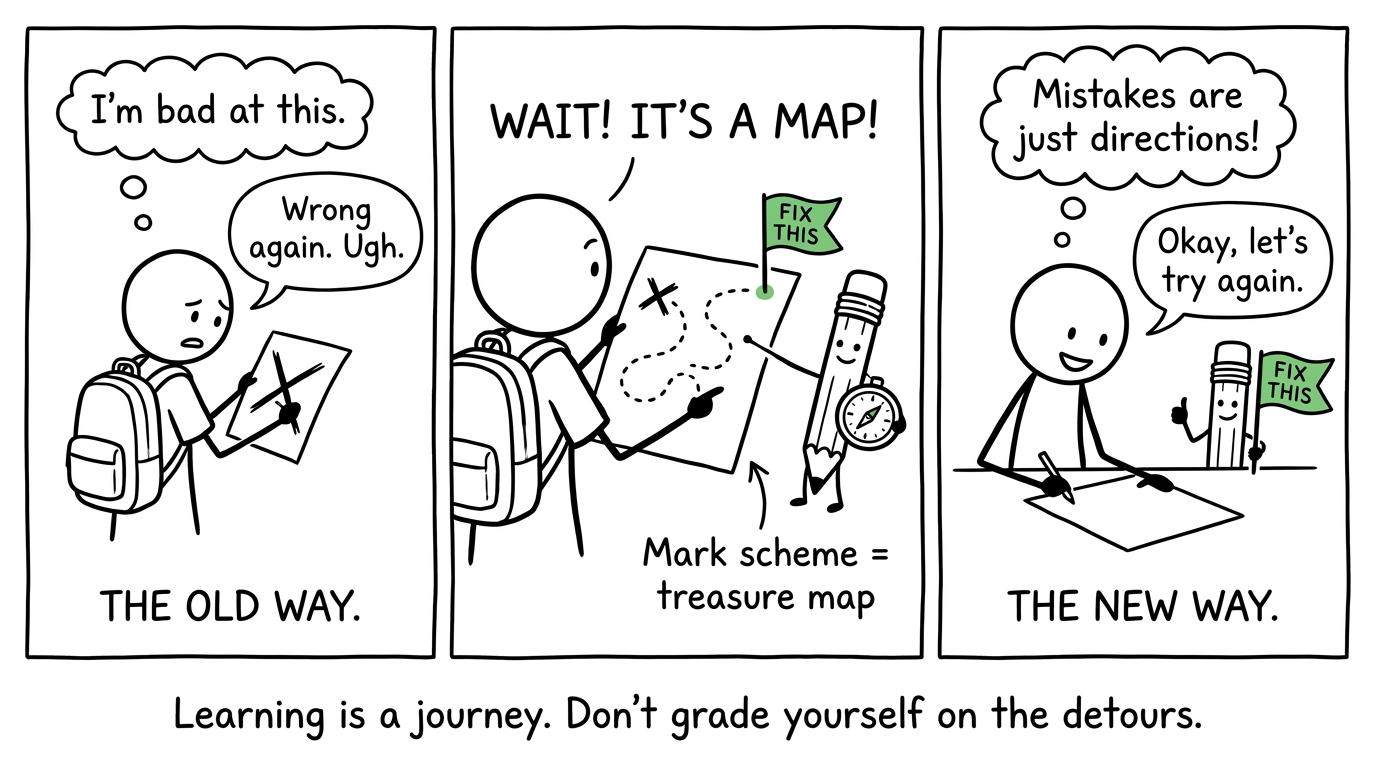 A mark scheme becomes a treasure map leading towards a precise revision fix
Common mistakes when trying to catch up
Revising what feels comfortable
Familiar topics create quick satisfaction, but they may not recover many marks. Let diagnostic questions choose your priorities.
Treating every mistake as a knowledge problem
Not every lost mark requires relearning a chapter. Some need slower algebra, clearer working or better recognition of the question type. Classify the error before choosing the remedy.
Starting with full papers too soon
A difficult full paper can provide useful information, but repeating them without repairing gaps becomes exhausting. Use topic questions and mini tests between papers.
Watching solutions without reattempting questions
A clear explanation can create an illusion of fluency. Close the solution, wait, and reproduce the reasoning independently.
Trying to match somebody else's pace
Your classmate's strongest topic is not your revision timetable. The relevant comparison is between what you could do last week and what you can do now.
Ignoring your exact specification
AQA Level 222 Further Mathematics and OCR Level 333 Additional Mathematics are not the same course. Confirm your entry and use matching papers, calculator rules and content lists.
Falling behind is a position, not an identity
Further Maths makes gaps visible because its ideas depend closely on one another. That can feel discouraging, but it also makes the route forward clearer. Repair the first weak link and several later topics may become easier at once.
Start with one honest diagnostic. Choose one small gap. Learn it, practise it, mark it and return to it. Then repeat.
MathsGenie gives you a free place to run that cycle: begin with the AQA Further Maths revision area, repair prerequisite skills through the GCSE revision lessons, and build confidence with practice questions, mini tests, mark schemes and video solutions. As the exam approaches, add specification-matched past papers and carefully chosen predicted papers.
You do not need to catch everyone else. You need to make the next part of the course more understandable than it was yesterday.











