

Feeling Behind in GCSE Astronomy? A Calm Plan
Feeling behind GCSE Astronomy? Learn why the course feels overwhelming and follow a calm catch-up plan for astronomy, maths and exam practice.
A classmate names every stage of stellar evolution. Someone else seems completely at ease with right ascension. You are still trying to remember why the Moon has phases. The gap can feel enormous.
If you are feeling behind GCSE Astronomy, the useful answer is yes: this feeling is understandable, and being behind now does not mean you must remain behind. The course combines scientific knowledge, observational skills and GCSE-level mathematics across a broad specification. Catching up begins by identifying precise gaps, not by trying to relearn the universe in one anxious weekend.
A calm recovery plan looks like this:
- check exactly which specification topics you have covered;
- separate astronomy gaps from maths gaps;
- prioritise foundational and frequently connected ideas;
- revise one small topic at a time;
- answer questions without notes;
- mark your work and record why marks were lost;
- revisit weak skills within a few days;
- build towards timed papers gradually.
Why GCSE Astronomy can make you feel behind
Astronomy has an unusual sense of scale. One lesson may concern observations from Earth; another may move through planetary systems, stellar evolution and cosmology. A missed idea can reappear later in a different form.
The current Pearson Edexcel GCSE Astronomy specification contains sixteen topics. Topics 1 to 8 are assessed in Paper 1, Naked-eye Astronomy, while Topics 9 to 16 appear in Paper 2, Telescopic Astronomy. Each paper lasts 111 hour 454545 minutes, carries 100100100 marks and contributes 50%50\%50% of the qualification.
That breadth creates three reasons why students may feel behind.
First, progress is difficult to see. Learning one definition feels small beside an entire galaxy of content. Secondly, students enter the course with different levels of informal knowledge. Someone who has read about space for years may know more vocabulary, but that does not automatically mean they can apply the specification accurately. Thirdly, astronomy draws on several kinds of thinking at once: recall, explanation, calculation, graph interpretation and evaluation of observations.
Comparison usually reveals what another student can say aloud. It does not reveal their misconceptions, missed homework or weaker topics. Treat comparison as unreliable evidence.
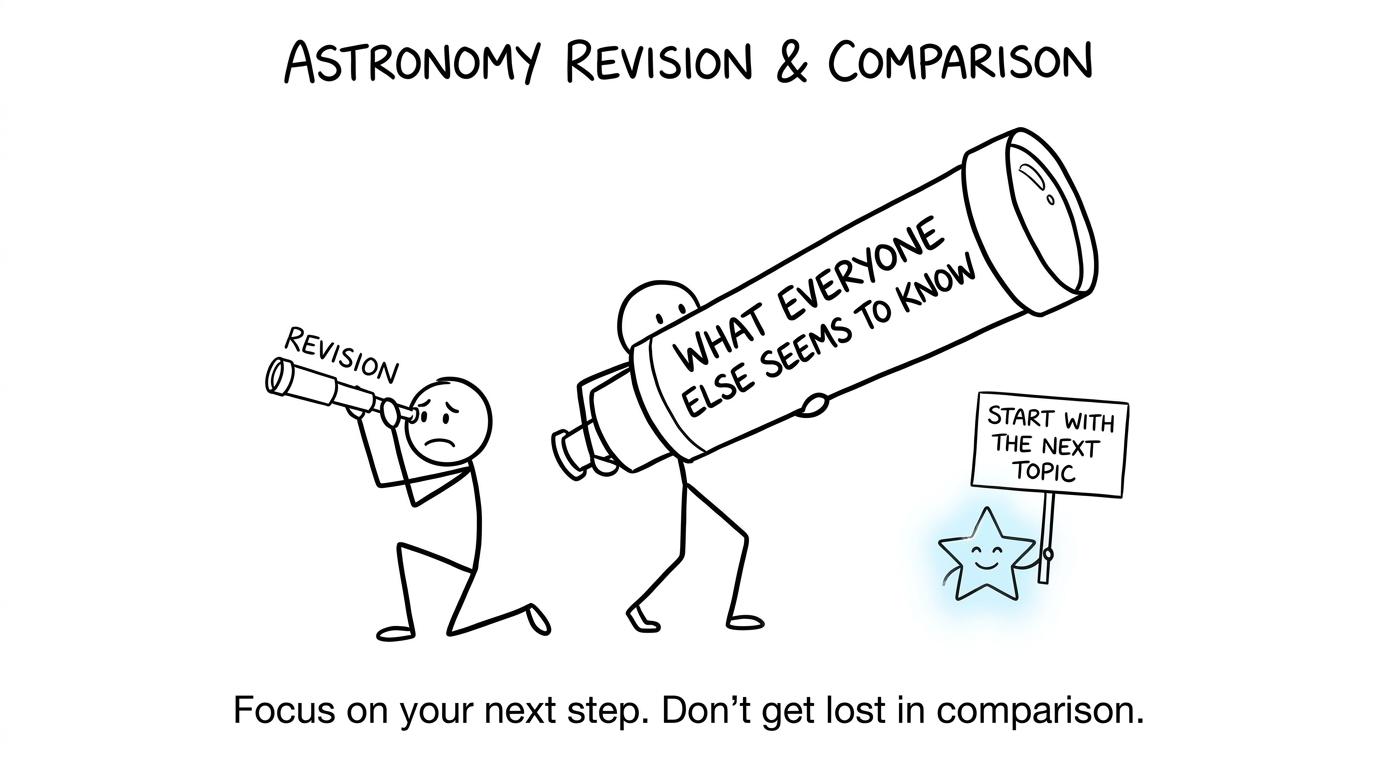 A student compares revision telescopes while a friendly star recommends starting with the next topic
What being behind actually means
“Behind” is too vague to guide revision. Replace it with a diagnosis.
A knowledge gap
You cannot yet recall or explain an astronomical idea, such as the cause of seasons, retrograde motion, stellar evolution or redshift. This calls for a short revision lesson, careful notes and retrieval practice.
A mathematical gap
You understand the astronomy but lose control of standard form, ratios, rearranging equations, units or graphs. This is often encouraging: the obstacle is narrower than it first appeared.
Official subject requirements state that mathematical skills account for at least 20%20\%20% of GCSE Astronomy marks. Required skills include standard form, ratio, percentages, inverse-square relationships, base-101010 logarithms, significant figures, specialist distance units, algebra, graphs and angular measures.
MathsGenie's standard form revision guide is particularly relevant because astronomical quantities are often extremely large or small. A number in standard form has the structure
a×10n,1≤a<10,a \times 10^n, \qquad 1 \le a < 10,a×10n,1≤a<10,where nnn is an integer. You can also rebuild proportional reasoning with the GCSE ratio revision guide and strengthen data presentation through drawing linear graphs.
An application gap
You know the facts but cannot decide which ones matter in an unfamiliar question. More rereading will not solve this by itself. You need exam-style questions, marking and reflection.
An observational gap
You may know the theory but feel uncertain about planning, analysing or evaluating observations. The qualification assesses observational knowledge and skills in the written examinations. Across the qualification, at least 15%15\%15% of marks must assess observational work.
Focus on purpose, equipment, safety, variables, data quality and possible improvements. Learn to distinguish accuracy, precision, repeatability and reliability rather than using “human error” as a universal explanation.
How to catch up without panicking
Panic encourages dramatic plans: six topics tonight, an entire paper tomorrow and every formula before breakfast. These plans feel serious because they are difficult. They usually collapse because they are difficult.
A better plan reduces the size of the next decision.
Map the course honestly
List the sixteen specification topics and use three labels:
- Secure: you can answer questions without notes.
- Developing: you recognise the content but make errors.
- Missing: you have not learnt it or cannot explain it.
Do not label a topic secure because your notes look familiar. Familiarity is not recall. Test yourself first.
Then choose no more than three priority areas. Begin with topics that support later understanding or appear repeatedly in connected contexts: Earth-Moon-Sun relationships, celestial observation, planetary motion, astronomical units, starlight and interpreting data.
Build a repeatable revision cycle
For each priority topic:
- learn one manageable section;
- close the notes and retrieve the key ideas;
- complete a short set of questions;
- mark every answer;
- record the reason for each lost mark;
- return to the topic after a short gap.
A useful error log separates mistakes into knowledge, mathematics, application, units and question reading. This turns a disappointing score into instructions.
If planning is the difficult part, adapt the structure in MathsGenie's one-week GCSE revision plan. The astronomy content differs, but the sequence of diagnosis, focused practice, marking and retesting transfers well.
Repair the maths separately
Do not wait for an astronomy question to expose the same maths weakness again. Practise that skill in a simpler setting first.
For instance, if scales and proportional comparisons are unreliable, return to writing and simplifying ratios. If you misread plotted data, practise axes, coordinates, gradients and intercepts independently.
Students taking GCSE Maths with Edexcel, AQA, OCR or Eduqas should use resources matched to their own board and tier. However, the mathematical techniques required in Astronomy are not a separate, mysterious branch of maths. Improving core number, algebra and graph skills can support both qualifications.
Move from short questions to papers
A full paper taken too early may merely confirm that much of the course is unfinished. Start with questions from topics you have revised. Then use mixed sections. Finally, attempt complete papers under timed conditions.
Past papers are most useful when you analyse them. The process should be attempt, mark, classify, repair and retest. MathsGenie's guidance on when to start GCSE past papers explains why papers should be treated as diagnostic information rather than a verdict on ability.
For supplementary maths practice, use Edexcel GCSE Maths past papers and mark schemes. If Edexcel is not your GCSE Maths board, choose the corresponding board resources on MathsGenie. Nearer the maths exams, GCSE predicted papers can provide additional unseen practice, but they should complement topic repair and past papers rather than replace them.
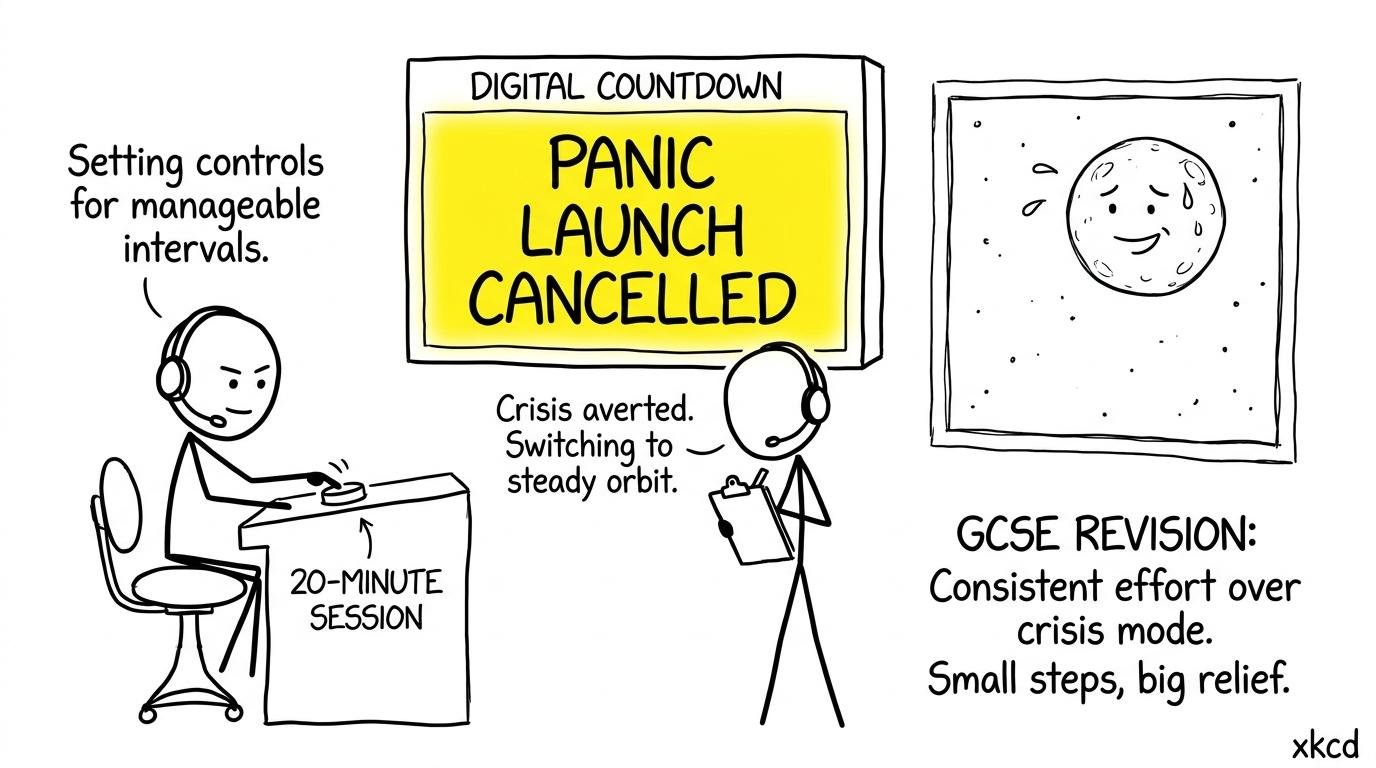 A calm revision session cancels the panic launch at astronomy mission control
A realistic weekly catch-up rhythm
Consistency matters more than one heroic session. A workable week might contain:
- two sessions for astronomy knowledge;
- one session for mathematical skills;
- one session for observational questions;
- one mixed-question session;
- one short review of the error log.
Keep each session narrow enough to finish. “Revise stellar evolution” may still be too broad. “Retrieve the sequence for stars of different initial masses, then answer five questions” provides a clear endpoint.
If independent revision feels unfamiliar, MathsGenie's guide to self-studying GCSE Maths offers a practical lesson, practice, mark, fix routine. The same discipline works for astronomy: learn actively, test promptly and let errors determine what happens next.
Common mistakes when trying to catch up
Starting with the most impressive topic
Black holes and cosmology may be fascinating, but revision order should be determined by your gaps and the specification. Secure the ideas that connect multiple topics before chasing the most dramatic content.
Copying notes instead of retrieving knowledge
Neat notes can create a feeling of progress without testing memory. After a short review, close the material and explain the idea from memory. Check what you omitted or confused.
Ignoring mathematical working
A correct calculator output may not communicate the method. Write substitutions, preserve units, use an appropriate number of significant figures and avoid rounding too early.
Memorising equations without understanding quantities
Pearson states that the examination paper supplies the relevant formulae and astronomical data. That does not remove the need to choose an equation, identify quantities, substitute correctly, rearrange where necessary and interpret the result.
Doing papers without reviewing them
Completing many papers can feel productive, but repeating an uncorrected mistake only makes it familiar. Spend serious time with mark schemes and video solutions. Record one specific correction for every lost mark.
Treating a bad day as evidence
One poor session may reflect tiredness, an unusually weak topic or questions that exposed valuable gaps. It does not measure your final grade. Look for patterns across several attempts.
You do not need to catch up all at once
Feeling behind is painful partly because your attention rests on the whole distance rather than the next step. Yet qualifications are not completed in one leap. They are built through small acts of clarification: one corrected misconception, one accurately plotted graph and one better evaluation of an observation.
Begin today with a specification check and one priority topic. Use MathsGenie as your free revision base for the mathematical side of Astronomy and your wider GCSE Maths preparation. Combine revision lessons with practice questions, mini tests, mark schemes and video solutions. Then build towards past papers and predicted papers when your foundations are ready.
You do not need to feel caught up before you start. Starting properly is how you catch up.










