Feeling Behind in GCSE Arabic? How to Catch Up
Feeling behind GCSE Arabic? Learn why the gap often feels worse than it is, diagnose each skill and build a calm catch-up plan alongside maths revision.
It can happen in a single lesson. Someone answers fluently, another student seems to recognise every word, and suddenly you feel as if the whole class has moved ahead without you.
If you are feeling behind GCSE Arabic, the short answer is yes: that feeling is understandable, and it does not mean you cannot catch up. Students arrive with different levels of exposure to spoken and written Arabic. More importantly, GCSE Arabic assesses several distinct skills. You may be comfortable speaking but less confident reading, or know plenty of vocabulary yet struggle to produce an accurate written response.
The solution is not to revise everything in a panic. It is to identify the precise gaps, work on them in small cycles and protect enough time for your other GCSE subjects, including maths.
A quick catch-up checklist
Start here rather than creating an enormous timetable:
- Confirm your exam board, specification and tier with your teacher.
- Separate listening, speaking, reading and writing rather than judging your Arabic as one ability.
- Complete a short diagnostic task in each skill.
- Choose no more than two priority weaknesses at first.
- Practise actively, then check your work against teacher feedback or the mark scheme.
- Revisit the same skill within a few days.
- Keep maths and your other subjects visible in the plan.
- Tell your teacher if you do not understand your current level or what to revise next.
This approach turns a vague fear, “I am behind”, into a list of actions you can actually complete.
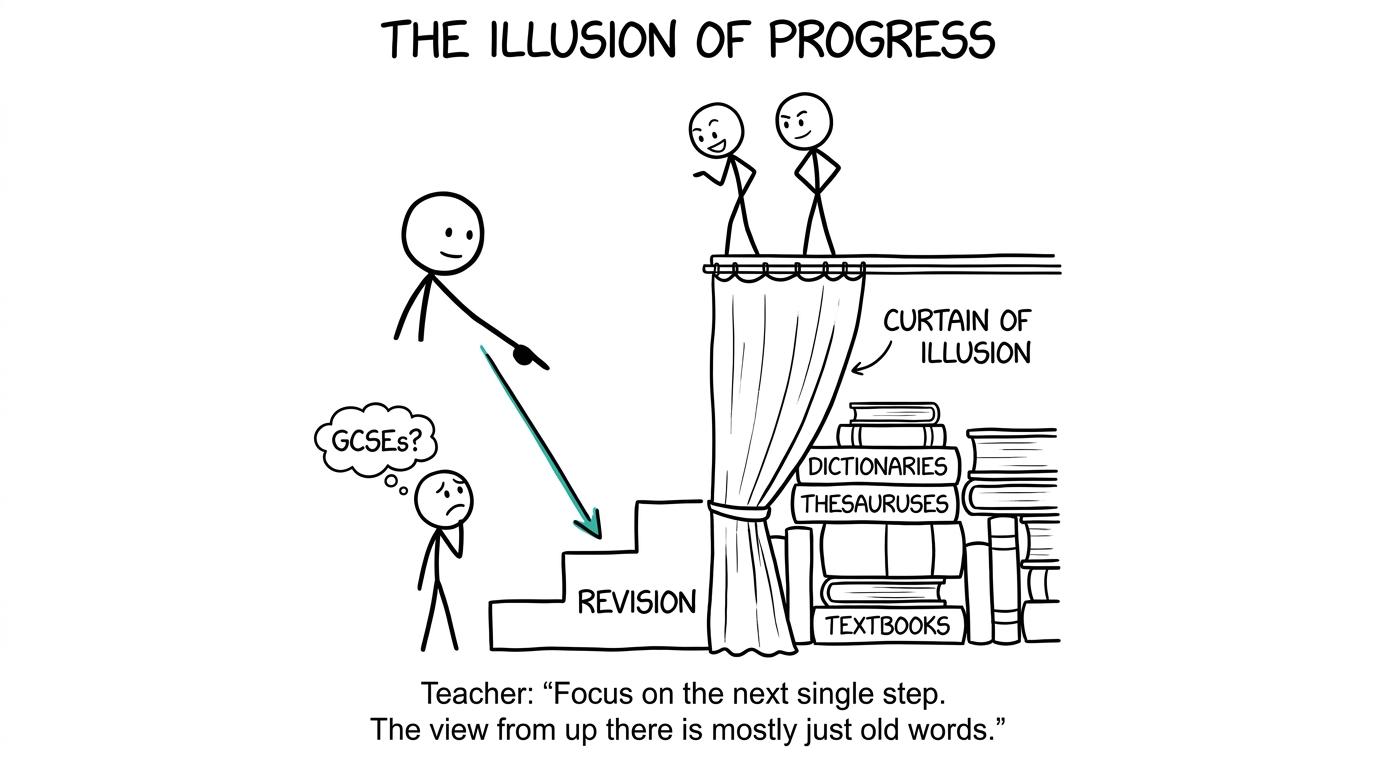 A worried student discovers that the apparent revision gap is not quite what it seemed
Why feeling behind in GCSE Arabic is so convincing
Comparison is usually based on incomplete evidence. You hear another student give one polished answer, but you do not see the vocabulary they forgot yesterday or the help they receive outside school. You are comparing your full set of difficulties with a small, visible part of somebody else's performance.
Arabic can make this comparison particularly confusing because students may have very different starting points. Some regularly hear Arabic at home but have had less formal practice with spelling, grammar or extended writing. Others may have learnt to read but feel hesitant during spontaneous conversation. Familiarity in one area does not automatically mean complete GCSE readiness.
There is also more than one form of Arabic in everyday life. The standard written and formal language used in GCSE contexts may not match the variety a student commonly hears or speaks. A confident speaker can therefore have genuine gaps in formal reading or writing without being “bad at Arabic”.
The useful question is not whether somebody else looks ahead. It is: which assessed skill currently costs you marks?
Understand what your GCSE Arabic course assesses
Always use the specification named by your school. Do not assume that a resource for a different qualification has the same tasks, timing or mark scheme.
For example, the current Pearson Edexcel GCSE Arabic qualification assesses listening, speaking, reading and writing in separate papers. Each skill contributes 25%25\%25% of the qualification, and students take either foundation or higher tier across the papers. The speaking assessment includes structured tasks, while reading and writing include translation as part of the course requirements.
That structure matters because “behind” is too broad a diagnosis. Your profile might look like this:
- Listening: you know words on a vocabulary list but cannot recognise them at natural speed.
- Speaking: you understand a question but need too long to form a response.
- Reading: unfamiliar words make you abandon a passage before using context.
- Writing: your ideas are clear, but accuracy, spelling or grammatical structures reduce the marks.
Ask your teacher which paper format, themes and tier apply to you. Edexcel, AQA, OCR and Eduqas are familiar names across UK GCSEs, but they do not all offer identical subjects or specifications. Your school’s entry information is the reliable starting point.
Diagnose the gap without judging yourself
A diagnostic is evidence, not a verdict. Choose one short task for each assessed skill and complete it without excessive notes or repeated pauses. Then record what actually happened.
For each mistake, use one of these labels:
- Vocabulary: the key word was unknown.
- Recognition: you knew the word but did not recognise it in speech or connected text.
- Grammar: the tense, agreement or sentence structure caused the problem.
- Production: you understood the idea but could not express it independently.
- Exam technique: you misread the instruction, missed a detail or managed time poorly.
Make each note specific. “Writing is terrible” offers no direction. “I cannot consistently form a past-tense response” gives you something teachable and testable.
The same principle improves maths revision. MathsGenie’s guide to finding your weakest GCSE topics explains how to turn mistakes into a focused shortlist rather than revising an entire course indiscriminately.
Build a calm GCSE Arabic catch-up plan
Catching up is less about dramatic effort and more about closing one gap repeatedly. A useful revision session has four parts:
Retrieve
Spend a few minutes recalling vocabulary, structures or speaking prompts without looking at your notes. Retrieval shows what is genuinely available from memory.
Practise
Complete one focused task. That could be listening for key details, reading a short passage, rehearsing responses aloud or producing a paragraph under a sensible time limit. Avoid switching between several unrelated weaknesses in the same short session.
Check
Use the relevant mark scheme, teacher feedback or an approved model response. Do not merely count correct answers. Identify why marks were lost and what a stronger response needed.
Revisit
Return to the same weakness on another day with different material. A correction that looks obvious while the answer is open has not necessarily become an independent skill.
A manageable starting pattern is four short Arabic sessions across the week: two on your weakest area, one on your second priority and one mixed review. Adjust the duration around your school workload and teacher guidance. Consistency matters more than designing a plan so demanding that you abandon it after two days.
If planning itself feels difficult, the structure in MathsGenie’s GCSE maths revision timetable can be adapted across subjects. For a shorter daily routine, see the 20-minute GCSE revision approach.
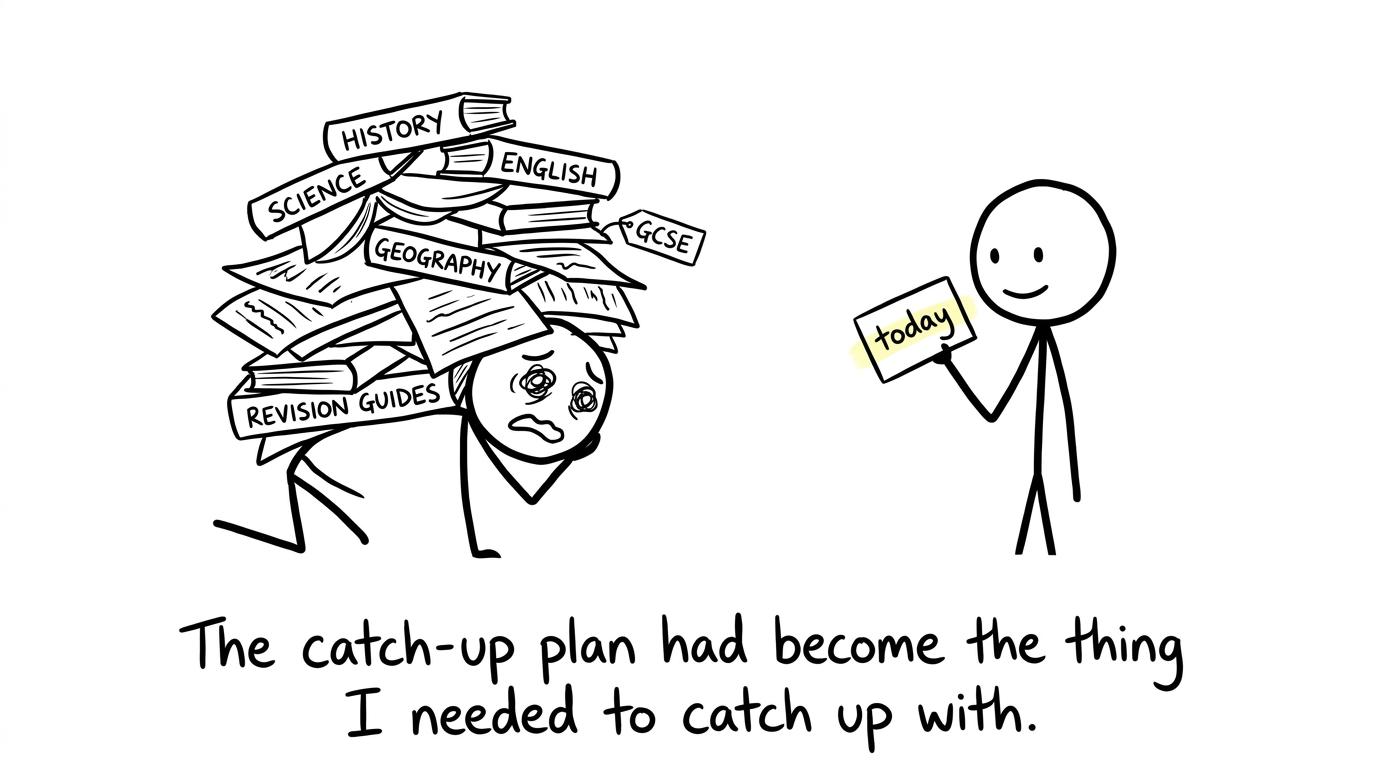 A student learns that carrying the entire revision plan at once is not the same as making progress
Match your practice to the weak skill
Different weaknesses require different forms of practice. Copying vocabulary repeatedly will not fully solve a listening problem, just as reading model paragraphs will not automatically make speaking spontaneous.
If listening feels weakest
Use short recordings connected to your specification. Listen first for the main idea, then for details. Review the transcript only after committing to an answer. Keep a list of words you knew on paper but failed to recognise when spoken.
If speaking causes anxiety
Practise producing short answers aloud rather than silently planning perfect ones. Record yourself where appropriate, listen back and identify one improvement at a time. Your teacher can confirm the task formats and help distinguish a communication issue from a pronunciation or grammar issue.
If reading feels slow
Practise identifying names, time references, opinions, negatives and linking words before translating every sentence. The aim is accurate comprehension, not necessarily understanding every isolated word.
If writing loses marks
Build a small bank of reliable structures that you can use accurately and adapt. After each task, correct recurring errors and rewrite only the affected sentence or section. Ask your teacher which parts of the mark scheme reward communication, range and accuracy for your paper.
Keep Arabic catch-up from damaging maths revision
Panic in one subject often spreads. A student worried about Arabic may devote every evening to it, then feel behind in maths a week later. That is not catching up; it is moving the pressure.
Give each subject a defined place. The MathsGenie GCSE maths revision hub organises free resources by exam board, including Edexcel, AQA, OCR, Eduqas, WJEC and CCEA. Use it to select a revision lesson or focused question set without losing time searching.
A balanced week might include short Arabic skill sessions alongside targeted maths practice. In maths, complete a topic, mark it and record the exact error. Then use Edexcel GCSE Maths mini tests, where relevant to your board, to check whether the method survives under time pressure.
As exams approach, progress from topic work to realistic assessment. MathsGenie’s Edexcel GCSE Maths past papers include official mark schemes and worked solutions where available. If you need a broader structure, the one-month GCSE maths revision plan shows how diagnosis, focused practice and timed papers can fit together.
Common mistakes when trying to catch up
Revising what already feels comfortable
Familiar vocabulary and easy tasks feel productive because they produce quick success. Keep some confidence-building review, but give most catch-up time to the weakness identified by evidence.
Making an impossible timetable
A plan containing every topic, every night and no rest will create another way to feel behind. Set a small minimum you can maintain on difficult school days.
Treating mistakes as proof of low ability
A mistake is useful only when it is classified and corrected. “Wrong again” teaches nothing. “Missed the negative” or “used the wrong tense” tells you what to notice next time.
Using resources for the wrong specification
A well-made resource can still be unhelpful if its task format, topics or assessment demands do not match your qualification. Confirm your board and tier before relying on it.
Looking at the mark scheme too early
Recognition is easier than recall. Attempt the task before checking the answer, then use feedback actively. Maths students can strengthen this habit with MathsGenie’s guide to turning mark-scheme mistakes into marks.
Waiting to feel confident before practising
Confidence often arrives after repeated evidence that you can improve. Begin with a task small enough to attempt today.
You do not need to catch everyone
The idea of catching “everyone else” has no clear finish line. There will always be someone who speaks faster, remembers more vocabulary or finds a particular task easier. Your GCSE is assessed against published requirements, not against the most confident person in your classroom.
Find the first measurable gap. Practise it, check it and revisit it. Ask your Arabic teacher for specification-specific direction, then keep your wider GCSE plan balanced.
For maths, make MathsGenie’s free GCSE revision resources your starting point. Use revision lessons and practice questions to rebuild weak topics, mini tests to check them, and past papers, predicted papers, mark schemes and video solutions to prepare for exam conditions. You do not need to repair everything tonight. You need one clear next step, and then another.