

Extra Practice Material GCSE Drama: Is It Worth It?
Extra practice material GCSE Drama: learn what to request, how to show you have already tried, and how to use each resource effectively in revision.
It can feel awkward to ask for extra practice material GCSE Drama teachers have not already set. You may worry that the request sounds like an admission that you ignored the original work, want an easier task or expect your teacher to organise your revision for you.
In reality, a focused request usually communicates the opposite. It shows that you have reviewed your work, identified a gap and want to act on feedback. The key is not simply to ask for “more worksheets”. Explain what you have attempted, name the skill you need to improve and request material that matches it.
This matters particularly when you are balancing Drama with GCSE maths. Both subjects reward purposeful practice, but neither improves merely because you accumulate more paper. The useful resource is the one that addresses a specific weakness.
The short answer
Yes, it is worth asking your teacher for extra GCSE Drama practice material when you:
- have completed or genuinely attempted the existing task;
- can identify a particular skill or component that needs attention;
- ask for something manageable and relevant to your exam board;
- are prepared to use the resource and review the feedback;
- avoid requesting restricted assessment material that your teacher cannot release.
Before asking, check which board you study: AQA, Pearson Edexcel, OCR or Eduqas, because assessment structures and terminology vary. Your teacher can tell you whether you would benefit most from a past-paper question, an exemplar response, rehearsal prompt, annotation task, design exercise or practice extract.
Why asking for extra material can help
“More practice” sounds productive, but volume is not the real goal. Direction is.
A student who completes several unfocused tasks may learn less than one who answers a single relevant question, checks it against the assessment criteria and rewrites the weakest paragraph. The same principle applies in maths: twenty familiar questions can feel reassuring, while five carefully chosen questions may reveal what actually costs marks.
Official GCSE Drama support differs between boards, but specifications and exam-board resources commonly include sample assessment materials, past papers, mark schemes, examiner guidance or exemplification. Some recent materials may only be available to schools through secure services, so your teacher may have appropriate resources that students cannot access independently.
Your teacher also knows the performance text, live theatre work and practical choices used by your class. That context allows them to recommend something more useful than a generic internet search.
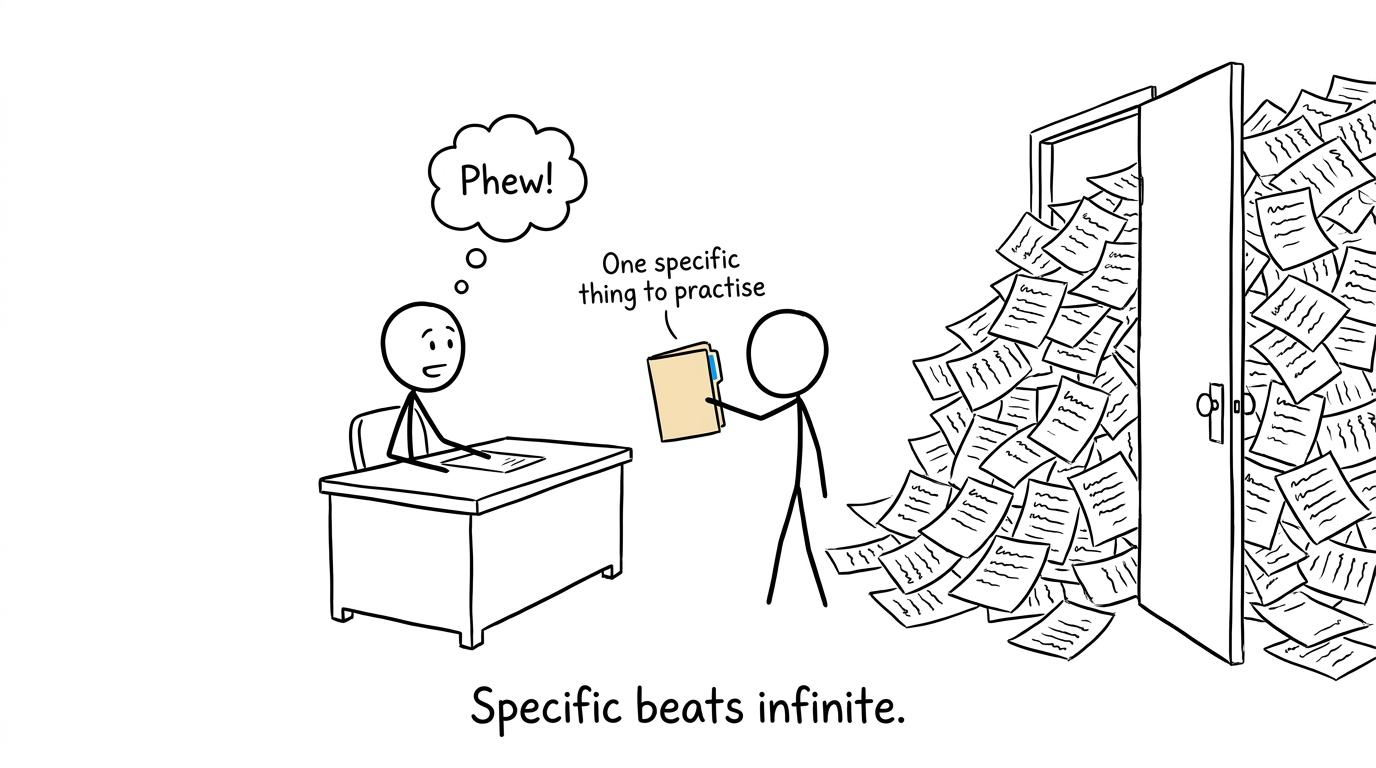 A student asks for one specific practice resource while an avalanche of unnamed worksheets waits outside
Decide what you actually need before asking
A vague request creates work for the teacher and often produces vague practice. Spend five minutes diagnosing the problem first.
Written examination practice
You might need help with:
- understanding a command word;
- planning within a sensible time;
- using precise dramatic terminology;
- explaining how an acting or design choice creates meaning;
- selecting relevant evidence from the studied text;
- evaluating live theatre rather than merely describing it;
- developing a response far enough to reach the higher levels of a mark scheme.
Instead of asking for “another Drama paper”, ask whether there is one suitable question on your weakest area. A past question accompanied by its mark scheme or an anonymised exemplar can be more valuable than an entire paper.
Practical and performance preparation
For practical work, extra material may not look like a worksheet. You could request:
- a short extract for character exploration;
- an additional rehearsal stimulus;
- a vocal or physical-skills checklist;
- prompts for evaluating rehearsal decisions;
- a design brief for lighting, sound, costume or set;
- guidance on recording development in the format required by your course.
Practical assessment is controlled by the specification and your centre’s arrangements. Ask before using extra scripts, outside feedback or additional recorded material in assessed work. Your teacher can clarify what is permitted.
Feedback you have not yet acted upon
Sometimes you do not need a new resource at all. You need to revisit the old one properly.
Look at your latest feedback and identify one repeated comment. Perhaps you describe a performance choice without analysing its effect, or make a promising point without enough detail. Ask your teacher whether correcting that response would be better than starting another.
That question signals maturity: you are interested in improvement, not simply completion.
How to ask without sounding as though you have not tried
The conversation can be short. A useful request contains four parts:
- what you have already done;
- what you noticed;
- the precise resource you want;
- what you will do with it.
You could say:
“I completed the practice question and checked my feedback. I am still finding it difficult to explain the effect of performance choices rather than just describe them. Is there another question or exemplar I could use to practise that skill? I can bring my attempt to the next lesson.”
For practical work, you might say:
“I have rehearsed the extract using the notes from last lesson, but my vocal choices still feel too similar throughout. Could you suggest a short exercise or another section I can use to practise contrast?”
Neither request claims that effort guarantees extra teacher time. Both make the existing effort visible and give the teacher a clear starting point.
If you are asking by email
Keep it concise and send it at a reasonable time. Include your class, the relevant component and the specific issue. Do not attach a large collection of unfinished work unless your teacher has asked for it.
A suitable structure is:
Subject: GCSE Drama practice for written evaluation
Hello [Teacher’s name],
I have completed [task] and reviewed [feedback or mark scheme]. I noticed that I need more practice with [specific skill]. Is there a suitable question, extract or exemplar I could work on? I will complete it by [realistic date].
Thank you.
A realistic deadline matters. Asking for material and never returning to it is what can make the request appear performative.
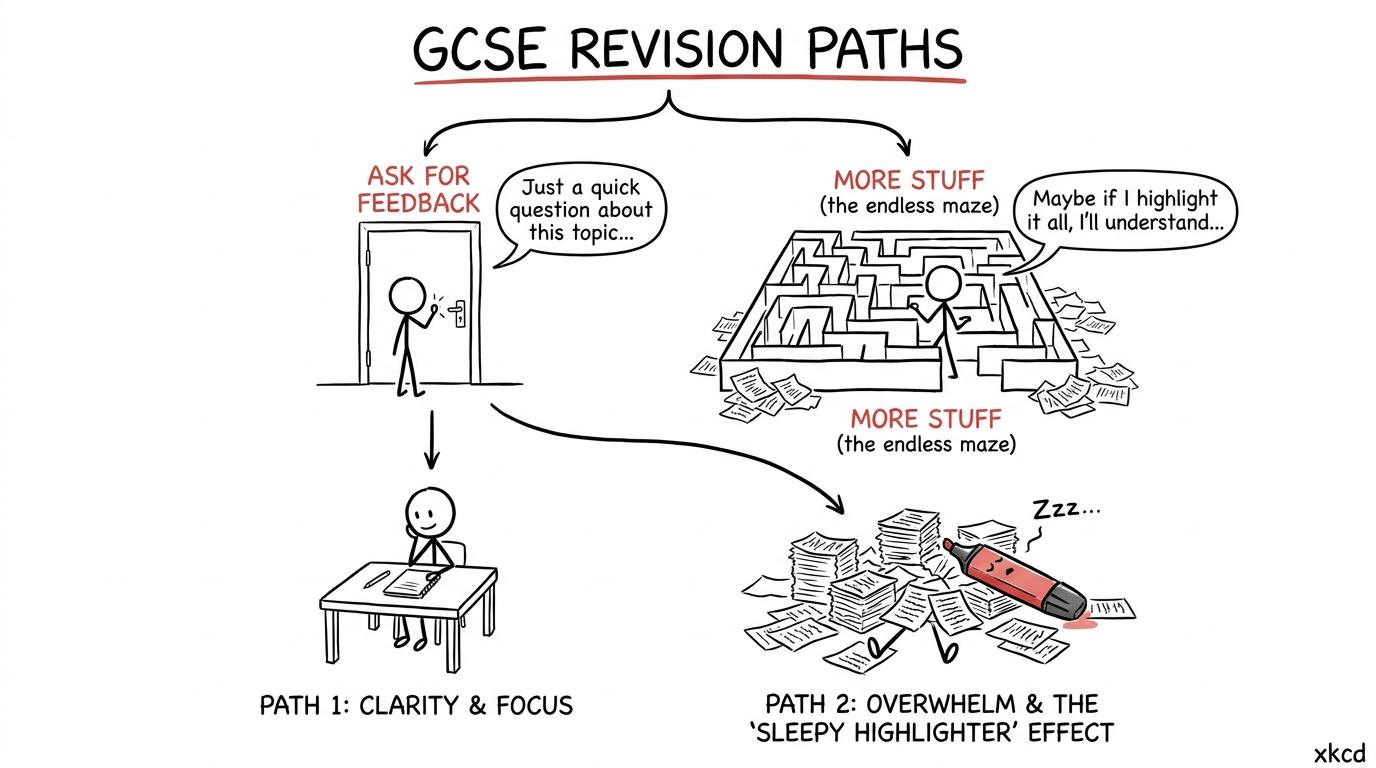 One student takes the clear ask-for-feedback path while another gets lost in a maze of extra stuff
What to request from your Drama teacher
The best choice depends on the weakness you have diagnosed.
| Revision need | Focused request |
|---|---|
| Unfamiliar question wording | One relevant past or sample question |
| Weak structure | A planning frame or anonymised exemplar |
| Unclear use of assessment criteria | The relevant mark scheme and guidance on applying it |
| Limited acting detail | A short extract with a vocal and physical-skills focus |
| Repetitive design ideas | A new design brief or production constraint |
| Weak evaluation | A prompt that requires analysis of effect and audience response |
| Poor timing | A manageable timed section rather than a full paper |
Ask for the smallest resource capable of exposing the problem. If your teacher offers three tasks, clarify which one should come first.
Turn extra material into useful practice
Receiving a resource is only the beginning. Use a simple cycle:
- attempt it without unnecessary notes;
- compare the work with the criteria, mark scheme or teacher guidance;
- identify one or two precise weaknesses;
- improve the response or repeat the rehearsal task;
- return later to check whether the skill is more secure.
Keep a brief record of what changed. For written work, note whether you improved terminology, evidence, explanation or evaluation. For performance, record the choice you tested and the intended effect. This gives your next conversation with your teacher substance.
The method transfers neatly to maths revision. Begin with the GCSE Maths revision hub, use a short task to locate a weakness, then choose targeted revision rather than collecting random questions. The GCSE Maths topics by exam board and tier guide can help you distinguish a specific gap from a broad label such as “algebra”.
If revision time is becoming crowded, build both subjects into a realistic GCSE maths revision timetable. The aim is not to give every subject equal time every evening. It is to decide in advance what each session is meant to repair.
Balance GCSE Drama practice with maths revision
Students preparing for maths exams can easily let another subject’s unfinished work expand into every available evening. A focused request prevents that. If your teacher gives you one purposeful Drama task, schedule it, complete it and return to your maths priorities.
For maths, your board and tier matter. Foundation and Higher papers require practice appropriate to the course you are taking. Use the best order for learning GCSE maths topics when gaps are broad, or follow a one-month GCSE maths revision plan when the examination period is approaching.
Nearer the exams, avoid relying only on predictions. MathsGenie’s guide to using GCSE predicted topics sensibly explains why predictions should sharpen revision rather than replace full specification coverage. Drama works similarly: one likely style of question is not a substitute for understanding your component as a whole.
 A drama student performs to an audience of supportive maths equipment
Common mistakes when requesting more practice
Asking for “anything extra”
This makes the teacher diagnose your needs from scratch. Name the component and skill instead.
Pretending you have completed work that you have not
Teachers can usually see the difference between a serious attempt and an untouched task. Be honest: “I started this, but I cannot get beyond the planning stage” is a useful basis for help.
Requesting a full paper when one question would do
A large task can hide the weakness you meant to address. Choose focused practice first, then test the skill in a longer assessment.
Ignoring the mark scheme or assessment criteria
Completion alone does not reveal why an answer gains marks. Ask how the criteria apply to your response, then make a visible improvement.
Expecting immediate marking
Your teacher may be willing to provide material without having time to mark an extra full response immediately. Ask whether self-assessment, peer discussion, an exemplar or feedback on one paragraph would be appropriate.
Collecting resources without using them
A folder full of untouched practice creates the feeling of revision without its benefits. The one-week GCSE maths revision plan uses short cycles of attempting, marking and correcting, a useful model for managing work across subjects.
Ask with evidence, then follow through
Asking your teacher for extra GCSE Drama practice is worthwhile when the request is specific, honest and connected to action. Show what you have attempted. Explain the gap. Ask for one suitable next step. Then complete it and use the feedback.
That is not a sign that you are failing to try. It is what organised revision looks like.
For the maths side of your timetable, let MathsGenie make the next step equally clear. Start with the free MathsGenie GCSE revision area, then combine revision lessons and practice questions with mini tests, past papers, predicted papers, mark schemes and video solutions. Choose one weakness today, practise it properly and make your next request, to a teacher or to yourself, precise.










