Extra Practice Material GCSE Arabic: How to Ask
Extra practice material GCSE Arabic advice: ask your teacher confidently, demonstrate your effort and build a focused revision plan that works.
Asking for help can feel strangely risky. You may worry that your teacher will think you ignored the first worksheet, failed to revise independently or simply want them to do more work for you. Yet if you are searching for extra practice material GCSE Arabic, the short answer is yes: it is worth asking. The important part is how you ask.
A thoughtful request shows that you are taking responsibility. Bring evidence of what you have attempted, identify the skill you need to improve and ask for a manageable next step. That sounds very different from saying, “Have you got anything else?”
This matters especially when GCSE Arabic must share your revision time with maths and other subjects. More material is useful only when it solves a specific problem.
A quick checklist before asking your teacher
Before you approach your teacher, make sure you can explain:
- which GCSE Arabic specification and tier you are following;
- whether you need listening, speaking, reading or writing practice;
- what material you have already completed;
- where you became stuck or lost marks;
- what type of extra resource would help;
- when you will complete it and ask for feedback.
This preparation takes only a few minutes, but it changes the meaning of the conversation. You are not asking your teacher to rescue your revision. You are asking them to help you direct it.
Why asking for extra GCSE Arabic material is worthwhile
The current Pearson Edexcel GCSE Arabic qualification has separate assessments in listening, speaking, reading and writing, with foundation and higher tiers. Students are entered for one tier across the papers. That means “I need more Arabic practice” is too broad to guide an effective response.
Your teacher may be able to provide specification-matched questions, unused classroom tasks, speaking prompts, vocabulary retrieval activities or guidance towards appropriate past-paper sections. They also know which material is suitable for your tier and which weaknesses have appeared in your classwork.
That judgement matters. A difficult higher-tier text is not automatically better practice for a foundation-tier student. Nor will another reading passage fix a problem with spontaneous speaking. The best extra material sits just beyond what you can currently do and gives you a clear opportunity to improve.
There is another benefit: asking creates a small moment of accountability. Once you tell a teacher that you plan to complete a task by Friday, the task becomes more concrete. Good revision often grows from these modest commitments rather than dramatic promises.
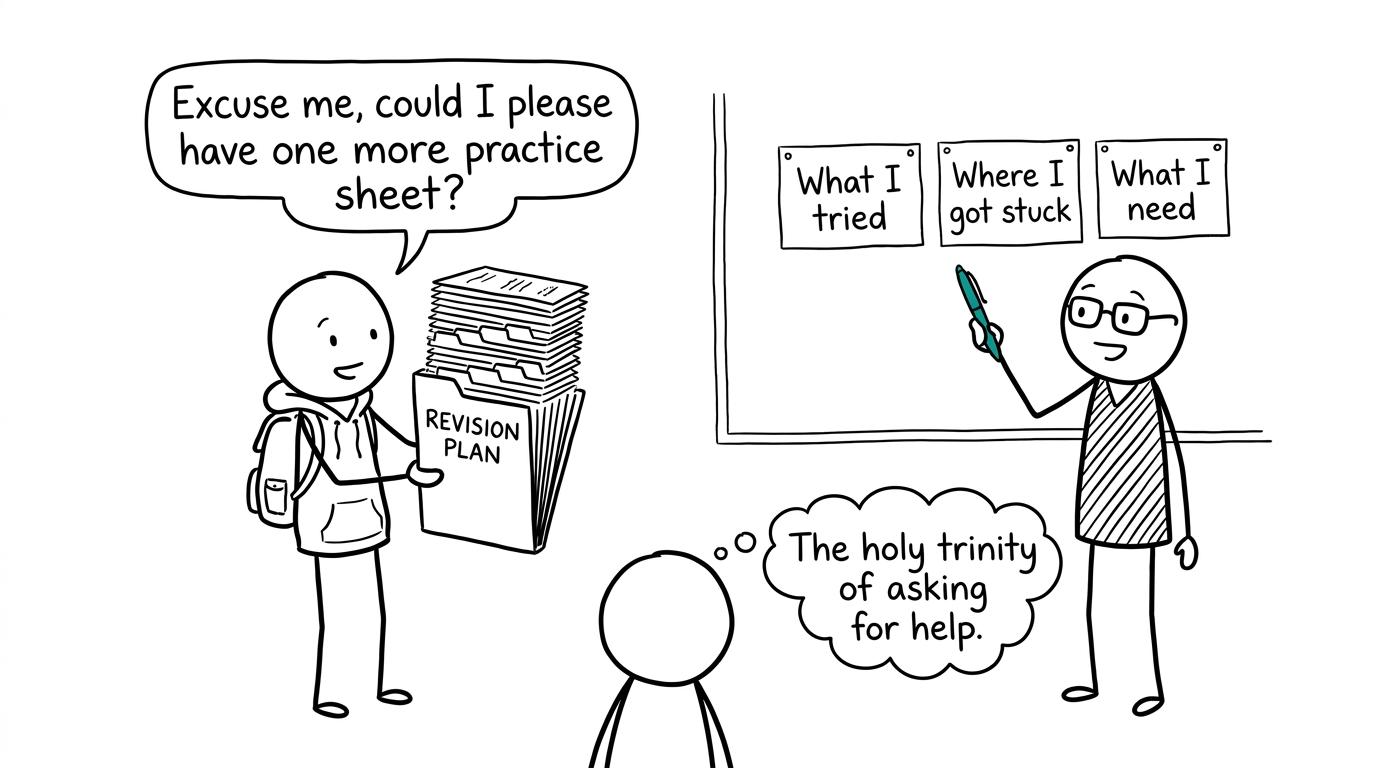 A student shows a teacher what they tried, where they got stuck and what they need
How to ask without sounding as though you are not trying
The most convincing evidence of effort is visible effort. Take your completed work, marked mock, vocabulary record or error log with you. You do not need to produce a perfect folder. You simply need to show that you have attempted something and thought about the result.
A useful request has three parts:
- What you tried: identify the worksheet, topic or paper section you completed.
- What you noticed: explain the precise difficulty or repeated error.
- What you want next: request a particular kind of practice.
You might say:
I completed the reading questions from our last lesson and checked my corrections. I am still struggling to infer opinions when the wording is unfamiliar. Could you recommend one or two similar foundation or higher-tier tasks for me to complete this week?
For speaking practice, you could adapt the request:
I have practised my answers aloud, but I hesitate when I receive an unexpected follow-up question. Could I have some additional prompts that match our specification and tier?
These are not excuses. They show diagnosis, action and a sensible next step. Asking for one or two resources also sounds more purposeful than requesting an unspecified pile.
Choose the right moment
Avoid beginning a long conversation while your teacher is setting up a lesson or dealing with another class. Ask briefly whether there is a suitable time to speak, or send a concise message through the communication system approved by your school.
Keep the request easy to answer. Include your board, tier, target skill and deadline. If your school has rules about sharing materials or teacher contact, follow them.
Ask for direction, not unlimited marking
Teachers may have limited time and may not be able to mark every additional task. You can still ask for material while taking responsibility for checking it.
Try asking whether there is a mark scheme, model response, checklist or self-assessment method you should use. For speaking, ask whether your teacher could listen to one short attempt or identify the single feature you should focus on next. A narrow feedback request is often more useful than “Can you check everything?”
Request material that matches the weakness
Extra work should answer a question about your performance. Use your recent classwork or mock to choose the category.
Listening
Ask for short audio tasks with questions, transcript-based correction activities or practice distinguishing key details, opinions and time references. Complete the task without pausing first, then use any permitted transcript or answers for review.
Speaking
Request role-play prompts, picture-based tasks or unpredictable follow-up questions that reflect your specification. Practise responding aloud rather than silently planning perfect sentences. Your teacher can also clarify the formal conditions that apply to preparation and assessment.
Reading
Ask for passages at the correct tier, translation practice or questions involving gist, detail and inference. Record why an answer was wrong: unknown vocabulary, grammar, rushed reading or misunderstanding the question.
Writing
Request a suitable prompt and the relevant marking criteria. Your goal is not merely to write more. It is to improve control of vocabulary, grammar, accuracy, relevance and communication. Ask whether you should redraft an existing response before starting a new one.
GCSE language specifications expect students to understand and produce language using a range of vocabulary and grammatical structures. Foundation and higher expectations are not identical, so confirm your entry tier rather than downloading random worksheets labelled only “GCSE Arabic”.
Turn extra material into an effective revision cycle
The quiet danger of revision is collecting. A new worksheet feels like progress because it is tangible. But an untouched worksheet is only paper.
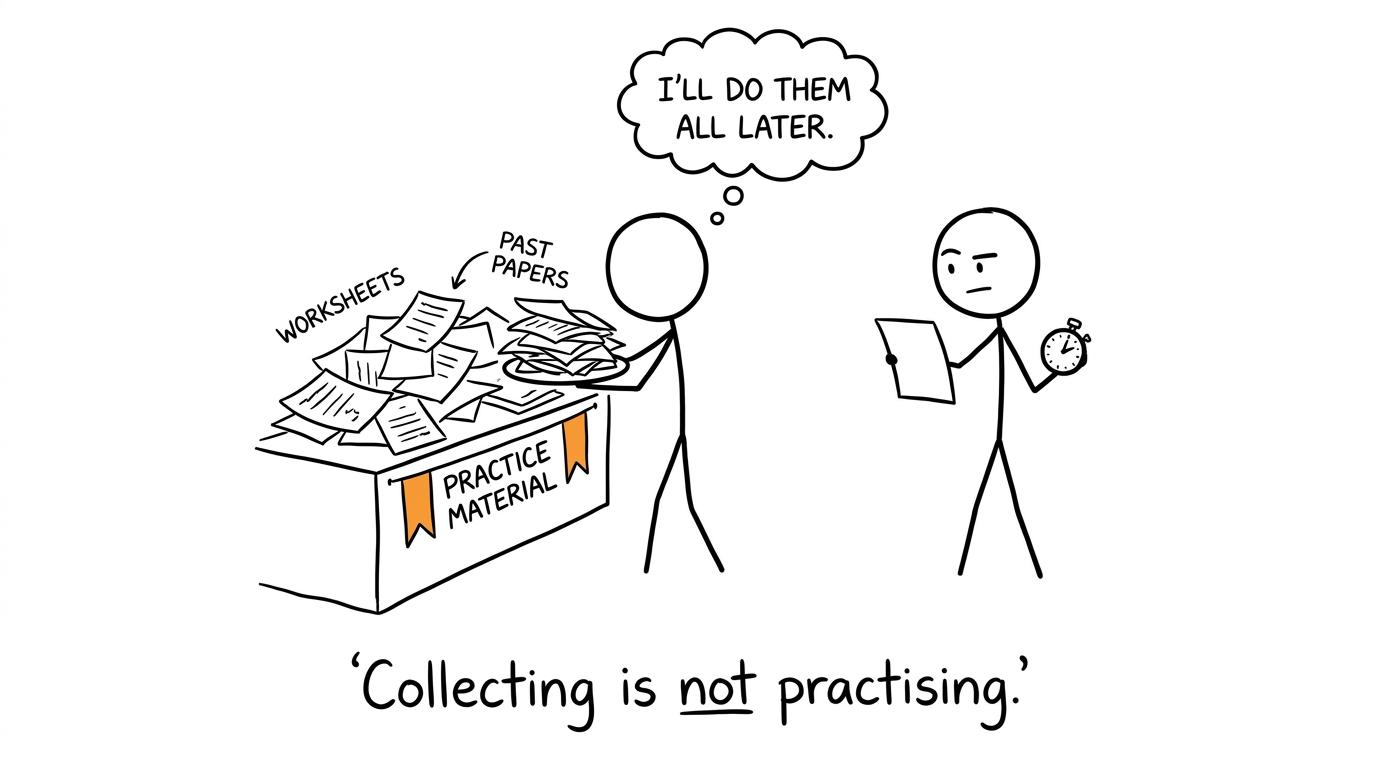 A student discovers that collecting worksheets is not the same as practising
Use each resource in a simple cycle:
- complete it without unnecessary support;
- check it using teacher feedback, answers or assessment criteria;
- record the exact reason for each important mistake;
- correct the work;
- revisit the same skill on another day.
This is also a powerful approach to maths. The MathsGenie guide to finding your weakest GCSE topics explains how evidence from questions can guide your next revision choice. The subject changes, but the principle does not: diagnose first, then practise the smallest skill that needs repair.
If time is tight, use a short, repeatable session rather than waiting for an empty afternoon. The twenty-minute GCSE maths revision routine offers a useful model: retrieve, practise, check and choose the next step. You can apply the same structure to a short Arabic listening task or vocabulary review.
Balance GCSE Arabic with maths revision
The target audience for this advice is often carrying two worries at once: improving Arabic while preparing for demanding maths papers. The answer is not to let whichever subject feels most urgent consume the entire evening.
Give each session a defined job. For example, an Arabic block might focus only on speaking prompts, while a maths block targets one topic identified from a marked paper. Keep separate error logs so that one vague list does not become overwhelming.
The GCSE maths revision hub lets you choose board-aligned resources for Edexcel, AQA, OCR and Eduqas. That is separate from your Arabic specification, which may use a different awarding organisation, so check both subjects independently.
For a sustainable weekly structure, adapt the principles in the GCSE maths revision timetable. Schedule shorter skill sessions, mark what you complete and return to weaknesses later. If you need a longer horizon, the one-month GCSE revision plan can help you organise diagnostic work, focused practice and timed papers.
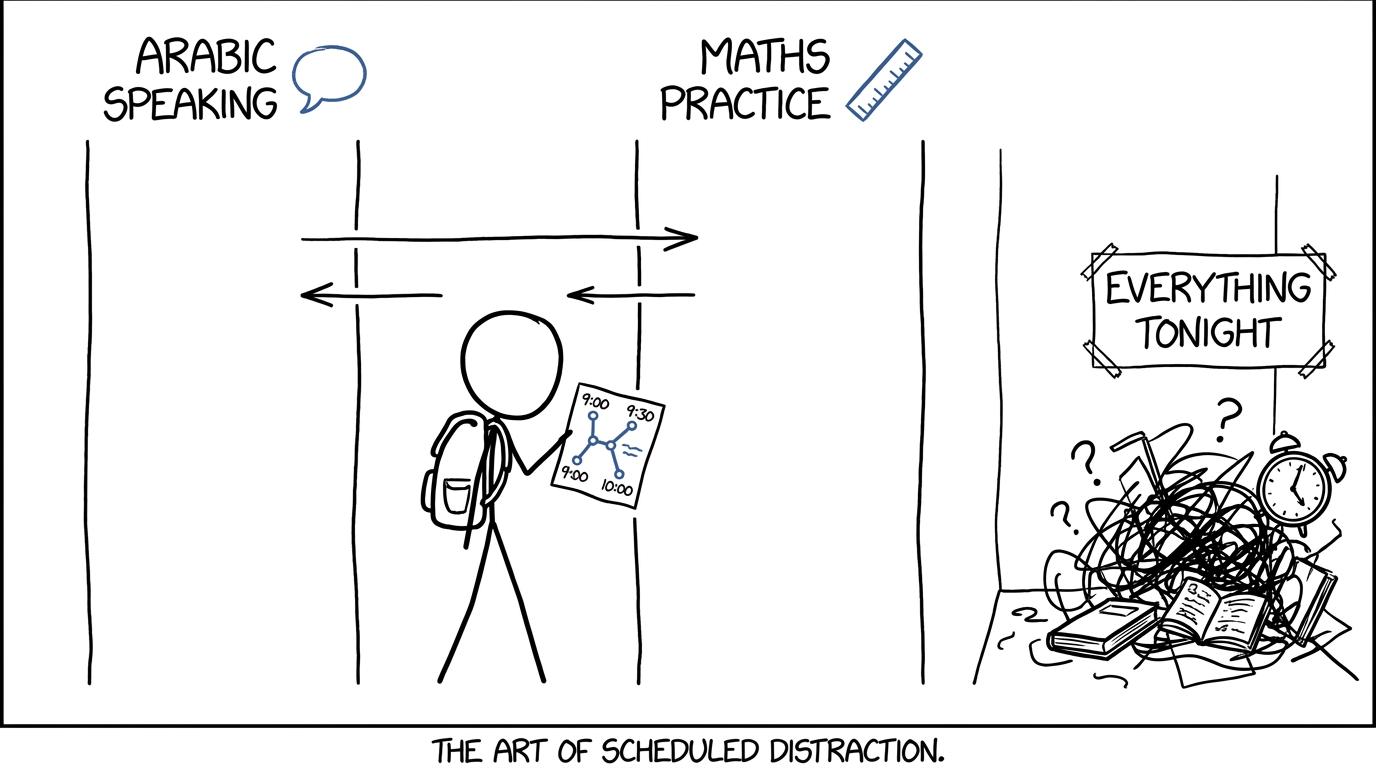 A student calmly switches between Arabic and maths revision instead of attempting everything at once
Common mistakes when asking for more material
Asking before attempting what you already have
Complete or seriously attempt the existing task first. If it was inaccessible, show where you stopped and explain why. Evidence of difficulty is more useful than an untouched page.
Requesting “anything”
A broad request creates extra work for your teacher and may produce unfocused material. Name the paper, skill, tier and difficulty you need.
Assuming more difficult means more valuable
Choose work aligned with your specification and current tier. Challenge is useful when it develops an assessed skill, not when it simply makes the page harder to understand.
Expecting every task to be individually marked
Ask how to self-assess and reserve teacher feedback for a specific uncertainty. Correction is part of your revision, not an administrative step that belongs entirely to somebody else.
Collecting resources without scheduling them
Agree with yourself when the material will be attempted. One completed task, properly corrected, is worth more than a crowded folder.
Neglecting other GCSE subjects
Extra Arabic practice should fit into your wider plan. For maths, short assessments such as Edexcel GCSE maths mini tests can reveal where focused practice is needed without occupying an entire evening. Closer to an exam, use a calm plan such as the GCSE maths night-before checklist rather than trying to complete every unused resource.
Ask clearly, then use the answer well
It is worth asking your teacher for extra GCSE Arabic practice material when your request is specific, evidence-based and realistic. Show what you attempted. Identify the skill that is holding you back. Ask for a small amount of suitable work and explain how you will use feedback.
The courage to ask is useful, but the habit that follows matters more: attempt, check, correct and return. Apply that same discipline to maths through MathsGenie. Start with the free revision lessons and practice questions, use mini tests to expose gaps, then build exam confidence with past papers, predicted papers, mark schemes and video solutions. Open the MathsGenie GCSE revision area, choose your board and tier, and make your next revision session specific enough to complete.