Exam Countdown GCSE Further Maths: Help or Pressure?
Exam countdown GCSE Further Maths advice: learn when a timer motivates, when it adds pressure, and how to build a calm, practical revision plan.
A countdown can begin as a sensible reminder and end up feeling like a threat. You open your phone, see the number of days shrinking, and suddenly every unfinished topic seems to get louder.
So, does an exam countdown GCSE Further Maths students can see each day actually help? It can but only when the number leads to a clear, manageable action. If it causes constant checking, rushed revision or lost sleep, it is adding pressure rather than improving preparation.
The countdown itself is neutral. What matters is the system attached to it. A useful countdown says, “Here is what I can do today.” An unhelpful one merely says, “Time is disappearing.”
A quick countdown checklist
Your GCSE Further Maths countdown is probably helping if it:
- reminds you to begin a specific revision task;
- helps you distribute topics across the remaining time;
- includes rest, schoolwork and other GCSE exams;
- moves you towards timed practice papers;
- can be hidden when you are not planning revision.
It may be adding pressure if you:
- check it repeatedly without starting any work;
- translate days remaining into a prediction about your result;
- try to compensate with very long revision sessions;
- lose sleep because the number feels too small;
- compare your countdown or progress with someone else’s.
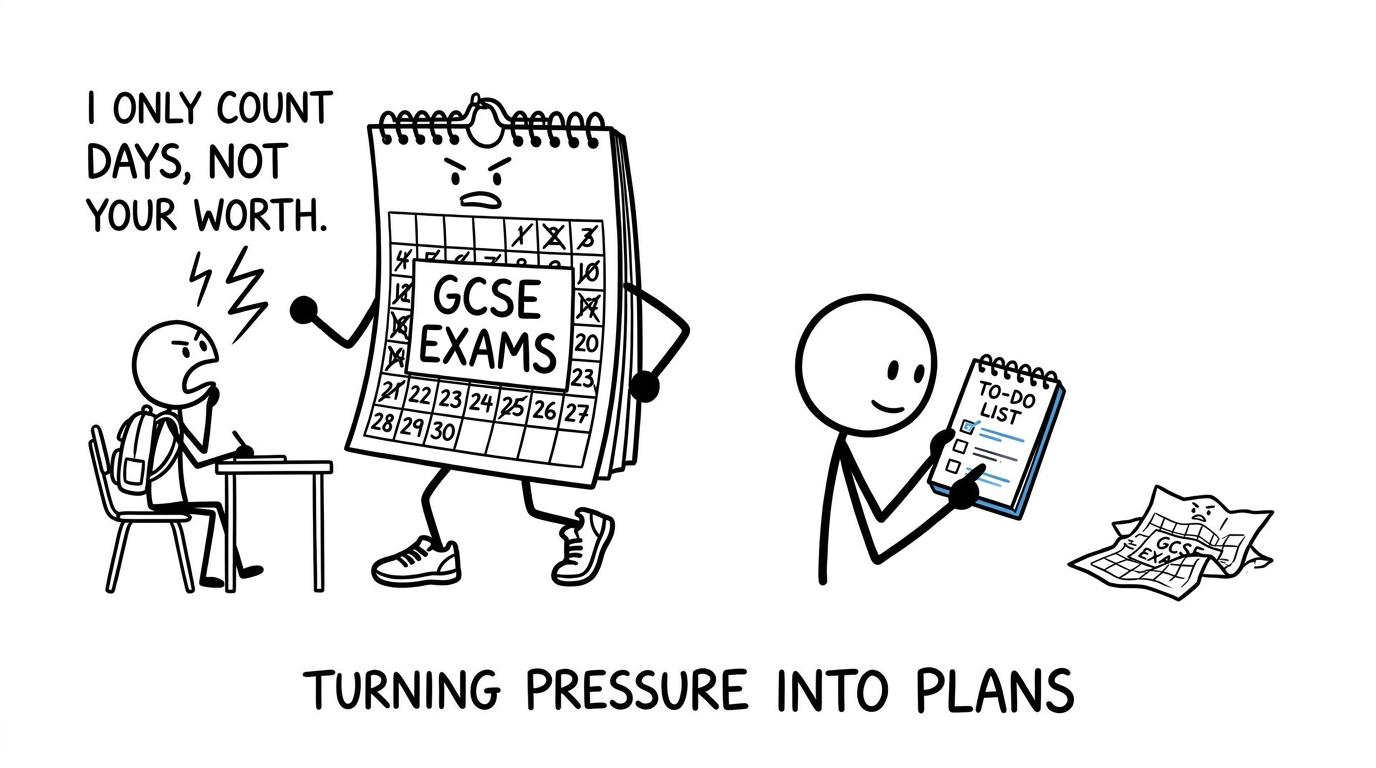 A student turns an intimidating exam countdown into a small revision list
Why an exam countdown can improve revision
A distant exam is easy to treat as an abstract problem. There is always another weekend ahead, so difficult topics can quietly be postponed. A countdown makes the deadline concrete.
That can be valuable for Further Maths because the subject rewards secure understanding, not hurried recognition. You need time to learn methods, practise them independently, review errors and return to them later. The AQA GCSE Further Maths revision hub brings together lessons, exam questions and course-specific resources so that the remaining time can be attached to real tasks.
A countdown can help in three particular ways.
It turns intention into scheduling
“I should revise Further Maths” is an intention. “After school on Wednesday, I will practise matrices and mark the questions” is a plan.
Government and NHS guidance on exam pressure consistently recommends realistic schedules, manageable chunks, regular breaks and testing your learning. A countdown supports that advice when it helps you decide when each task will happen.
If planning feels difficult, adapt the structure in the GCSE maths revision timetable. Further Maths should sit alongside your other subjects, not consume every available evening simply because its exam is approaching.
It encourages useful prioritisation
You do not need to give every topic equal time. Some are already secure. Others cause repeated mistakes or leave you unable to begin a question.
Use a short diagnostic set or part of a paper, mark it, and create three lists:
- Secure: topics you can complete accurately without support.
- Uncertain: topics where your method is mostly correct but unreliable.
- Not ready: topics where you cannot yet choose a method independently.
Spend most of your focused revision on the final two lists. This is more useful than starting at the first page of a revision guide and moving through it in order.
It gives revision a finish line
Revision can otherwise feel endless. A well-designed countdown shows when you will move from learning topics to mixed questions, then from mixed questions to timed papers and final review.
For a longer runway, the one-month GCSE maths revision plan offers a useful rhythm of diagnosis, topic work, retrieval and paper practice. The individual topics need adapting for Further Maths, but the structure remains sound.
When the countdown starts adding pressure
The problem is not noticing that time is limited. The problem is treating time as evidence about your ability.
A student might see a short countdown and think, “There is not enough time, so there is no point beginning.” Another might respond by attempting hours of unfocused work. Both reactions make the number more important than the next action.
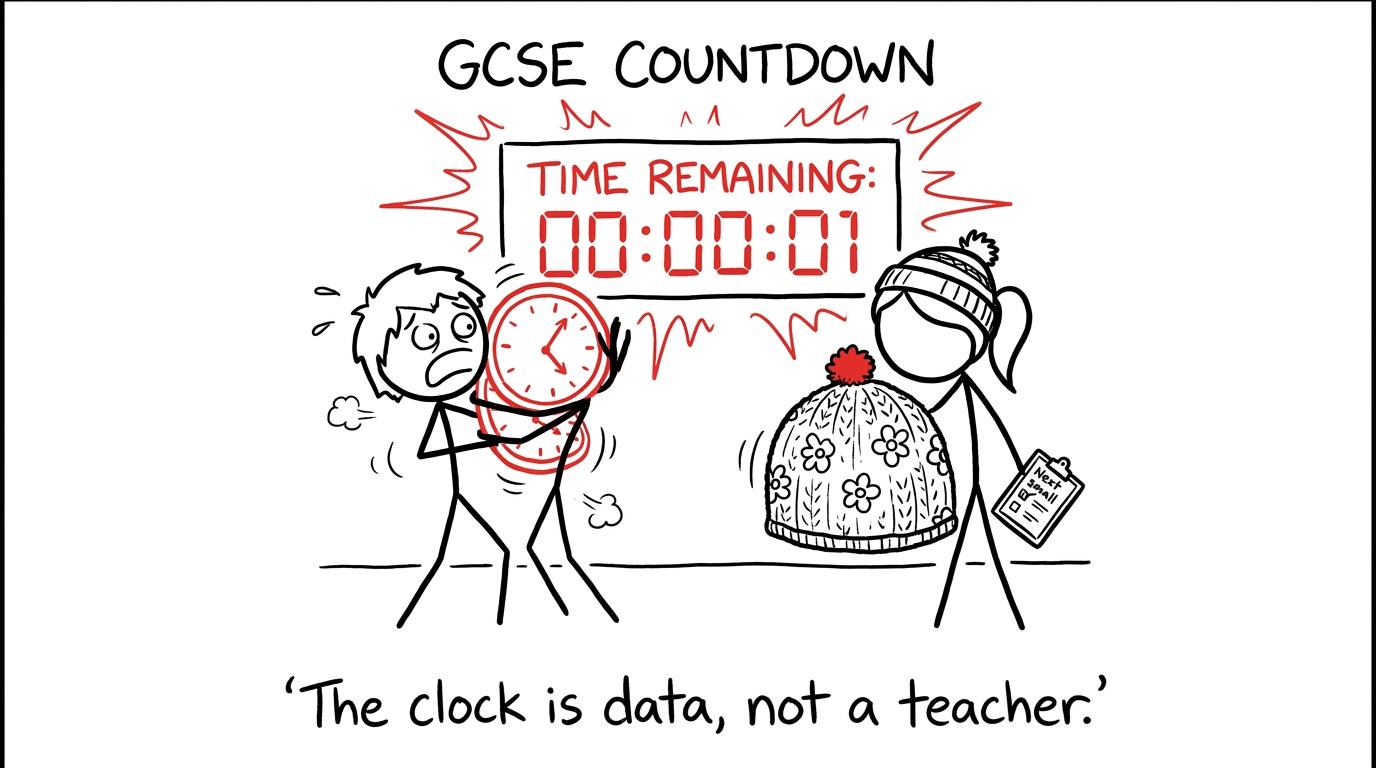 Students discover that a countdown clock is data rather than a teacher
The countdown becomes a judgement
Days remaining do not measure knowledge, likely marks or personal worth. They measure time. Nothing more.
A student with fewer available days but a precise list of weaknesses may revise more effectively than someone who began earlier without checking their understanding. Progress should be measured through completed questions, corrected errors and improving independence rather than not through how long the countdown has been running.
Other exams disappear from the plan
“GCSE Further Maths” is often used informally for qualifications such as AQA’s Level Two Certificate in Further Mathematics. Your exact course, assessment format and dates depend on your school and awarding body, so check your official school timetable and specification rather than relying on a generic online countdown.
Your calendar must also account for English, science, standard GCSE Maths and every other subject you sit. A Further Maths timer that ignores the rest of the exam season creates an unrealistic picture of your available energy.
Rest begins to feel like wasted time
A countdown can make an evening away from revision seem irresponsible. It is not. Breaks, sleep, food, movement and time with other people support concentration and help keep exam pressure in proportion.
If anxiety is interfering with sleep, school, eating or everyday life, tell a parent, carer, teacher or another trusted adult. Revision advice is not a substitute for appropriate support. NHS guidance recommends asking for help when stress becomes difficult to manage or begins affecting daily life.
How to use a countdown without letting it control you
The best countdown is deliberately boring. It appears during planning, gives you useful information, and then gets out of the way.
Count revision opportunities, not just calendar days
A raw total of days is misleading. Some contain other exams, lessons, family commitments or necessary rest. Instead, look at the sessions you can realistically use.
Label each available session with one purpose:
- learn or review one method;
- complete focused practice questions;
- revisit an earlier topic;
- attempt a timed section;
- mark work and correct errors;
- rest or catch up.
Leave spare capacity. A plan with no room for disruption is not ambitious; it is fragile.
Set a small daily minimum
Your minimum should be achievable on a difficult school day. A short session completed consistently is more valuable than a heroic plan repeatedly postponed.
The twenty-minute GCSE maths revision routine shows how to combine retrieval, exam-style questions and immediate marking in a compact block. For Further Maths, choose one narrowly defined skill rather than a broad label such as “algebra”.
When you have more energy, extend the practice. When you do not, completing the minimum preserves momentum.
Convert the countdown into phases
Rather than displaying one dramatic number, divide the remaining period into purposeful phases.
Build: learn uncertain content through revision lessons and focused questions.
Test: complete mixed questions without notes and identify where methods break down.
Simulate: use AQA GCSE Further Maths past papers under suitable timed conditions, then check the mark scheme.
Repair: return to the topics responsible for lost marks and attempt fresh questions.
Taper: reduce intensity near the exam, review concise reminders, prepare equipment and protect sleep.
If little time remains, the one-week GCSE maths revision plan can help you prioritise. Do not try to squeeze a month’s workload into a week. Reduce the scope while keeping the cycle of practise, mark and repair.
Check the countdown once a day
Put the timer inside your planner rather than on every phone screen. Check it when choosing the day’s task, then close it.
You can also replace “days to go” with “next useful action”. Instead of seeing a shrinking number whenever you unlock your phone, display a calm instruction such as “mark yesterday’s paper” or “review one weak topic”.
Make feedback more important than time
The most useful question is not “How long is left?” It is “What did my last attempt reveal?”
After completing practice questions or a paper:
- mark it promptly using the mark scheme;
- separate knowledge gaps from slips and misread questions;
- record the exact topic or error pattern;
- review the relevant lesson;
- attempt a fresh question without copying the solution.
Past papers are therefore not simply performances. They are diagnostic tools. A disappointing mark can be valuable if it produces a specific repair plan.
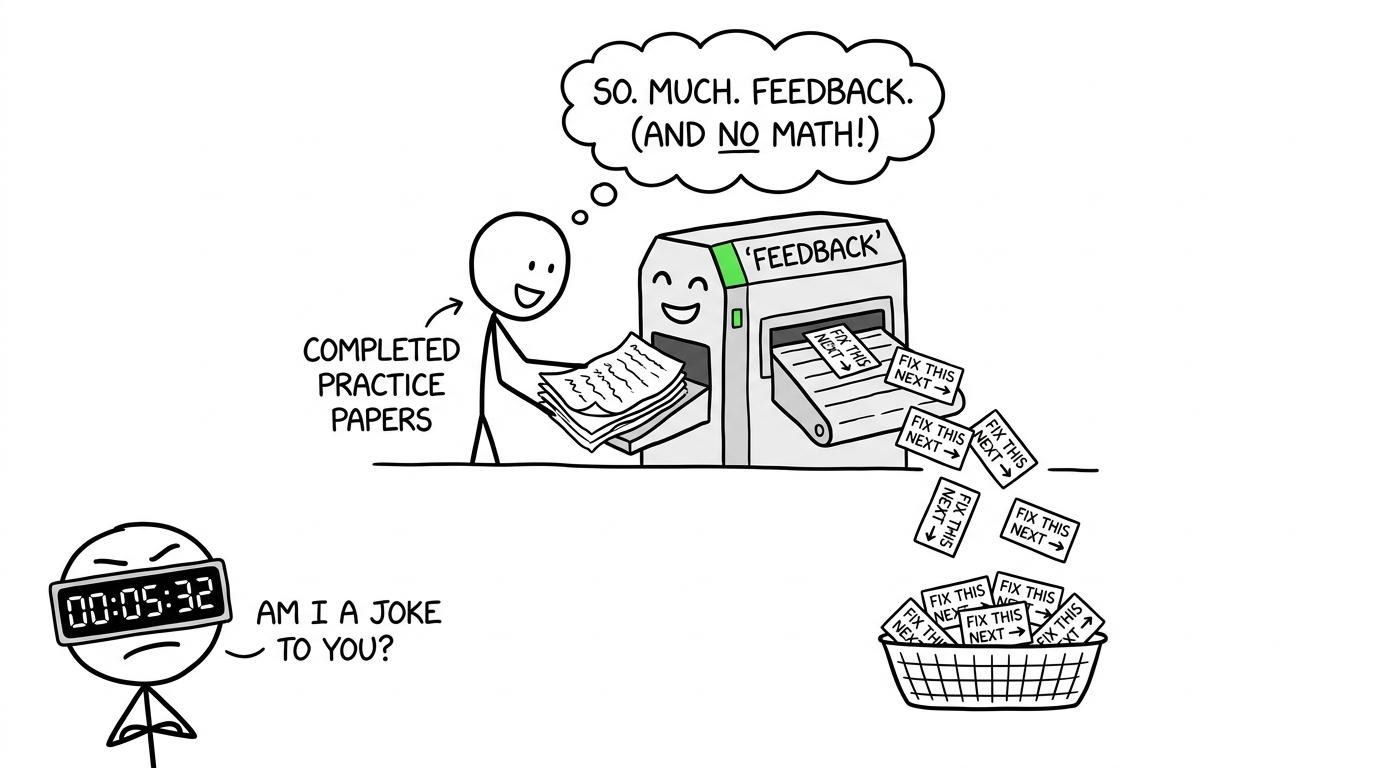 A feedback machine produces useful revision tasks while the countdown looks jealous
Shorter tests can be useful when a full paper would be too demanding. MathsGenie’s GCSE maths mini tests are designed for focused timed practice. They are not a replacement for your exact Further Maths specification, but they can strengthen overlapping GCSE skills and make shorter revision sessions easier to start.
Common countdown mistakes
Copying somebody else’s timetable
Another student may have different subjects, commitments, strengths and support. Use their timetable as inspiration, not evidence of what you “should” be doing.
Revising only comfortable topics
Crossing off familiar work feels productive, but it may not change your exam readiness. Let marked questions determine what returns to the plan.
Scheduling every available minute
Unexpected homework, tiredness and difficult topics will disrupt a perfect calendar. Include catch-up space and genuine rest from the beginning.
Completing papers without reviewing them
Finishing a paper is only half the process. The learning happens when you study the mark scheme, understand missed methods and try again.
Turning the final evening into an emergency
The night before is for calm consolidation and practical preparation, not learning the entire course. Use the GCSE maths night-before plan to keep the final session bounded and sensible.
The countdown should end with the next action
A GCSE Further Maths exam countdown helps when it makes revision specific, realistic and easier to begin. It adds pressure when it becomes a judgement, encourages cramming or follows you throughout the day.
Keep the number in perspective. Verify your actual exam details through your school, map the remaining sessions, and let completed questions guide what comes next. Then use MathsGenie as the practical engine of the plan: start with free revision lessons, move into practice questions, check mark schemes and video solutions, and build towards past papers. Mini tests and predicted papers can support wider GCSE Maths preparation where they match your course.
Open the MathsGenie GCSE Further Maths revision page, choose one weak topic and begin one manageable task today. The clock can count the days. Your job is simply to use the next session well.