Exam Anxiety GCSE Modern Hebrew: A Practical Plan
Exam anxiety GCSE Modern Hebrew advice for speaking, listening, reading and writing, with a calm revision plan that protects your GCSE maths time.
The hardest part of an exam is sometimes not the question. It is the moment before it, when your heart speeds up, familiar words disappear and one difficult task seems to predict your entire result.
If you are dealing with exam anxiety GCSE Modern Hebrew can feel particularly exposed. Speaking requires an immediate response. Listening moves forward without waiting. Reading tests close attention, while writing asks you to retrieve vocabulary, grammar and Hebrew script under time pressure.
The practical answer is not to eliminate every nerve. It is to make each part of the assessment familiar enough that anxiety no longer controls your next action. That means rehearsing the actual Modern Hebrew tasks, using short timed sessions and preparing a recovery routine for moments when your mind goes blank. If you are also preparing for maths exams, your plan must protect time for both subjects rather than allowing the most worrying one to consume every evening.
Your calm Modern Hebrew checklist
Before building a detailed plan, check that you can do the following:
- Name the four assessed skills: listening, speaking, reading and writing.
- Confirm your exam board, tier and current assessment arrangements with your teacher.
- Break each skill into small, repeatable exam tasks.
- Practise retrieving language rather than only rereading notes.
- Rehearse under gradually increasing time pressure.
- Keep an error log organised by mistake type.
- Prepare a breathing and restart routine for the exam itself.
- Leave protected sessions for your other GCSEs, particularly maths.
- Tell a trusted adult if anxiety is persistent, overwhelming or affecting daily life.
For the current AQA GCSE Modern Hebrew specification, the qualification is linear and each of listening, speaking, reading and writing contributes 25%25\%25%. Foundation tier covers grades 111 to 555, while Higher tier covers grades 444 to 999, and students take all four assessments at the same tier. Always use the specification and materials for your own exam series, because schools and awarding organisations can update administrative details.
Turn one large fear into four trainable skills
“Modern Hebrew” is too large to revise in a single session. Anxiety thrives on vague instructions such as “learn all the vocabulary”. A useful plan replaces that impossible command with a visible action.
For example, one session might focus on identifying opinions in a short listening passage. Another might involve describing unfamiliar photographs aloud. A third could test recognition of past, present and future time frames in a reading text. These are small enough to begin and specific enough to assess.
This principle also works in maths. The MathsGenie GCSE maths revision hub divides a large qualification into lessons, practice questions and exam resources. Use the same thinking for Hebrew: define the skill, practise it, check it and revisit it.
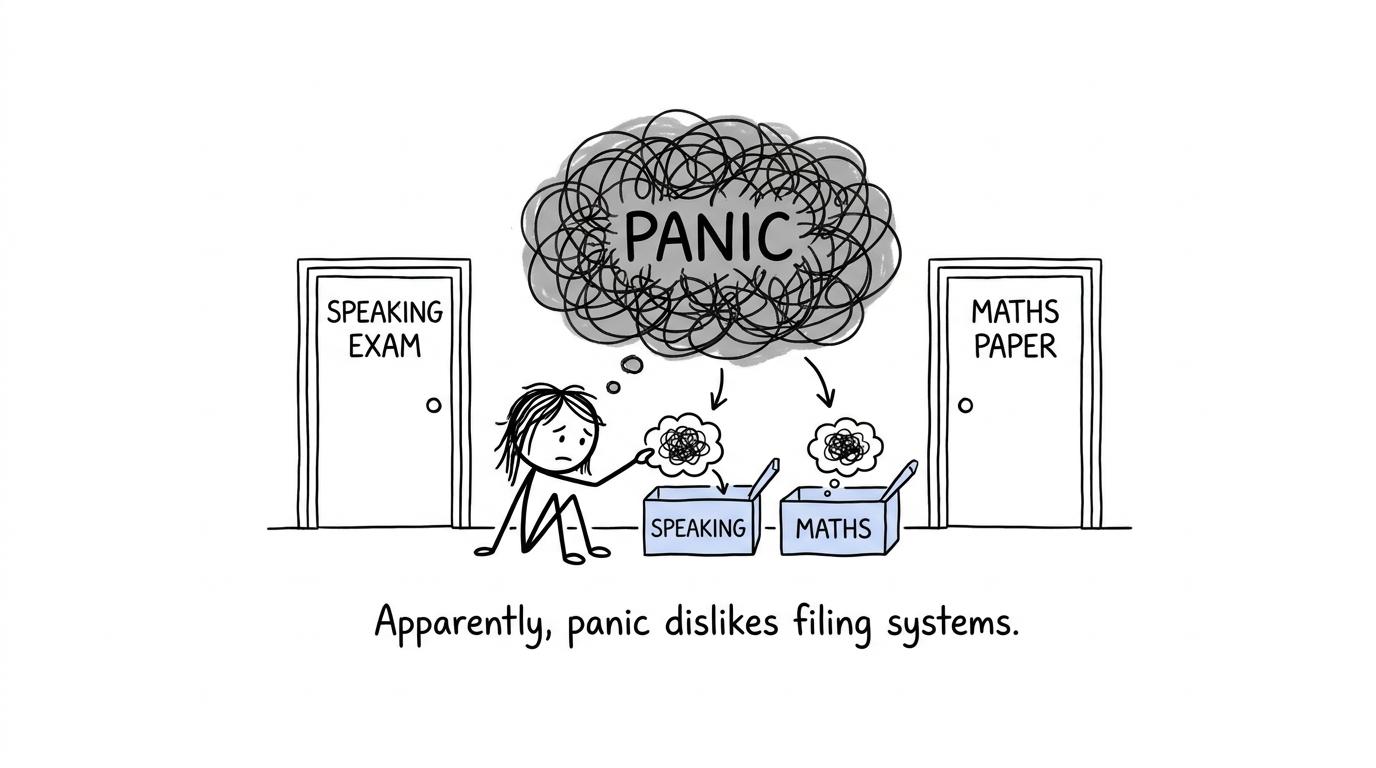 A student calmly sorts speaking and maths worries into separate boxes
Reduce anxiety in the speaking assessment
Speaking anxiety often comes from the belief that every answer must be fluent and flawless. That is not the task. AQA assesses communication and interaction, including the ability to express information, opinions and different time frames. Preparation should therefore build flexible language rather than one delicate script.
Create answer frameworks, not memorised speeches
Prepare reusable building blocks for:
- stating and justifying an opinion;
- describing what happened previously;
- explaining present routines;
- discussing future intentions;
- comparing two ideas;
- asking a question;
- repairing an answer when a word is missing.
A fully memorised paragraph can feel reassuring until the examiner asks something slightly different. Then the script becomes a trap. Frameworks are safer because they let you adapt familiar structures to an unfamiliar prompt.
Practise answering in different orders and ask a teacher, classmate or family member to use unpredictable follow-up questions. Begin without a timer. Once the task feels manageable, add the timing and preparation conditions specified by your exam board.
Practise recovery as deliberately as fluency
A pause is not the end of an answer. Rehearse what you will do if a word disappears: breathe out, use a simpler sentence, describe the idea another way or move to a related detail. AQA’s communication guidance recognises rephrasing and repair strategies as part of sustaining communication.
Record short answers and review one feature at a time. First ask whether the meaning is clear. Later check tense, agreement, pronunciation and range. Trying to correct everything simultaneously can turn useful feedback into another source of panic.
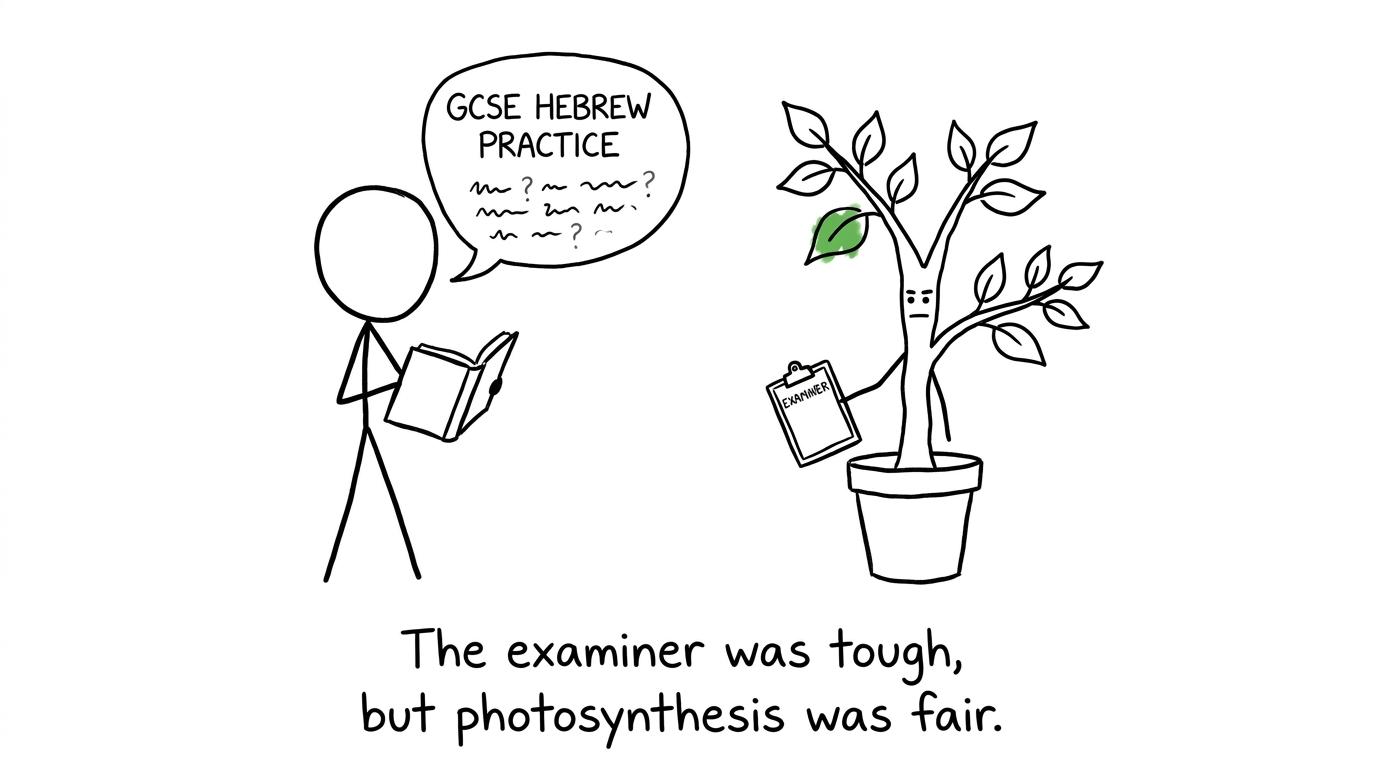 A GCSE student practises speaking with a remarkably strict houseplant
Make listening feel less uncontrollable
Listening can provoke a particular kind of anxiety because the recording continues even after one unfamiliar word. The solution is to stop treating total comprehension as the goal.
Before the audio begins, inspect the question carefully. Predict the kind of information required: a person, place, opinion, reason, time frame or detail. During the recording, listen for that category rather than attempting to translate every sentence in your head.
Train with short clips using three passes during revision:
- identify the overall subject;
- locate the detail required by the question;
- review the transcript or answer and diagnose what blocked understanding.
The final step matters. “I am bad at listening” is not a diagnosis. “I confused a negative with a positive statement” or “I did not recognise the future form” gives you something concrete to practise.
Use audio featuring different speakers and natural pacing. If you miss an item in the exam, mark it mentally, return your attention to the current question and avoid replaying the mistake in your head. One missed detail must not be allowed to take the next answer with it.
Build confidence in reading Hebrew under pressure
Hebrew script can make anxious reading feel slower, especially when similar-looking letters, unfamiliar vocabulary or unpointed text interrupt recognition. Practise reading for meaning rather than transliterating every word.
Use a consistent sequence:
- read the question first;
- scan the passage for names, time markers, connectives and repeated vocabulary;
- identify whether the writer is reporting a fact or expressing an opinion;
- infer unfamiliar language from the surrounding sentence;
- answer only what the question requests.
For translation from Modern Hebrew into English, prioritise accurate meaning. A polished English sentence that changes the original message is not an improvement. Build a correction log with categories such as tense, negation, pronoun reference, vocabulary and omitted detail.
The same diagnostic habit strengthens maths revision. The guide to finding your weakest GCSE topics explains how to turn an unsatisfactory score into a short list of fixable causes. Evidence is calmer than guesswork.
Control the writing paper before it controls you
Writing anxiety often begins with a blank page. Remove that moment from your rehearsal.
When practising, start by identifying every required bullet point. Briefly assign suitable content, time frames, opinions and reasons before drafting. Your plan should be a route map, not a second essay.
Train separate layers of accuracy:
- clear communication of each required idea;
- suitable vocabulary for the topic;
- control of past, present and future references;
- gender and number agreement;
- verb forms and word order;
- accurate spelling in Hebrew script;
- a final check against the task instructions.
Do not spend all your time creating one perfect response with unlimited help. Complete shorter pieces from memory, then use feedback to select one recurring weakness for the next session. That cycle produces familiarity without making every practice attempt feel like a full examination.
Use gradual exposure instead of sudden pressure
Doing a full paper immediately can reinforce fear if you are not ready for it. Build pressure in stages:
- complete one task with notes and no timer;
- repeat a similar task without notes;
- introduce a generous time limit;
- use the official time limit;
- combine tasks under realistic conditions;
- review errors before repeating the simulation.
This is the language equivalent of moving from a topic exercise to a mini test and then a complete paper. Maths students can use Edexcel GCSE maths mini tests for shorter rehearsal before attempting Edexcel GCSE maths past papers. Whichever board you take, the principle is the same: build skill first, then test it under pressure.
The MathsGenie guide to using past papers properly offers a useful cycle: attempt, mark, diagnose, relearn and retest. Apply that cycle to official Modern Hebrew materials supplied by your exam board and school.
Balance Modern Hebrew with GCSE maths revision
Anxiety can distort a timetable. You may avoid Hebrew because it feels uncomfortable, or revise it for hours because stopping feels irresponsible. Neither response is efficient.
Give each session a finish line. A Hebrew block could contain one listening task, one speaking recording and a short error review. Your maths block might use a revision lesson followed by practice questions and marking. The GCSE maths revision timetable guide shows how focused weekday sessions and longer weekend practice can work together.
Plan the week by evidence rather than mood. Allocate more time to weaknesses, but keep regular contact with every assessment skill. Near the exams, use realistic rehearsal without sacrificing sleep or filling the final evening with panic. The GCSE maths night-before plan provides a similarly restrained approach for your maths papers.
What to do when anxiety rises in the exam
The NHS advises slow, comfortable breathing as a practical response to stress. This works best when practised regularly rather than attempted for the first time in the exam hall.
Use a simple restart routine:
- place both feet on the floor;
- relax your jaw and shoulders;
- breathe in gently through your nose;
- breathe out slowly without forcing it;
- identify the smallest next action.
That action might be underlining the key instruction, locating a familiar word, planning one sentence or moving temporarily to another question. The purpose is not to feel perfectly calm. It is to restart useful behaviour.
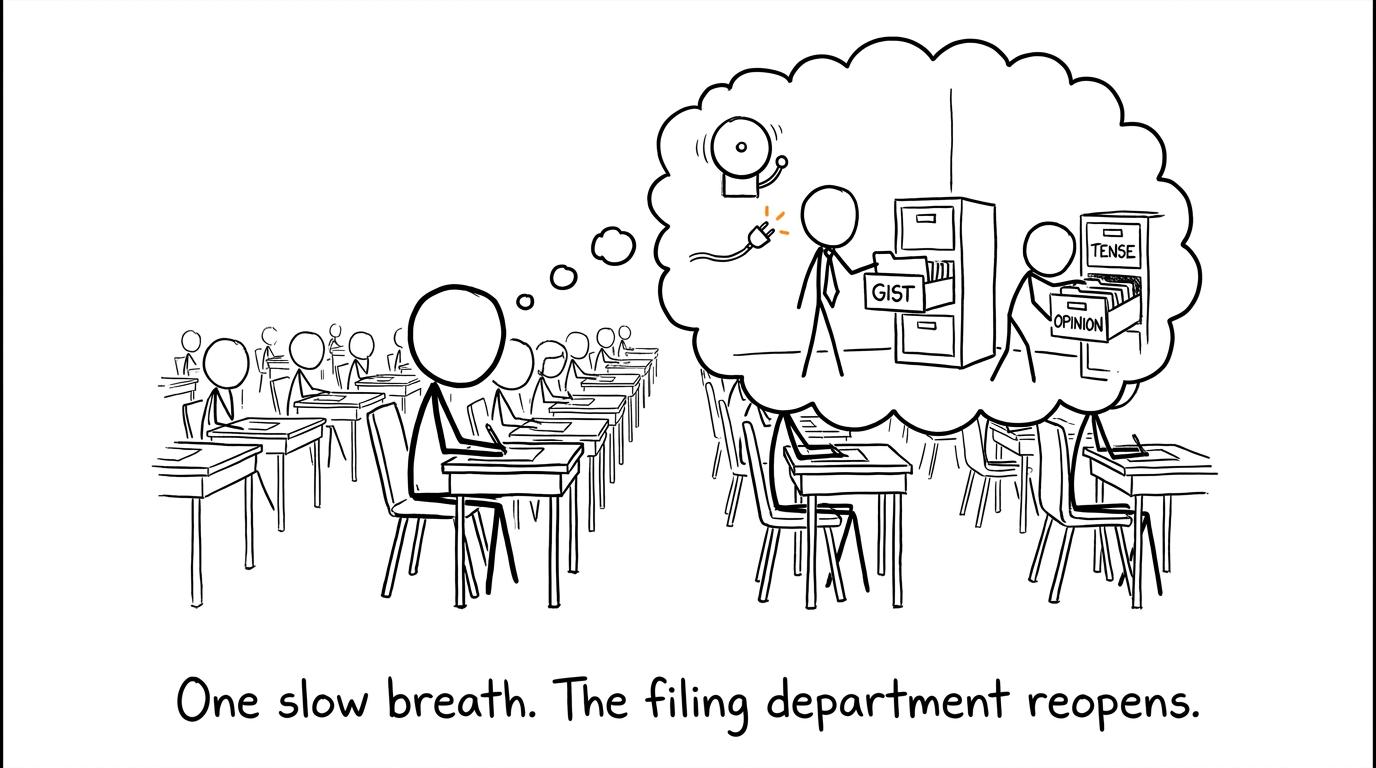 A calm mental filing department reopens after one slow breath
If anxiety regularly causes panic, sleep problems, physical illness, persistent distress or avoidance of school and revision, speak to a parent, carer, teacher, pastoral lead or GP. Asking for support is an appropriate response, not evidence that you have failed to prepare.
Common mistakes when managing Modern Hebrew exam anxiety
Revising vocabulary without retrieving it
Rereading a list can feel productive while giving little evidence that you can recall language in speech or writing. Close the notes and test yourself in both directions and within complete sentences.
Memorising one perfect speaking answer
A rigid script may collapse when the wording or follow-up question changes. Practise flexible structures, spontaneous responses and repair strategies instead.
Treating every unknown word as a crisis
Reading and listening tasks assess overall messages as well as specific details. Use context and continue. Do not let one gap erase information you can understand.
Completing papers without analysing errors
A score cannot tell you what to do next. Separate vocabulary gaps, grammar errors, misunderstood instructions, timing problems and anxiety-driven slips.
Letting Hebrew anxiety replace maths revision
Your GCSE timetable must reflect all your exams. Use the MathsGenie past-paper library and short topic sessions to keep maths moving even during intensive language preparation.
Make the next session small enough to start
Confidence rarely arrives before practice. More often, it appears afterwards, when a familiar task proves that you know what to do next.
Choose one Modern Hebrew skill today and complete one short, measurable task. Review the result without judging yourself, record one correction and decide when you will return to it. Then protect the rest of your GCSE plan.
For maths, make MathsGenie GCSE revision your free home base. Use revision lessons and practice questions to rebuild weak topics, mini tests to check recall, and past papers, predicted papers, mark schemes and video solutions to make exam conditions increasingly familiar. Anxiety becomes more manageable when the next step is clear; and MathsGenie is designed to help you find it.