Exam Anxiety GCSE English Literature: A Calm Plan
Exam anxiety GCSE English Literature advice with practical revision, quote recall, timed writing and in-exam steps to help you feel more in control.
There is a particular kind of panic that English Literature can create. You open a novel you have read several times, recognise every character, and suddenly feel as though you remember nothing useful. The quotations blur. The themes seem enormous. Every practice question appears to demand a brilliant idea immediately.
If exam anxiety GCSE English Literature is making revision or timed writing harder, the answer is not to memorise the entire course. It is to reduce uncertainty: know what your papers require, prepare adaptable evidence, practise starting answers and build a routine for moments when anxiety interrupts your thinking.
The goal is not to feel perfectly calm. It is to know what to do next, even when you are nervous.
Your calm English Literature checklist
Focus on these practical steps:
- Confirm your exam board, set texts, paper structure and assessment objectives.
- Reduce each text to a manageable map of characters, themes and turning points.
- Learn a small bank of flexible quotations rather than hundreds of isolated lines.
- Practise retrieving ideas without the book open.
- Rehearse planning and opening answers under gentle time limits.
- Use mark schemes to make expectations less mysterious.
- Prepare a short routine for blank-mind moments in the exam.
- Tell a trusted adult if anxiety is persistent, intense or affecting daily life.
This is the same principle that makes efficient GCSE maths revision effective: replace a vague fear with a specific next action.
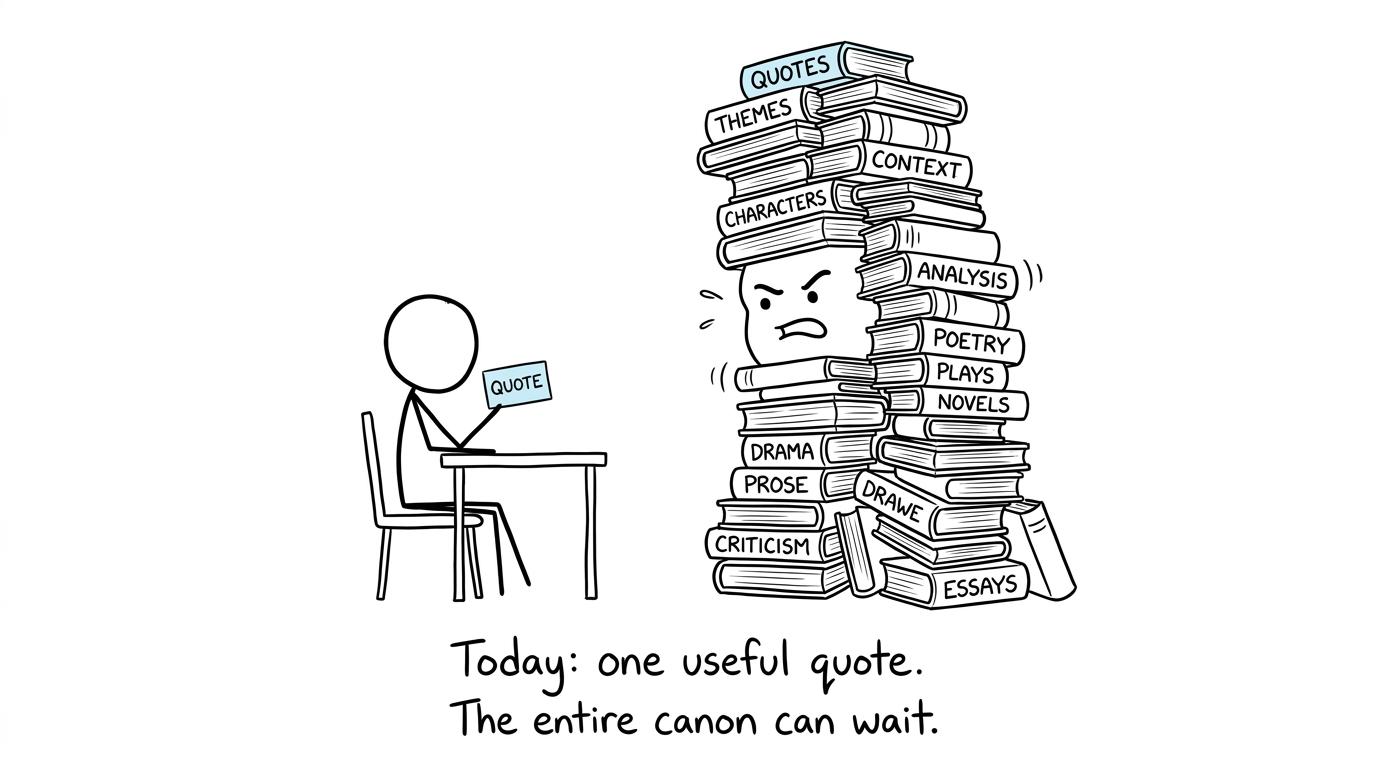 A student calmly choosing one useful quotation instead of confronting the entire literary canon
Why English Literature anxiety feels different
English Literature can feel less predictable than a subject built around short, definite answers. You may worry that your interpretation is not clever enough, that the exact quotation will disappear, or that an unexpected character or theme will appear.
The closed-book element can intensify this. For example, AQA states that its GCSE English Literature assessments are closed book, although stimulus material is provided where required. Its Shakespeare and nineteenth-century novel questions include extracts, while other sections may ask students to draw more heavily on recall. Requirements differ between Edexcel, OCR and Eduqas, so use your own specification and teacher's guidance rather than assumptions from another board.
Three uncertainties often combine:
- Memory uncertainty: “What if I forget every quotation?”
- Interpretation uncertainty: “What if my idea is wrong?”
- Time uncertainty: “What if I cannot finish?”
Treat these as separate skills. Memory improves through retrieval. Interpretation becomes safer when it is supported by evidence. Timing improves through repeated, staged practice. One frightening problem becomes three trainable ones.
Make the specification smaller
Anxiety likes undefined tasks. “Revise Macbeth” has no visible finishing point. “Recall three ideas about ambition and connect each to a moment in the play” does.
Create a one-page map for each set text containing:
- central characters and relationships;
- four or five major themes;
- important changes or turning points;
- relevant contextual ideas that genuinely illuminate the text;
- a compact quotation bank;
- common question types and command words.
Do not begin by decorating the page. Begin by testing whether you can reconstruct it from memory. The useful question is not “Have I read my notes?” but “What can I produce without seeing them?”
A similar evidence-first approach appears in MathsGenie's guide to finding your weakest GCSE topics. In Literature, your weak area might be recalling poetry comparisons, connecting context to an argument or analysing a writer's method. Name the weakness precisely and it becomes revisable.
Build a quotation bank that bends without breaking
Trying to memorise every impressive quotation often increases anxiety. A smaller set of flexible, accurately remembered quotations is usually more useful.
Choose evidence that can support several lines of argument. Organise it by character, theme and development across the text. For each quotation, know:
- who says it or where it appears;
- what is happening at that point;
- one or two significant words or methods;
- the themes it could support;
- how it connects to the text as a whole.
Short quotations can be powerful because they are easier to recall and integrate into sentences. The purpose of evidence is not to prove that you can recite the book. It is to support an interpretation.
Use active recall: cover the quotation, retrieve it, check it, then revisit it later. If precise wording repeatedly escapes you, learn a shorter fragment rather than repeatedly rehearsing an unreliable full sentence.
For poetry, revise connections as well as individual poems. Build clusters around ideas such as power, conflict, identity, memory or nature, depending on your anthology. This reduces the fear that only one comparison will work.
Practise the start, not only the whole essay
Students often postpone timed practice because a complete essay feels exhausting. That avoidance preserves the anxiety: the opening minutes remain unfamiliar.
Instead, practise the first part of the process:
- read the question and underline its focus;
- translate it into a direct task;
- generate a provisional argument;
- select two or three relevant moments;
- plan the order of ideas;
- write one clear opening paragraph.
A short planning drill lowers the barrier to starting. Later, extend selected plans into full responses. This resembles MathsGenie's short GCSE revision routine: a focused session completed regularly is more useful than an ambitious session repeatedly avoided.
When you do write a complete response, use the timing recommended by your teacher for your board and paper. Do not copy a timing plan from a different specification. AQA, Edexcel, OCR and Eduqas papers differ in structure, marks and duration.
Use mark schemes to reduce ambiguity
A mark scheme should not become a list of phrases to force into every paragraph. Use it to understand what the assessment rewards.
Check your board's assessment objectives. These commonly cover constructing an informed personal response, analysing language, form and structure, using relevant context, and, where required, comparison. The exact weighting and application vary by specification and question.
After practice, ask:
- Did I answer the precise question?
- Did my evidence support my argument?
- Did I analyse the writer's choices rather than retell events?
- Did context clarify the text rather than interrupt the paragraph?
- Did I compare throughout where comparison was required?
That reflective loop is also central to using GCSE past papers properly. Attempt, check, identify the cause of lost marks, practise the weak skill and retest it. Feedback becomes information rather than a verdict.
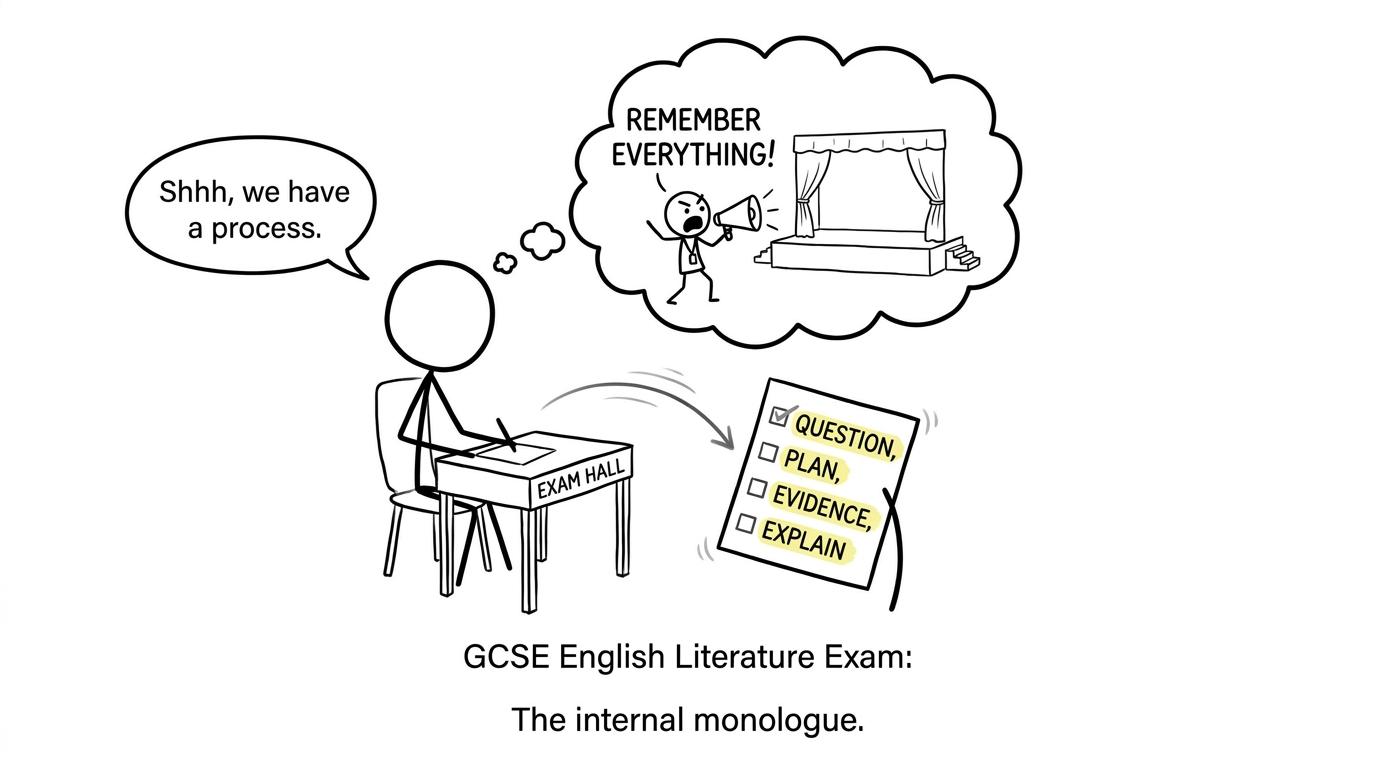 An anxious brain being handed a simple exam checklist
What to do when your mind goes blank
Going blank can be a temporary effect of high anxiety. It does not mean that your knowledge has vanished permanently.
Pause before forcing sentences onto the page. Put both feet on the floor, release your shoulders and breathe slowly. UK government guidance on exam pressure recommends slow, deep breathing as a way to regain a sense of control.
Then return to the smallest concrete task:
- reread the question slowly;
- circle the character, relationship or theme;
- write down any relevant moment from the text;
- add one word, image, contrast or structural choice;
- turn that note into a simple claim.
If a perfect quotation does not arrive, do not spend several minutes chasing it. Use another accurate quotation or, where appropriate, make a clear reference to the relevant event. Follow the guidance you have been given about how your exam board rewards references.
Your first sentence does not need to be your most sophisticated sentence. It needs to move the answer forwards.
Prepare for uncertainty instead of predicting questions
Prediction can feel comforting, but building revision around one expected character or theme creates fragile confidence. Prepare adaptable ideas across the whole specification.
Use official past papers and sample assessment materials to understand question styles. Then vary your practice: familiar themes, less obvious characters, extract-based tasks, unseen poetry and comparisons where these belong to your course.
MathsGenie's guide to starting past papers explains a principle that crosses subjects: begin with manageable sections while there is still time to respond to what the practice reveals. Exam practice is a diagnostic tool, not a performance staged to prove you are already ready.
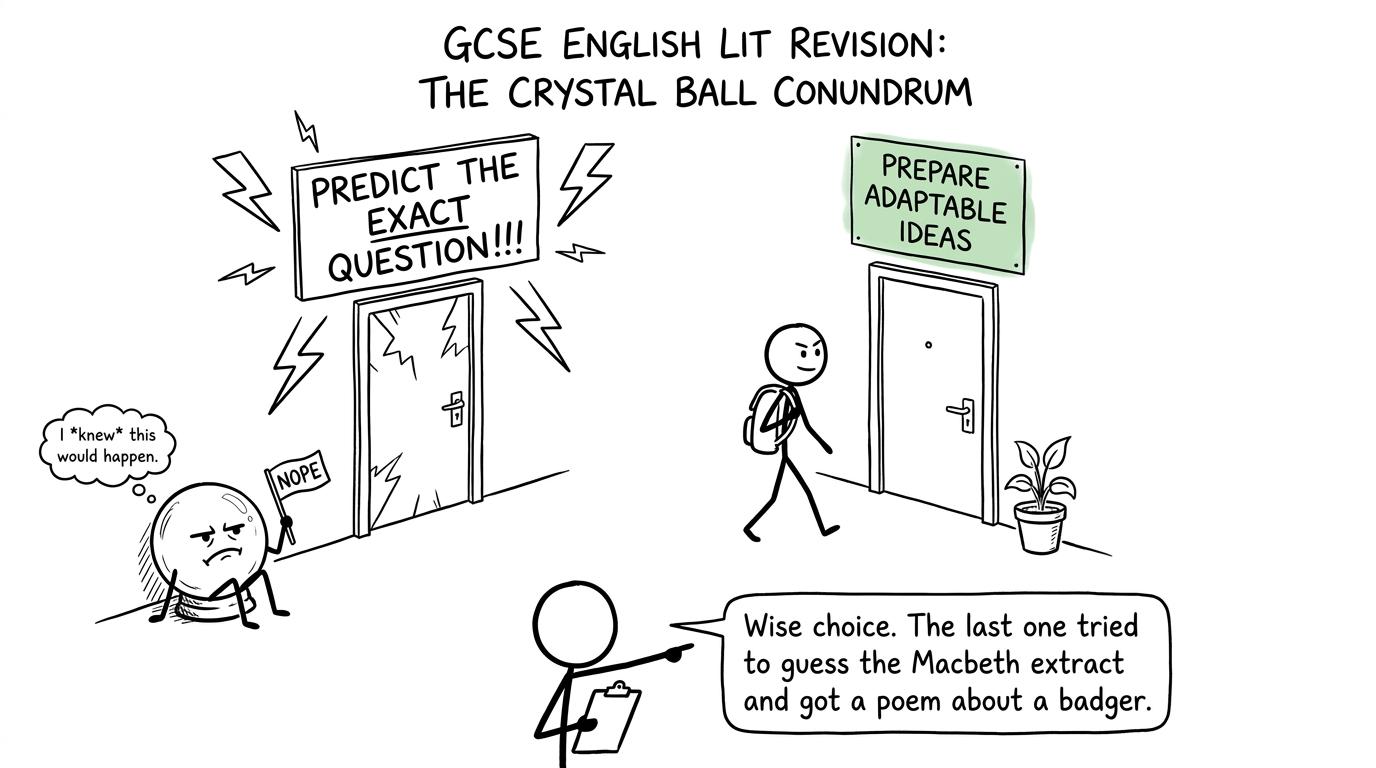 A student choosing adaptable preparation over predicting the exact exam question
Common mistakes when managing Literature anxiety
Rereading instead of retrieving
Rereading can feel reassuring because the text looks familiar. Close the book regularly and retrieve quotations, plot moments and arguments. Familiarity is not the same as recall.
Memorising complete essays
A memorised response may not fit the question actually asked. Learn flexible knowledge and practise adapting it. Examiners reward engagement with the task, not the nearest prepared essay.
Treating context as a separate history paragraph
Context should help explain meanings, attitudes or authorial choices. Long detached passages consume time and can weaken the argument.
Waiting until confidence arrives
Confidence often follows action rather than preceding it. Begin with one quotation test, one plan or one paragraph. The GCSE one-week revision plan demonstrates how small, scheduled tasks can replace last-minute indecision across a busy exam timetable.
Comparing yourself with other students
Someone else's confident conversation outside the exam room does not reveal the quality of their preparation. Measure your own progress through recall checks, completed plans and corrected responses.
Ignoring anxiety that needs support
Exam nerves are common, but you do not have to manage severe distress alone. Speak to a parent or carer, teacher, head of year, school pastoral team, counsellor or GP if anxiety is persistent, feels unmanageable, disrupts sleep or stops you attending school or completing ordinary activities. Seek urgent help if you feel unsafe.
Keep English Literature and maths revision working together
The reader searching for English Literature support may still have a calculator paper, algebra test or non-calculator paper waiting elsewhere in the timetable. Do not allow one anxious subject to consume every revision session.
Use a planner to alternate demanding tasks. After a timed Literature paragraph, a short, clearly defined maths topic can provide a useful change of mental gear. MathsGenie's GCSE maths revision hub brings together free revision lessons, exam questions, practice papers and board-specific resources. When you need exam-condition practice, use Edexcel GCSE maths past papers or choose the correct board and tier from the main hub.
The structure matters more than heroic hours: attempt, mark, diagnose, improve and return. For final maths preparation, Edexcel predicted papers can add fresh practice, but they should supplement topic revision and official past papers rather than become a promise about what will appear.
A calmer next step
English Literature becomes less intimidating when you stop asking your memory to hold an entire course at once. Map each text. Build flexible evidence. Practise retrieving it. Rehearse the opening minutes of an answer. Learn how to restart when anxiety interrupts you.
Then choose one small action today: recall five quotations, plan one unfamiliar question or review one marked response. Afterwards, return to MathsGenie for free GCSE maths revision lessons, practice questions, mini tests, past papers, predicted papers, mark schemes and video solutions. A good revision planner does not remove every nervous feeling. It makes sure those feelings no longer decide what you do next.