Exam Anxiety GCSE Chemistry: A Practical Plan
Exam anxiety GCSE chemistry advice: build a topic plan, practise calculations and practical questions, handle panic and approach exam day calmly.
A chemistry paper can feel unusually unpredictable. One page asks about bonding, the next shows unfamiliar apparatus, and then a calculation appears involving moles, concentration or percentage yield. If exam anxiety GCSE chemistry searches have brought you here, the useful answer is this: reduce uncertainty by revising chemistry in distinct question types, rehearse the calculations and practical methods that worry you, and prepare a simple response for moments when panic interrupts your thinking.
You do not need to feel completely calm before you can perform well. You need a routine that still works when you feel nervous.
Your GCSE Chemistry anxiety checklist
Use this as your starting plan:
- Confirm your exam board, qualification and tier.
- Divide the specification into knowledge, calculations and practical skills.
- Turn vague worries into named topics.
- Practise short sets before attempting full papers.
- Mark answers and record the precise reason for each lost mark.
- Revisit weak material rather than repeatedly reading comfortable notes.
- Rehearse what you will do if you go blank in the exam.
- Speak to a trusted adult if anxiety is persistent or affecting daily life.
This approach reflects current official guidance from Ofqual and the NHS: structured, manageable revision and familiarity with exam tasks can help students feel more in control.
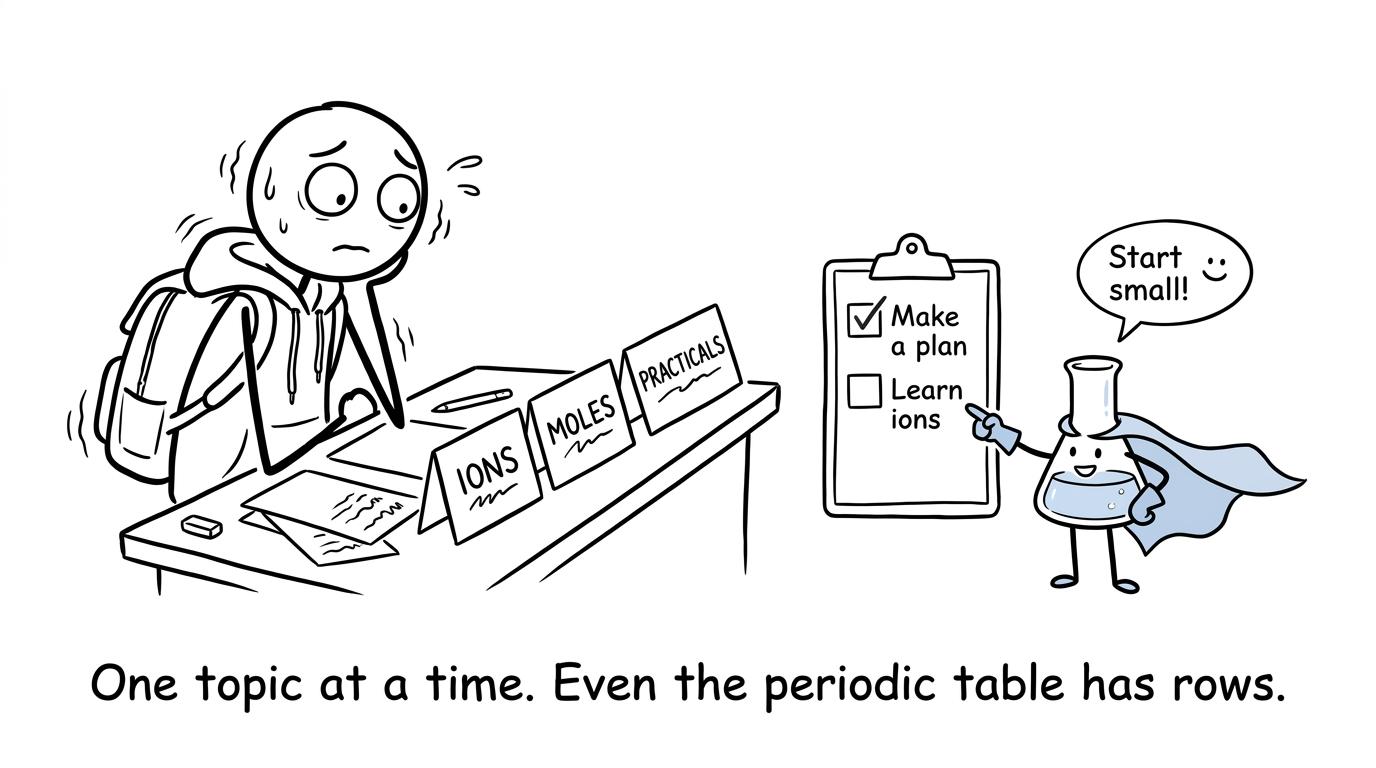 A GCSE student and a superhero beaker turning chemistry revision into a small queue of topics
Why GCSE Chemistry creates a particular kind of anxiety
Chemistry combines several forms of thinking. You must recall facts, interpret diagrams, apply ideas to unfamiliar substances, describe practical methods and complete numerical calculations. Anxiety often grows when all of that is treated as one enormous subject called “chemistry”.
Make the worry smaller by identifying its category:
- Recall anxiety: “I will forget tests, ions or reaction conditions.”
- Calculation anxiety: “I cannot tell which equation to use.”
- Practical anxiety: “I mix up methods, variables and apparatus.”
- Question-language anxiety: “I know the topic but do not understand what the examiner wants.”
- Timing anxiety: “One difficult calculation will consume the paper.”
Each problem needs a different response. Flashcards may help recall, but they will not build confidence with an unfamiliar graph. A full paper may improve timing, but it is inefficient if rearranging formulae is the real obstacle.
Build a chemistry-specific revision map
Start with the specification for your board: Edexcel, AQA, OCR or Eduqas. Separate Science Chemistry and Combined Science do not always have identical content, so use the qualification you are actually taking. Check whether you are entered for foundation or higher tier as well.
Create three columns in your revision plan.
Chemistry knowledge
Include areas such as atomic structure, bonding, chemical changes, energy changes, rates, equilibrium, organic chemistry, analysis, the atmosphere and resources where they appear in your specification.
Do not write “revise bonding”. Use smaller targets such as “compare ionic and covalent structures” or “explain conductivity using particles”. Ofqual recommends manageable, time-limited targets because they turn revision into an action rather than a judgement about your ability.
Quantitative chemistry
List the numerical skills separately: relative formula mass, moles, reacting masses, concentration, percentage yield, atom economy, rates, gradients and significant figures, as appropriate to your course and tier.
Official GCSE Chemistry specifications include mathematical skills such as ratios, fractions, percentages, standard form, means, substitution, rearranging equations and interpreting graphs. If these make chemistry feel threatening, rebuild them through the GCSE Maths revision hub rather than hoping they disappear.
Useful starting points include percentages revision, writing and simplifying ratio and standard form practice. These are maths resources, but the skills transfer directly to chemistry calculations.
Practical and data questions
For each required or specified practical, revise:
- the purpose of the method;
- the independent, dependent and control variables;
- the apparatus and measurements;
- safety and procedural decisions;
- expected observations or results;
- sources of uncertainty;
- improvements and conclusions;
- possible graphs or calculations.
Do not rely only on memorising a polished method. Examiners may place the same skill in an unfamiliar context. Ask what each step achieves. Understanding gives you something to reason from when recall becomes imperfect.
Make calculations feel predictable
A chemistry calculation is rarely “just chemistry”. It usually has a recognisable mathematical structure beneath the scientific language.
Common structures include:
percentage yield=actual yieldtheoretical yield×100\text{percentage yield}=\frac{\text{actual yield}}{\text{theoretical yield}}\times 100percentage yield=theoretical yieldactual yield×100 rate=quantity changedtime taken\text{rate}=\frac{\text{quantity changed}}{\text{time taken}}rate=time takenquantity changed concentration=mass of solutevolume of solution\text{concentration}=\frac{\text{mass of solute}}{\text{volume of solution}}concentration=volume of solutionmass of soluteYour exact formulae and required units depend on the specification and question, so check your board’s current guidance. The calming habit is consistent: identify the quantities, write the relationship, convert units if necessary, substitute carefully and review whether the answer is sensible.
If making a variable the subject causes hesitation, use the rearranging formulae revision resources. For experimental results, averages revision can strengthen work involving means and ranges.
Keep a chemistry calculation error log with four labels:
- wrong relationship;
- unit conversion;
- calculator or arithmetic error;
- rounding or significant figures.
“Bad at moles” is too broad to repair. “I forget to convert volume before substituting” gives you a clear next action.
Practise the chemistry paper without overwhelming yourself
Avoiding exam questions provides short-term relief, but it preserves their unfamiliarity. Instead, build exposure gradually.
Begin with one untimed question from a weak topic. Then complete a short mixed set. Next, try a timed section. Move to a full paper only when shorter practice no longer feels chaotic.
After marking, sort lost marks into three groups:
- Knowledge: a fact, definition or process was missing.
- Application: you knew the content but could not use it in context.
- Execution: the method was sound, but wording, units, arithmetic or timing caused the loss.
This distinction matters. More note-reading will not fix rushed units. More calculations will not fix an incomplete explanation of metallic bonding.
MathsGenie’s article on when to start past papers explains how to progress from short diagnostic work towards timed papers. Use official chemistry papers from your own exam board for chemistry practice. MathsGenie’s GCSE predicted maths papers can separately help you rehearse the numerical fluency and timed problem-solving that support quantitative chemistry.
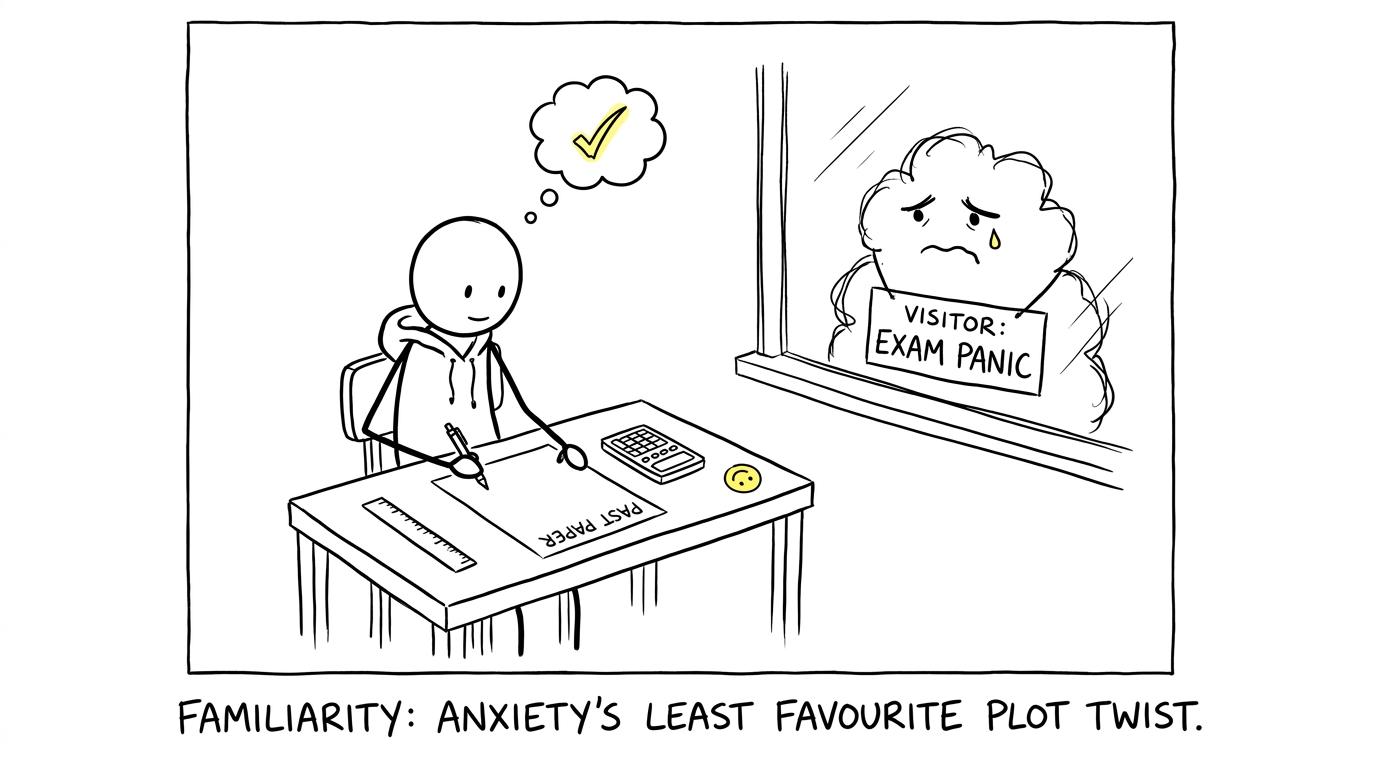 Exam Panic waiting outside while a student calmly practises a mock paper
What to do when anxiety appears in the exam
Anxiety may feel like a prediction, but it is a physical and mental response. A racing heart does not prove that you have forgotten the course.
If your mind goes blank:
- Put both feet on the floor and release tension in your shoulders.
- Slow your breathing for a minute or two, without forcing enormous breaths.
- Read only the current question, not the remaining paper.
- Underline the command word and identify the topic.
- Write one relevant fact, relationship or observation.
- If you still cannot begin, leave space and return later.
Official Ofqual guidance recommends slow, deep breathing to help control physical reactions to anxiety. Practise this before exam day so it feels familiar rather than like an emergency experiment.
For calculation questions, write down the relevant relationship even if the final route is not yet clear. For extended responses, convert the command word into a job: “describe” asks what happens, “explain” needs linked reasons, and “evaluate” requires evidence, limitations and a supported judgement.
A calmer plan for the final day
The night before is not the time to reconstruct the whole periodic table from memory. Choose a closing time and protect your sleep. NHS guidance notes that sleep supports thinking and concentration, while all-night cramming is generally unhelpful.
Complete a short review of:
- your most frequent error patterns;
- essential tests, definitions and conditions;
- equations you are expected to recall or use;
- required practical purposes and variables;
- unit conversions and calculator settings.
Pack the equipment permitted for your paper. Check your calculator, pens and journey arrangements. The GCSE exam week checklist offers a useful model for reducing last-minute decisions, even though you should adapt the equipment and paper details for Chemistry.
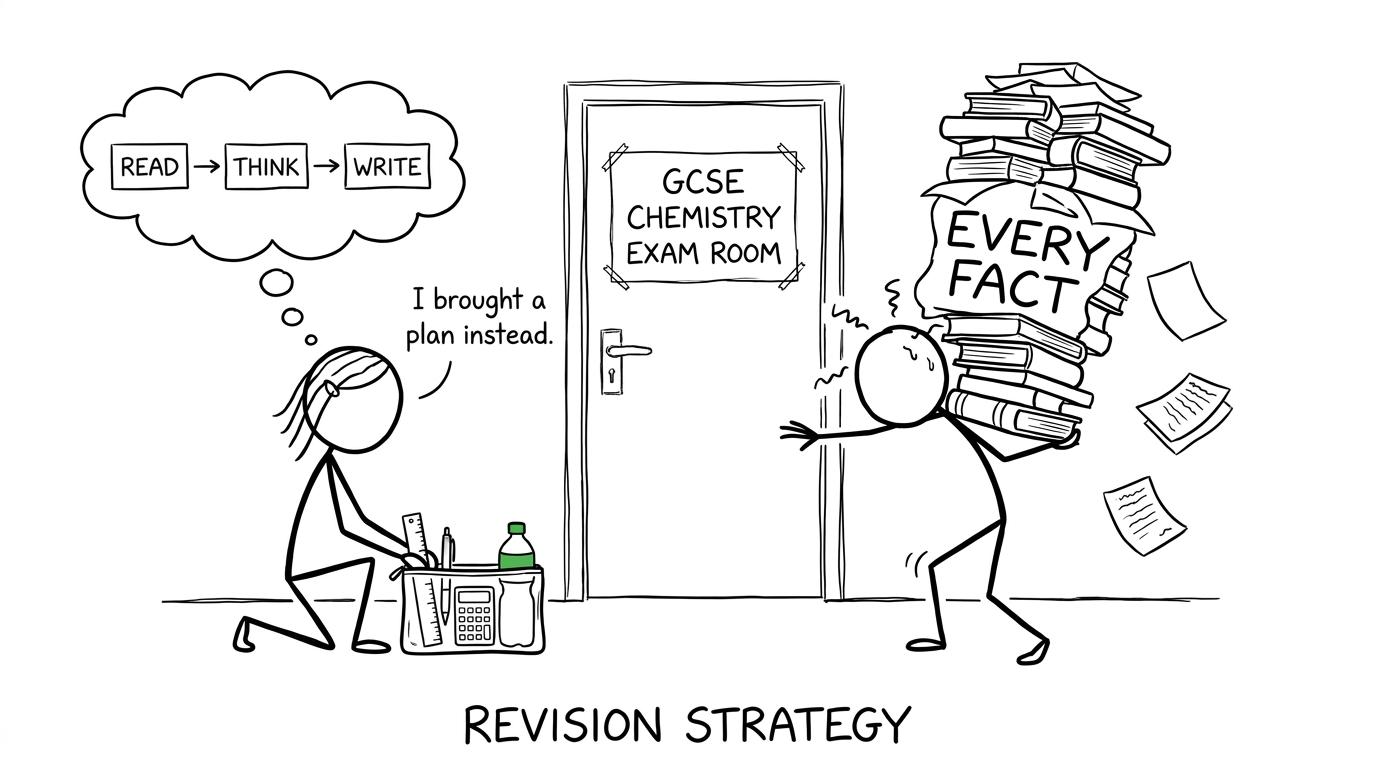 One student bringing a plan while another tries to carry every chemistry fact
Common mistakes when managing GCSE Chemistry anxiety
Revising only the topics that feel safe
Comfortable revision creates activity without reducing uncertainty. Begin with a small weak area, then finish with something more secure if you need momentum.
Memorising calculations as disconnected tricks
Learn what each quantity represents and track units. A formula is easier to recover when its meaning is understood.
Confusing coefficients and subscripts
When balancing equations, change coefficients in front of formulae, not the subscripts inside substances. Altering a subscript changes the chemical formula itself.
Treating one poor paper as a forecast
A practice paper is diagnostic evidence, not a prediction of your final grade. Identify the two or three largest sources of lost marks and repair those first.
Waiting until exam day to manage panic
Rehearse breathing, question-skipping and timed practice beforehand. Familiar responses are easier to use under pressure.
Keeping serious anxiety private
If anxiety is severe, persistent, causes physical symptoms, disrupts sleep or stops you attending school and completing ordinary activities, speak to a parent, carer, teacher, pastoral lead or another trusted adult. A GP is an appropriate place to seek further help.
Turn uncertainty into the next small action
Confidence rarely arrives before practice. More often, it appears afterwards: one practical understood, one calculation corrected, one timed section completed without giving up.
For Chemistry, use your exam board’s specification, official past papers and mark schemes to direct subject revision. Then use MathsGenie as your free maths support system. Strengthen percentages, ratio, standard form, averages, graphs and formula rearrangement through revision lessons, practice questions, mini tests, mark schemes and video solutions. Use past papers and predicted maths papers to make timed numerical work feel ordinary.
Start with one chemistry worry you can name. Find the skill beneath it. Practise it briefly, mark it honestly and return to it. A large subject becomes manageable in exactly the same way a long paper does: one question at a time.