Evening Classes GCSE French: Are They Worth It?
Evening classes GCSE French: compare feedback, speaking practice, fees and self-study to decide whether an adult course is worth your time and money.
You finish work, deal with everything waiting at home, and then face one more decision: travel to a classroom or trust yourself to revise French alone. If you have searched for evening classes GCSE French, the short answer is this: they can be worth paying for when you need regular speaking practice, expert feedback and external accountability. They are less compelling if you already revise consistently, can access a suitable speaking partner and mainly need to rebuild vocabulary or grammar.
For an adult also preparing for GCSE maths, the real cost is not only the course fee. It is the evening each week, the travel and the revision displaced elsewhere. A good decision therefore depends on what the class actually provides, and whether you will use it.
The quick decision checklist
An evening GCSE French course is more likely to be worth it if:
- it prepares learners for your exact exam board and current specification;
- it includes regular, individual speaking feedback;
- you struggle to maintain self-study without a fixed commitment;
- the timetable is realistic alongside work, family and maths revision;
- the provider can explain examination entry and speaking assessment arrangements;
- you can afford the full cost without expecting the fee itself to create motivation.
Self-study may be the better choice if:
- you are already disciplined enough to follow a weekly plan;
- you need flexibility more than a fixed classroom appointment;
- your main gaps are vocabulary, listening repetition or grammar drills;
- the available class is a general conversational course rather than a GCSE course;
- paying for occasional tuition or speaking practice would target your weaknesses more precisely.
The important distinction is simple: buying a class and learning French are not the same transaction.
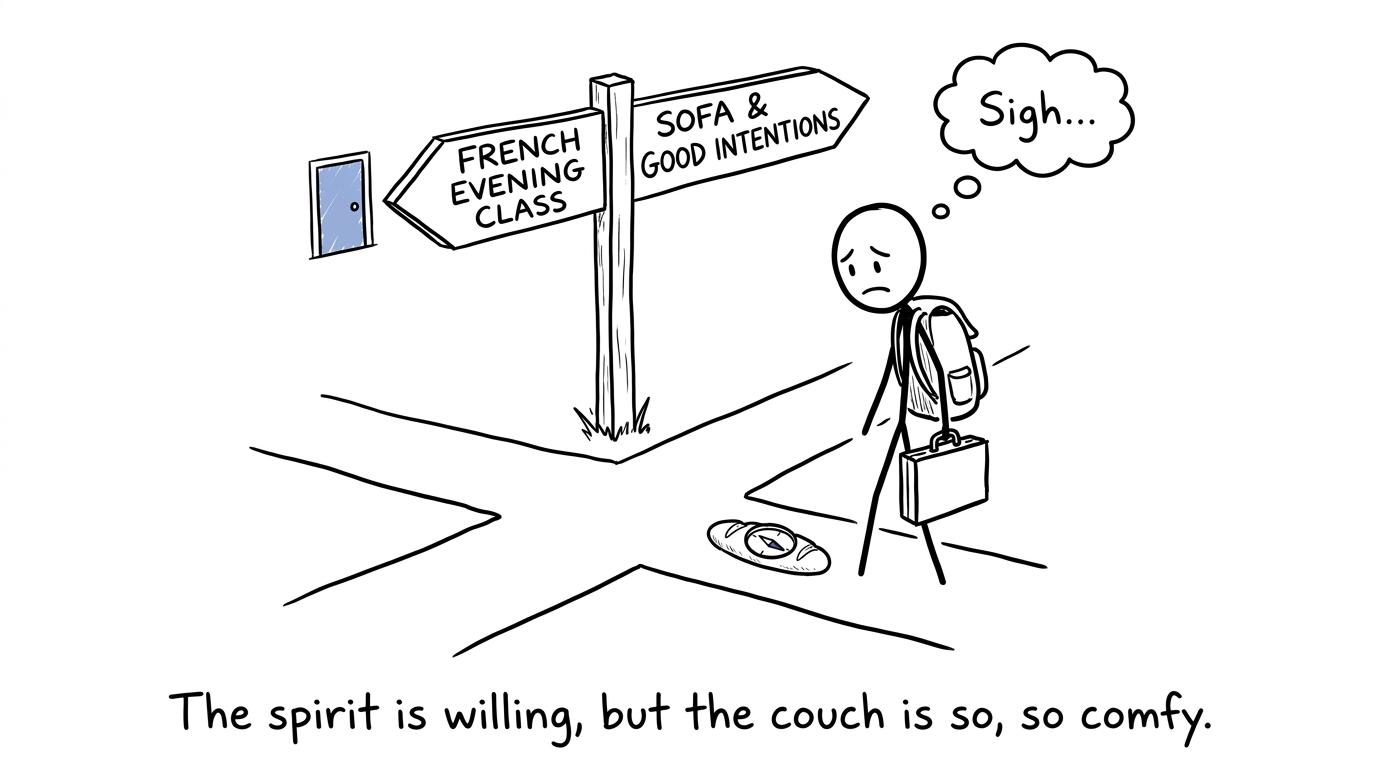 An adult learner choosing between French class and the sofa
What GCSE French evening classes should provide
Current GCSE French qualifications assess listening, speaking, reading, writing, vocabulary and grammar. For reformed qualifications in England first examined from summer 2026, official specifications include tasks such as dictation, reading aloud, role-play, visual stimuli, translation and extended writing. Exact formats and timings depend on the board and tier.
That breadth is why a genuinely exam-focused course can help. It should do more than teach useful phrases for restaurants and holidays.
Structured coverage of the specification
A strong tutor maps lessons to the relevant AQA, Edexcel or Eduqas specification, or the appropriate qualification where you live. They should know which themes, prescribed vocabulary and grammatical structures learners must cover. They should also distinguish between foundation and higher tier requirements.
Ask which specification the course follows before enrolling. A general intermediate French class may improve your language, but it may not rehearse GCSE question types or prepare you for assessment conditions.
Feedback you cannot easily give yourself
Self-study is well suited to flashcards, reading and repeated listening. It is weaker at diagnosing pronunciation, hesitation and answers that sound understandable to you but not to another listener.
A teacher can identify whether your pronunciation is clear, whether a tense has been formed accurately and whether an answer actually addresses the prompt. That immediate correction is often the most valuable part of a course.
The same principle applies in maths. Completing questions feels productive, but improvement usually happens when errors are exposed and corrected. MathsGenie's guide to using mark schemes effectively explains why feedback matters more than simply accumulating completed work.
Real speaking practice
Speaking is the hardest element to reproduce alone because genuine conversation contains uncertainty. You cannot fully predict the next question, pause indefinitely or quietly replace the other speaker's words.
A useful class creates frequent opportunities to answer unprepared questions, ask questions and respond naturally. A large class in which each learner speaks for only a few minutes offers much less value. Before paying, ask about class size and how much individual speaking time is typical.
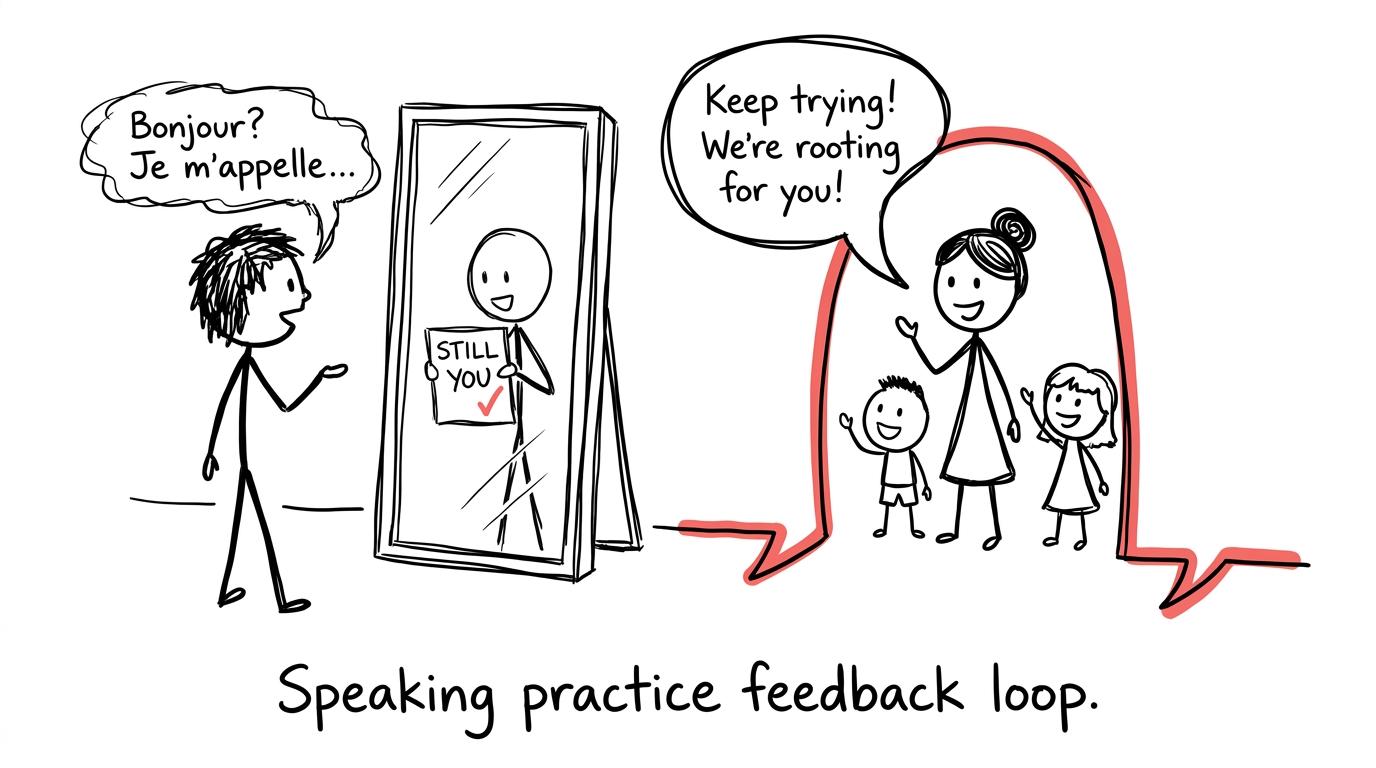 A learner discovers that a mirror is a limited speaking partner
The hidden value of a fixed commitment
The best feature of evening classes may have little to do with French. A class creates a deadline.
At home, revision competes with urgent tasks and easy entertainment. A booked classroom places one protected block in the week. For someone who repeatedly intends to revise but does not begin, that structure has genuine value.
But accountability only works if attendance is realistic. A course scheduled after a long commute may look ideal in September and become difficult by November. Check its duration, travel time, homework expectations and cancellation policy. Online delivery saves travelling, although it still requires a quiet space and reliable participation.
For adults balancing two GCSEs, use the same planning discipline you would apply to maths. The GCSE maths revision timetable helps turn broad intentions into repeatable sessions, while the one-month GCSE maths plan is useful when examinations are closer.
Evening classes versus self-study
Neither route is automatically better. They solve different problems.
Where evening classes are stronger
Classes are strongest for interaction, correction and momentum. A skilled tutor can notice recurring weaknesses before they harden into habits. Classmates also make role-play and spontaneous conversation possible.
A course can reduce planning fatigue too. Instead of deciding what to revise every night, you follow an organised sequence. That convenience matters when French is competing with work, family and GCSE maths.
Where self-study is stronger
Self-study offers flexibility and control. You can repeat a difficult listening extract, move quickly through familiar vocabulary and schedule revision around shifts or caring responsibilities. It can also cost far less.
The weakness is that freedom demands decisions. You must select resources, balance all four language skills, assess your own work and keep going when nobody expects you to attend.
Short, repeatable routines can make this manageable. Maths students can use MathsGenie's 20-minute revision routine as a model: choose one precise goal, practise actively, check the result and record the next action. The subject changes, but the habit does not.
Why a hybrid approach often wins
For many adult learners, the best answer is not class or self-study. It is a carefully limited combination.
Use the class for speaking, tutor feedback and specification guidance. Use short home sessions for vocabulary retrieval, listening and written practice. This avoids paying a tutor to supervise tasks you can complete independently while preserving the human feedback that is difficult to replace.
A hybrid plan also protects maths revision. Keep one or two fixed maths sessions using the GCSE maths revision hub, then fit shorter French retrieval sessions around the evening class. If you follow AQA or OCR for maths, use the dedicated AQA GCSE maths resources or OCR GCSE maths resources so your practice matches your board and tier.
How to judge whether the cost is reasonable
Adult course fees vary significantly by provider, location, duration and whether the course leads to an examination entry. Compare the whole commitment rather than the advertised fee alone.
Include:
- tuition and enrolment fees;
- textbooks or digital resources;
- examination entry charges, if separate;
- travel and parking;
- the number of taught hours you are realistically likely to attend;
- any private speaking support you might still need.
A useful comparison is:
cost per attended hour=total expected costhours you realistically expect to attend\text{cost per attended hour}=\frac{\text{total expected cost}}{\text{hours you realistically expect to attend}}cost per attended hour=hours you realistically expect to attendtotal expected costThis is not a worked guarantee of value. It is simply a way to avoid treating a long course as inexpensive when work or travel means you may miss many sessions.
Then compare the class with the real alternative. If self-study means buying resources but rarely opening them, the cheaper option may deliver poor value. If you already maintain a reliable routine, a full course could be unnecessary.
Check the examination arrangements before paying
This is particularly important for adult and private candidates. A language course does not automatically include entry for GCSE French.
Ask the provider:
- Is this an accredited GCSE course or a general language course?
- Which board, specification and tier does it prepare learners for?
- Is examination entry included in the price?
- Where will the written papers be taken?
- Who will conduct and record the speaking assessment?
- Can the centre accept an adult or private candidate for every component?
- When must entry arrangements be confirmed?
Current GCSE French qualifications are linear, so the required assessments are normally completed in the same examination series and at one tier. Speaking has controlled administrative requirements and cannot simply be arranged as an informal conversation with any tutor. Confirm everything directly with an approved examination centre before assuming that a course leads to the qualification.
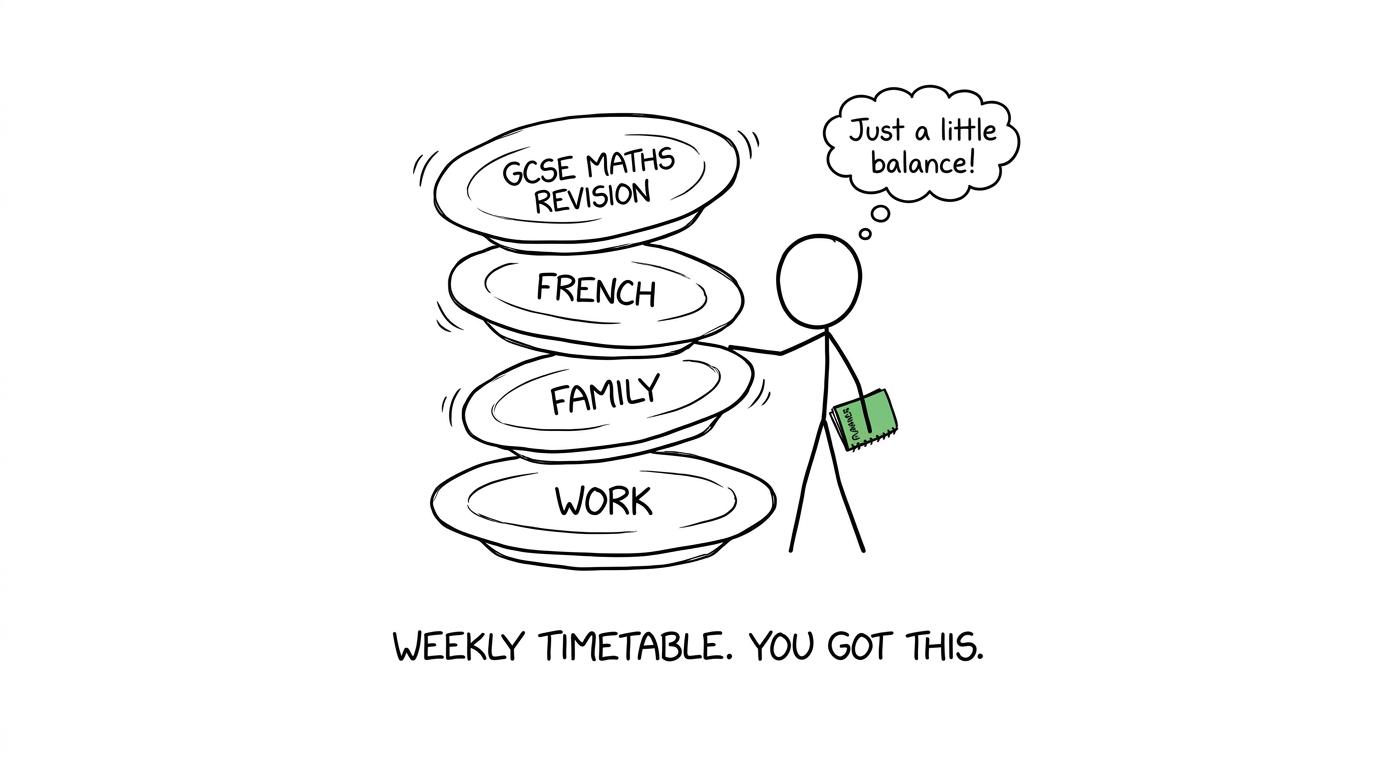 A calm planner balancing work, French and maths revision
Protecting your GCSE maths revision time
An evening class can improve French while quietly damaging maths if it consumes the only evening on which you reliably revise. The answer is not to abandon either subject. It is to give each a clear job.
Keep French class night for interactive work. On another evening, use a short maths lesson followed immediately by questions. At the weekend, test yourself under time pressure. MathsGenie's Edexcel GCSE mini tests are useful when a full paper is unrealistic.
As exams approach, move from isolated skills to mixed assessment. The guide to using GCSE past papers properly shows how to complete, mark, repair and retest rather than treating a final score as the end of the session.
The principle across both subjects is the same: attendance is an input, not an outcome. What matters is whether you can perform the skill independently afterwards.
Common mistakes when choosing a French evening course
Assuming every French class prepares you for GCSE
Conversation courses and GCSE courses have different aims. Check the specification, assessment tasks and tier explicitly.
Paying before confirming exam entry
Tuition may not include an examination place. Speaking assessment arrangements can also limit which centres accept private candidates. Obtain written clarification before committing.
Valuing classroom hours instead of personal feedback
A long course is not necessarily a good course. Ask how often your speaking and writing will receive individual correction.
Expecting one weekly lesson to be enough
Language learning needs recall between lessons. Without brief home practice, vocabulary and grammar can fade before the next class.
Ignoring the opportunity cost
A class that leaves no time for GCSE maths, rest or homework may be badly timed even if the teaching is excellent. Build a realistic weekly plan before enrolling.
Choosing the cheapest option automatically
Price matters, but so do attendance, class size, course alignment and examination support. Compare what you will actually receive and use.
Are evening classes GCSE French worth it?
They are worth it when the course supplies something you cannot reliably create alone: speaking practice, accurate feedback, specification expertise and a commitment you will honour. They are not automatically worth it merely because a teacher is present.
Before enrolling, ask for the syllabus, confirm examination arrangements and look honestly at your week. If a hybrid route gives you the feedback of a class and the flexibility of independent revision, that may offer the strongest balance.
Then protect the rest of your GCSE preparation. Start with the free MathsGenie GCSE maths hub, choose your board and tier, and use revision lessons, practice questions, mini tests, past papers, predicted papers, mark schemes and video solutions to turn limited revision time into focused progress.