Evening Classes GCSE Computer Science: Worth It?
Evening classes GCSE Computer Science guide: compare adult tuition, self-study, exam access, funding and time before choosing the best route for you.
It is easy to underestimate the difficulty of learning after work. The course may look manageable on paper, yet Tuesday evening arrives with unanswered emails, a cold dinner and very little enthusiasm for debugging Python.
So, are evening classes GCSE Computer Science actually worth it for an adult learner? Often, yes, particularly if you need a fixed routine, access to a teacher, regular programming practice or help arranging the examination. Self-study can be equally effective when you are disciplined, comfortable solving problems independently and able to confirm your exam arrangements early. The right choice depends less on intelligence than on structure, cost and the kind of support you genuinely use.
The short answer: when is an evening class worth it?
An adult GCSE Computer Science evening course is likely to offer good value when:
- you struggle to maintain a weekly self-study routine;
- programming is new to you and immediate feedback would help;
- the provider teaches the exact exam-board specification you will sit;
- tuition, practical work and examination entry are clearly explained;
- you learn better through discussion and scheduled deadlines;
- the total cost is affordable without creating pressure elsewhere.
Self-study may be the better option when:
- you already have some programming experience;
- you can follow a specification and plan revision independently;
- local classes clash with work or caring responsibilities;
- you mainly need the qualification rather than extensive teacher support;
- you have already found an approved centre willing to enter you.
The word that matters is not class. It is useful. Paying for attendance does not automatically create progress.
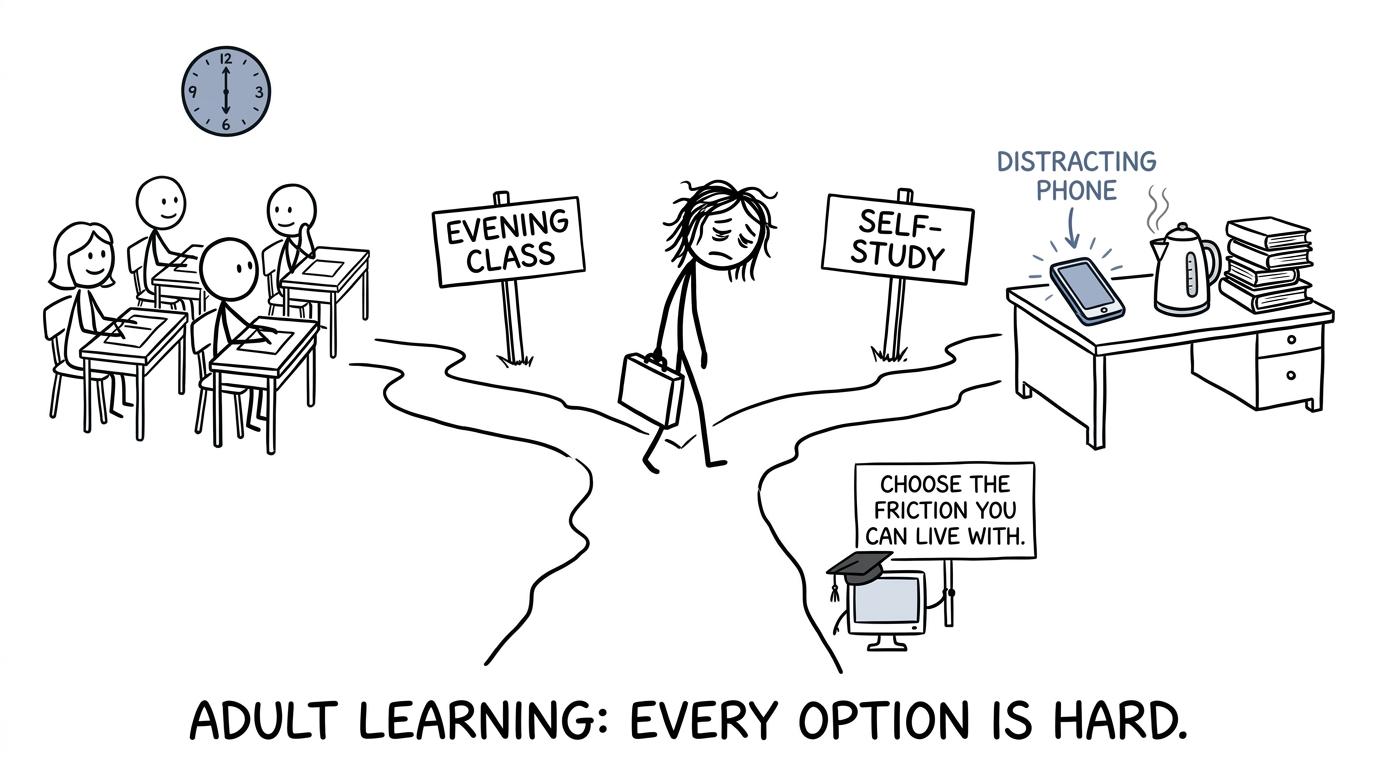 An adult learner choosing between an evening class and self-study
What GCSE Computer Science actually requires
GCSE Computer Science is more than learning to write a few short programs. Current Department for Education subject content includes algorithms, abstraction, decomposition, logic, data representation, computer systems, networks, cyber security and the social effects of digital technology. Students must also develop practical experience of designing, writing, testing and refining programs.
That breadth changes the calculation. A self-taught learner might enjoy programming but neglect computer architecture. Another may memorise networking definitions while avoiding code. A well-run evening course should prevent this imbalance by following the specification systematically.
Assessment arrangements vary by exam board and qualification version. AQA, Pearson Edexcel, OCR and Eduqas do not necessarily use identical paper structures or programming arrangements. For example, Pearson Edexcel includes an onscreen programming assessment, while OCR's established specification uses written examinations that assess practical programming knowledge. AQA has updated its specification for first examinations in 2027, so learners must check which version applies to their examination year.
Unlike GCSE maths, GCSE Computer Science is not normally divided into foundation and higher tiers. Everyone entered for a particular specification prepares for the same qualification assessments. That makes choosing the correct exam board, specification and examination series especially important.
Evening classes versus self-study
The comparison is not simply “expensive” against “free”. Each route carries visible and hidden costs.
| Consideration | Evening class | Self-study |
|---|---|---|
| Weekly structure | Timetabled and externally enforced | Must be created and maintained by you |
| Teacher feedback | Usually available during or between lessons | Requires forums, books, videos or separate tuition |
| Programming support | Errors can be discussed promptly | Debugging may take longer but builds independence |
| Specification coverage | Strong if the provider follows the correct board | Depends on the quality of your plan |
| Flexibility | Limited by lesson times and travel | High, particularly with online resources |
| Social support | Other adult learners may reduce isolation | Usually solitary unless you build a study group |
| Cost | Tuition may be funded, subsidised or privately charged | Resources may be inexpensive, but exam entry still costs money |
| Exam administration | The provider may handle entry | You may need to arrange private-candidate entry yourself |
A class buys more than information. Information is abundant. It buys a timetable, feedback and consequences for not turning up. For some learners, those are the most valuable parts.
The real value is accountability
Adult revision often fails quietly. There is no dramatic moment when the plan collapses. One missed session becomes three, and the examination remains comfortably distant until it suddenly is not.
An evening class creates an appointment. You know that algorithms will be covered on a particular evening and that someone may notice if your programming task is unfinished. This external accountability can be worth paying for if consistency is your main obstacle.
But attendance is not the same as learning. You still need to retrieve knowledge, write code without copying, review mistakes and answer exam-style questions. A learner who attends every lesson passively may make less progress than a self-taught learner who practises deliberately.
A useful weekly pattern is:
- one taught lesson or focused learning session;
- one independent programming session;
- one short retrieval session for theory;
- one block of exam-question practice;
- one review of errors and unfinished topics.
The same rhythm works for maths. MathsGenie's guide to stopping GCSE maths content from being forgotten explains how retrieval, spacing and exam questions turn exposure into durable knowledge.
Compare the full cost, not just the course fee
Before enrolling, ask for the complete price. It may include tuition but exclude registration, examination-centre charges, software, textbooks or resit fees. Travel and lost working time also matter.
A simple decision measure is:
Total cost=tuition+exam fees+materials+travel+lost time\text{Total cost}=\text{tuition}+\text{exam fees}+\text{materials}+\text{travel}+\text{lost time}Total cost=tuition+exam fees+materials+travel+lost timeThen compare that total with what the course provides. Does it include marked work? Is practical programming supervised? Are missed lessons recorded? Will the provider arrange your examination entry? How large is the class?
Funding should never be assumed. In England, adult funding rules provide legal entitlements in certain circumstances, including eligible learners taking a first full Level 2 qualification between the ages of 19 and 23. Other support may depend on earnings, employment status, residency, the qualification's funding approval and local priorities. English and maths have broader statutory funding arrangements than Computer Science.
Rules also vary across England, Scotland, Wales and Northern Ireland. Ask the college or adult education provider for a written explanation of tuition fees, funding eligibility and examination costs before committing.
Check exam access before choosing self-study
A self-study course does not itself enter you for a GCSE. Private candidates must normally register through an approved school, college or examination centre. Not every centre accepts private candidates, every exam board or qualifications involving particular assessment arrangements.
Confirm these points early:
- the exam board and specification code;
- whether the centre accepts private candidates for Computer Science;
- which programming language and software will be used;
- whether all required assessments can be delivered;
- entry deadlines, fees and late-fee policies;
- arrangements for access needs, where relevant.
This is one area where an evening course can justify its price. If the provider includes examination entry and already has the necessary facilities, it removes a significant administrative risk. Never assume this is included simply because “GCSE” appears in the course title.
How much maths does GCSE Computer Science involve?
Computer Science and maths overlap through logical reasoning, data representation, problem solving and careful use of rules. The GCSE subject content includes binary and hexadecimal numbers, binary addition, shifts, data capacity and Boolean logic.
You do not need advanced algebra, but confidence with place value, powers, units and systematic reasoning helps. For instance, binary place values follow powers of two:
20, 21, 22, 23,…2^0,\ 2^1,\ 2^2,\ 2^3,\ldots20, 21, 22, 23,…This is one reason adult learners preparing for both qualifications should coordinate their revision rather than treating the subjects as unrelated. MathsGenie's free GCSE maths revision hub provides lessons, questions and board-specific resources. Topics such as standard form strengthen number sense, while probability revision develops the habit of reasoning from defined outcomes.
If maths is the qualification you urgently need for employment, training or further education, protect time for it. An interesting Computer Science course should not quietly consume every available revision evening.
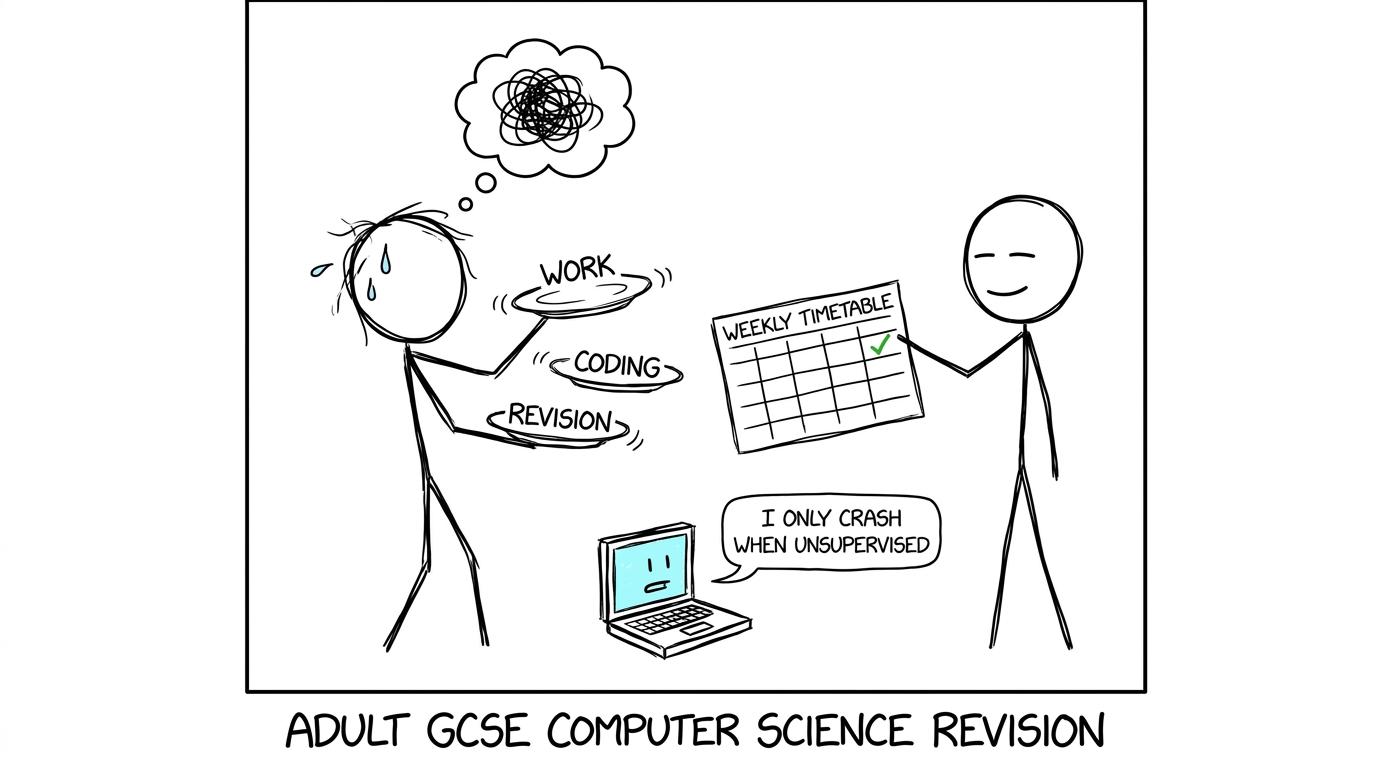 A learner balancing work, coding and revision
Questions to ask an evening-class provider
A good course should survive specific questions. Before paying, ask:
- Which exam board and specification are taught?
- Is the course designed for the examination year you intend to sit?
- Is examination entry included?
- How much live programming will students complete?
- Which language and development environment are used?
- How often is work marked with individual feedback?
- What happens when a lesson is missed?
- Are past papers and mark schemes built into the course?
- What proportion of the timetable covers theory rather than programming?
- Are there additional charges?
Be cautious if answers remain vague. “Learn coding” is not the same promise as “prepare for a specified GCSE qualification”. The first may be enjoyable and useful, but it may not prepare you for the questions that earn marks.
A practical self-study alternative
Self-study works best when it imitates the strongest parts of a class. Fix a weekly timetable, follow the specification in order and create deadlines that cannot be endlessly moved.
Use a simple cycle:
- learn one tightly defined topic;
- retrieve the key ideas without notes;
- practise programming where the topic requires it;
- answer exam-style questions;
- mark the work and record the reason for each error;
- revisit the weakness several days later.
Do not measure progress by hours watched. Measure it by tasks you can complete independently. MathsGenie's explanation of how to find weak GCSE topics quickly provides a useful diagnostic approach, while the best order for learning GCSE maths topics can help if you are managing Computer Science alongside a maths resit.
Common mistakes when choosing a course
Choosing by convenience alone
A nearby course is not good value if it teaches the wrong specification, offers little programming practice or cannot arrange the assessment you need.
Assuming Computer Science means only coding
Programming matters, but so do systems, networks, data representation, cyber security, databases and ethical or legal issues. Check the full specification.
Paying before confirming examination entry
Course enrolment and examination entry are separate unless the provider explicitly combines them. Get confirmation in writing.
Underestimating independent practice
One evening lesson each week is rarely enough by itself. Programming improves through writing, testing and correcting code, not merely watching someone else do it.
Trying to revise every subject in the same way
Code needs practical repetition. Theory needs retrieval and exam questions. Maths needs written methods and precise checking. For maths papers, use Edexcel GCSE past papers and mark schemes and follow the MathsGenie past-paper revision process rather than simply collecting scores.
So, are evening classes worth it?
Evening classes are worth the time and cost when they solve a problem you cannot reliably solve alone: consistency, feedback, programming support or exam access. They are poor value when they merely provide information you could organise independently, particularly if the specification and assessment arrangements are unclear.
Before deciding, compare the complete cost, inspect the timetable, verify the exam board and speak directly to the examination centre. Then be honest about your habits. The best route is not the one that sounds most impressive. It is the one you will still follow on a dark weekday evening when motivation has gone home early.
If GCSE maths is part of your plan, make MathsGenie's free GCSE revision resources your starting point. Use revision lessons to rebuild understanding, practice questions to develop accuracy, mini tests to check recall, and past papers, predicted papers, mark schemes and video solutions to turn revision into marks.