English Language Exam Timing: Minute-by-Minute
English language exam timing plans for AQA and Edexcel GCSE resits, with minute-by-minute guidance based on paper lengths and question marks.
A GCSE English Language paper can feel strangely short and painfully long at the same time. There is enough time to write strong answers, but not enough time to hesitate over every sentence. For resit students, that pressure can be especially sharp because the result may affect college, training or employment plans.
The solution is not to write faster from the first minute. Effective English language exam timing means giving each task a sensible share of the paper, setting clear stopping points and protecting enough time for the high-mark writing question.
The plans below cover the current AQA and Pearson Edexcel GCSE English Language specifications. AQA Papers 1 and 2 each last 105105105 minutes and carry 808080 marks. Edexcel Paper 1 lasts 105105105 minutes and carries 646464 marks, while Paper 2 lasts 125125125 minutes and carries 969696 marks.
Your exam timing checklist
Before looking at individual papers, remember four principles:
- Check your exam board and paper code before practising.
- Write the finishing time for each question on the front of your paper.
- Move on when that time arrives, even if an answer feels imperfect.
- Reserve the final 555 minutes for checking writing, not adding another reading paragraph.
Marks should shape your decisions. A question worth 222 marks cannot receive the same attention as one worth 404040 marks. However, a simple minutes-per-mark calculation is not enough because reading and planning also take time.
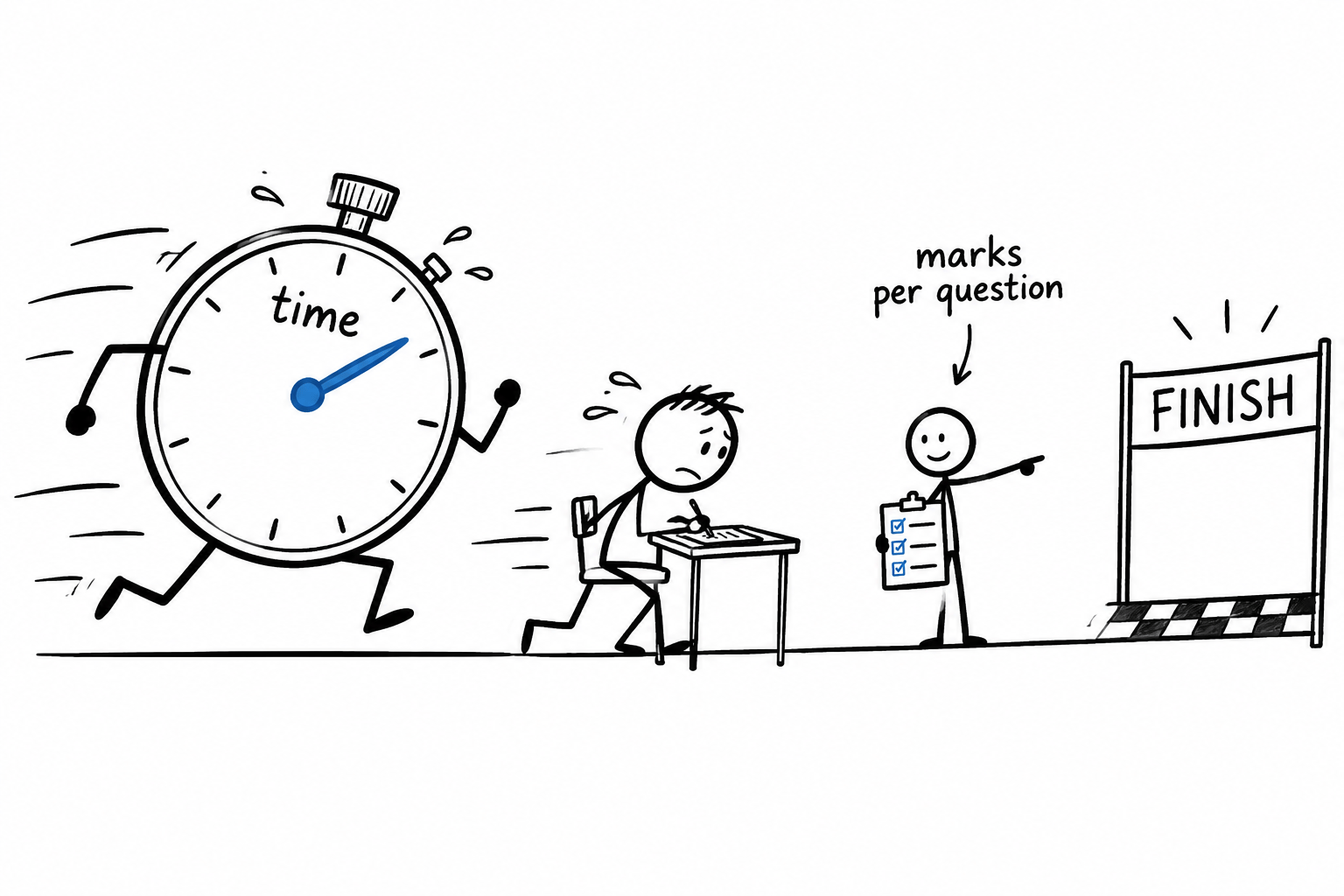 A student escapes an enormous stopwatch by following a marks-per-question checklist
AQA English Paper 1 timing
AQA Paper 1, Explorations in Creative Reading and Writing, lasts 111 hour 454545 minutes. It contains 404040 reading marks and 404040 writing marks. From the first examinations under the revised Paper 1 format in summer 2026, Question 1 is multiple choice and Question 3 focuses on one structural effect. The mark allocations remain 444, 888, 888, 202020 and 404040.
A balanced English Paper 1 timing plan is:
| Time | Task | Marks |
|---|---|---|
| 000-555 minutes | Read all questions and locate the specified lines | Preparation |
| 555-151515 minutes | Read and annotate the fiction extract | Preparation |
| 151515-202020 minutes | Question 1 | 444 |
| 202020-303030 minutes | Question 2 | 888 |
| 303030-404040 minutes | Question 3 | 888 |
| 404040-656565 minutes | Question 4 | 202020 |
| 656565-707070 minutes | Plan Question 5 | Preparation |
| 707070-100100100 minutes | Write Question 5 | 404040 |
| 100100100-105105105 minutes | Check paragraphs, spelling and punctuation | Checking |
Question 4 receives the largest share of the reading time because it carries half of the reading marks. Question 5 deserves a protected block because it is worth half of the entire paper. A shorter complete response is usually more useful than an ambitious opening followed by an unfinished piece.
When checking Question 5, look first for sentence boundaries, paragraphing and easily corrected spellings. Do not spend the final minutes replacing every ordinary word with a complicated alternative.
AQA English Paper 2 timing
AQA Paper 2, Writers' Viewpoints and Perspectives, also lasts 105105105 minutes and carries 808080 marks. The question values are 444, 888, 121212, 161616 and 404040.
The two sources make the opening reading period essential. Read with the questions in mind and mark evidence you could use for comparison.
| Time | Task | Marks |
|---|---|---|
| 000-101010 minutes | Read both sources and annotate key viewpoints | Preparation |
| 101010-151515 minutes | Question 1 | 444 |
| 151515-252525 minutes | Question 2 | 888 |
| 252525-404040 minutes | Question 3 | 121212 |
| 404040-606060 minutes | Question 4 | 161616 |
| 606060-656565 minutes | Plan Question 5 | Preparation |
| 656565-100100100 minutes | Write Question 5 | 404040 |
| 100100100-105105105 minutes | Check technical accuracy and task fulfilment | Checking |
This English Paper 2 timing plan increases the time gradually as the reading marks rise. Question 4 needs evidence from both sources, so do not arrive there having spent too long polishing Question 2.
The writing task asks you to communicate for a particular purpose and audience. Use the planning minutes to settle your viewpoint, structure and tone. That small investment prevents the middle of the response from becoming repetitive.
Edexcel English Paper 1 timing
Pearson Edexcel Paper 1, Fiction and Imaginative Writing, lasts 111 hour 454545 minutes and contains 646464 marks. Section A carries 242424 reading marks: Question 1 is worth 111 mark, Question 2 is worth 222, Question 3 is worth 666 and Question 4 is worth 151515. Section B imaginative writing carries 404040 marks.
| Time | Task | Marks |
|---|---|---|
| 000-101010 minutes | Read the fiction extract and questions | Preparation |
| 101010-121212 minutes | Question 1 | 111 |
| 121212-151515 minutes | Question 2 | 222 |
| 151515-252525 minutes | Question 3 | 666 |
| 252525-505050 minutes | Question 4 | 151515 |
| 505050-555555 minutes | Review Section A | Checking |
| 555555-606060 minutes | Choose and plan the imaginative writing task | Preparation |
| 606060-100100100 minutes | Write Section B | 404040 |
| 100100100-105105105 minutes | Check the writing | Checking |
The early questions should be brief. Question 1 is worth only 111 mark, so it should never become a five-minute search for the perfect phrase. The real reading priority is Question 4, while the largest single block belongs to imaginative writing.
Edexcel English Paper 2 timing
Edexcel Paper 2, Non-fiction and Transactional Writing, lasts 222 hours 555 minutes and carries 969696 marks. The reading section contains several questions across two texts, followed by comparison work. The writing section offers a choice of transactional tasks.
Because individual reading prompts can vary in the mental effort they require, use the printed marks beside each question as your final guide. This plan protects time for the larger evaluation and comparison questions:
| Time | Task |
|---|---|
| 000-101010 minutes | Read the first text and preview its questions |
| 101010-353535 minutes | Complete the shorter questions and larger analysis or evaluation task on Text 1 |
| 353535-454545 minutes | Read and annotate Text 2 |
| 454545-707070 minutes | Complete the questions on Text 2 |
| 707070-909090 minutes | Complete the synthesis and comparison work, giving most time to the highest-mark comparison |
| 909090-959595 minutes | Choose and plan the transactional writing task |
| 959595-120120120 minutes | Write the transactional response |
| 120120120-125125125 minutes | Check accuracy, tone and format |
Within each reading block, deal with low-mark retrieval questions quickly. A 111-mark or 222-mark item needs a precise answer, not a developed paragraph. Save sustained explanation and carefully selected evidence for the larger questions.
How to practise these timings as a resit student
Do not begin by attempting a complete paper every evening. Timing is a habit, and habits improve through smaller repetitions.
Start with one question under the suggested limit. Mark it, identify what was missing and repeat the same question type later in the week. Then combine a full reading section with a writing task. Finally, sit a whole paper under exam conditions.
The guide to using AQA English Language past papers explains how to turn each attempt into useful feedback. You can also follow the GCSE English Language exam-conditions practice guide and use mark schemes to improve English Language answers.
If the resit is close, use the GCSE English Language last-minute revision plan. If you are unsure where marks are disappearing, begin by finding your weakest English Language topics.
Common timing mistakes
Spending too long reading
Reading carefully matters, but repeatedly rereading every line leaves too little time to explain evidence. Read once with purpose, annotate briefly and return to precise sections when answering.
Treating every question equally
The questions are not equally valuable. Let the marks decide the depth of your answer and use your planned stopping times.
Sacrificing the writing task
Both boards award substantial marks for writing. Beginning it late can place a large proportion of the paper at risk. Move on from reading when your schedule says so.
Practising without a visible clock
Timed practice only works when you check your progress. Record when you start and finish each question. Afterwards, compare the extra minutes spent with the marks gained.
Make the clock predictable
The clock feels threatening when every decision must be made during the examination. A rehearsed plan removes many of those decisions. You know when to read, when to write and when to leave an imperfect answer behind.
Use MathsGenie's free revision support alongside practice questions, past papers, mark schemes, predicted papers, revision lessons, video solutions, mini tests and a realistic revision plan. Start with one timed section today. The aim is not instant speed. It is calm control, repeated until the timetable feels familiar.