GCSE: Use AQA English Language Past Papers Properly
GCSE students: learn how to use AQA English Language past papers properly with timed practice, mark schemes, reflection, and a revision plan.
A quiet GCSE panic: you did a past paper, but got nothing from it
The most common GCSE revision mistake isn’t that you don’t do enough papers. It’s that you do them like you’re scrolling: fast, reactive, and slightly numb. You finish an AQA GCSE English Language past paper, feel a brief hit of relief, then open the mark scheme and realise you can’t quite explain why your answer is “wrong”. The paper becomes a mirror you avoid, not a tool you use.
Here’s the more hopeful truth: a past paper is only valuable if it changes what you do next. If you’re a maths student, you already understand this instinctively. In maths, feedback is visible: if you can’t solve ax2+bx+c=0ax^2+bx+c=0ax2+bx+c=0, you learn a method and practise it. English is the same, just with different evidence. In this guide, you’ll learn how to use AQA GCSE English Language past papers properly, with the discipline of a maths routine, and the reflection of a writer.
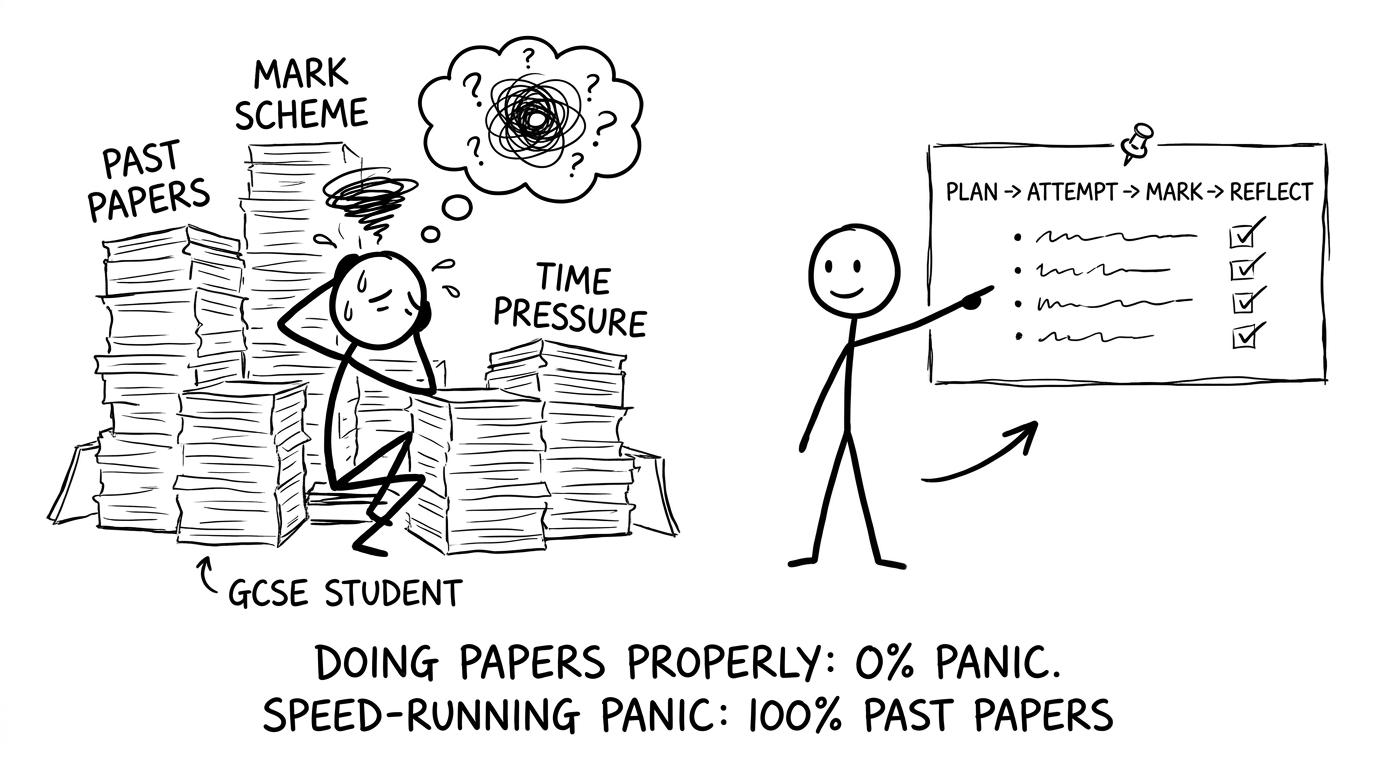 A stick-figure checklist for doing past papers properly
The “properly” checklist (save this)
Use this as your one-page routine for any AQA GCSE English Language past paper:
- Pick the right paper (Paper 1 or Paper 2, correct spec, correct year)
- Set exam conditions (timings, no phone, single sitting)
- Attempt first, mark second (no peeking at mark schemes)
- Mark in two passes: (1) literal marks (2) quality targets
- Create a “next time” action for each question
- Do a short rewrite (10 minutes) using your targets
- Log mistakes like a maths error log
- Cycle back: revisit the same question type within 7 days
On YesGenie, you can keep this cycle tight by pairing past papers with lessons, practice questions, and topic revision across subjects, for example, your maths practice can stay consistent via GCSE Past papers and board-specific pages.
Choosing the right AQA GCSE English Language past papers
Not all GCSE past papers are equal in the moment you’re in.
Match the paper to the skill you’re building
- If you’re building confidence and timing, choose a recent paper and do it fully timed.
- If you’re building one weak area (like evaluation or comparison), you can do a paper selectively, but still under timed conditions for that question.
- If you’re close to exams, rotate papers to cover both reading and writing.
On YesGenie, start from the hub so you’re not hunting PDFs in the dark: AQA GCSE English Language Revision.
Don’t “save” papers forever
Students hoard past papers the way people hoard fresh notebooks. The logic is emotional: “I’ll use them when I’m ready.” But readiness is built by exposure. In maths, you wouldn’t wait until you “feel ready” to practise simultaneous equations. You practise, mark, and improve.
How to sit an AQA GCSE English Language past paper like a real GCSE
Exam conditions aren’t about being strict. They’re about making your practice diagnostic.
Set up exam timing (and why it matters)
AQA English Language has two papers, each with reading and writing sections. Whatever your teacher recommends, your job is consistency: use the same timings every time so you can compare attempts.
If you like maths-style structure, treat time as a budget. For example, if you allocate ttt minutes to a question and you overspend by 555, you must “take” that 555 from somewhere else. It’s simple arithmetic:
Total time=∑(time per question) \text{Total time} = \sum \text{(time per question)} Total time=∑(time per question)The goal isn’t perfection. The goal is learning what your real pace feels like.
Attempt first, mark second (no exceptions)
If you check the mark scheme mid-way, you’re not testing skill; you’re testing memory. In GCSE maths, you’d never open video solutions half-way through a paper and then count the marks as if they’re yours. English works the same way.
Marking AQA GCSE English Language past papers properly
Most students “mark” English by reading the examiner comments, feeling vaguely judged, and moving on. A proper GCSE marking routine is more mechanical than that.
Pass 1: mark for the basics (structure and evidence)
For each question, check:
- Did you answer what the question asked?
- Did you use enough evidence from the text?
- Did you explain your evidence rather than just spotting it?
This is the equivalent of checking in maths whether you substituted correctly before doing algebra.
Pass 2: mark for quality (the part that actually improves grades)
Create two columns:
- What earned marks
- What would have earned the next level
Then write one target you can actually perform next time. Not “be more detailed”. Something like:
- “Embed shorter quotations and analyse individual words.”
- “Write one alternative interpretation and weigh it.”
- “Link language method to effect on reader with a clear because.”
This is your English version of: “I lost marks because I didn’t simplify fully.”
Use YesGenie’s ecosystem so marking turns into action
A past paper is a diagnosis; a lesson is the treatment. If you discover your weakness is “structure under pressure”, you can keep your revision balanced by continuing your maths routine too. Use Resources on YesGenie to rotate between past papers, predicted papers, and shorter tests.
For maths students keeping momentum, board pages like AQA GCSE Maths Revision Guides are ideal for quick topic refreshers between English papers.
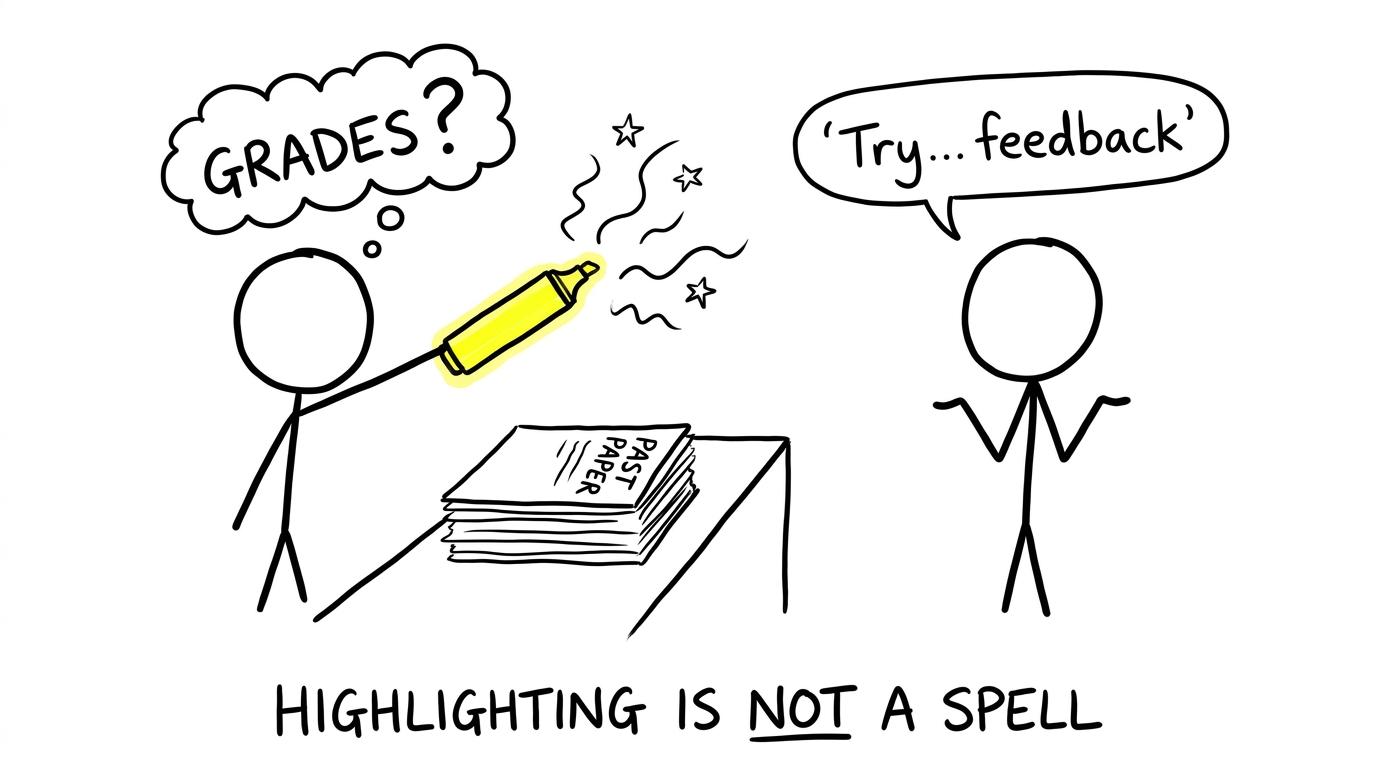 A highlighter used like a magic wand, with the punchline about feedback
A worked method: turning feedback into a higher-mark answer
Let’s make this concrete. Suppose you answered a reading question asking you to evaluate a statement about a writer’s attitude. Your answer includes a quotation and a basic explanation, but it’s stuck in the middle band.
Step-by-step upgrade routine (10 minutes)
Step 1: Keep your original point. Write it in one sentence.
Step 2: Add a zoom-in. Choose one word from your quotation and explore its connotations.
Step 3: Add an alternative interpretation. Write one sentence that begins: “However, it could also suggest…”.
Step 4: Add a judgement. Decide which interpretation is stronger and why.
That’s the English equivalent of showing the full method in maths rather than jumping from the question to the answer. Examiners reward visible thinking.
A maths analogy (because you’re a maths student)
In maths, compare:
- Minimal working: “x=3x=3x=3”
- Exam working:
English is similar: you’re making your reasoning legible so marks can attach to it.
Using AQA GCSE English Language past papers alongside maths revision
Most GCSE students don’t struggle because they’re lazy. They struggle because they’re juggling. Maths, English, science, options, coursework in the background, and a calendar that keeps moving.
Here’s a sustainable rhythm:
- One full English past paper per week (alternate Paper 1 and Paper 2)
- Two short English “rewrites” per week (10-15 minutes each)
- Three maths sessions per week (topic practice + mixed questions)
On YesGenie, keep maths efficient with board-specific practice and papers, such as Edexcel GCSE Maths Past Papers (useful even if you’re not Edexcel, because maths skills transfer well) and structured courses like WJEC GCSE Maths Revision.
If you prefer shorter bursts, build stamina using split resources (where available) and keep your weakness list updated using Other Resources.
Common mistakes students make with AQA GCSE English Language past papers
- Doing papers open-book and then feeling confused by the real exam.
- Marking with vibes, not targets: “I need more analysis” isn’t a plan.
- Ignoring timing data: if you always run out of time, your practice must include pacing.
- Rewriting nothing: improvement comes from editing at least one answer.
- Focusing only on grade labels instead of the next actionable skill.
- Over-highlighting: it looks like work, but it doesn’t create new ability.
- Not balancing subjects: dropping maths for weeks to cram English usually backfires.
Bringing it home: make each GCSE paper change your next week
AQA GCSE English Language past papers aren’t just tests. They’re rehearsals. And like any rehearsal, the magic isn’t in the performance; it’s in what you do after.
If you want a simple promise to keep: every GCSE paper must produce at least three concrete targets and one rewritten answer. That’s how you turn effort into improvement.
When you’re ready, use AQA GCSE English Language Revision to access past papers and exam practice, and keep your maths revision sharp with the wider YesGenie toolkit: GCSE Past papers, Resources, and maths-focused support like AQA GCSE Maths Revision Guides. Build your routine, mark properly, reflect briefly, then practise again. That’s how GCSE grades move, quietly, steadily, and sooner than you think.