EAL GCSE English Resit: A Practical Guide
EAL GCSE English resit advice for faster reading, stronger vocabulary, accurate writing and finding the right exam support, with free practice resources.
Resitting English Language can feel frustrating when you understand the ideas but need longer to process the wording. An EAL GCSE English resit asks you to read unfamiliar texts, interpret subtle meanings and write accurately under time pressure, all in a language you may still be learning.
The most useful response is not to revise every English word. It is to practise the specific reading, vocabulary and writing decisions that earn marks. Start by confirming your exam board, analyse your previous paper or mock, then build a weekly routine around timed reading, precise evidence and checked writing.
MathsGenie’s free GCSE English Language revision hub brings together resources for AQA, Edexcel, Eduqas, OCR and WJEC, so begin with the materials matching your specification.
Your resit preparation checklist
Before doing another full paper, check that you can answer these questions:
- Which exam board and specification are you taking?
- Which reading and writing question types appear on each paper?
- Where did you lose marks previously: understanding, analysis, comparison, timing or accuracy?
- Can you explain what each command word requires?
- Do you have a small vocabulary system that you review regularly?
- Have you asked your teacher, EAL co-ordinator or exams officer what support is available?
- Are you practising under timed conditions as well as completing slower learning tasks?
English Language is untiered, unlike foundation and higher tier GCSE Maths. Every candidate takes the same level of paper for their exam board. That makes familiarity with the paper especially valuable. You should know where extended answers appear, how much they are worth and how long you can reasonably spend on them.
Understand what the examiner is assessing
GCSE English Language is not a test of whether you sound like a native English speaker. It assesses defined reading and writing skills. Across exam boards, these include retrieving information, interpreting ideas, analysing language and structure, comparing viewpoints, evaluating texts and communicating clearly.
Accuracy also matters. The national assessment objectives require vocabulary, sentence structures, spelling and punctuation to be assessed. However, ambitious writing does not mean filling every paragraph with rare words. A precise familiar word is usually safer than an impressive word used incorrectly.
Open your exam board’s past paper beside its mark scheme. For AQA students, the AQA GCSE English Language revision page collects relevant papers and materials. Students following Pearson Edexcel can use the Edexcel GCSE English Language revision page.
For each question, write down three things:
- the skill being assessed;
- the type of evidence needed;
- the shape of a successful answer.
This turns a large language examination into a sequence of recognisable tasks.
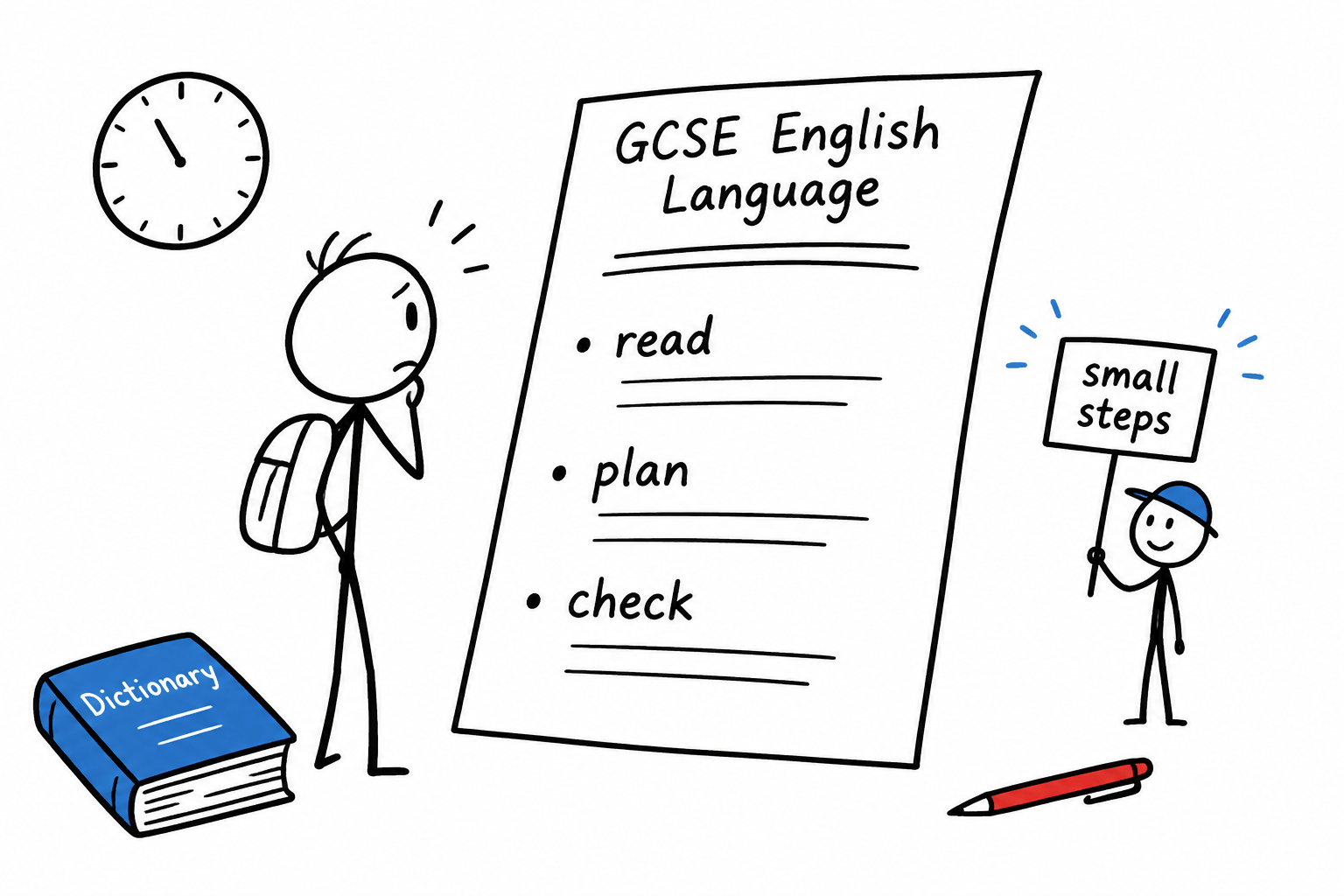 A stick-figure student facing an English exam with a calm reminder to read, plan and check
Improve reading speed without losing understanding
Reading faster does not mean moving your eyes quickly across every line. It means knowing when to skim, when to scan and when to read closely.
Preview the question first
Read the question before studying the relevant section of the source. Circle or underline the command word, the required focus and any specified lines. If the question asks how a writer presents a place as threatening, you are looking for evidence connected to danger, uncertainty or fear. You do not need to decode every unrelated detail first.
Read in layers
Use three passes when practising:
- Skim for the text’s situation, speaker and overall viewpoint.
- Scan for details connected to the question.
- Read the selected lines closely, noticing words, contrasts and changes.
During revision, record how long each pass takes. Reduce the time gradually while checking that your answers remain accurate. Speed without comprehension simply creates a faster mistake.
Stop translating every sentence
Your first language is a resource, not a problem. It can help you understand an idea or plan an answer. But translating every sentence word by word during the exam consumes time and can hide the writer’s tone.
Practise identifying meaning in groups of words. If one unfamiliar word appears, use the surrounding sentence, punctuation and wider paragraph to infer its likely meaning. Continue reading unless that word is essential to the question.
To identify where your reading process breaks down, use the guide to finding your weakest English Language topics. A specific diagnosis, such as selecting weak evidence, is more useful than deciding that you are simply “bad at reading”.
Build vocabulary you can actually use
Long vocabulary lists often create the feeling of work without producing reliable exam language. Build smaller groups organised by purpose.
For reading responses, learn analytical verbs such as “suggests”, “emphasises”, “contrasts”, “implies” and “reinforces”. Understand the difference between them. A contrast places differences together; an implication communicates an idea indirectly.
For viewpoint writing, collect language for agreement, contrast and development:
- “A more convincing explanation is…”
- “Although this may appear reasonable…”
- “The wider consequence is…”
- “By contrast…”
Keep a vocabulary record with four parts: the word, a short meaning, one original sentence and a common collocation. Revisit words after a day, several days and a week. Most importantly, use them in short exam responses. Recognition is not the same as control.
You may also write a quick plan in your first language before expressing it in English during untimed revision. Then compare the two versions. Ask whether the English communicates the same meaning naturally rather than copying the original grammar.
Write accurately under exam pressure
Accuracy improves when proofreading becomes a routine, not an activity attempted in the final few seconds.
Use sentences you can control
Varying sentence structures can create effect, but every sentence needs a clear purpose. Begin with secure structures and add complexity carefully. Watch for recurring EAL difficulties such as missing articles, inconsistent verb tenses, subject-verb agreement and sentence boundaries.
Choose two personal accuracy targets at a time. For example, you might check past-tense endings and full stops for one week. Once these become more reliable, choose the next pair. Trying to correct ten habits simultaneously makes feedback difficult to remember.
Separate planning from checking
Before extended writing, plan your audience, purpose, form and paragraph sequence. After writing, check in passes:
- first for missing words and incomplete sentences;
- next for verbs, agreement and punctuation;
- finally for spelling, capital letters and repeated vocabulary.
Reading one sentence at a time from the end can help you notice technical errors because you are less distracted by the story or argument.
Use past papers as feedback, not judgement
A past paper should produce information, not just a grade. Begin with individual questions completed without a timer. Compare your response with the mark scheme, improve it, then attempt a similar task under time pressure.
Later, complete whole papers in exam conditions. Follow the process in how to use GCSE past papers properly: mark carefully, create an error log and turn each weakness into a new practice task.
Your error log might include four columns: question type, lost marks, reason and next action. “Reading problem” is too broad. “I described the quotation but did not explain the effect of the verb” gives you something concrete to practise.
A consistent short routine usually works better than occasional exhausting sessions. The guide to staying consistent with GCSE English Language revision can help you build a manageable weekly plan. If your home environment is busy, use these English Language revision strategies for limited quiet space.
Ask for support early
Being an EAL student does not automatically provide extra time or another access arrangement. Arrangements depend on current JCQ rules, evidence of need and what represents your normal way of working. Some support is restricted in assessments where reading English is the skill being tested.
Speak to your teacher, EAL co-ordinator, SENCo or exams officer well before the examination. Ask:
- whether your language needs have been assessed;
- what classroom and revision support is available;
- whether any access arrangement may apply;
- how arrangements from a previous centre are transferred for a resit;
- which approved resources you may use in the examination.
Do not assume that a bilingual dictionary, reader or extra time will be permitted. Your centre must check the current regulations and complete any required process. If you are a private candidate, contact the examination centre early because it will need time to review evidence and arrangements.
Common mistakes EAL resit students should avoid
Translating every word: This damages timing and can make idiomatic language more confusing. Focus on the passage’s overall meaning and the words relevant to the question.
Using memorised paragraphs: A prepared paragraph rarely fits an unseen text exactly. Learn flexible methods and sentence structures instead.
Choosing long quotations: Short, precise evidence leaves more time for explanation and analysis.
Using difficult vocabulary inaccurately: Clear communication earns more credit than forced sophistication.
Ignoring feedback after marking: Recording a mark without correcting the answer wastes the most valuable part of the exercise.
Completing only full papers: Full papers test performance. Short, targeted tasks develop the weak skills that affect performance.
Make the resit a more deliberate attempt
A resit is not the same journey repeated. You now know the pressure of the room, the appearance of the paper and the habits that failed to produce the result you wanted. That knowledge has value if you turn it into a precise plan.
Use MathsGenie’s free GCSE English Language resources to find your exam board, practise with past papers and study the mark schemes. Work on one reading or writing weakness at a time, review your vocabulary regularly and ask your centre for support early. Progress in an additional language can feel slow from one day to the next, but the evidence appears in clearer sentences, quicker decisions and fewer repeated errors. Start with one timed question today.