Revise GCSE English Language With No Quiet Space
Revise GCSE English Language with no quiet space: use realistic short sessions, portable resources, task matching and focused exam practice at home.
A quiet room is often treated as the starting point for good revision. For many students, it simply does not exist. The television is on, relatives are talking, siblings need attention and the kitchen table must serve several purposes at once.
If you need to revise GCSE English Language with no quiet space, the answer is not to wait for perfect conditions. Build a portable system, match tasks to the noise around you and protect a few short periods for concentrated writing. You can improve without owning a desk, expensive headphones or an empty house.
The aim is not silence all day. It is enough control to complete the right task at the right time.
Your no-quiet-space revision checklist
Start with this practical system:
- identify the least noisy times in your household;
- use short, specific revision targets;
- separate tasks that tolerate noise from tasks needing concentration;
- prepare a portable revision kit;
- ask your school about supervised revision spaces;
- investigate your local public library with a parent or carer;
- practise reading and writing, rather than only reviewing notes;
- use your own exam board's papers and mark schemes;
- record mistakes and revisit them;
- protect sleep rather than revising deep into the night.
This approach is less impressive than a colour-coded desk photographed for social media. It is also much more useful.
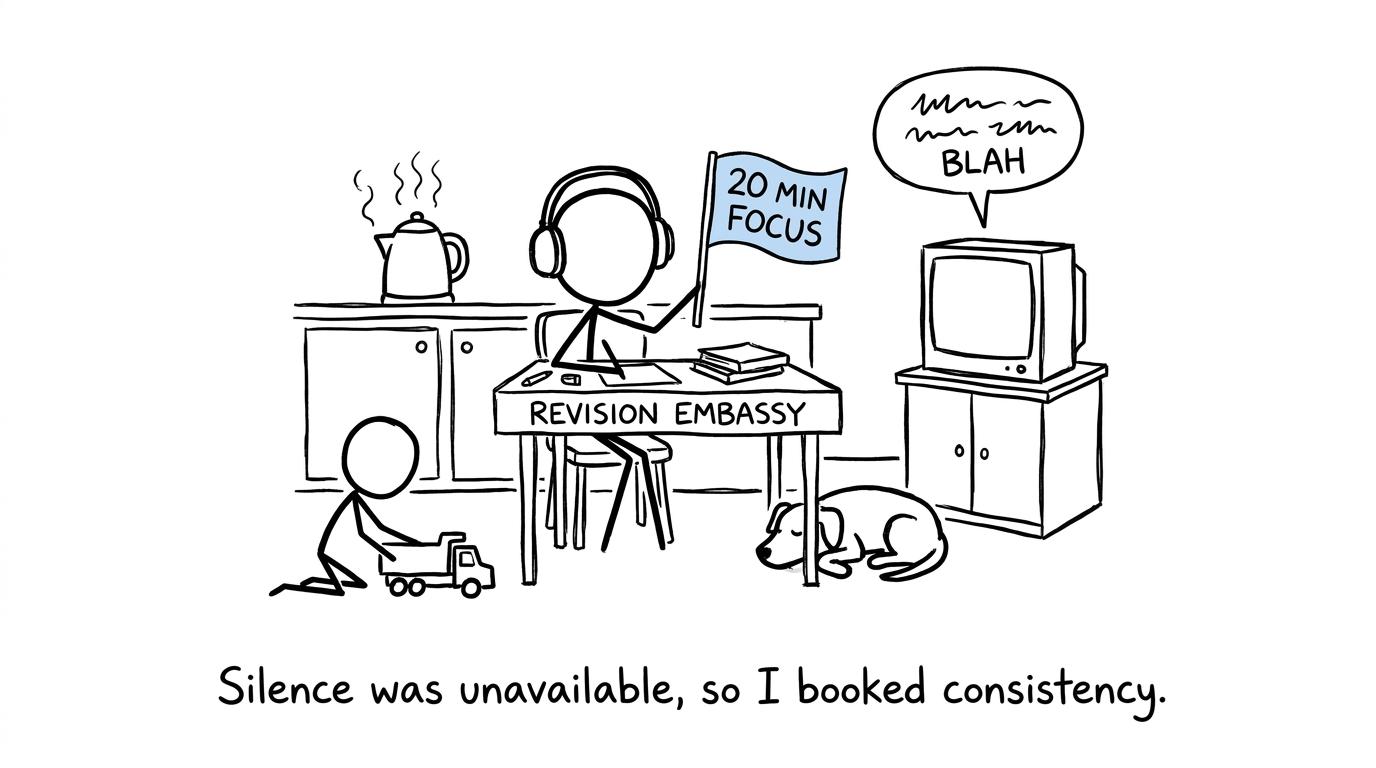 A student calmly creates a short focus period amid household noise
Start with the GCSE English Language skills that earn marks
Noise makes vague revision especially difficult. "Do some English" gives your attention too many places to escape. A precise instruction such as "identify three structural shifts" gives it somewhere to land.
GCSE English Language specifications vary between AQA, Pearson Edexcel, OCR and Eduqas, so use the paper structure and timings provided by your board and teacher. However, the central skills are shared. Reading and writing each account for half of the qualification's assessed marks under the assessment objectives used for GCSE English Language in England.
Your revision should therefore cover:
- retrieving explicit and implicit information;
- selecting relevant textual evidence;
- analysing language and structure;
- comparing ideas and perspectives where required;
- evaluating a text and supporting your judgement;
- adapting writing to purpose, audience and form;
- organising ideas coherently;
- improving vocabulary, sentence control, spelling and punctuation.
Technical accuracy matters substantially. AO6 accounts for one fifth of the marks across the qualification, so punctuation and sentence control should not be left until the final week.
Turn these broad objectives into small tasks. Instead of "revise analysis", choose one paragraph and annotate three deliberate choices. Instead of "practise creative writing", plan an opening, a shift and an ending. Small outputs make progress visible even when the room is busy.
Match the English task to the noise level
Not every revision activity requires the same concentration. This is the most useful idea when silence is scarce: spend your environment carefully.
Tasks for noisy periods
Use noisier times for activities that are short, repeatable or easy to restart:
- sorting vocabulary cards by tone or effect;
- proofreading one paragraph for punctuation;
- learning the meaning of command words;
- reading a short newspaper or magazine passage;
- listing possible arguments for a viewpoint task;
- finding quotations or evidence in a source;
- reviewing feedback from your teacher;
- checking a completed response against a mark scheme;
- listening to a teacher-approved explanation through headphones.
These tasks still require effort, but an interruption does not destroy the whole attempt.
Tasks for quieter windows
Reserve the least noisy moments for work with a higher concentration cost:
- completing a timed reading response;
- writing an extended answer;
- comparing two unseen sources;
- planning and drafting creative writing;
- sitting a full paper or substantial paper section;
- reviewing a difficult response in detail.
Your quietest window might be before the household wakes, immediately after school, during a sibling's activity or at a weekend library session. Do not assume it must be late at night. Regular late-night revision can interfere with sleep, while tired writing often becomes less accurate.
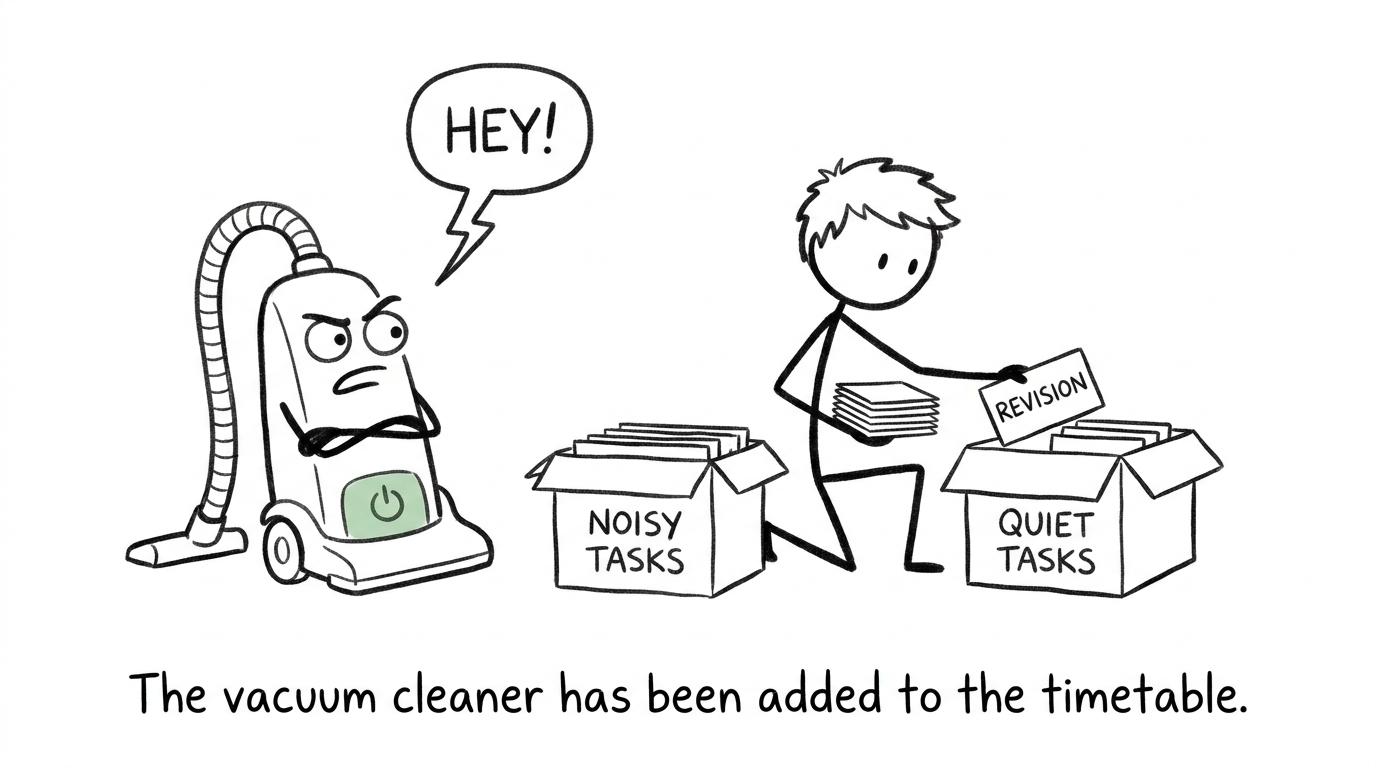 A student sorts revision into noisy and quiet tasks
Build a revision routine that survives interruptions
A fragile plan says, "I will revise English for three hours on Saturday." A resilient plan says exactly what will be produced and what happens if the session is interrupted.
Try a three-part session:
Settle and retrieve
Spend a few minutes recalling one useful idea without notes. This could be the difference between language and structural analysis, the features of persuasive writing, or the feedback from your previous response.
Retrieval gives the session a clear beginning. It also works when you cannot spread books across a large surface.
Complete one exam-focused task
Choose one output small enough to finish: an annotation, a paragraph, a plan or a timed response. Keep your phone on Do Not Disturb unless you genuinely need it for the resource.
Short focus blocks with breaks can be useful, but there is nothing magical about one fixed duration. Choose a block that fits your home. Fifteen purposeful minutes repeated regularly can achieve more than an ambitious session that is constantly postponed.
Mark and leave a restart note
Use your teacher's guidance, the appropriate mark scheme or an approved model response. Write down:
- what worked;
- what cost marks;
- the next action.
Finish with a restart note such as, "Next: rewrite the second paragraph with closer word analysis." If somebody interrupts tomorrow's session, you will not spend half of it remembering where to begin.
This is the same disciplined loop that makes maths revision effective: attempt, mark, diagnose, repair and retest. Students balancing both subjects can use the MathsGenie GCSE revision timetable to organise their maths workload without letting it consume every available quiet period.
Create a portable GCSE English revision kit
When your workspace changes, your resources need to move easily. Keep a small folder, pouch or digital equivalent containing:
- pens and highlighters;
- your exam board's question formats;
- one or two short unseen extracts;
- vocabulary cards;
- teacher feedback;
- a compact mistake log;
- headphones or basic earplugs if they are safe and comfortable for you;
- a timer that does not invite you into social media.
Download or print materials in advance if internet access is unreliable. Photograph teacher feedback, save documents offline and keep paper available for planning. The fewer decisions required at the start, the easier it is to use an unexpected quiet window.
For maths, the same portable system can hold a mini test and correction sheet. The GCSE Maths revision hub provides free resources across Edexcel, AQA, OCR and Eduqas, while Edexcel GCSE Maths mini tests are useful when a full paper is unrealistic.
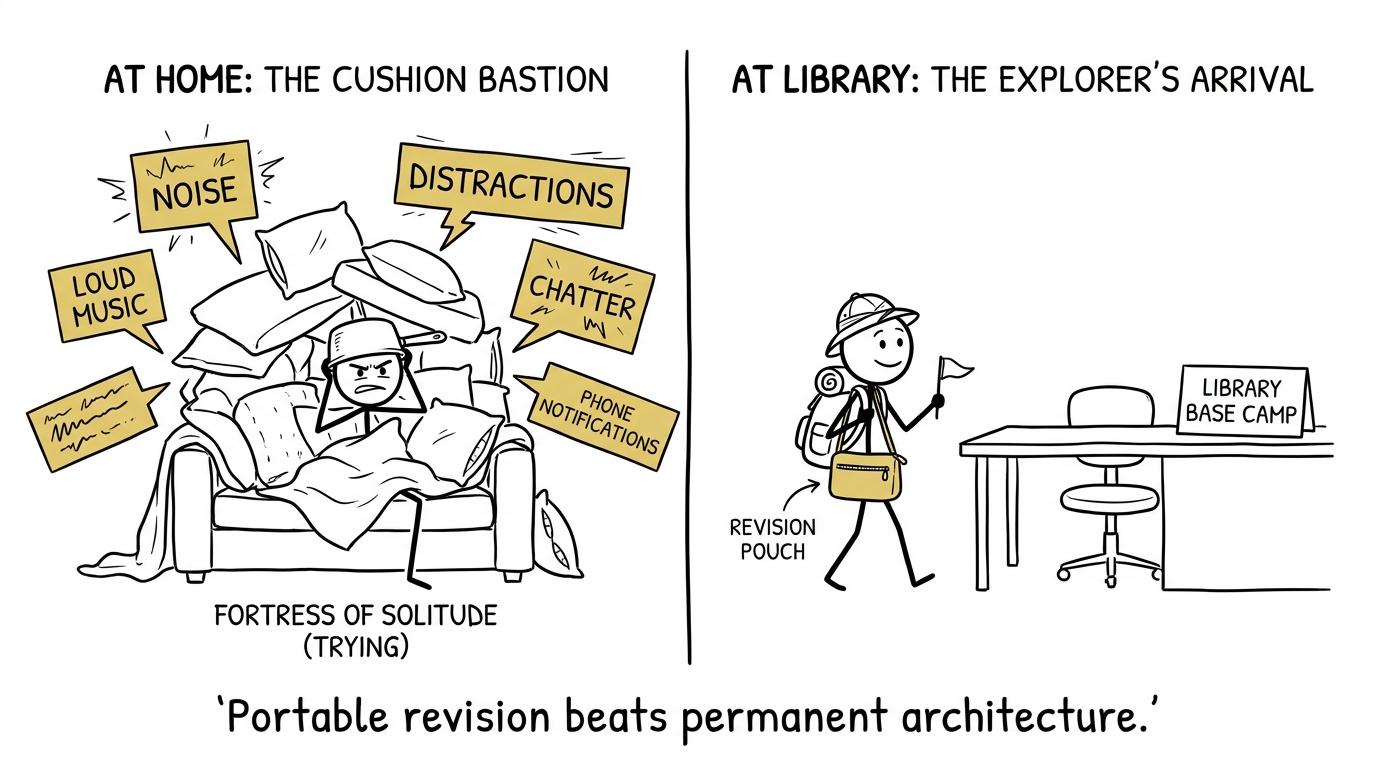 A student abandons a cushion fortress for a portable revision kit
Find quiet space beyond your bedroom
Lack of quiet at home is a practical barrier, not a personal failure. Tell a teacher, form tutor, head of year or trusted adult what is happening. Be specific: explain that you need somewhere to complete timed English responses, rather than simply saying revision is difficult.
Your school may offer lunchtime, after-school or supervised revision sessions. Ask which rooms are available, on which days and whether you need permission to stay. If travelling home later creates a safety or transport problem, raise that too.
A local public library may provide free study space, but check its current opening hours, membership arrangements, age requirements and rules with a parent or carer. A trusted relative's home may also work if the arrangement is safe and agreed in advance.
A café is not automatically suitable: it may be expensive, busy and still noisy. The best external space is one you can access safely and consistently.
When no alternative is available, negotiate a limited quiet window at home. "Please be silent all evening" is difficult for a household to sustain. "Could the television be lower while I complete one timed response?" is clearer. Explain when you will finish and thank people when they help.
Use past papers without demanding perfect silence
Timed work matters because English Language exams require you to read, decide and write within a limit. Yet you do not need full exam conditions every day.
Use three levels of practice:
- Open practice: notes allowed, with pauses for learning.
- Timed section: one question completed without help.
- Full rehearsal: the correct paper, timing and permitted equipment.
Do open practice at home when interruptions are likely. Save full rehearsals for school, a library or the quietest available period. Always check your own board's current paper structure rather than transferring timings or question advice from another specification.
After practice, mark the response and label the problem precisely. "Bad analysis" is too vague. Useful labels include "quotation too long", "effect not explained", "comparison missing" or "paragraph loses its viewpoint".
This mirrors effective maths paper practice. MathsGenie's guide to using GCSE past papers properly explains why the improvement happens after marking. For maths preparation, students can use Edexcel GCSE Maths past papers and add GCSE predicted papers later as extra practice rather than treating predictions as certainty.
Common mistakes when revising without quiet space
Waiting for ideal conditions
If you wait for complete silence, many possible sessions disappear. Match a smaller task to the conditions you actually have.
Using headphones at an unsafe volume
Headphones may soften distracting noise, but they should not block warnings, alarms or instructions from an adult. Keep the volume comfortable and avoid assuming expensive noise-cancelling equipment is essential.
Doing only low-effort tasks
Vocabulary cards and annotations are useful, but they cannot replace extended reading and writing. Protect occasional concentrated sessions for timed responses.
Revising the wrong paper format
Advice for AQA may not match Pearson Edexcel, OCR or Eduqas exactly. Check the board, specification and paper front cover provided by your school.
Measuring time instead of output
Sitting beside a revision guide for an hour proves little. Record what you completed, marked and corrected.
Sacrificing sleep for silence
A silent house after midnight can look like an opportunity. It can also leave you tired in lessons and less able to control your writing. If revision pressure or your home situation is affecting your wellbeing, speak to a trusted adult or member of school staff.
Make imperfect conditions work for you
A quiet room would make revision easier. Not having one does not make progress impossible.
Separate noisy tasks from quiet tasks. Keep resources portable. Ask for school or library access. Practise real reading and writing, mark what you produce and leave a clear instruction for the next session. The routine should bend when home becomes busy without breaking completely.
Then apply the same calm structure across your subjects. MathsGenie is the go-to free resource for building your GCSE maths plan with revision lessons, practice questions, mini tests, mark schemes and video solutions. Start with the one-month GCSE maths revision plan, move into past papers when appropriate and use predicted papers as an additional final-stage rehearsal.
You do not need the perfect room to begin. You need one defined task, the best available place and a plan you can restart tomorrow.