Staying Consistent: GCSE English Language Revision
Staying consistent GCSE English Language revision is easier with a minimum routine, focused practice, useful feedback and a plan for difficult weeks.
Motivation usually disappears at the least convenient moment. You have maths questions waiting, an English response that needs rewriting and a phone offering something easier. The temptation is to promise yourself that tomorrow will be different.
The practical answer to staying consistent GCSE English Language revision is not to manufacture endless motivation. It is to create a routine that still works when you feel tired: a small minimum task, a regular cue, immediate feedback and a simple rule for restarting after a missed session.
That might mean analysing one paragraph, planning one writing task or rewriting one weak response. Small actions can feel unimpressive, but consistency is rarely dramatic. It is mostly the decision to begin before you feel ready.
Your consistency checklist
Use this as your default plan when motivation is low:
- Set a minimum session you can complete in ten minutes.
- Decide the exact task before the session begins.
- Attach revision to an existing cue, such as arriving home or finishing dinner.
- Alternate reading and writing skills across the week.
- Attempt work before opening notes or a mark scheme.
- Record one specific improvement after each task.
- Keep English revision balanced with your GCSE maths workload.
- If you miss a session, restart at the next planned opportunity without trying to repay everything.
MathsGenie’s guide to efficient GCSE English Language revision provides a useful companion structure for choosing worthwhile tasks.
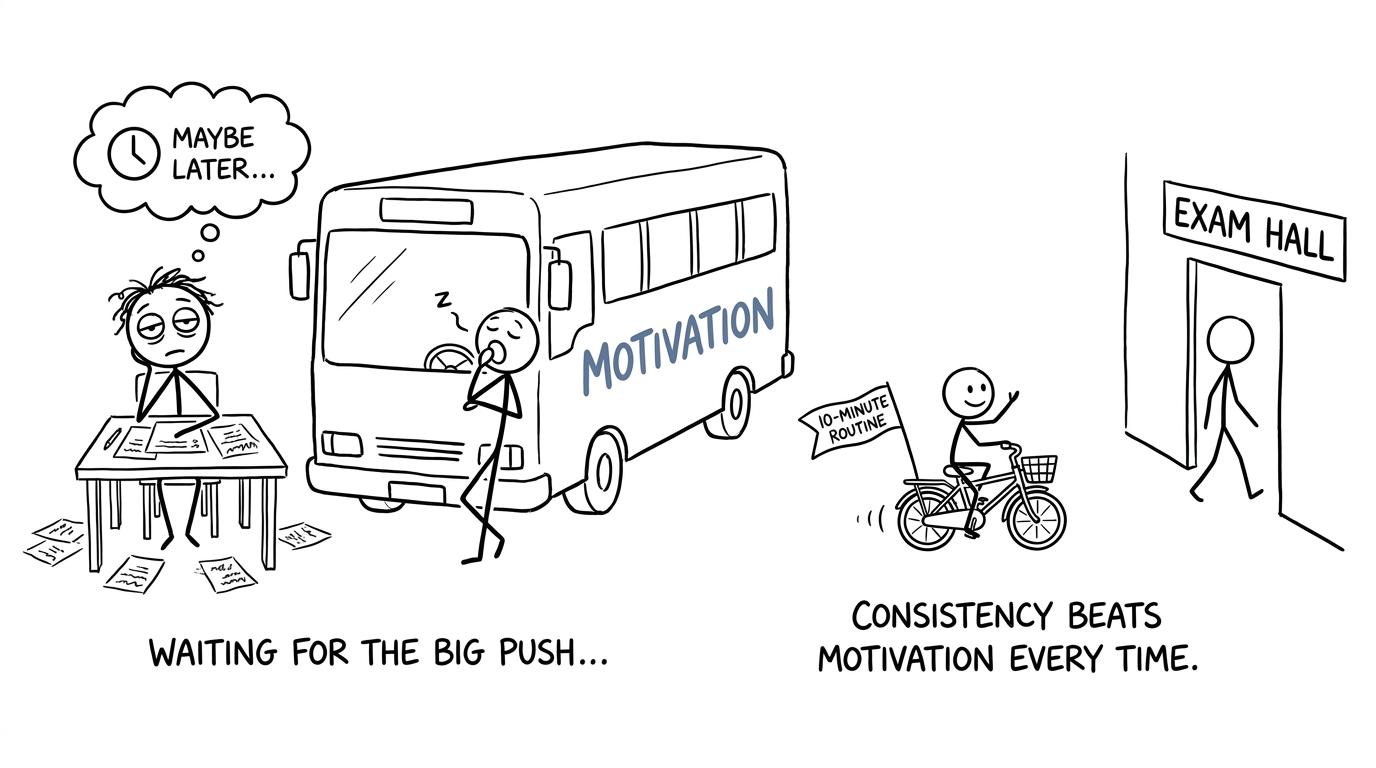 A student chooses a small revision routine instead of waiting for motivation
Stop asking motivation to do a routine's job
Motivation is useful for starting ambitious plans. It is much less reliable on a wet Wednesday after a full school day.
A routine removes the daily negotiation. Instead of asking, “Do I feel like revising English?”, you follow a decision already made: after dinner on Tuesday, complete one reading question. The cue and task stay stable even when your mood changes.
Make the first action almost automatic. Leave the paper ready, put your phone elsewhere and write the question you will answer at the top of the page. Reducing these small decisions matters because an unclear session is easy to postpone.
Your minimum should be deliberately modest. On a difficult evening, it could be:
- identify two methods in an unseen extract;
- plan the order of a transactional response;
- improve the punctuation in one paragraph;
- compare your last answer with one part of the mark scheme;
- rewrite an opening so that its purpose and tone are clearer.
The minimum protects the habit. If energy returns once you start, continue. If it does not, complete the minimum and stop without guilt.
Make every English session produce evidence
English Language revision can feel vague because there is no list of quotations to memorise and no single calculation to complete. The qualification tests transferable reading and writing skills through unseen material. Although paper structures differ between AQA, Edexcel, OCR and Eduqas, the assessment objectives across GCSE English Language cover interpretation, analysis, comparison, evaluation, effective communication and technical accuracy.
That means passive rereading is not enough. A productive session should leave evidence behind: an answer, a plan, an annotation, a correction or a rewritten paragraph.
The Education Endowment Foundation's guidance on metacognition emphasises planning, monitoring and evaluating learning. Applied to English revision, that becomes a simple loop:
- Plan: choose one question type and decide what successful work should contain.
- Monitor: while writing, check the command word, evidence and remaining time.
- Evaluate: use feedback or the mark scheme to identify one change for next time.
If you are unsure which skill needs attention, use the MathsGenie guide to finding your weakest English Language areas. A specific weakness such as “I name techniques without explaining their effects” is far easier to address than “I am bad at English”.
Use the attempt, check, rewrite loop
The most dependable revision cycle is short enough to repeat:
- attempt one focused task without looking at the answer;
- check it against the question, mark scheme and teacher feedback;
- rewrite the weakest part immediately;
- record one instruction for your next response.
The rewrite is important. Reading feedback can create recognition without changing what you can produce independently. Rewriting forces you to perform the improvement while the problem is still visible.
A useful target is behavioural rather than vague. Replace “analyse in more detail” with “select a shorter quotation, examine one word and connect its effect to the question”. Replace “improve writing” with “check that each paragraph has a clear purpose and that the tone suits the audience”.
MathsGenie explains this feedback process in its guide to using GCSE mark schemes effectively. AQA students can also follow the more specific routine for using AQA English Language past papers properly.
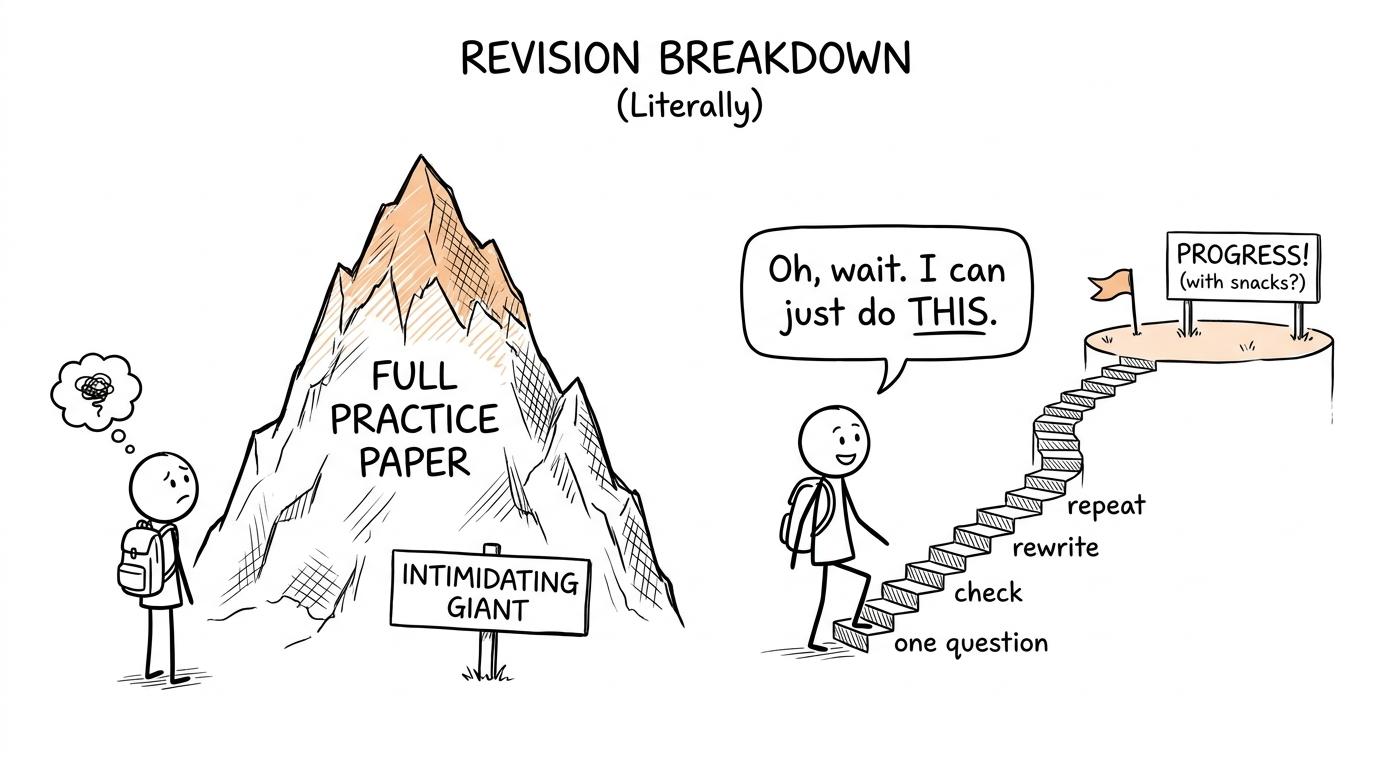 A huge practice paper becomes manageable when divided into small steps
Build a weekly plan that survives difficult weeks
A strong plan has two versions: the normal week and the difficult week. Without a reduced version, one busy evening can collapse the entire timetable.
Your normal week
Aim for three distinct English sessions:
- Reading practice: complete one analysis, comparison or evaluation question appropriate to your board.
- Writing practice: plan a response and write a substantial section under time pressure.
- Feedback practice: mark, annotate and rewrite previous work.
Use the correct board resources. The AQA GCSE English Language revision hub and Edexcel GCSE English Language revision hub organise relevant lessons, questions, past papers and mark schemes.
Your difficult week
Shrink each session rather than abandoning the subject:
- annotate one paragraph instead of a complete extract;
- plan one response instead of writing it fully;
- rewrite one paragraph instead of reviewing a whole paper.
This is not lowering your ambition. It is protecting continuity until your available time and energy improve.
Keep one evening free if possible. Rest should be part of the plan rather than treated as a failure to revise. A timetable with no margin tends to break as soon as schoolwork, illness or family commitments change the week.
Borrow the clarity of maths revision
Students preparing for maths exams already know what purposeful practice feels like. You answer a question, check the method, find the error and try again. English needs the same feedback discipline, even though responses are less binary.
Treat question types like maths topics. Track whether the difficulty lies in:
- understanding the task;
- selecting evidence;
- analysing language or structure;
- comparing perspectives;
- evaluating convincingly;
- organising ideas;
- controlling vocabulary, sentences, spelling and punctuation;
- completing the response within the available time.
Then practise the smallest skill that addresses the problem. Do not complete another full paper merely because full papers look serious. Papers diagnose weaknesses; focused practice repairs them.
This approach also protects maths revision. English Language is untiered, unlike foundation and higher tier GCSE maths, but both subjects reward familiarity with their actual assessments. Keep your mathematics work moving through the GCSE maths revision hub, where you can select your exam board and use revision lessons, practice questions, mini tests and papers.
On particularly busy days, the twenty-minute GCSE maths revision routine can help you maintain one subject while giving the longer session to English.
Measure consistency without becoming obsessed
Do not measure success only by hours. A long session can contain very little deliberate practice, while a focused fifteen minutes can repair a recurring mistake.
At the end of each week, ask:
- Which question types did I actually attempt?
- What feedback did I apply?
- Which weakness appeared more than once?
- Did I practise reading and writing?
- What is the smallest useful task for next week?
A simple record needs only the date, task and next action. Avoid elaborate trackers that take longer to maintain than the revision itself.
Also expect occasional missed sessions. Consistency does not mean a perfect record. It means returning quickly. Do not respond to one missed Tuesday by planning an exhausting weekend catch-up. Complete the next scheduled task and allow the routine to resume.
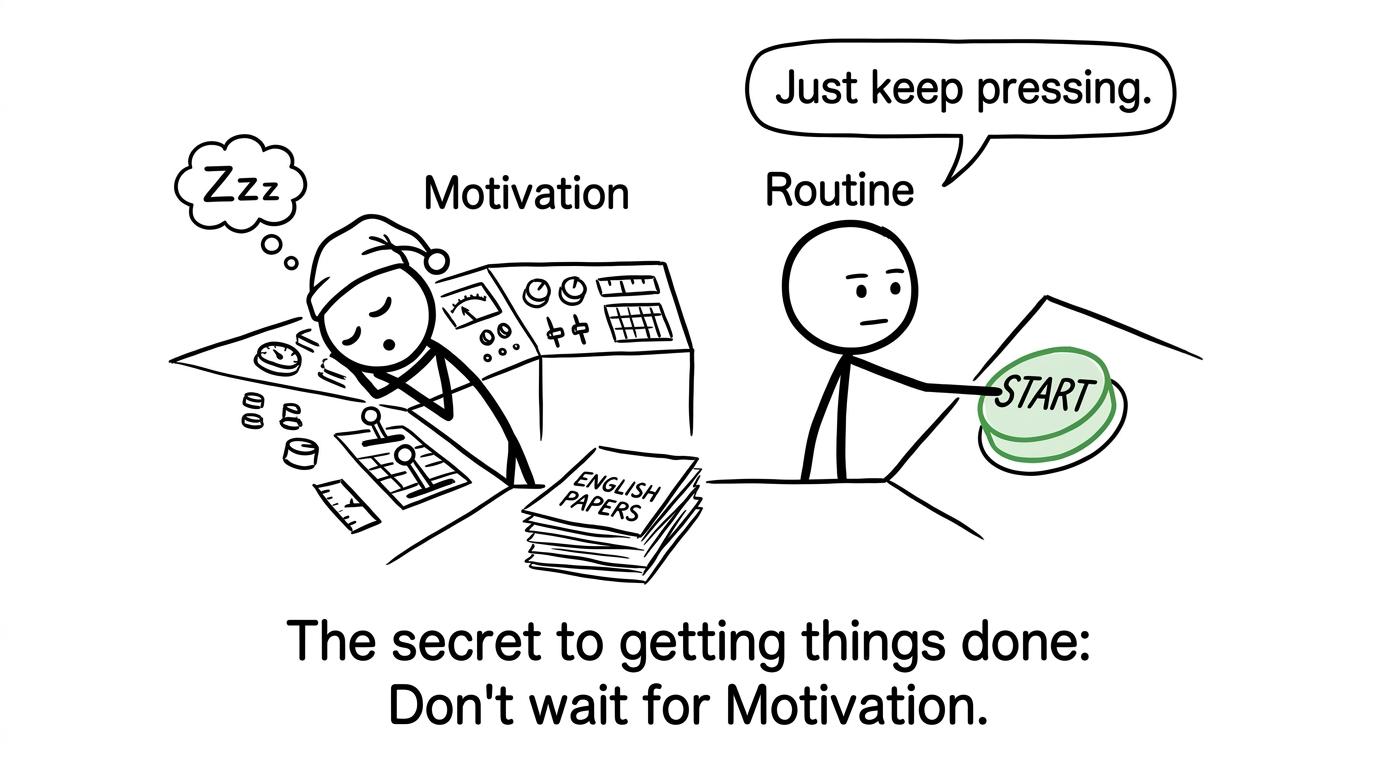 Routine calmly starts the revision session while motivation sleeps
Common mistakes when motivation dips
Making every session a full paper
Full papers develop timing and stamina, but they demand considerable energy. Use individual questions and rewrites between full-paper attempts so that practice remains sustainable and weaknesses receive attention.
Revising “English” without naming a task
“Revise English” creates too many choices. Decide the board, paper, question and outcome in advance. The clearer the starting instruction, the less motivation you need.
Copying notes instead of producing responses
Terminology lists and paragraph frames can support revision, but improvement requires independent attempts. Close the notes and produce something that can be checked.
Treating a missed day as a ruined week
This turns a scheduling problem into an identity problem. Missing one session says nothing about your ability or commitment. Restart with the next small task.
Ignoring feedback because it feels uncomfortable
Repeatedly attempting questions without changing anything can reinforce the same habits. Use mark schemes carefully, seek teacher feedback where available and rewrite while the advice is fresh.
Letting English consume the maths timetable
English responses can expand to fill any available time. Give sessions a clear finish point, then return to your maths priorities. MathsGenie’s GCSE revision resources provide mini tests, self-assessment materials and structured paper practice when you need a defined next step.
Consistency is the skill beneath the subject
The weeks when you feel motivated are not the real test of a revision plan. The real test is whether the plan still gives you a sensible next action when school has been difficult, another subject needs attention or the exam feels uncomfortably close.
Choose one small English Language task now. Attempt it, check it and rewrite one part. Then schedule the next session before you stop.
Use MathsGenie as your free revision home base: choose the correct English Language board resources, practise with past papers and mark schemes, and keep GCSE maths progressing through revision lessons, practice questions, mini tests, video solutions and predicted papers. Motivation may come and go. A clear routine gives you somewhere reliable to return.