Do GCSE ICT Class Sets Matter for Your Grade?
GCSE ICT class sets matter less than your course, teaching and revision habits. Learn what sets can change, what they cannot, and how to improve your grade.
It is easy to treat a set number as a prediction. Move up, and a high grade suddenly feels possible. Move down, and it can feel as though a decision has already been made about your future.
But do GCSE ICT class sets matter in that way? The short answer is no: your set does not directly determine the grade printed on your certificate. It can influence the pace of lessons, the support you receive and how confidently you see yourself. Yet the examiner marks your answers or assessed work, not the classroom in which you learnt it.
There is also an important qualification point. In England, the old GCSE Information and Communication Technology qualification was discontinued. Schools may still use “ICT” informally for GCSE Computer Science, digital qualifications or Level 111/222 vocational courses. Before worrying about your set, find the exact qualification title, awarding organisation and specification you are following.
The answer at a glance
- A higher set does not automatically produce a higher grade.
- A lower set does not impose a formal grade ceiling unless it changes your qualification or exam entry.
- GCSE Computer Science is normally untiered, unlike GCSE Maths, so students taking the same specification can access the full grade range.
- “ICT” may refer to Computer Science or a vocational digital qualification, and their assessment structures differ.
- Sets can affect lesson pace, expectations, support and confidence, so they are not meaningless.
- Focused practice, accurate feedback and specification coverage are more useful predictors of progress than a set label.
- If your class is not covering what you need, speak to your teacher early rather than silently trying to compensate.
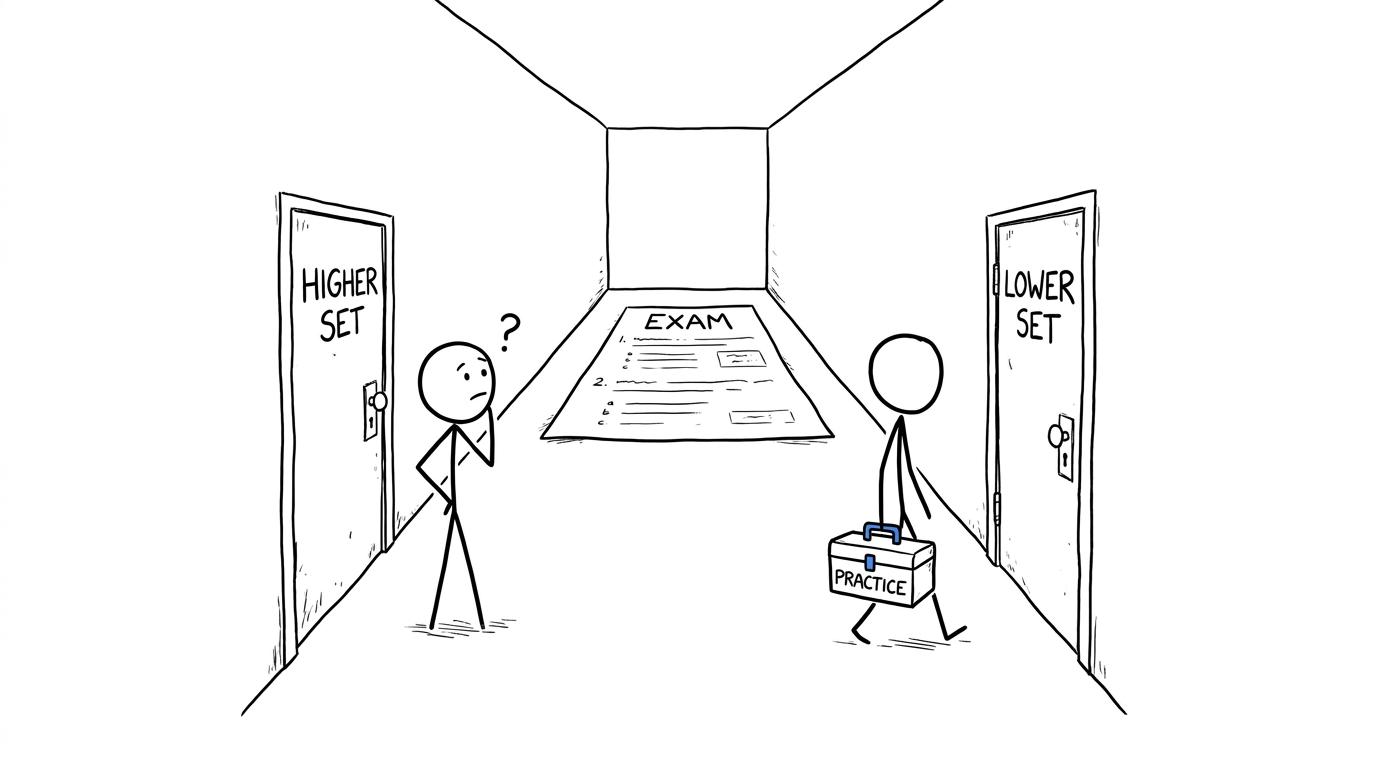 Two classroom doors lead towards the same examination while practice provides the useful tools
First, find out what “GCSE ICT” means at your school
This is the detail that changes the whole conversation.
The former GCSE ICT qualification is no longer available in England, but the name has survived in everyday school language. Your timetable might say ICT while you are actually taking GCSE Computer Science, an OCR Cambridge National, a Pearson BTEC Tech Award or another digital qualification. Students in Wales or Northern Ireland may follow different national arrangements again.
Ask your teacher or examinations officer for four pieces of information:
- the exact qualification title;
- the exam board or awarding organisation;
- the specification code;
- the assessment method, including examinations and any internally assessed components.
Do not assume that a friend at another school is taking the same course because both timetables say ICT. A course based largely on written Computer Science examinations creates different revision demands from one containing assessed vocational assignments.
The same principle matters in maths. You should know your board and tier before choosing resources, which is why the GCSE Maths topics by exam board and tier guide begins with those basic checks.
Does a higher or lower set change the grade available?
For GCSE Computer Science
Current GCSE Computer Science qualifications are untiered. There is no Foundation paper reserved for one group and Higher paper reserved for another in the way there is for GCSE Maths. If two classes are entered for the same specification, they work towards the same qualification and grade scale.
This distinction is crucial. In GCSE Maths, Foundation and Higher tier entries affect the range of grades available. Your maths tier therefore matters formally. A Computer Science set number is normally an internal school arrangement rather than an examination tier.
Your school may place different sets on different courses, however. One group might take GCSE Computer Science while another follows a vocational digital qualification. If that happens, the consequence comes from the qualification entry, not the name of the set itself.
For vocational ICT or digital qualifications
Vocational qualifications can include examined units, internally assessed work or a combination of both. Rules vary between specifications, so check the current course documents rather than relying on general advice about “ICT coursework”.
Being in a particular class might affect which qualification your school enters you for. Once entered, your result is still determined by the relevant assessment criteria. A class label is not itself part of the mark scheme.
What class sets can genuinely change
Saying sets do not decide your grade is not the same as saying they have no effect.
The pace and depth of teaching
A higher set may move through familiar material quickly and spend longer on demanding applications. A lower set may receive more modelling, repetition and guided support. Neither approach is automatically better for every student.
Fast teaching can create hidden gaps. Slower teaching can provide stronger foundations, but it becomes a problem if the class does not reach all required specification content. The real question is not “Is this the best set?” It is “Am I learning the full course at a pace that lets me understand and apply it?”
Expectations and confidence
Set labels can become stories students tell themselves. “I am in a lower set” quietly turns into “I am bad at this subject.” That second statement does more damage than the first.
Recent educational evidence on setting and streaming does not show that separating pupils by prior attainment reliably improves outcomes for everyone. The evidence base is limited, but it suggests that lower-attaining pupils can be disadvantaged while benefits for higher-attaining pupils are small. Set placement should therefore be treated as a snapshot of current attainment, not a measurement of fixed ability.
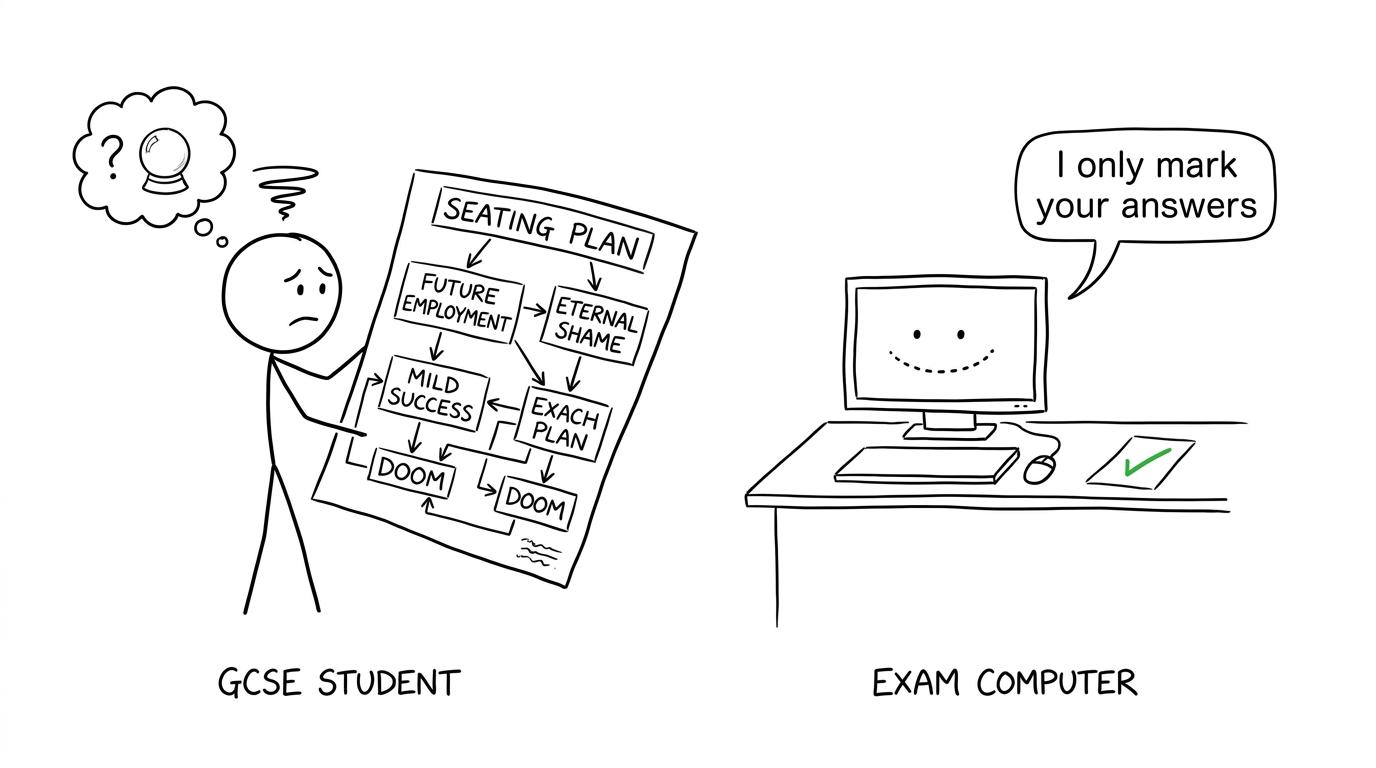 A computer reminds a worried student that it marks answers rather than seating plans
Access to feedback and practice
A student improves when mistakes become specific. “Revise programming” is vague. “I cannot trace nested selection accurately” gives you something to fix.
That process matters across ICT, Computer Science and maths. MathsGenie’s GCSE Maths revision hub provides free revision lessons, questions, worksheets, papers and solutions organised by board and topic. Even if your immediate concern is an ICT set, it offers a useful model for effective independent revision: identify a precise gap, learn it, practise it, mark it and return to it later.
Effort matters, but effective effort matters more
It is tempting to replace one oversimplification with another. If set placement does not decide the result, perhaps everything “comes down to effort”. That is not quite right either.
Teaching quality, prior knowledge, available technology, feedback, attendance and personal circumstances all affect learning. Students do not begin from identical positions. Effort is important because it is one of the factors you can influence, but hours alone are a poor measure of revision.
A productive routine has a short feedback loop:
- identify one weak area from a test, assignment or specification checklist;
- review the relevant knowledge or process;
- answer questions without copying notes;
- check against the mark scheme or teacher feedback;
- record the exact reason for each lost mark;
- revisit the skill after a gap.
This is better than rereading a folder for an evening and calling it revision. The GCSE Maths revision timetable shows how to build focused topic sessions, marking and timed practice into a realistic week.
How to improve from any set
Audit specification coverage
Print or save your specification and mark each area as secure, developing or not yet covered. For Computer Science, that may include algorithms, programming, data representation, computer systems, networks, cyber security and the wider impacts of digital technology. Use the headings from your own specification because wording and organisation vary between boards.
If an area has not been taught, ask when it will be covered. A calm, specific question is more useful than assuming your class has been forgotten.
Turn tests into a marks-leak list
After each assessment, classify what went wrong:
- missing knowledge;
- weak application;
- inaccurate terminology;
- misunderstood command word;
- incomplete explanation;
- programming or logical error;
- poor timing.
Your set cannot make this list for you. Once you have it, however, your next revision session becomes obvious.
Use the same approach for maths. Short topic tests and papers from the MathsGenie GCSE resources can reveal whether marks are being lost through knowledge, accuracy or exam technique.
Build the supporting maths
Computer Science specifications include computing-related mathematical skills. Depending on the course, you may meet binary and hexadecimal representation, logic, data capacity calculations and algorithmic reasoning. Confidence with number and structured problem-solving helps.
If numerical work feels fragile, strengthen the foundations rather than treating it as an ICT-only problem. The best order to learn GCSE Maths topics gives a sensible progression from number fluency to algebra, graphs, geometry, statistics and exam technique.
Use papers at the right time
Do not wait until every topic feels perfect. Begin with individual questions or short timed sections, then progress to complete papers once most content has been covered. The purpose is diagnosis before it becomes performance.
Maths students can use the guide on when to start GCSE past papers to plan that transition. For ICT or Computer Science, use official materials for your exact specification and apply the same paper, mark, repair and retest cycle.
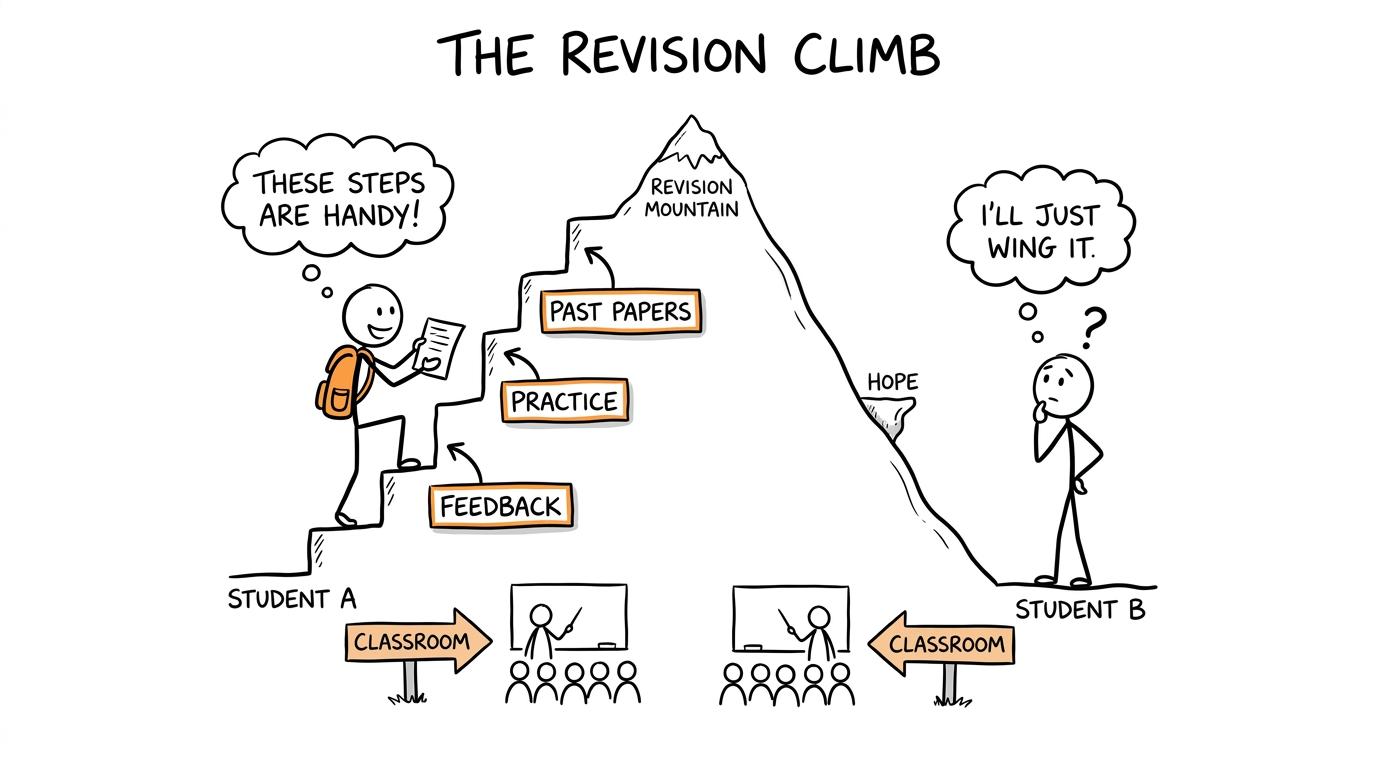 Students from different classroom sets climb the same revision mountain using feedback, practice and past papers
When should you ask to move sets?
A move may be worth discussing if your current class consistently works at an unsuitable pace, does not follow your intended qualification or is not giving you access to appropriate challenge and support.
Bring evidence rather than relying only on frustration. You could show:
- recent assessment results;
- completed extension work;
- a record of independently repaired weaknesses;
- teacher feedback;
- evidence that you are secure across current class content.
Also ask what criteria the school uses and when placement is reviewed. A move is not always possible because of timetables or class sizes. If you remain where you are, ask for a practical alternative: extension questions, extra feedback, access to another resource or a date for reconsideration.
Common mistakes when thinking about ICT sets
Confusing a set with an exam tier
A set is usually an internal grouping. A tier or qualification entry is an assessment decision. Check what you are actually entered for.
Assuming the top set guarantees success
Faster lessons do not replace retrieval, programming practice, accurate terminology or careful paper review. A strong class environment helps only if you use it.
Treating a lower set as a permanent judgement
Set placement usually reflects previous attainment and school organisation. It does not appear on your examination script or certificate.
Revising the wrong qualification
Generic “GCSE ICT” resources may not match your specification. Confirm the board, code and assessment structure before investing time.
Measuring revision by hours
Three unfocused hours can produce less learning than one short session built around a specific error. Track corrected weaknesses and improved answers, not time alone.
Your set is a starting place, not a finishing line
A class can shape your experience, but it does not write your result in advance. The qualification you are entered for matters. Complete specification coverage matters. Teaching, feedback and access to practice matter. Your response to all of those things matters too.
Begin by confirming your exact ICT or Computer Science course. Then identify one weakness, practise it, check the result and repeat. For your maths preparation, make MathsGenie’s free GCSE Maths revision resources your starting point. Use revision lessons and practice questions to repair individual topics, mini tests to check recall, and past papers, predicted papers, mark schemes and video solutions to build exam readiness.
Your set number is information. It is not a verdict.