Do GCSE Engineering Class Sets Matter?
GCSE engineering class sets matter less than access, feedback and practice. Learn what really affects your result and how maths revision can help.
A set number can feel like a verdict. Move up and it seems as though someone has confirmed you are capable; move down and it can feel as though a door has quietly closed. So, do GCSE engineering class sets matter to your final result?
The short answer is: your set may influence your classroom experience, but it does not directly determine your GCSE Engineering grade. Your assessed work, subject knowledge, mathematical accuracy, practical decisions and exam performance determine the outcome. A higher set is not awarded extra marks, and a lower set is not marked more harshly.
However, the honest answer is more nuanced than simply saying “effort is everything”. Teaching pace, expectations, specialist support, equipment and feedback can all affect how easy it is to make progress. Your task is to separate the label you have been given from the preparation you can control.
The quick answer: what actually matters?
Keep this checklist in mind:
- Your class or set is not an assessment criterion.
- Your school decides how classes are organised; the exam board assesses the submitted work and examination.
- GCSE Engineering includes both a written examination and non-exam assessment, so consistent work matters.
- Mathematical skills are assessed in engineering contexts.
- Your maths set can affect your GCSE Maths tier entry, but it does not automatically decide your Engineering grade.
- Regular practice, precise feedback and familiarity with the specification matter more than the name of your class.
- If your class is not giving you enough challenge or support, speak to your teacher early.
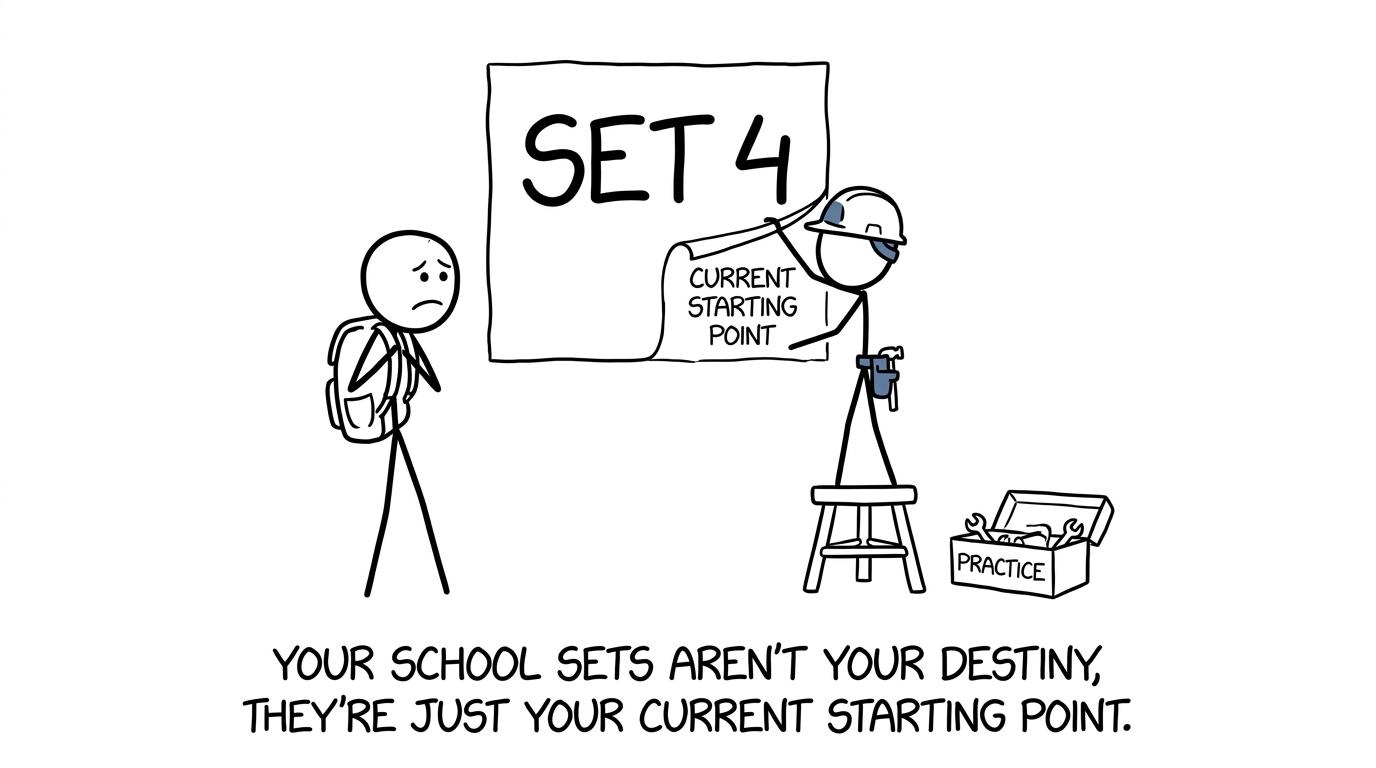 A student discovers that a set number is only a current starting point
What does a class set really tell you?
Setting usually means grouping students by current attainment in a particular subject. Streaming places students in similar groups across several subjects. Neither system is a permanent measurement of intelligence or future potential.
The Education Endowment Foundation’s evidence review reports that setting and streaming produce negligible average differences in progress, although outcomes vary between groups and studies. It also describes the evidence base as very limited. That matters because strong claims in either direction, “top sets guarantee success” or “sets make no difference at all”, go beyond what the evidence can support.
A set normally reflects some combination of previous assessments, teacher judgement, working pace and timetable constraints. It may describe where your performance was at one point. It cannot describe how accurately you will measure a component, how thoughtfully you will evaluate a design or how effectively you will revise six months later.
In engineering language, the set is an initial condition. It is not the finished product.
How GCSE Engineering is actually assessed
Students should always check the specification used by their school. The current AQA GCSE Engineering qualification, specification code 885288528852, has two assessed components:
- a written paper worth 60%60\%60% of the qualification;
- non-exam assessment worth 40%40\%40%.
The written examination lasts 222 hours and carries 120120120 raw marks. The non-exam assessment carries 808080 raw marks. The final result therefore comes from evidence you produce, not the set in which you were taught.
The assessment objectives reward three broad areas:
- knowledge and understanding of engineering principles and processes;
- application of knowledge, understanding and practical skills;
- analysis and evaluation of evidence in engineering contexts.
Application has the largest overall weighting at 50%50\%50%. That is a useful reminder: knowing facts matters, but being able to use them in an unfamiliar situation matters even more.
Your teacher and school will also manage important parts of the non-exam assessment. This means attendance, access to suitable facilities, timely feedback and careful project management can genuinely affect your opportunity to demonstrate what you know. Effort matters, but effort works best when it is paired with the right guidance and resources.
Why maths can influence your Engineering result
Engineering turns mathematical ideas into decisions. A dimension must be accurate. A graph must communicate what happened. A formula must use compatible units.
The AQA specification expects students to apply Key Stage 333 and Key Stage 444 mathematical knowledge in engineering contexts. Its required skills include:
- decimals, standard form, ratios, fractions and percentages;
- calculations involving time and cost;
- significant figures and arithmetic means;
- Pythagoras’ theorem and trigonometry;
- substitution and changing the subject of a formula;
- plotting, interpreting and finding the gradient of graphs;
- area, volume, density, pressure, stress and strain calculations.
Relevant engineering relationships include:
ρ=mV\rho = \frac{m}{V}ρ=Vm P=FAP = \frac{F}{A}P=AF I=VRI = \frac{V}{R}I=RVThese are not separate pieces of decorative maths. They help describe materials, forces, circuits and performance.
If these foundations feel uncertain, begin with the free GCSE Maths revision hub. It provides revision lessons, practice questions and solutions across exam boards including Edexcel, AQA, OCR and Eduqas. The best order to learn GCSE maths topics can also help you rebuild the necessary skills in a sensible sequence.
Does being in a higher set give you an advantage?
Sometimes, but not automatically.
A higher set may move faster, attempt more demanding questions or operate with higher expectations. That environment can be useful if it gives students more challenge and greater independence. Yet the label itself carries no marks. A student who rushes through lessons without checking mistakes can still underperform.
A lower set may offer more explanation, repetition and teacher support. Those can be advantages. The risk appears when a class receives a narrowed curriculum, slower progression without good reason or the message that ambitious outcomes are not expected.
This is why the practical question is not merely, “Which set am I in?” Ask instead:
- Am I covering the complete specification?
- Do I know how my work is assessed?
- Am I receiving precise feedback?
- Can I practise questions at an appropriate level?
- Do I know which mathematical skills are costing me marks?
Those questions expose the conditions that actually shape progress.
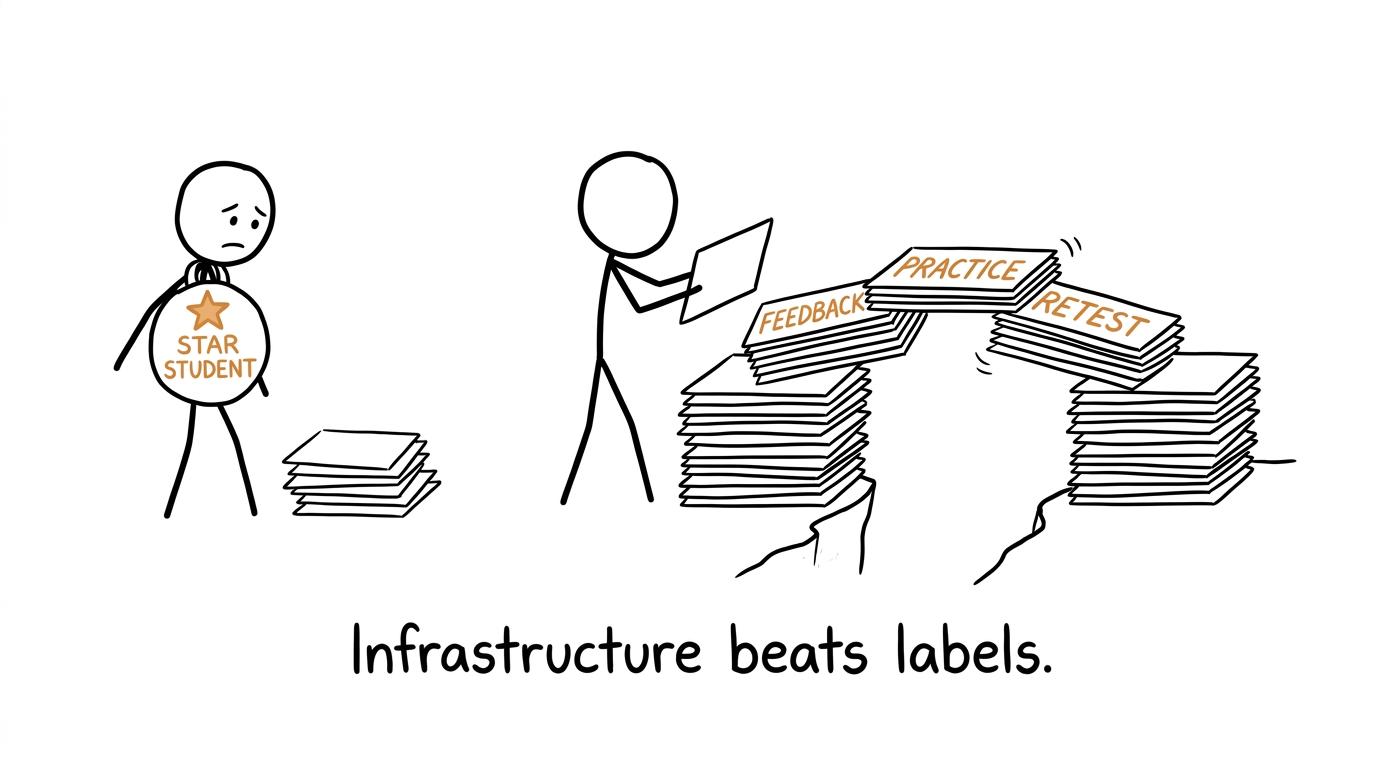 Students discover that feedback and practice build a stronger bridge than a classroom label
Your Engineering class and your Maths set are different
This distinction is important. Your school may organise Engineering and Maths independently. Being in a lower maths set does not automatically mean you cannot succeed in Engineering, particularly when you deliberately strengthen the mathematical topics the course uses.
Your GCSE Maths tier entry is a separate issue. Foundation tier awards grades 111 to 555, while higher tier awards grades 444 to 999, with a limited grade 333 available under the relevant awarding rules. Schools use evidence to decide which tier gives a student the best chance of a secure result.
If your maths set appears to be affecting your tier entry or access to necessary content, ask your maths teacher what evidence would support a review. Make the conversation specific. Recent assessments, completed topic tests and improved paper scores are more persuasive than simply saying you want to move.
You can gather that evidence through carefully marked practice. The Edexcel GCSE Maths past papers include papers and mark schemes, while students following another board can choose the appropriate section from the main revision hub.
What to do if you think your set is holding you back
Check the real gap
Complete a short mixed test and classify every lost mark. Was it caused by missing knowledge, weak application, inaccurate calculation or misreading the question?
A vague worry becomes manageable once it has a name. The advice in GCSE maths revision when you are stuck at a pass grade is useful for turning lost marks into a focused topic list.
Build a repeatable revision loop
Use a simple cycle:
- learn or revisit one method;
- answer practice questions without copying;
- mark the work immediately;
- record one precise correction;
- retest the skill on another day.
This works better than waiting for a set change to create motivation. A structured GCSE maths revision timetable can help you fit short sessions around Engineering coursework and other subjects.
Ask for challenge, not just promotion
Moving set may be appropriate, but it is not the only solution. Ask for extension questions, additional specification content, feedback on a project section or a chance to demonstrate improvement in the next assessment.
A calm question such as “Which two areas would I need to improve to work successfully at the next level?” is actionable. It invites evidence rather than argument.
Practise under assessment conditions
Topic practice develops individual tools; timed papers test whether you can select those tools under pressure. Maths Genie’s guide to when to start GCSE past papers explains how to move from short sections to complete papers.
Near the examination, use predicted papers as additional practice rather than as a list of guaranteed topics. The guide to predicted GCSE maths topics explains how to use predictions without neglecting the wider specification.
Common mistakes about class sets and Engineering
Treating a set as a permanent ability label
Sets normally reflect current attainment and school organisation. Performance can change. Concentrate on the next piece of evidence you can produce.
Assuming effort is the only factor
Effort is essential, but access to teaching, equipment, feedback and appropriate content also matters. Raise genuine barriers with your teacher rather than blaming yourself for conditions you cannot fix alone.
Ignoring the maths because Engineering is practical
The official content includes formulae, data, graphs, units and numerical reasoning. Avoiding maths leaves a predictable weakness in both written and practical contexts.
Revising only comfortable topics
Familiar revision feels productive because it goes smoothly. Better revision targets the skills repeatedly causing lost marks. A one-month GCSE maths revision plan can provide enough structure to keep weak topics in view.
Comparing class labels between schools
“Set 222” has no universal meaning. Schools use different numbers of sets, entry policies and teaching arrangements. Compare specifications, assessment evidence and skills, not labels.
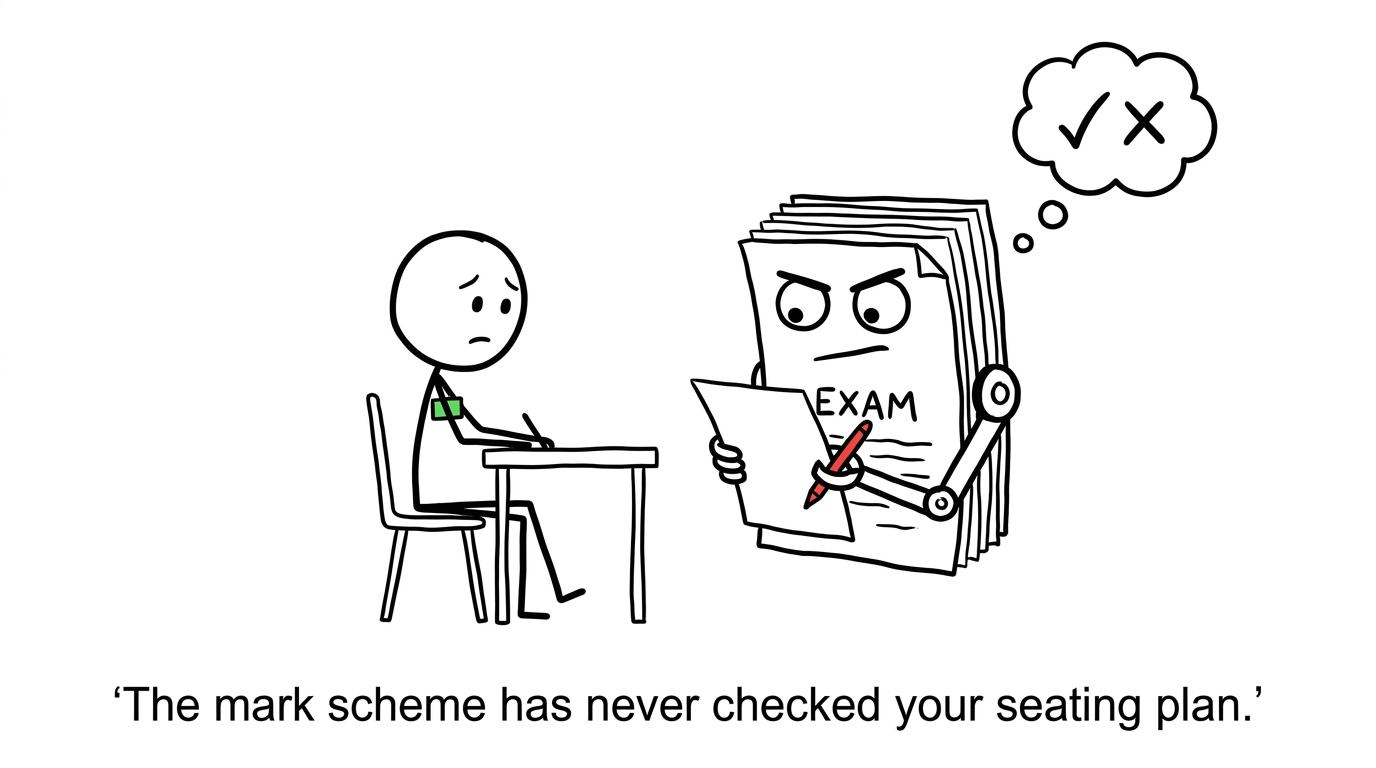 An exam robot ignores the student's set badge and checks only the submitted answers
Your set is a circumstance, not a result
A higher set can provide useful challenge. A lower set can create obstacles if expectations or access are restricted. Neither one writes your examination answers or completes your assessed work.
What changes outcomes is the quieter infrastructure around performance: complete subject coverage, accurate practice, useful feedback, repeated correction and the confidence to ask for support. Those things are less visible than a set number, but they are far more powerful.
Start with the MathsGenie GCSE Maths revision hub. Choose the mathematical skill that causes the most difficulty in Engineering, use the free revision lesson, complete the practice questions and check your method with the solutions. Then build towards mini tests, past papers and predicted papers with mark schemes and video solutions.
Your classroom tells you where today’s lesson happens. It does not decide where your GCSE result has to finish.