Do Documentaries Help GCSE History? Honest Guide
Documentaries help GCSE History when paired with recall and exam practice. Learn how to watch effectively, and when reading is better for your revision.
Revision has a convincing disguise. Sometimes it looks like a desk, a textbook and a pile of practice questions. Sometimes it looks like sitting comfortably while a documentary plays.
So, do documentaries help GCSE History? Yes, but mainly as a tool for building context, chronology and interest. Watching alone is unlikely to improve your grade substantially because GCSE History exams require you to recall precise knowledge, analyse causes and consequences, evaluate evidence and construct supported judgements.
A documentary can make the past feel coherent. It cannot, by itself, teach you how your exam board awards marks.
That distinction matters particularly if you are balancing History with GCSE Maths. Every hour has an opportunity cost. An enjoyable documentary may be worthwhile, but it should not quietly replace the active practice needed in either subject.
The short answer: when documentaries are useful
A documentary is most valuable when it:
- matches a topic on your specification;
- gives you a clear overview before detailed revision;
- helps you visualise chronology, places and relationships;
- presents an interpretation you can question;
- is followed by recall, checking and exam practice.
It is less valuable when it:
- covers an interesting period that is not on your course;
- simplifies a complicated debate without acknowledging uncertainty;
- encourages you to watch passively for a long time;
- replaces textbook reading, source work or timed answers;
- leaves you feeling familiar with a topic without testing what you remember.
The sensible conclusion is not that documentaries are good or bad. Their value depends on what you do before, during and after watching.
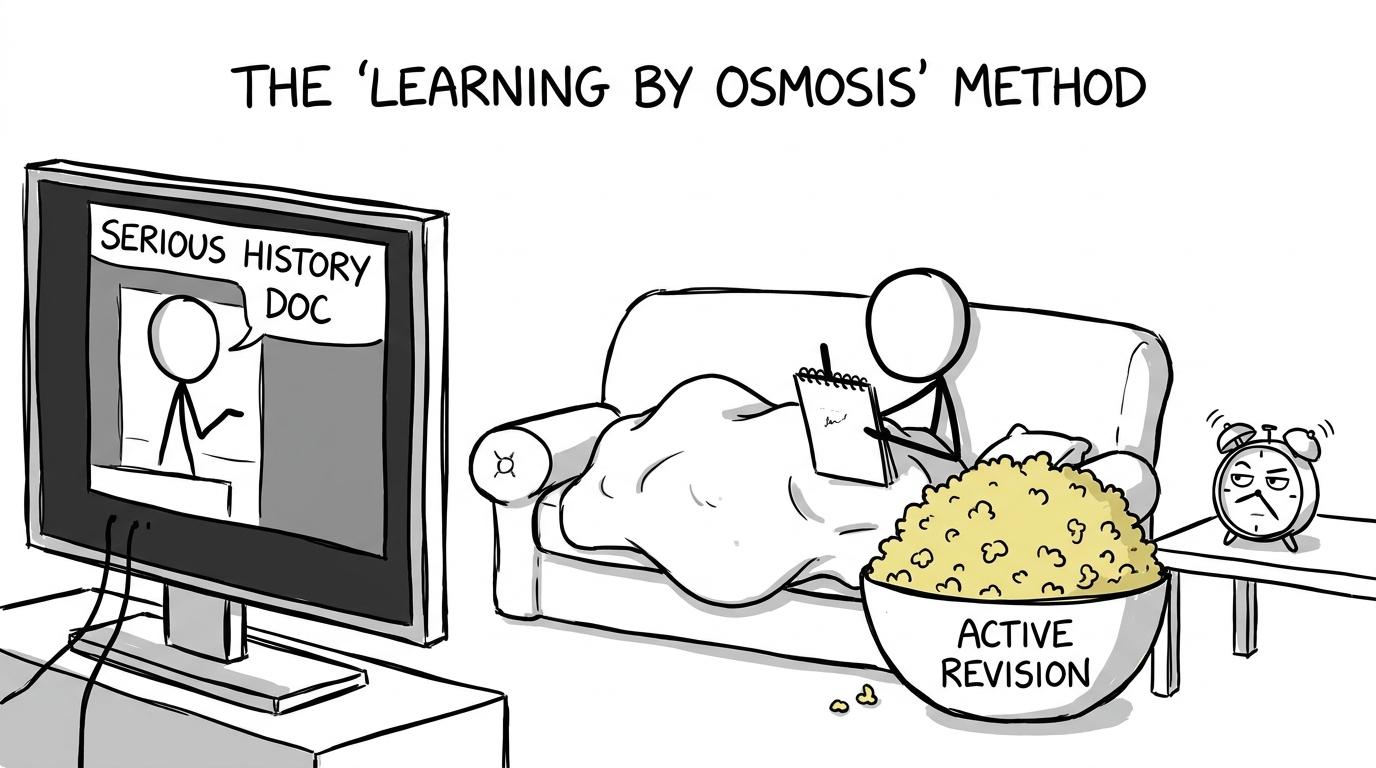 A student confidently mistaking popcorn and a documentary for active revision
What GCSE History exams actually assess
Across GCSE History specifications, the assessment objectives are set nationally. Although Edexcel, AQA, OCR and Eduqas organise their papers and topics differently, students are expected to demonstrate four broad abilities:
- accurate knowledge and understanding;
- explanation and analysis using concepts such as cause, consequence, change, continuity, significance, similarity and difference;
- analysis and evaluation of contemporary sources;
- analysis and evaluation of historical interpretations.
Documentaries can contribute to all four, but unevenly.
They can strengthen background knowledge and make causal connections easier to see. They can also provide an interpretation of events worth analysing. However, a finished documentary is a modern presentation, not automatically a contemporary source from the period. It may combine narration, archive material, reconstruction, music and selective editing.
That makes it something to think about critically, not something to copy unquestioningly.
Most importantly, the examiner does not award marks because a programme felt memorable. Marks come from answering the exact question with relevant knowledge, explanation and judgement.
How documentaries can genuinely improve your understanding
They make chronology easier to follow
History textbooks often divide a period into themes. That is useful for detailed revision, but it can make events feel disconnected. A well-structured documentary restores the sequence: one decision creates pressure, another event changes the situation, and later consequences become easier to understand.
This narrative framework can act like a mental map. When you return to your notes, individual facts have somewhere to belong.
They reveal relationships between events
Students sometimes remember isolated facts but struggle to explain why they matter. Documentary narration frequently emphasises relationships between political decisions, economic pressures, individual actions and public reactions.
That can support questions about causation, consequence and significance. The documentary supplies the broad picture; your specification and class materials supply the precise evidence.
They make unfamiliar settings more concrete
Maps, archive footage, photographs and reconstructions can help you picture places and conditions that are difficult to imagine from a short paragraph. This is particularly useful at the beginning of a topic, when nearly every name and institution feels unfamiliar.
Visual clarity is not the same as factual mastery, but it can make later reading less demanding.
They can increase curiosity
Enjoyment has real value. A student who becomes curious about a period may read more carefully, ask better questions and persist with difficult material.
But curiosity is the beginning of revision, not its final form. You still need to convert interest into knowledge you can retrieve and use under timed conditions.
Why passive watching is not enough
Learning research distinguishes between encountering information and retrieving it. While watching, information can feel obvious because the narration, images and chronology are all in front of you. Once the screen closes, much of that support disappears.
This creates a familiar trap: recognition feels like knowledge.
Active recall exposes the difference. If you cannot explain the main causes, identify the turning point or reconstruct the sequence without replaying the programme, the material is not yet secure.
Research on educational video also suggests that learning improves when viewers actively process what they watch, for example, by pausing, summarising, self-explaining and checking their understanding. The evidence does not mean every documentary automatically produces better results. It means video becomes more useful when it stops being purely passive.
The same principle applies to maths. Watching a solution can make a method look easy; completing an unseen question reveals whether you can actually use it. MathsGenie’s GCSE Maths revision hub combines explanations with questions, papers and self-testing so that watching becomes a bridge to practice rather than the destination.
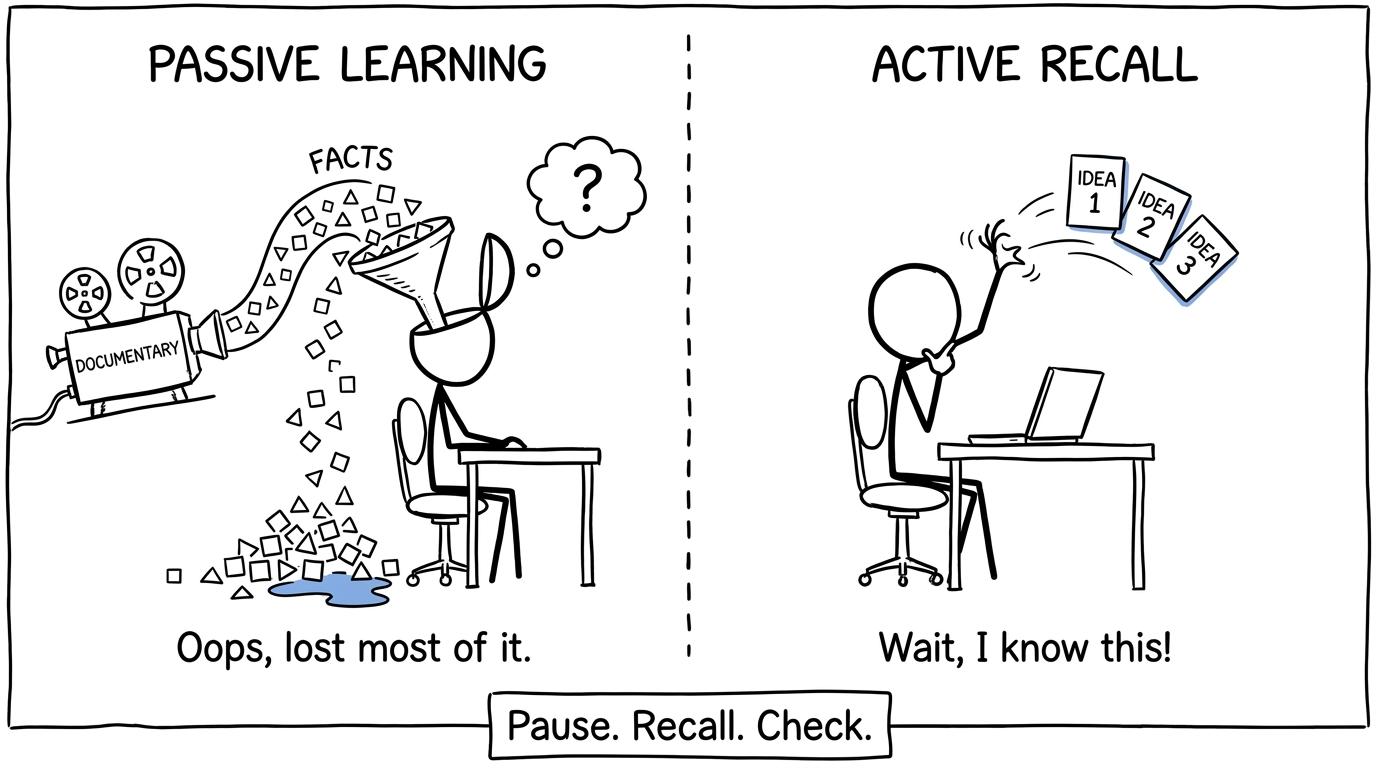 A student uses pause, recall and check to stop documentary facts escaping
A better way to watch a History documentary
Check the specification first
Confirm that the programme overlaps with the exact period, depth study or thematic study taught by your school. Similar titles can conceal very different coverage.
Write down a narrow purpose before pressing play. You might focus on chronology, a particular cause, the significance of one development or the documentary’s overall interpretation.
Watch in manageable sections
A long programme encourages attention to drift. Stop at natural transitions instead. After each section, close or pause the video and record from memory:
- the most important claim;
- the evidence used to support it;
- one connection to your course;
- one detail that needs checking.
Writing everything the narrator says creates a transcript, not revision. Selective notes require more thought.
Separate fact from interpretation
Documentaries are constructed accounts. Ask:
- Who produced the programme, and for what audience?
- Which historians or witnesses are included?
- What argument does the narration appear to favour?
- Which events receive the most attention?
- Could the same evidence support a different conclusion?
These questions do not prove that the programme is unreliable. They help you recognise it as an interpretation rather than an unfiltered view of the past.
Check your notes against trusted course materials
Compare names, dates, claims and terminology with your textbook, teacher materials and current exam-board specification. A documentary may range beyond your course, use dramatic shorthand or present a disputed claim confidently.
Your exam answer should be built around the content and skills required by your specification.
Finish with retrieval and exam practice
Without looking at your notes, produce a short timeline, a cause-and-consequence map or a plan for an exam question. Then check what you missed.
Repeat the recall on another day. Delayed retrieval is more revealing than immediately rereading a neat page of notes.
This learn-practise-check cycle also protects your maths revision time. MathsGenie’s guide to finding weak GCSE topics explains how evidence from questions can guide the next session instead of relying on what merely feels difficult.
Is reading around GCSE History worthwhile?
Yes, provided that “reading around” has a purpose.
Reading can add detail, show competing interpretations and deepen your understanding of context. It is especially useful when your textbook gives only a compressed explanation of a complicated development.
However, more information is not always more useful. Extra reading can introduce names, debates and examples that your course does not require. That may enrich your understanding, but it can also crowd out the precise knowledge needed for the examination.
A good order is:
- learn the specification content;
- practise the relevant question types;
- identify a genuine gap or uncertainty;
- read or watch selectively to deepen that area;
- return to an exam task.
Documentaries are often better for overview and atmosphere. Reading is usually better for precise detail, slower comparison and checking a claim. Exam questions are better for learning how to turn knowledge into marks. You need not choose only one method, but each should have a defined job.
Balancing History documentaries with maths revision
If maths is one of your priority exams, protect time for written problem-solving. A History documentary can fit into a lighter evening or the end of a demanding revision block, but it should not absorb the time assigned to practising weak maths topics.
Use a simple test: what evidence will this activity produce?
A worthwhile documentary session should leave you with a recall page, corrected misconceptions or an exam plan. A worthwhile maths session should leave you with completed questions, marked work and a specific error to fix.
For busy days, the MathsGenie 202020-minute revision routine provides a compact structure. If exams are approaching, the one-week GCSE Maths revision plan can help you allocate active practice before using spare time for wider viewing.
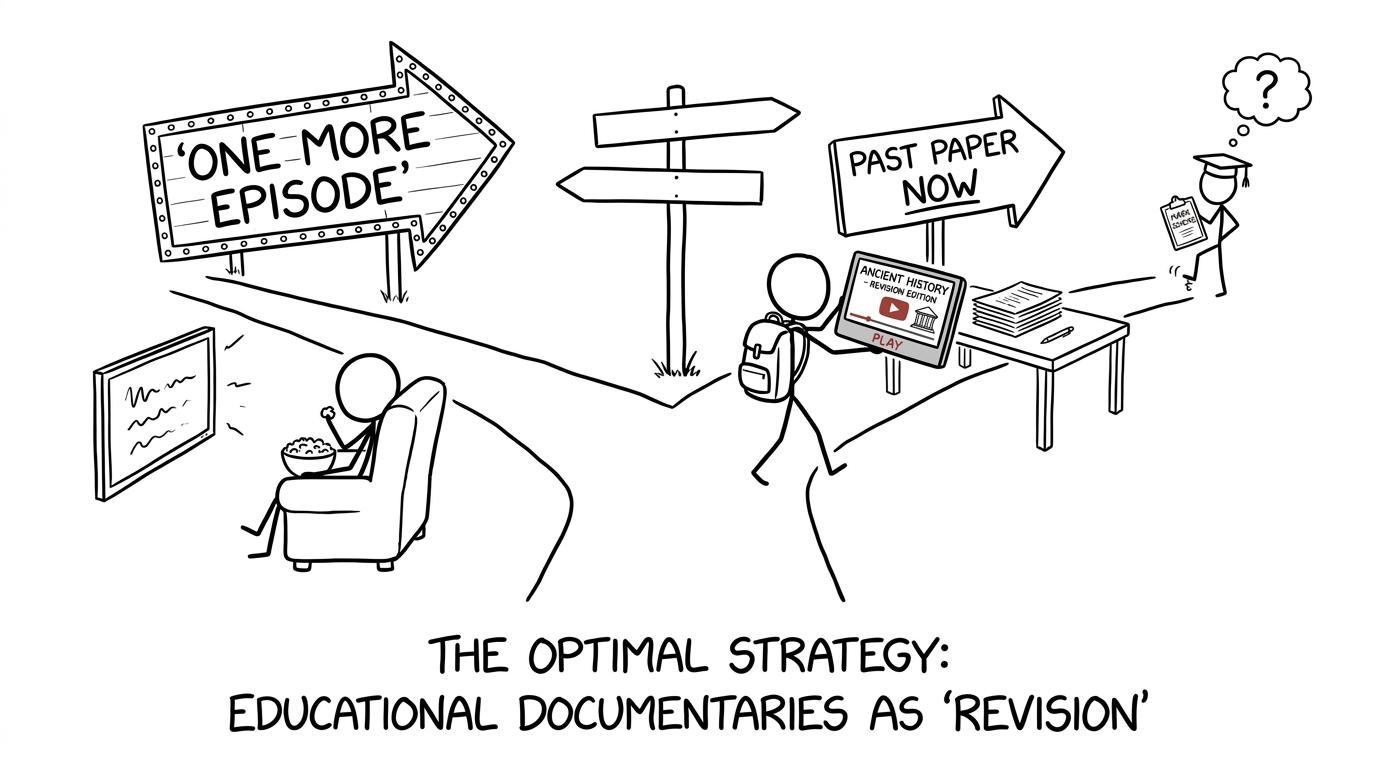 A student combines the documentary path with the past-paper path
Common mistakes when using documentaries for revision
Choosing entertainment instead of specification coverage
An excellent documentary can still be poor revision if it barely overlaps with your course. Check the topic before committing your time.
Watching while distracted
A programme playing beside messages, games or unrelated homework is background noise. If you cannot concentrate, save it for another time or choose a shorter task.
Copying every detail
Dense notes can create the appearance of effort without identifying what matters. Capture arguments, connections and selected evidence, then retrieve them from memory.
Treating dramatic presentation as proof
Music, reconstruction and confident narration make an argument persuasive, but they do not establish its accuracy. Verify important claims and consider what has been selected or omitted.
Replacing exam practice with content consumption
Knowing more history does not automatically produce a well-structured answer. Practise applying knowledge to your board’s command words and mark schemes.
The same error appears in maths when students watch explanations but avoid questions. The guide to starting GCSE past papers explains how to move gradually from topic practice to timed work. Nearer the examination, use the GCSE Maths night-before plan rather than attempting a documentary marathon or unfocused cramming.
Make every revision activity earn its place
Documentaries can help GCSE History. They can provide the story that makes separate facts connect, offer interpretations to question and make an unfamiliar period easier to enter. Reading around the subject can deepen that understanding further.
But enjoyable learning and effective exam preparation are not always identical. The grade improvement comes when you retrieve what you watched, verify it against the specification and apply it to examination questions.
Keep the documentary. Just give it a job.
Then protect the rest of your timetable. Use MathsGenie’s free GCSE Maths resources to move from revision lessons and video solutions into practice questions, mini tests, past papers, predicted papers and mark schemes. Watch when watching helps. Write when the examination requires you to write. And let completed, checked work, not time spent looking at a screen, be the measure of your revision.