Cramming vs Learning GCSE ICT: Know the Difference
Cramming vs learning GCSE ICT explained: spot false confidence, use retrieval and spaced practice, and build knowledge that survives exam pressure.
The evening before an exam can create a convincing illusion. You recognise every term on the page, your notes look familiar and the chapter suddenly seems manageable. Then the exam asks you to apply that knowledge to an unfamiliar situation, and the certainty disappears.
That is the practical difference between cramming vs learning GCSE ICT. Cramming helps information feel familiar for a short time. Learning means you can retrieve, explain and apply it without your notes, even after a delay and under exam pressure.
The quickest test is simple: close the book. If you can explain the idea, answer a fresh question and correct your reasoning, you are learning. If you can only recognise the answer when you see it, you are probably cramming.
A quick cramming or learning checklist
You are more likely to be cramming if you:
- reread or highlight for most of the session;
- copy definitions without explaining them;
- revise an entire unit once and never revisit it;
- avoid questions until you feel completely ready;
- check answers before making a genuine attempt;
- judge progress by time spent rather than what you can recall.
You are more likely to be learning if you:
- retrieve ideas with the notes closed;
- explain why an answer is correct;
- apply knowledge to unfamiliar scenarios;
- practise questions and use feedback;
- revisit topics across several days or weeks;
- track specific errors and test them again later.
This distinction matters beyond ICT. The same false confidence appears in maths when a method looks obvious in a revision video but becomes difficult on a blank page. MathsGenie's guide to efficient GCSE maths revision uses the same basic cycle: learn briefly, practise, mark, fix and revisit.
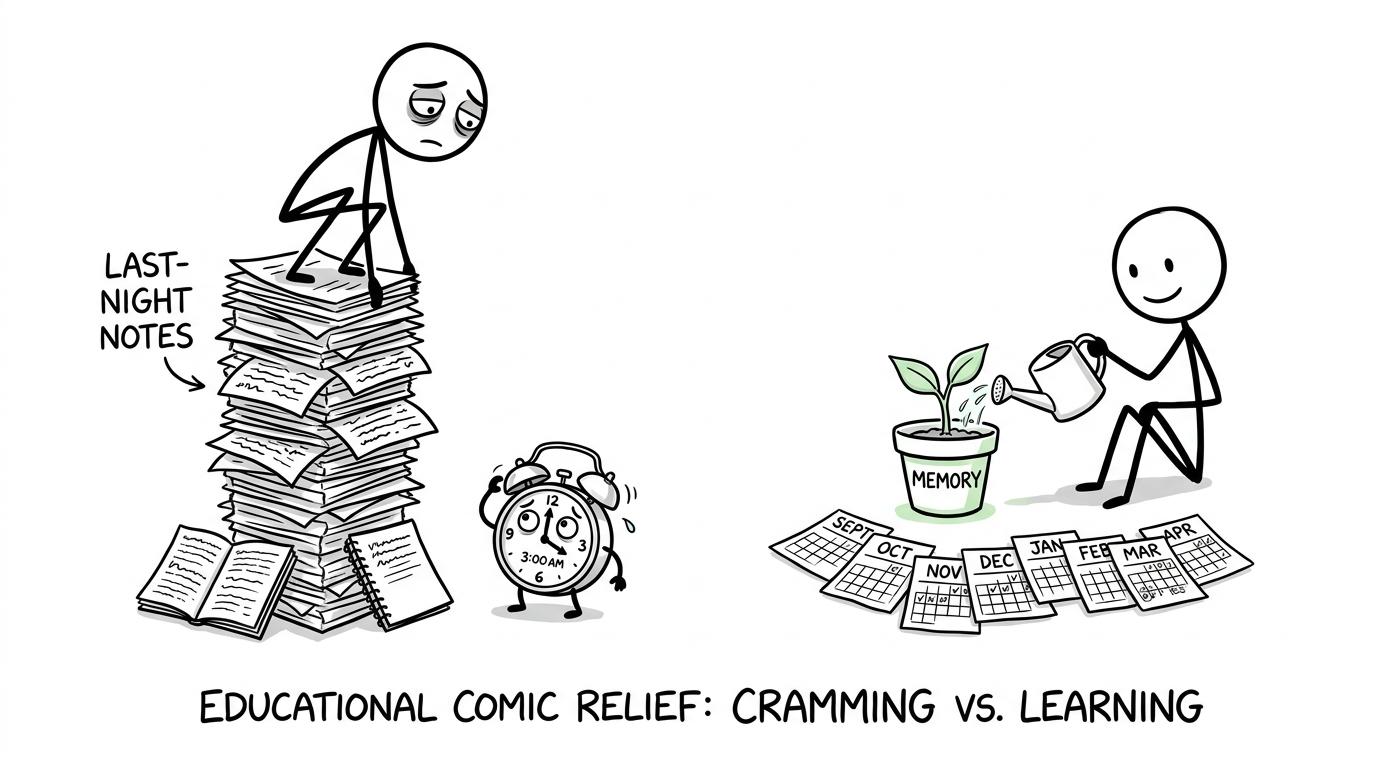 A student builds a tower of last-night notes while another grows memory gradually
What GCSE ICT means for your course
“GCSE ICT” is still widely used as an informal label, but it may not be the exact title printed on your timetable or specification. Depending on where you study, you might be taking GCSE Computer Science, GCSE Digital Technology or a vocational digital information technology qualification.
Check your exam board, qualification title and specification before planning revision. AQA, OCR, Pearson Edexcel and Eduqas or WJEC do not necessarily assess identical content or use identical paper structures. Your teacher, entry information and the front of a mock paper should confirm what applies to you.
Whatever the title, modern computing and digital qualifications generally require more than isolated definitions. Questions may ask you to apply knowledge, analyse a problem, justify a decision, trace a process or evaluate a digital solution. Current GCSE Computer Science assessment objectives explicitly include knowledge, application and analysis. That is why memorising a glossary alone does not hold up on exam day.
Why cramming can feel as though it works
Cramming is attractive because it produces fast changes in familiarity. After reading the same page several times, the words flow easily. That fluency can be mistaken for mastery.
But recognition and retrieval are different tasks. Recognition happens when the information is in front of you. Retrieval happens when you must produce it from memory. An exam normally demands the second.
Cramming also removes useful difficulty. If you read a definition and immediately repeat it, very little searching is required. If you return to it later, the attempt feels harder, but that effort reveals whether the knowledge is available without prompts.
This does not mean that every difficult revision activity is effective. Confusion without feedback is not learning. The productive sequence is to attempt retrieval, check the answer, understand the correction and try again after a delay.
Research reviewed by the Education Endowment Foundation supports retrieval practice, although it also warns that implementation matters. Questions should be appropriately challenging, misconceptions need feedback, and factual quizzes alone will not automatically prepare you for higher-order tasks such as analysis and evaluation.
The signs that knowledge will hold up in the exam
You can retrieve it without cues
Choose a small topic and put every resource away. Write what you know, define the essential terms or sketch the stages of a process from memory. Only then compare your response with the specification or class material.
The important evidence is not whether the page looks familiar. It is whether you can reconstruct the idea accurately.
You can explain relationships, not just definitions
A memorised definition may earn a mark, but understanding becomes visible when you can connect cause and effect. For example, you should be able to explain why a security measure is suitable in a particular context, not merely name it.
Try asking:
- What problem does this solve?
- Why would this option be chosen?
- What are its limitations?
- How does it connect to another part of the course?
- What would change in a different scenario?
These prompts turn separate facts into a usable structure.
You can handle a new question
Repeating one question until you remember its answer tests memory of that question. A fresh question tests whether the underlying idea can travel.
This is equally important in maths. A student may copy a solution successfully but still struggle when the values or wording change. The MathsGenie GCSE maths revision hub combines topic lessons with practice questions, papers and solutions so that understanding is tested rather than merely observed.
You still know it later
Immediate success is weak evidence. Test the topic again on another day without rereading first. If recall has faded, review the gap and schedule another attempt.
Spacing revision across time generally supports longer-term retention better than concentrating the same work into one final block. The exact interval can vary with the difficulty of the material and your exam date, so avoid treating one spacing schedule as a universal formula.
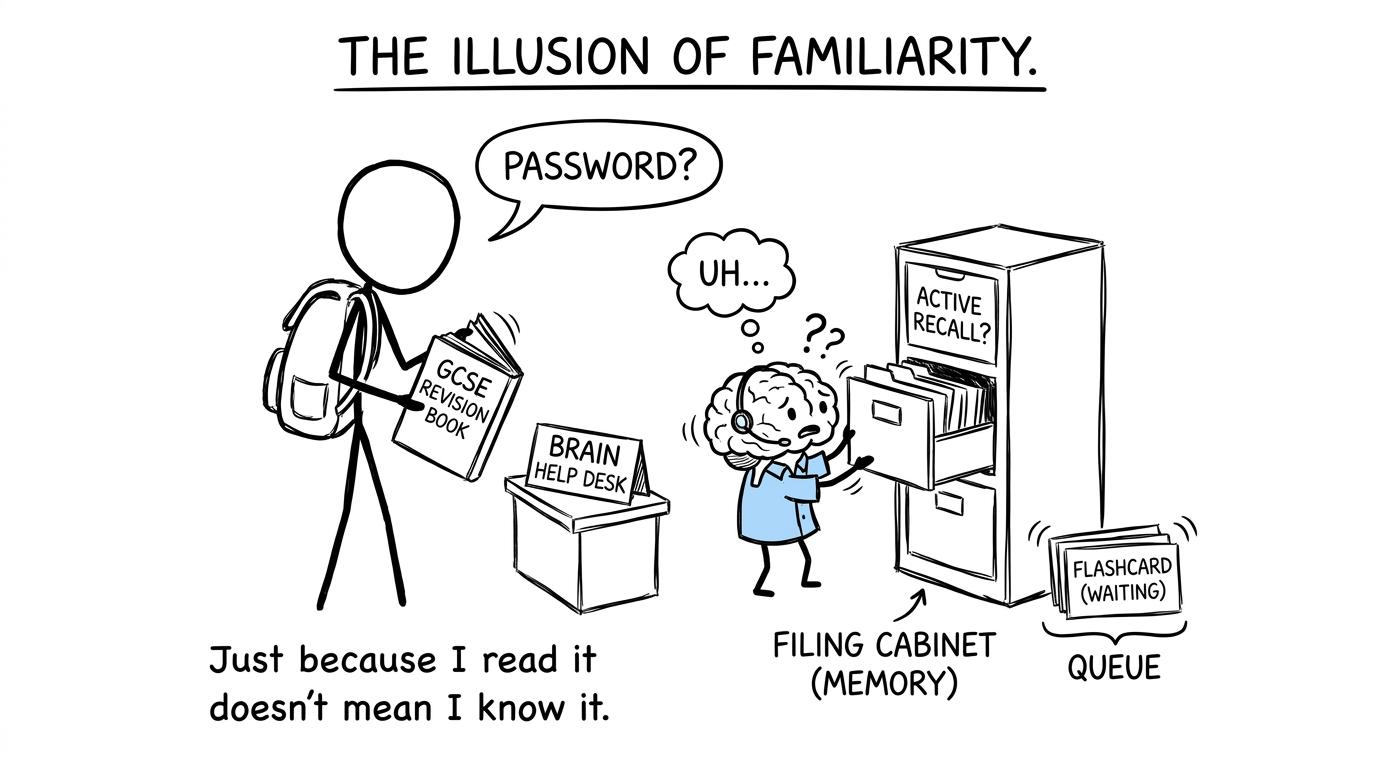 A brain at a help desk searches for information while a flashcard waits
How to turn an ICT revision session into learning
Begin with a precise target
“Revise networks” is too broad. A useful target describes what you should be able to do by the end, such as explaining the purpose of network protocols or comparing two methods in context.
Use your specification as a boundary. It stops revision expanding into interesting but unassessed material and helps you notice content you have missed.
Attempt retrieval before opening your notes
Start with a blank page, short quiz, flashcards or exam questions. Give yourself a real opportunity to remember. Looking immediately removes the very action that strengthens and tests recall.
If the answer does not come, that is diagnostic information rather than failure. Mark the gap, review the relevant explanation and try to retrieve it again.
Move from recall to application
Definitions are foundations, not the finished building. Once key knowledge is secure, use scenario questions, comparisons, code tracing or evaluation prompts that match your qualification.
Pay attention to command words. “State”, “explain”, “compare” and “evaluate” ask for different kinds of response. Use your board's mark schemes and examiner materials to understand the expected depth.
Mark for reasons, not just totals
A total mark tells you how the attempt ended. An error log tells you what to do next.
Classify each mistake as one of the following:
- missing knowledge;
- confused terminology;
- weak application to the scenario;
- incomplete explanation;
- misread command word;
- timing or concentration problem.
Then write one specific next action. Maths students can use the same approach with Edexcel GCSE maths past papers, where questions can be checked against mark schemes and available solutions. Students on other boards can begin from the main GCSE hub and select AQA, OCR, Eduqas, WJEC or CCEA.
Re-test instead of simply correcting
Reading the correct answer is only the repair stage. The proof comes when you answer again without support.
Use a different question where possible. Short tests are especially useful because they make repeated retrieval manageable. The Edexcel GCSE maths mini tests show how focused testing can sit between topic revision and complete papers.
A realistic weekly pattern
A sustainable routine does not need to dominate every evening. It needs to repeat.
- First session: retrieve previous knowledge, review one weak area and answer focused questions.
- Second session: revisit the same area without notes, then mix it with an older topic.
- Third session: complete exam-style questions under light time pressure and mark them carefully.
- Weekly review: inspect the error log and choose the next topics from evidence rather than preference.
Mixing topics helps you practise identifying which knowledge a question requires. However, if a topic is completely new, learn its basic structure before expecting mixed practice to fix it.
For maths, the GCSE one-month revision plan provides a broader version of this rhythm. If you need help deciding what deserves attention first, use the guide to finding your weakest GCSE topics.
Common mistakes when trying to stop cramming
Turning every note into a flashcard
Flashcards can support retrieval, but hundreds of low-value cards create another workload. Prioritise essential knowledge, then combine factual recall with application and explanation.
Testing only easy material
Correct answers feel encouraging, so students naturally return to comfortable topics. Keep some quick wins, but let mistakes decide a meaningful part of your plan.
Doing questions without feedback
Practice does not guarantee improvement if incorrect reasoning goes uncorrected. Check answers promptly, process the explanation and record the cause of the error.
Memorising mark schemes word for word
Mark schemes illustrate what earns credit, but an unfamiliar scenario may require you to adapt your knowledge. Learn what makes the response valid rather than copying one sentence mechanically.
Leaving every paper until the final week
Exam papers are not only a final measurement. Used earlier in smaller sections, they expose gaps in knowledge, timing and interpretation. Maths students can read when to start GCSE past papers for a staged approach.
Sacrificing sleep for one more session
A late-night session can add exposure while reducing alertness for the exam itself. When time is short, prioritise a small amount of targeted retrieval, prepare your equipment and stop at a sensible time. Panic is not evidence of productive revision.
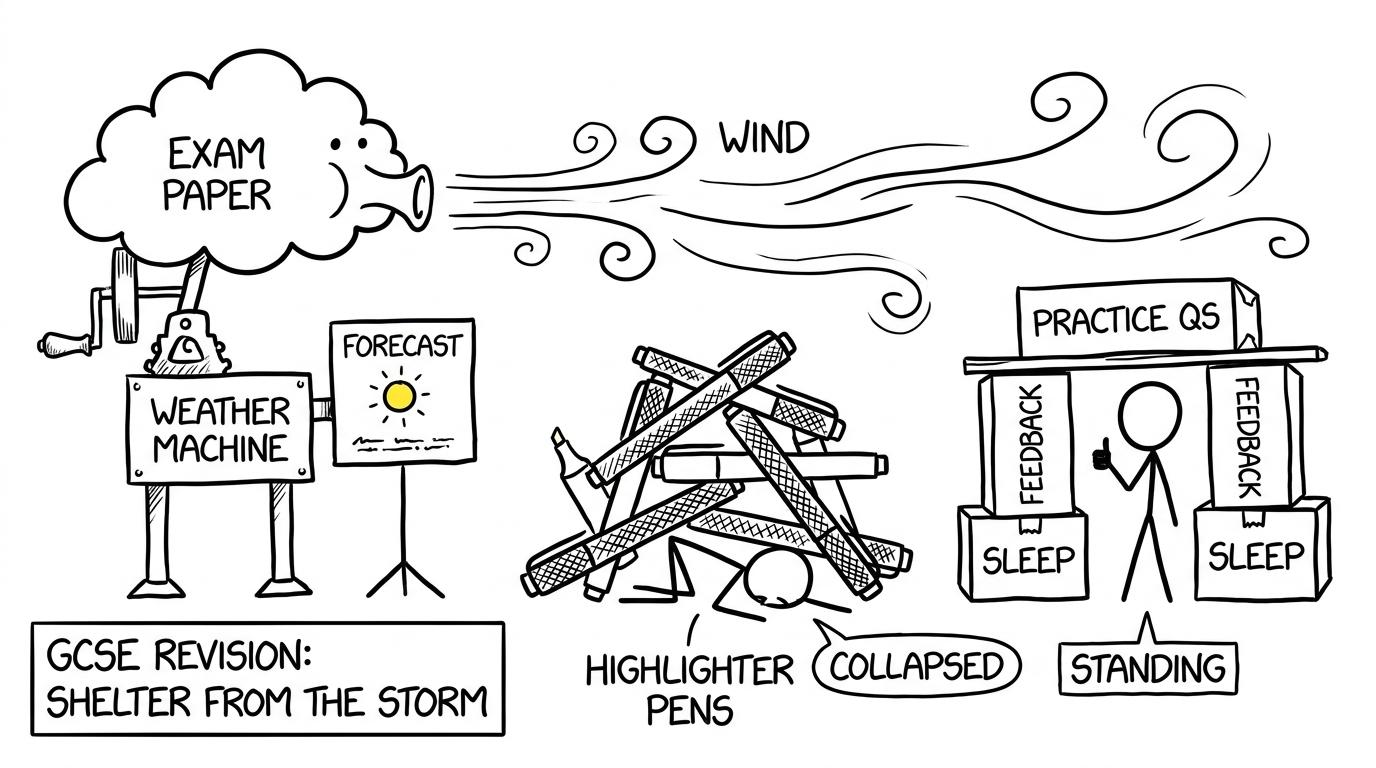 An exam storm knocks down a shelter made from highlighters while practice and feedback remain standing
Build revision that survives the closed book
The clearest distinction between cramming and learning is not how organised your desk looks or how many hours you record. It is what remains available when the notes disappear.
Close the book sooner. Retrieve before reviewing. Apply knowledge to unfamiliar questions. Mark the reason for every important mistake, then return later and prove that the gap has closed.
That habit transfers directly to GCSE maths. Use MathsGenie's free revision lessons to rebuild weak methods, practice questions and mini tests to strengthen recall, and past papers with mark schemes and video solutions to test performance. Nearer the exams, predicted papers can provide fresh timed practice without replacing full specification coverage.
Start with the MathsGenie GCSE revision timetable guide, choose one weak topic and complete the full loop today: retrieve, practise, mark, fix and schedule the re-test. Learning is quieter than cramming. It is also far more likely to be there when the exam paper opens.