Cramming vs Learning GCSE Further Maths
Cramming vs learning GCSE Further Maths: spot the difference, test what has stuck and build revision that survives unfamiliar questions on exam day.
There is a dangerous moment in revision when everything looks familiar. You recognise the page, remember the teacher’s explanation and feel certain you could do the question. Then the notes close, the wording changes, and the method disappears.
That is the practical difference between cramming vs learning GCSE Further Maths. Cramming creates short-term familiarity. Learning builds knowledge you can retrieve, adapt and use independently. On exam day, when questions are unfamiliar and hints are absent, only the second kind reliably holds up.
This guide will help you diagnose which kind of revision you are doing and turn fragile knowledge into something you can actually use.
The quick cramming-or-learning checklist
You are probably cramming if you:
- reread notes until they look obvious;
- copy methods without closing the example;
- complete several nearly identical questions in one sitting;
- check solutions before making a serious attempt;
- judge progress by hours spent rather than questions solved;
- never return to a topic after the session ends.
You are more likely to be learning if you:
- recall methods without looking at notes;
- practise questions with unfamiliar wording;
- explain why each step is valid;
- mark your work and classify mistakes;
- revisit topics after a delay;
- mix old and new material;
- can still begin a question under timed conditions.
The simplest test is this: close everything, wait until tomorrow, and attempt a different question. What remains is a better measure of learning than what felt easy tonight.
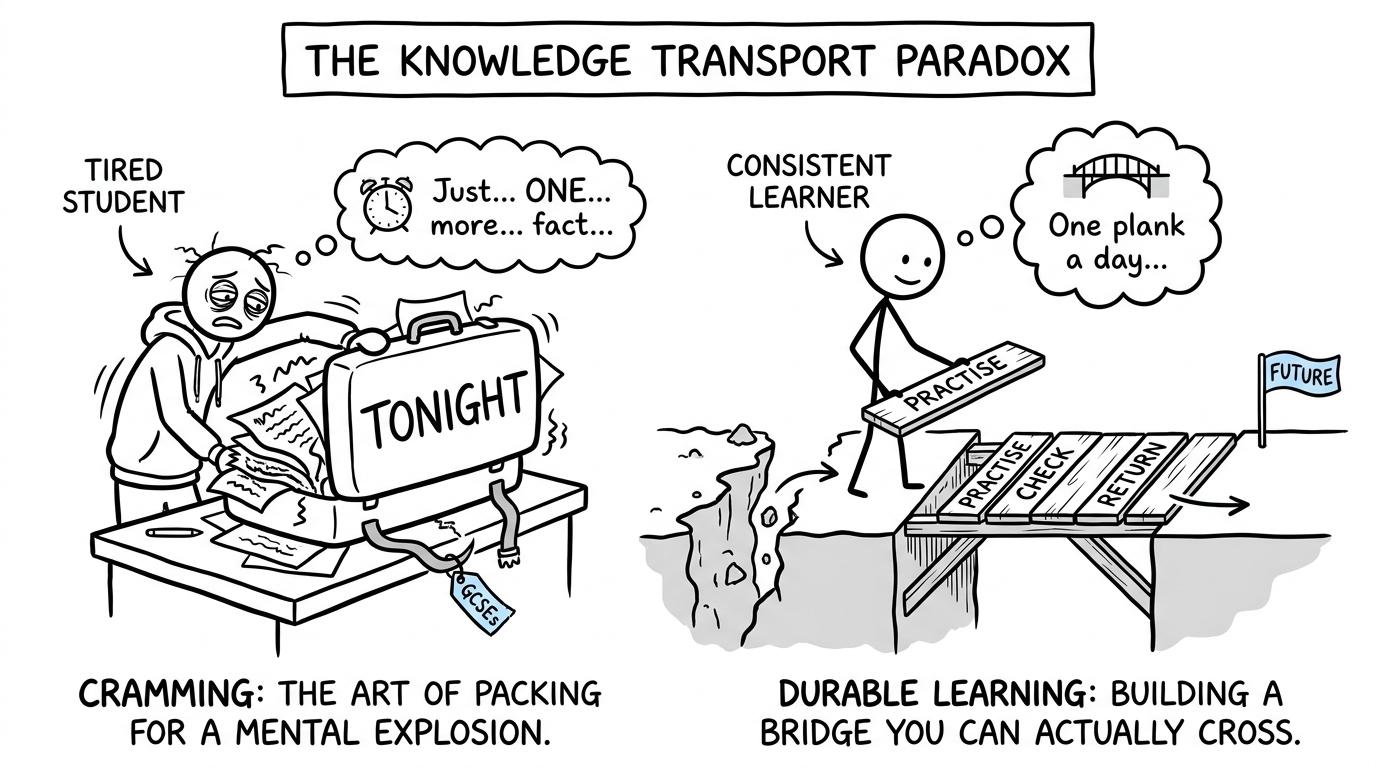 A student cramming a suitcase while another builds a revision bridge one plank at a time
Why cramming feels more successful than it is
Cramming is tempting because it produces fast improvement during the session. After watching a method and repeating it several times, your next answer may be correct. But the method is still sitting in short-term memory, supported by the examples around you.
This creates familiarity, and familiarity feels like understanding.
Research into learning consistently distinguishes massed practice from spaced practice. Revisiting material over separate sessions generally supports longer-term retention better than concentrating the same practice into one block. Retrieval practice, bringing an idea back from memory, is also more durable than simply seeing it again.
That does not mean reading explanations is useless. A clear explanation can begin the learning process. The mistake is stopping there.
GCSE Further Maths makes this distinction especially important because its questions often connect several ideas. You might need to manipulate an expression before using a theorem, recognise the structure of a function, or select a method without being told which one applies. A memorised surface pattern can fail as soon as the question changes shape.
Why genuine learning holds up on exam day
Genuine learning gives you three things: recall, selection and adaptation.
Recall means bringing a fact or method to mind without prompts. Selection means deciding which method fits. Adaptation means using that method when the question does not resemble the one in your notes.
Suppose you have revised expressions involving structures such as ax2+bx+cax^2+bx+cax2+bx+c, functions written as f(x)f(x)f(x), or differentiation from a rule such as xnx^nxn. Recognising those forms on a summary sheet is only the first layer. Exam readiness means knowing what information matters, choosing a valid route and carrying it through accurately.
A useful model is:
exam readiness=recall+method choice+accurate execution.\text{exam readiness}=\text{recall}+\text{method choice}+\text{accurate execution}.exam readiness=recall+method choice+accurate execution.Cramming may temporarily strengthen the final part because you have just copied the procedure. Learning develops all three.
For students taking the AQA Level 2 Certificate in Further Mathematics, the current specification includes number, algebra, coordinate geometry, calculus, matrix transformations and geometry. It is an untiered qualification assessed through calculator and non-calculator papers. Other qualifications may differ, so confirm your exact specification with your school.
The AQA GCSE Further Maths revision hub brings together appropriate lessons, questions and past-paper resources. If a GCSE skill underneath the Further Maths content is weak, the broader GCSE Maths revision hub can help you repair that foundation first.
Five tests that reveal whether you have learned a topic
The blank-page test
Close your notes and write the method, key conditions and likely first step from memory. Do not aim for beautiful notes. You are testing access.
If you can remember only isolated symbols, reopen the lesson briefly, then close it and try again. The second attempt should still require effort. That effort is part of retrieval, not evidence that you are failing.
The delayed-question test
Attempt a different question after at least 242424 hours. If you could solve a topic on Monday but cannot start it on Tuesday, Monday’s confidence was probably short-lived.
A delayed score is more informative than an immediate one. You can think of the gap as:
retention gap=immediate score−delayed score.\text{retention gap}=\text{immediate score}-\text{delayed score}.retention gap=immediate score−delayed score.A large retention gap tells you to revisit the topic. It does not tell you that you are bad at maths.
The changed-wording test
Textbook exercises often group similar questions together. Exams do not always announce the technique so politely.
Try a mixed question set in which the topic is not labelled. Can you identify the relevant idea before calculating? If not, you may have memorised a routine without learning when to use it.
MathsGenie’s GCSE mini tests are useful for short, low-stakes checks. They make it harder to rely on the order or appearance of your notes.
The explanation test
Ask yourself why a step works. Why is a factor valid? Why can a matrix represent that transformation? Why does a gradient condition imply a particular relationship?
You do not need a long speech. One accurate sentence is enough. If your only explanation is “that is what the example did”, the method is still fragile.
The pressure test
Finally, remove support. Use a timer, put away your phone and attempt a section without pausing for hints. Mark it afterwards, not during the attempt.
This is where using GCSE maths past papers properly matters. A paper is not merely a score generator. It reveals whether knowledge survives time pressure, mixed topics and unfamiliar wording.
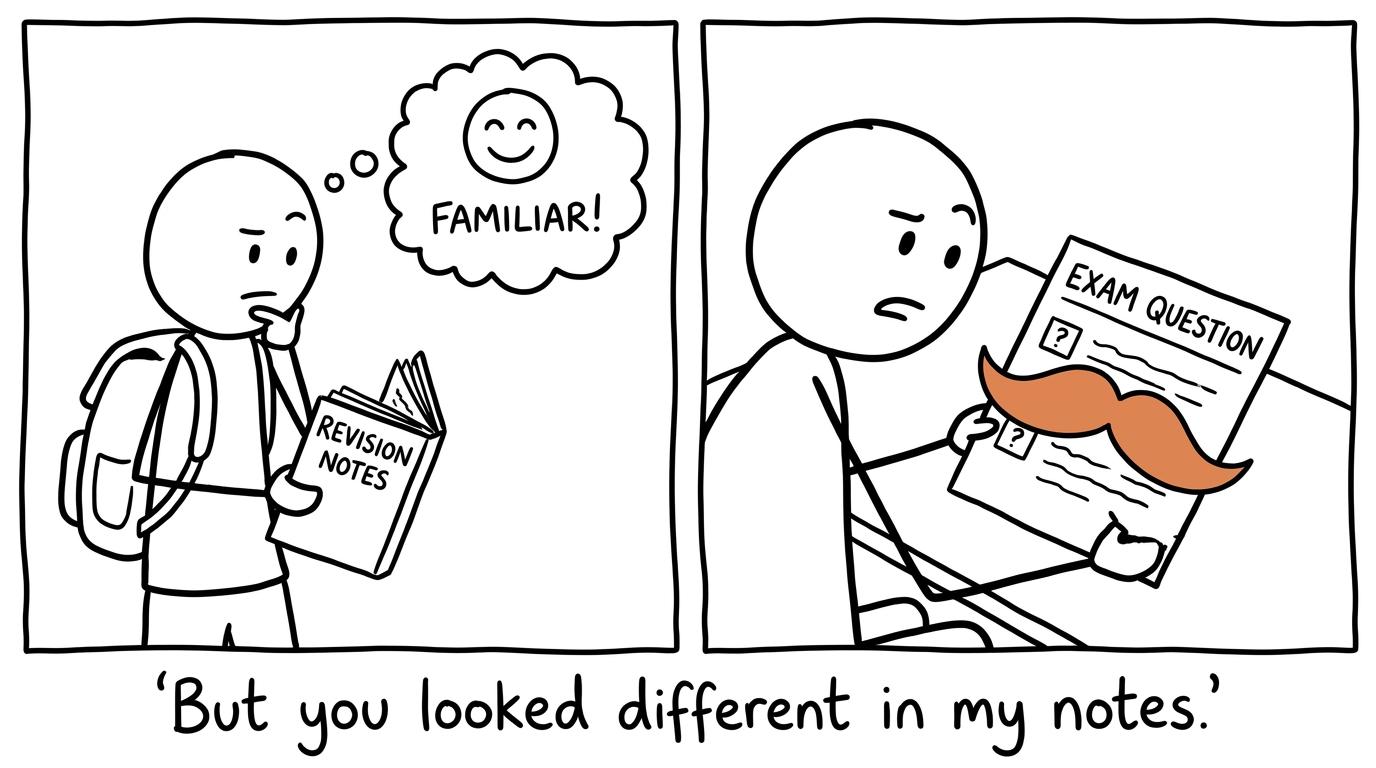 An exam question in disguise surprises a student who only recognised the version in their notes
How to replace cramming with a learning cycle
Use this cycle for one carefully chosen topic:
- Retrieve: write down what you remember before opening resources.
- Relearn: use a short revision lesson to repair the exact gap.
- Practise: answer questions without copying the method.
- Mark: use the mark scheme or video solution and check every step.
- Diagnose: label each error precisely.
- Retest: attempt a different question after 242424 to 484848 hours.
- Mix: include the topic later among unrelated questions.
The diagnosis stage is what turns an incorrect answer into useful revision. “Calculus wrong” is too broad. “Used the power rule correctly but did not substitute the required value” gives you a repairable problem.
If you are unsure where marks are leaking, follow the weak-topic diagnostic process. Keep an error log with the topic, reason for the lost mark and next action. Then let that evidence determine tomorrow’s session.
Spacing does not require a perfect timetable. A workable pattern is to revisit a topic the next day, later in the week and again through mixed paper practice. The GCSE one-month revision plan offers a structure for combining retrieval, topic repair and timed work. If the exam is much closer, use the one-week maths revision plan to prioritise rather than attempting to relearn everything at once.
What to do when the exam is very close
Sometimes cramming is not a choice but a consequence of the calendar. If the exam is tomorrow, you cannot create weeks of spaced practice. You can still avoid passive revision.
Choose a small number of weak but recoverable areas. For each one:
- attempt a question before reviewing the method;
- use a revision lesson only where the attempt exposes a gap;
- complete another question independently;
- mark it carefully;
- write one brief reminder for the morning;
- stop at a sensible time and protect your sleep.
Do not begin an enormous new chapter late at night simply to feel thorough. Secure methods you almost know, review recurring errors and prepare your equipment. The aim is no longer long-term mastery. It is to make the knowledge you have as accessible and reliable as possible.
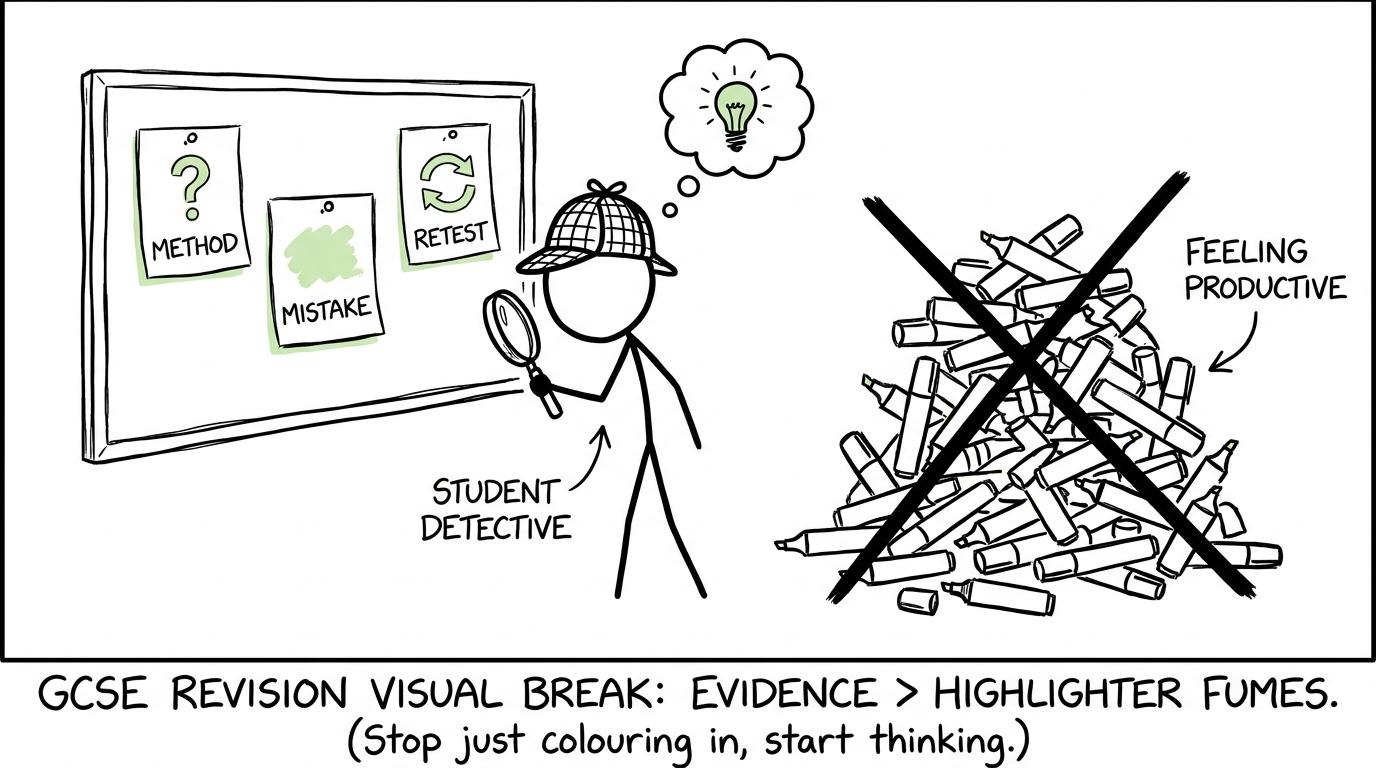 A student detective follows clues labelled method, mistake and retest instead of investigating highlighter pens
Common mistakes when trying to learn Further Maths
Doing only your favourite topics
Comfortable topics produce reassuring scores but little diagnostic value. Begin with questions that have recently cost you marks. The goal is not to prove what you know; it is to discover what needs attention.
Repeating one question type for too long
Blocked practice can help you establish a method, but staying there creates predictability. Once the basic procedure is stable, mix it with other topics so that you must choose the method yourself.
Looking at solutions too early
A solution can feel instantly obvious after you see it. Give yourself a genuine attempt first, even if all you can write is the relevant information or a possible first step.
Recording answers but not mistakes
A total mark cannot tell you what to do tomorrow. Separate knowledge gaps, selection errors, algebra slips, calculator errors and exam-technique problems.
Treating one correct answer as mastery
One success immediately after a lesson proves very little. Look for repeated success on different questions, on different days and eventually under timed conditions.
Using predicted papers as predictions rather than practice
Predicted papers provide fresh exam-style material, but they cannot guarantee what will appear. Use them after topic learning to test transfer, alongside official past papers rather than instead of them.
Make your revision survive exam day
The difference between cramming and learning is not mainly how long you sit at a desk. It is what your brain has to do while you are there.
If the answer remains visible, the topic remains labelled and the solution is one click away, revision can feel smooth while leaving little behind. Close the notes. Retrieve the idea. Attempt the question. Mark honestly. Return later.
MathsGenie gives you one free place to run that cycle: revision lessons for rebuilding understanding, practice questions for independent work, mark schemes and video solutions for precise feedback, mini tests for retrieval, and past papers and predicted papers for exam pressure. Use the revision planner to schedule your returns rather than relying on last-minute urgency.
Start with the AQA Further Maths revision resources, choose one topic, and test what you can do without help. The result may feel less comforting than rereading. It will also be far more useful.