

Cramming vs Learning GCSE Drama: Know the Difference
Cramming vs learning GCSE Drama: spot false confidence, test real recall and build revision habits that work under pressure on exam day for GCSE students.
There is a dangerous moment in revision when everything looks familiar. You recognise the terminology. You have highlighted the important lines. Your notes seem clear. It feels like progress.
But familiarity is not the same as being able to produce a strong answer without help. That is the practical difference between cramming vs learning GCSE Drama: cramming helps material feel recognisable for a short time, while learning helps you retrieve, explain and apply it when the notes are gone.
The quickest test is simple. Close everything. Can you explain the idea, connect it to a theatrical choice and answer an unfamiliar question? If not, you may have revised the page without learning the content.
This matters particularly when you are balancing Drama with maths and other GCSE subjects. Your time is limited, so every revision session needs to leave something durable behind.
The quick cramming or learning checklist
You are probably cramming if you:
- reread or highlight for most of the session
- copy polished notes without testing yourself
- revise a whole topic once and then abandon it
- remember examples only when they are directly in front of you
- avoid questions because getting stuck feels unproductive
- measure revision by time spent rather than what you can retrieve
You are more likely to be learning if you:
- recall ideas before opening your notes
- explain terminology in your own words
- connect dramatic choices to meaning and audience response
- answer questions in unfamiliar forms
- check your answer against assessment guidance
- return to the content across several days
- use mistakes to decide what to revise next
The distinction is not about how hard you appear to be working. It is about what remains available when support is removed.
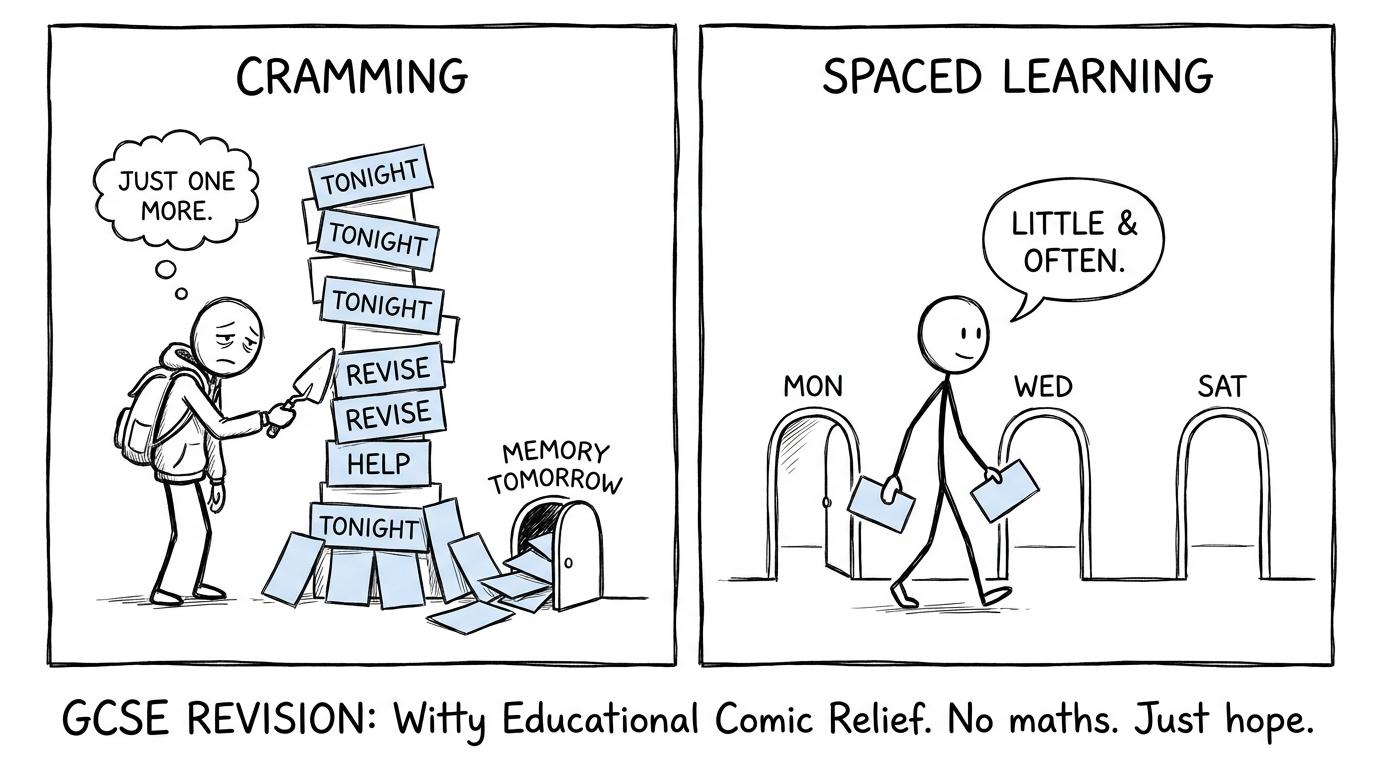 A student cramming cards into one night while another spaces learning across the week
What GCSE Drama actually asks you to do
GCSE Drama is not simply a memory test. Although specifications differ between AQA, Edexcel, OCR and Eduqas, assessment typically requires a combination of knowledge, practical understanding, analysis, evaluation and the communication of artistic intentions.
The common assessment objectives cover four broad capabilities:
- creating and developing ideas for theatrical performance
- applying performance or design skills
- demonstrating knowledge of how drama is developed and performed
- analysing and evaluating your work and the work of others
That means memorising a list of terms is only a starting point. Knowing that pace, pitch, posture, proxemics, lighting intensity or staging configuration exists does not automatically mean you can explain why a theatre maker might use it.
Written assessment structures vary by board, so check the current specification and guidance supplied by your school. For AQA, Edexcel and OCR, the written component represents 40%40\%40% of the qualification. Questions may involve a set performance text, live theatre and practical decisions from the viewpoint of a performer, director or designer. The precise format and permitted materials are board-specific.
Real learning therefore has several layers:
- Recall: Can you remember the relevant term, moment or choice?
- Understanding: Can you explain what it means?
- Application: Can you use it to address the exact question?
- Analysis: Can you connect the choice to meaning or audience response?
- Evaluation: Can you judge how effectively it achieved its purpose?
Cramming often reaches the first layer. Exam questions frequently demand the rest.
Why cramming can feel so convincing
Cramming creates fast familiarity. When you reread a page several times, the words become easier to process. That ease can be mistaken for mastery.
The problem appears when the page is removed. Recognition asks, “Have I seen this?” Retrieval asks, “Can I produce it?” An exam requires retrieval.
This explains why making beautiful notes can feel productive while leaving you unable to begin a question. The notes are not useless, but they become useful only when they support a cycle of recall, application and feedback.
Research into learning consistently supports distributing revision across time rather than concentrating the same practice into one sitting. Retrieval practice also strengthens access to knowledge more effectively than repeatedly encountering the same material passively. The two methods can work together: retrieve an idea now, check it, and retrieve it again on a later day.
The same principle matters in maths. Watching a solution can make a method look obvious, but the meaningful test is whether you can start a fresh question alone. MathsGenie's guide to stopping forgotten GCSE maths content uses the same sequence of spaced practice, retrieval and checking.
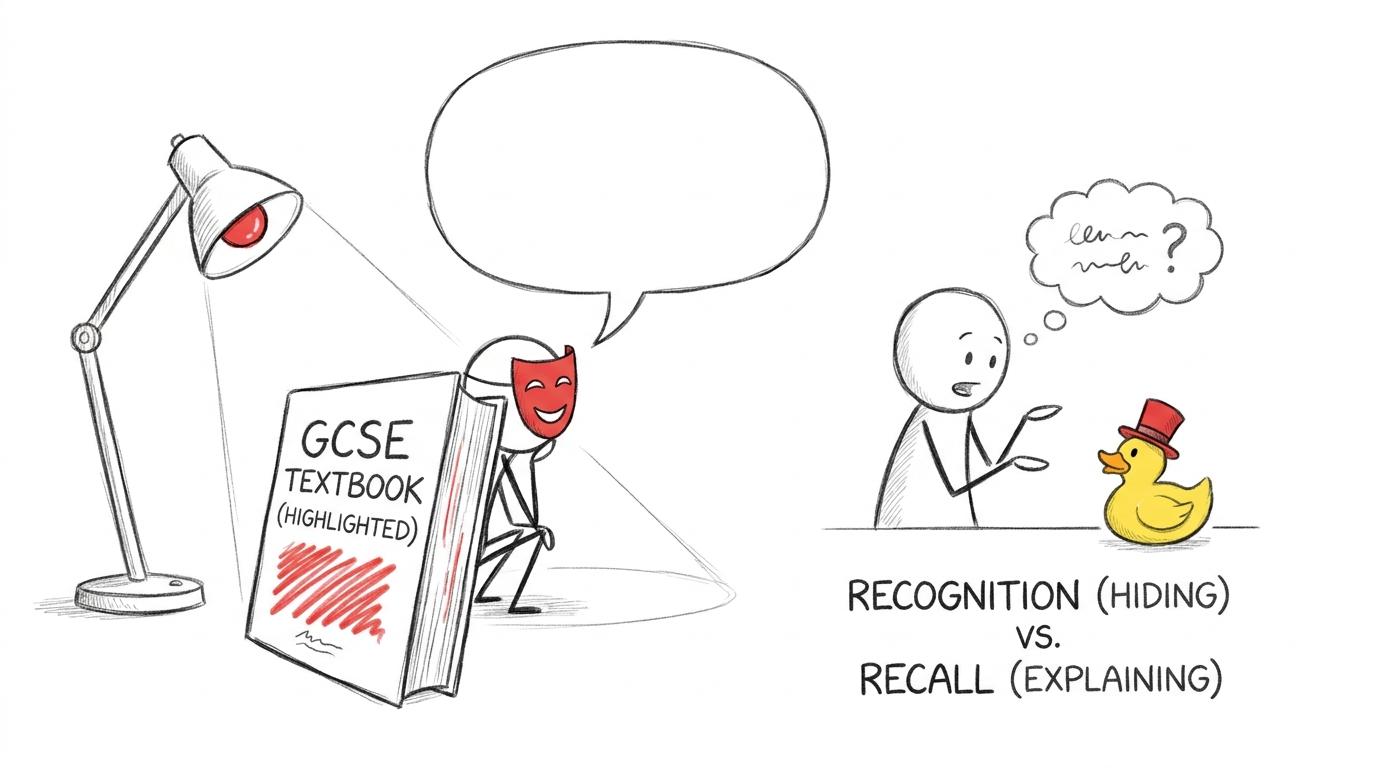 A highlighted book fails to hide an empty answer while a student explains an idea to a theatre duck
How to test whether you are actually learning
Remove your notes before judging yourself
Choose a narrow area, such as vocal skills, costume design, one character's motivation or a specific moment from the production you watched. Put your materials away and write everything relevant that you can remember.
Then check your notes. Do not focus only on missing facts. Look for weak connections. Could you name a performance choice but not explain its effect? Could you describe a scene but not evaluate it? Those gaps tell you what the next session should address.
Change the question
Crammed knowledge is often tied to the wording used in your notes. Learned knowledge is more flexible.
Test the same material through different prompts. Explain a moment from the perspective of a performer, then a director, then a designer. Consider how a choice communicates character, creates atmosphere or changes the audience's interpretation.
You are not trying to memorise one answer for every possible question. You are building a network of knowledge that can respond when the wording changes.
Speak your reasoning aloud
Drama is built around choices and intentions, so verbal explanation is valuable. Without reading, explain:
- the precise theatrical choice
- where it occurs
- how it would be realised in performance
- what meaning it communicates
- how the audience might respond
If your explanation depends on vague words such as “effective”, “dramatic” or “interesting”, ask what made it effective and what the audience understood as a result.
Use delayed success as the real measure
An answer completed immediately after reading notes provides limited evidence. Try the material again later, without looking first.
A useful pattern is:
- first session: learn and retrieve
- later in the week: retrieve and answer a short question
- the following week: revisit it within mixed revision
There is no single spacing schedule that suits every learner or every deadline. The important feature is that the content returns after some forgetting has begun. MathsGenie's GCSE revision timetable guide can help you plan this rhythm across subjects.
Turn revision into an evidence loop
Good revision produces evidence. You attempt something, inspect the result and decide what happens next.
For Drama, use this loop:
- select one precise area from your specification
- retrieve what you know without support
- apply it to an exam-style prompt
- check the content and assessment focus
- record one specific weakness
- revisit that weakness on another day
Your error note should identify the cause rather than merely record that an answer was weak. For example, you might note that you described acting but did not analyse its effect, or made a design suggestion without connecting it to the play's context.
This is similar to using a mark scheme after a maths paper. MathsGenie's guide to finding your weakest GCSE topics explains how to turn lost marks into a focused revision list. For shorter school days, the 20-minute GCSE maths revision routine follows the same useful principle: retrieve, attempt, mark and choose the next target.
Balance Drama revision with GCSE maths
Students rarely cram one subject in isolation. A late Drama session can displace maths practice, while a long maths paper can push set-text revision into tomorrow. A plan should reduce that competition.
Keep each task specific. “Revise Drama” and “do maths” are not useful instructions. Better tasks identify an observable action: retrieve one character's development, plan one evaluation paragraph, complete a mini test or correct questions from a paper.
Use MathsGenie's free GCSE maths revision hub to organise the mathematical side of your week. Its revision lessons, topic questions, mini tests and papers help you move from learning a method to demonstrating it independently.
When you are ready for longer practice, complete the correct paper for your board and tier under timed conditions. The Edexcel GCSE Maths past papers, for example, include mark schemes and worked support where available. The wider guide to using GCSE past papers properly explains how to mark, diagnose and retest rather than merely collect a score.
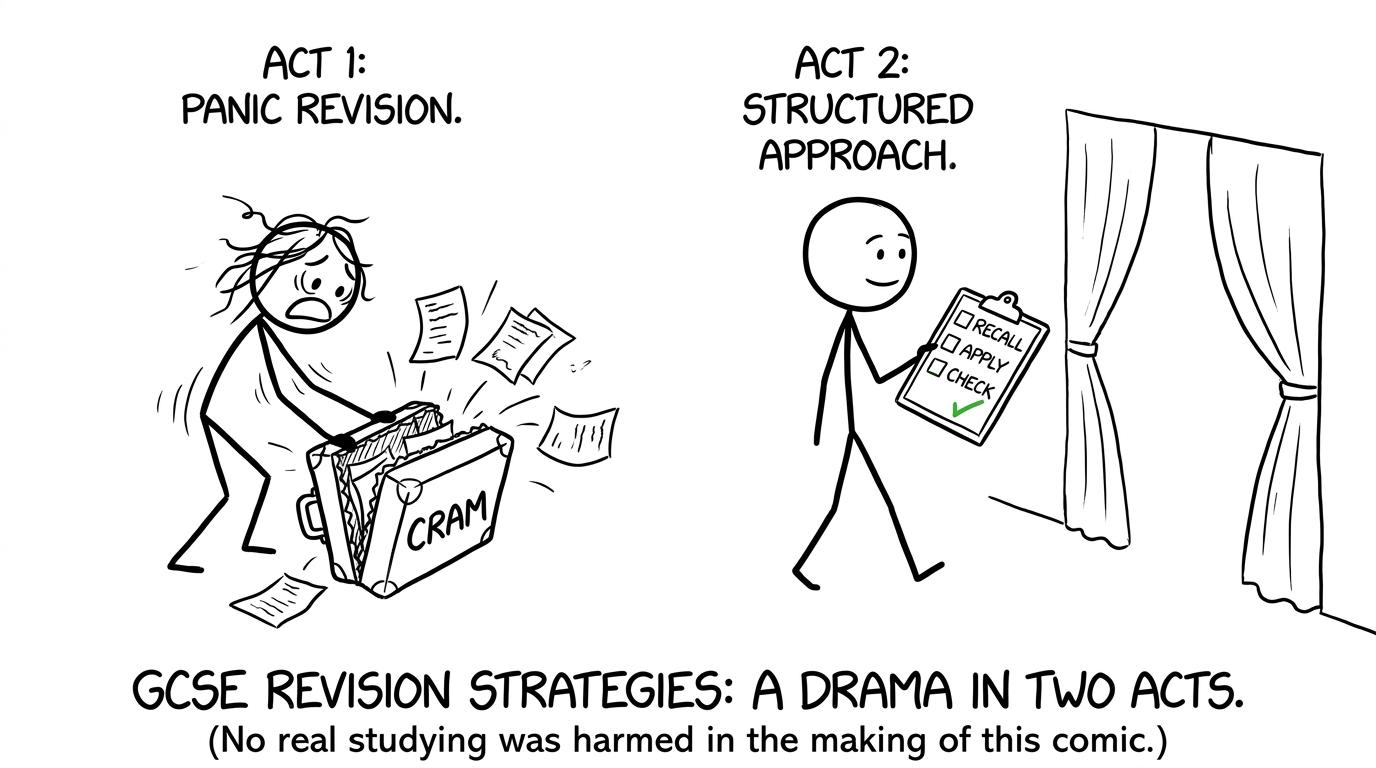 Backstage, one student's cram suitcase bursts while another follows a recall, apply and check routine
Common mistakes when moving beyond cramming
Turning retrieval into another copying task
Writing from the textbook is transcription, not retrieval. Close the source first. Struggling to remember is not proof that the session has failed; it is information about what needs attention.
Memorising generic analytical phrases
A polished phrase cannot replace a precise theatrical choice. Examiners need to understand what a performer, director or designer would do, where it would happen and why it would matter.
Revising terminology without the set text
Terms become useful when connected to moments, characters, relationships and artistic intentions. Keep moving between vocabulary and its practical use.
Treating one successful answer as mastery
Immediate success may depend on short-term familiarity. Revisit the idea later and change the wording of the question before deciding it is secure.
Ignoring the exact exam board
AQA, Edexcel, OCR and Eduqas do not use identical paper structures, set texts or question formats. Use the current specification and materials given by your teacher rather than relying on generic advice alone.
Spending too long planning revision
A colour-coded timetable can become a quieter form of avoidance. Plan enough to know the next task, then begin. If exams are close, MathsGenie's one-week GCSE maths revision plan shows how to prioritise diagnosis, focused practice and timed evidence.
Learning is what remains when the prompt changes
The difference between cramming and learning is not simply how many hours you work. It is whether your knowledge survives delay, missing notes, unfamiliar wording and exam pressure.
For GCSE Drama, test whether you can recall precise content, apply it as a theatre maker, analyse its meaning and evaluate its effect. For GCSE maths, test whether you can choose and carry out a method on an unseen question. In both subjects, the honest attempt is more valuable than the comfortable reread.
Start small today. Close your Drama notes and retrieve one narrow area. Then open MathsGenie, choose one weak maths topic and use a revision lesson followed by practice questions. Mark the attempt, watch the video solution where needed, and schedule a retest. As exams approach, add mini tests, past papers and predicted papers.
That cycle, learn, retrieve, apply, check and return, is how revision begins to hold up when it matters.










