Colour-Coding Notes for GCSE Psychology: Does It Help?
Colour coding notes GCSE Psychology: discover when colour supports recall, when it wastes time and how to combine it with effective self-testing.
A page can look beautifully organised and still leave your mind blank in an exam. That is the uncomfortable truth behind colour coding notes GCSE Psychology students often spend hours perfecting. Colour can help you organise information and direct attention, but colouring alone is unlikely to produce strong, lasting recall. The useful work begins when the colours help you retrieve, explain and apply what you know.
So, should you throw away your highlighters? No. Use them with restraint. Colour-coding is best treated as a signposting system, not as the revision itself.
The short answer
Colour-coding can support GCSE Psychology revision when it:
- distinguishes genuinely different categories of information;
- makes important relationships easier to see;
- directs attention towards a small number of essential details;
- helps you create prompts for later self-testing;
- remains consistent across your notes and flashcards.
It becomes less useful when you:
- highlight most of the page;
- choose colours for appearance rather than meaning;
- repeatedly copy notes without testing yourself;
- assume recognising a colourful page means you can recall its content;
- spend more time selecting pens than answering questions.
The strongest approach is simple: use colour to organise information, then close the notes and attempt to retrieve it.
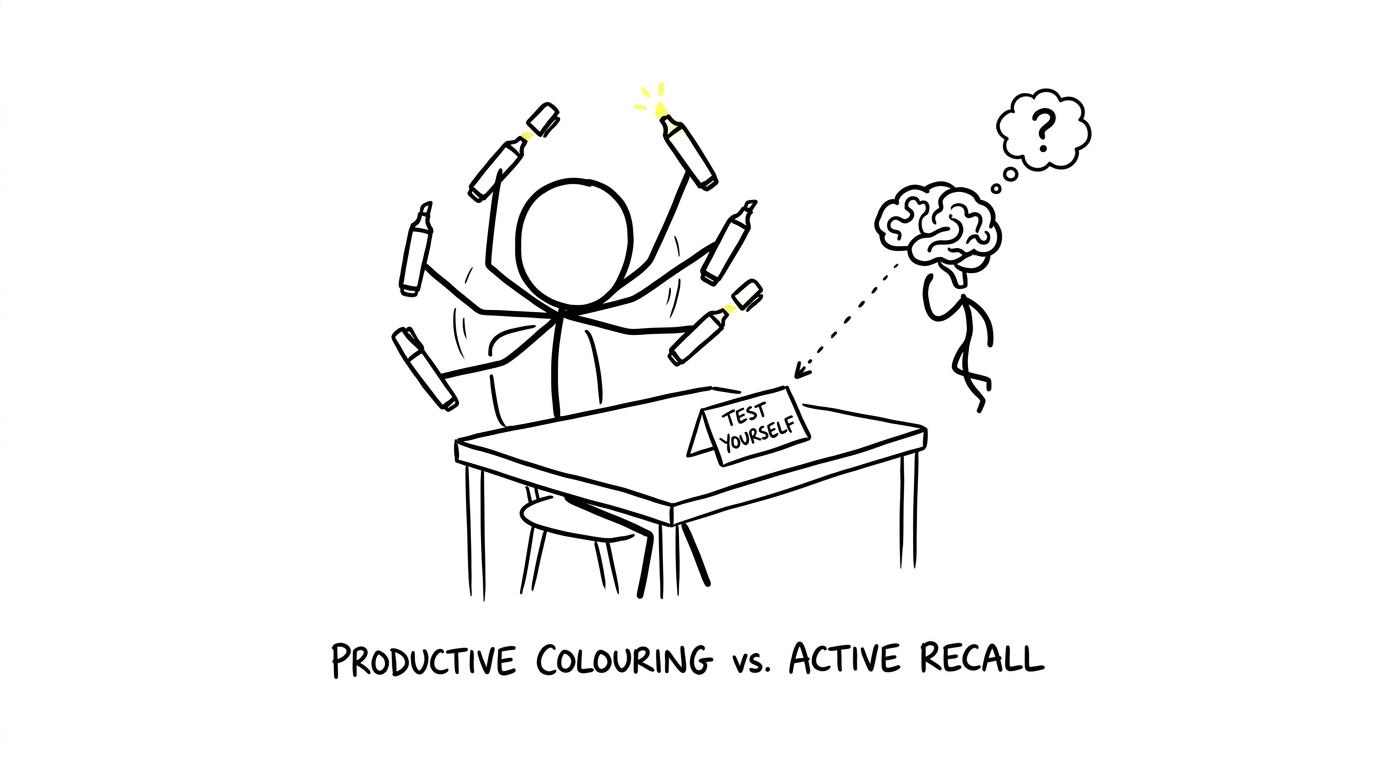 A student conducting an orchestra of highlighters while a brain points towards a self-testing flashcard
What colour-coding can genuinely do
Colour is good at attracting attention. A carefully chosen visual cue can make one item stand out from its surroundings, helping you notice a definition, study detail or evaluation point when you first process the material.
Recent research into colour cues in instructional materials suggests that selective colour can guide visual attention and may support retention. However, adding numerous colours can increase cognitive load and weaken the advantage. Research into background colour also suggests that colour by itself is not a dependable retrieval cue for complex written material.
That distinction matters. Colour may help you find and organise knowledge, but finding information on a page is not the same as retrieving it in an examination.
Colour provides structure
GCSE Psychology contains different types of knowledge. Depending on your specification, you may need to remember concepts, theories, research studies, evidence, conclusions, strengths, weaknesses and research methods.
A restrained system might assign one colour to key terminology, another to evidence and another to evaluation. This makes the underlying structure more visible. You are not asking your brain to remember that a paragraph was green. You are using green to signal that the paragraph performs a particular job.
This is especially relevant to the AQA GCSE Psychology specification, which assesses knowledge and understanding, application and extended responses. Knowing a definition is useful, but students must also recognise when and how to use that knowledge.
Colour can help you decide what matters
Choosing what to colour requires a decision. If you pause and ask, “Is this a theory, a finding or an evaluation point?”, you are processing meaning rather than merely decorating the page.
The value comes from that judgement. If every line receives a colour, no judgement has taken place and nothing stands out.
Colour can make review quicker
A consistent key can make notes easier to scan before a self-test. You might quickly locate the evaluations of a theory or identify which details belong to a named study. That can reduce friction when preparing flashcards or planning an extended answer.
But quicker scanning should lead to active revision. It should not become another round of passive rereading.
Why colourful notes can create false confidence
Fluency is the feeling that information is familiar and easy to process. Neat, colourful notes often feel fluent because you have seen them before and can follow their structure. Unfortunately, familiarity can be mistaken for knowledge.
An exam does not normally show you your original page and ask whether it looks familiar. It asks you to produce relevant knowledge from memory, choose it under pressure and apply it to the question.
This explains why highlighting has generally received a low rating in major reviews of learning techniques, while practice testing and spaced practice have much stronger support. Highlighting is not necessarily harmful. It is simply incomplete.
The same problem appears in maths revision. Watching a solution can feel straightforward because each line makes sense when it is already on the screen. The real test is whether you can select and carry out the method independently. The GCSE Maths revision hub supports that transition with revision lessons, questions, papers and solutions organised by topic and exam board.
How to colour-code GCSE Psychology notes effectively
A useful system should be simple enough to remember without consulting a complicated key.
Limit the number of categories
Use approximately three or four functional categories. For example:
- key concepts and definitions;
- named evidence or research details;
- applications or examples;
- evaluation points.
Your exact categories should match the way your teacher and specification organise the course. Avoid assigning a new colour to every topic. The colour should communicate the type of information, not merely identify the chapter.
Keep the same meaning throughout
If blue represents evidence in one unit, it should still represent evidence later. Consistency reduces the mental effort needed to interpret your own system.
Do not depend on colour alone. Add headings, labels, symbols or underlining so that the structure remains usable if you print the notes in black and white or have difficulty distinguishing particular colours.
Colour after understanding the material
Reading with a highlighter already touching the page makes almost every sentence feel important. Read a manageable section first. Then decide which small parts deserve emphasis and why.
This delay forces selection. It also stops the familiar pattern in which the opening lines receive careful highlighting and the final paragraph becomes a rainbow because concentration has faded.
Turn each colour into a retrieval prompt
After colour-coding, hide the explanatory text and use the remaining heading or prompt to recall it. Then check your answer and correct any omission.
For example, your colour system might tell you that a section contains evaluation, but you should still retrieve the actual strength or limitation and explain why it matters. The cue opens the door; recall walks through it.
The Education Endowment Foundation’s summaries of cognitive science research emphasise that retrieval involves an active attempt to remember. Looking at notes immediately removes that attempt. Feedback is also important because unchecked recall can reinforce an error.
The revision routine that makes colour useful
A productive session can follow this sequence:
- Read and understand one small section.
- Condense it into a clear set of notes.
- Add selective colour according to your fixed categories.
- Close or cover the notes.
- write everything you can recall about the heading;
- compare your response with the original;
- correct missing or inaccurate details;
- revisit the same material after a delay.
This combines organisation, retrieval, feedback and spacing. Colour has a supporting role, while the harder cognitive work receives most of your time.
You can also turn coloured categories into mixed questions. Ask for a definition, then evidence, then an evaluation point. Mixing demands prevents you from learning a page only in one predictable order.
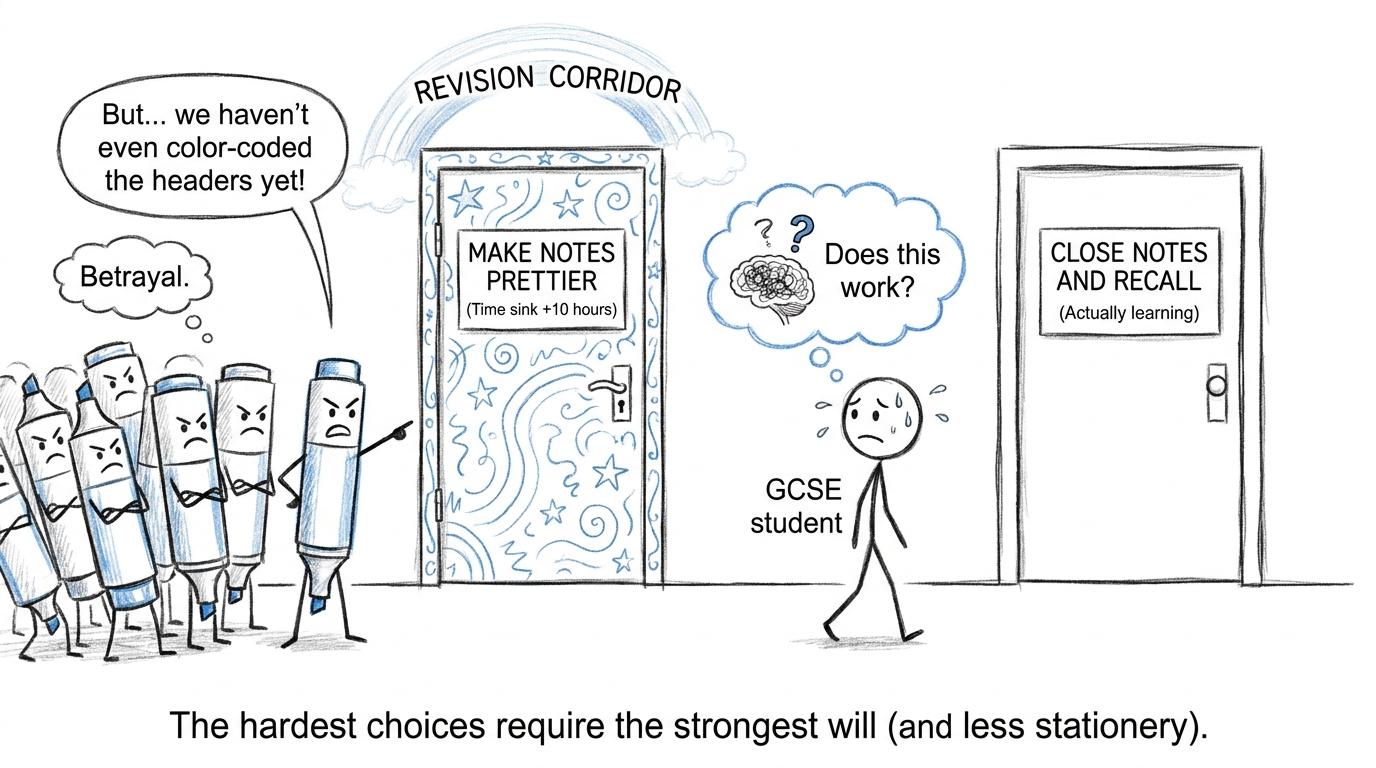 A student choosing active recall while an offended pile of highlighters watches
Applying the same lesson to GCSE maths
Psychology notes and maths questions look different, but they share one revision principle: recognition is not enough.
For maths, colour can label information in an error log. You could use a small visual code to separate:
- a missing piece of knowledge;
- an incorrect method;
- a calculator or arithmetic slip;
- a misread instruction;
- an incomplete line of working.
The colour does not correct the mistake. It helps you notice a pattern and choose the next revision task. If algebra errors repeatedly fall into the same category, return to the relevant revision lesson and practise questions without looking at the solution.
MathsGenie’s guide to using GCSE past papers properly explains how to mark, diagnose and retest mistakes rather than treating a total mark as the end of the process. The GCSE maths topics by board and tier guide can then help you identify suitable Foundation or Higher content for Edexcel, AQA, OCR or Eduqas.
For shorter retrieval sessions, use Edexcel GCSE Maths mini tests or follow the 20-minute maths revision routine. Both move you from looking at material to producing answers.
Common mistakes when colour-coding notes
Highlighting complete paragraphs
When almost everything is emphasised, nothing has priority. Highlight only the word, phrase or sentence that carries the essential idea.
Creating a complicated key
A system with numerous colours, symbols and exceptions creates another body of information to remember. If interpreting the code interrupts revision, simplify it.
Recopying notes for appearance
Rewriting can be valuable when you condense, reorganise or explain ideas. Copying the same wording into a neater colour scheme usually provides much less challenge than recalling it.
Confusing time spent with progress made
A long session can produce attractive pages without exposing a single knowledge gap. Measure progress by what you can explain or answer without support.
Never returning to the material
One polished page is not a revision schedule. Revisit the topic after a delay and retrieve it again. A GCSE maths revision timetable can help you build the same spaced habit across maths topics.
Using notes instead of exam questions
Notes build and organise knowledge. Exam questions test whether you can select and use it. Psychology students need questions that match their own specification, while maths students should use papers for the correct board and tier. A Level students can apply the same principle using resources such as the Edexcel A Level Maths past papers.
The verdict: useful tool or satisfying distraction?
Colour-coding is neither a memory miracle nor a complete waste of time. It can direct attention, clarify categories and make later revision more efficient. Its benefit depends on what happens next.
If colour helps you decide what information means and then prompts you to retrieve it, keep using it. If the process ends with a beautiful page and no self-test, it is mostly satisfying administration.
Let your notes be clear rather than perfect. Then close them, answer a question and check what you actually know. For maths, start with MathsGenie’s free revision lessons and practice questions, diagnose gaps with mini tests, and build towards past papers and predicted papers with mark schemes and video solutions. The page does not need to look impressive. Your next answer needs to be stronger.