Colour Coding Notes GCSE Further Maths: Does It Help?
Colour coding notes GCSE Further Maths: learn when colour aids attention, when it wastes revision time, and how to combine it with active exam practice.
A neat page can create a powerful feeling: everything is organised, so everything must be learned. Unfortunately, the two are not the same.
The honest answer to whether colour coding notes GCSE Further Maths content helps is this: colour can direct attention and organise difficult ideas, but it does not reliably create recall by itself. It is useful as a signpost, not as the engine of revision. The learning happens when you retrieve a method, answer questions, check your working and return to the topic later.
That distinction matters in Further Maths. Whether you are taking the AQA Level 2 Certificate in Further Mathematics or another additional maths qualification, you must apply ideas rather than merely recognise them on a colourful page.
The short answer: helpful tool or satisfying distraction?
Colour-coding can help when it:
- separates definitions, methods and warnings;
- reveals the structure of algebraic reasoning;
- draws attention to a condition or common error;
- makes a page easier to scan before active practice;
- helps you categorise mistakes after marking questions.
It is less useful when it:
- turns revision into decorating or copying;
- uses so many colours that none has a clear meaning;
- replaces answering questions from memory;
- makes you dependent on cues that will not appear in the examination;
- consumes more time than the mathematical practice itself.
A sensible rule is to spend less time designing notes than using them. Once a page is clear enough to support practice, stop improving its appearance and start testing what you know.
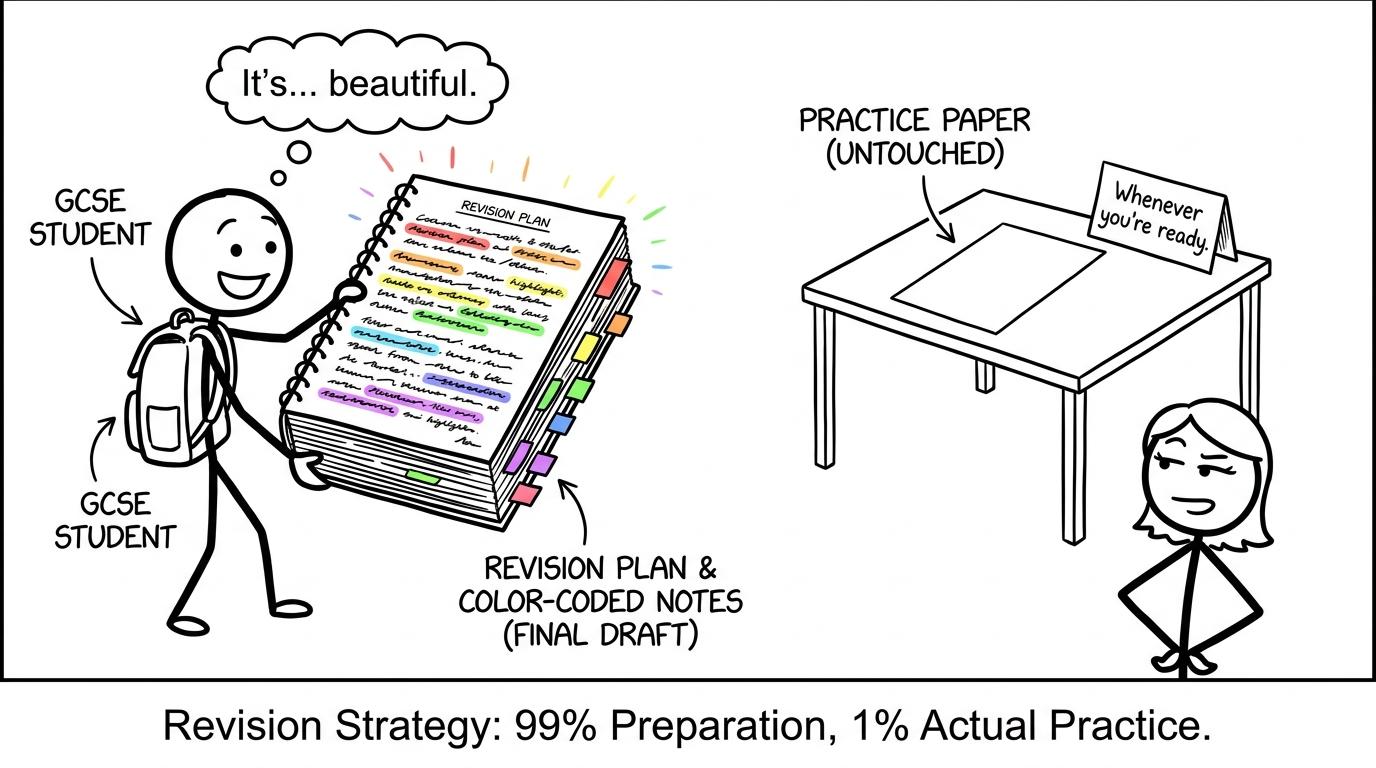 A colourful notebook delays the moment of attempting a practice paper
What the evidence really says about colour and recall
Research into colour cues suggests that carefully chosen colour can guide visual attention and help learners organise detailed material. Some studies of multimedia lessons have found improvements in retention or transfer when relevant information is highlighted. They also suggest that excessive colour may increase cognitive load rather than reduce it.
There are important limits to that evidence. A study involving colour cues in a video, diagram or programming lesson does not automatically prove that making rainbow-coloured GCSE Further Maths notes will improve an examination grade. Different tasks place different demands on memory.
Research has also found that colour may be a weak retrieval cue when it is merely part of the background. In other words, remembering that a formula was written in green is not necessarily the same as being able to select and apply it in an unfamiliar problem.
There is a further risk. If learning always happens with strong visual cues, performance may suffer when those cues disappear. Your examination paper will not reproduce your highlighting system. Eventually, you need to solve problems in ordinary black print on white paper.
The wider evidence for retrieval practice is more dependable. Trying to recall information strengthens access to it and exposes gaps that rereading can hide. Educational guidance also emphasises planning, monitoring and evaluating revision rather than assuming that one technique works equally well for every learner and topic.
So colour-coding is not useless. It is simply a supporting technique. Retrieval, feedback and repeated question practice should remain at the centre.
Why Further Maths notes need a different approach
AQA describes its Level 2 Certificate as an additional qualification intended to extend students who are already strong at GCSE Maths. Its content includes number, algebra, coordinate geometry, calculus, matrix transformations and geometry. It is untiered, unlike foundation and higher tier GCSE Maths.
These areas involve connected reasoning. For example, a student may need to recognise a function, manipulate an expression and interpret a graph within the same problem. A beautifully highlighted definition cannot replace fluency with those connections.
Use the AQA GCSE Further Maths revision hub to see the relevant lessons, questions and revision resources together. If a core skill is insecure, the wider GCSE Maths revision area can help you repair the foundation before returning to the harder application.
Colour is most valuable here when it makes relationships visible. It might distinguish:
- a mathematical condition from its consequence;
- a general rule from a special case;
- an original error from its correction;
- facts that must be recalled from steps that can be derived;
- separate representations, such as an equation and its graph.
The colour should carry meaning. If every important sentence is yellow, yellow no longer tells you what kind of importance you are looking at.
A simple colour-coding system that does not take over
Use no more than three or four categories. The exact colours do not matter, and students with colour-vision differences can use symbols, boxes, underlining or labelled margins instead.
| Category | What to mark |
|---|---|
| Definition or fact | Precise language, notation and facts you need to recall |
| Method or decision | The reason for choosing a particular mathematical process |
| Warning or mistake | Sign errors, missing conditions and recurring misconceptions |
| Connection | A link to another topic or representation |
The system should remain consistent across topics. Do not make differentiation green on one page, make all functions green elsewhere and then use green for errors in a third notebook. The category matters more than the topic.
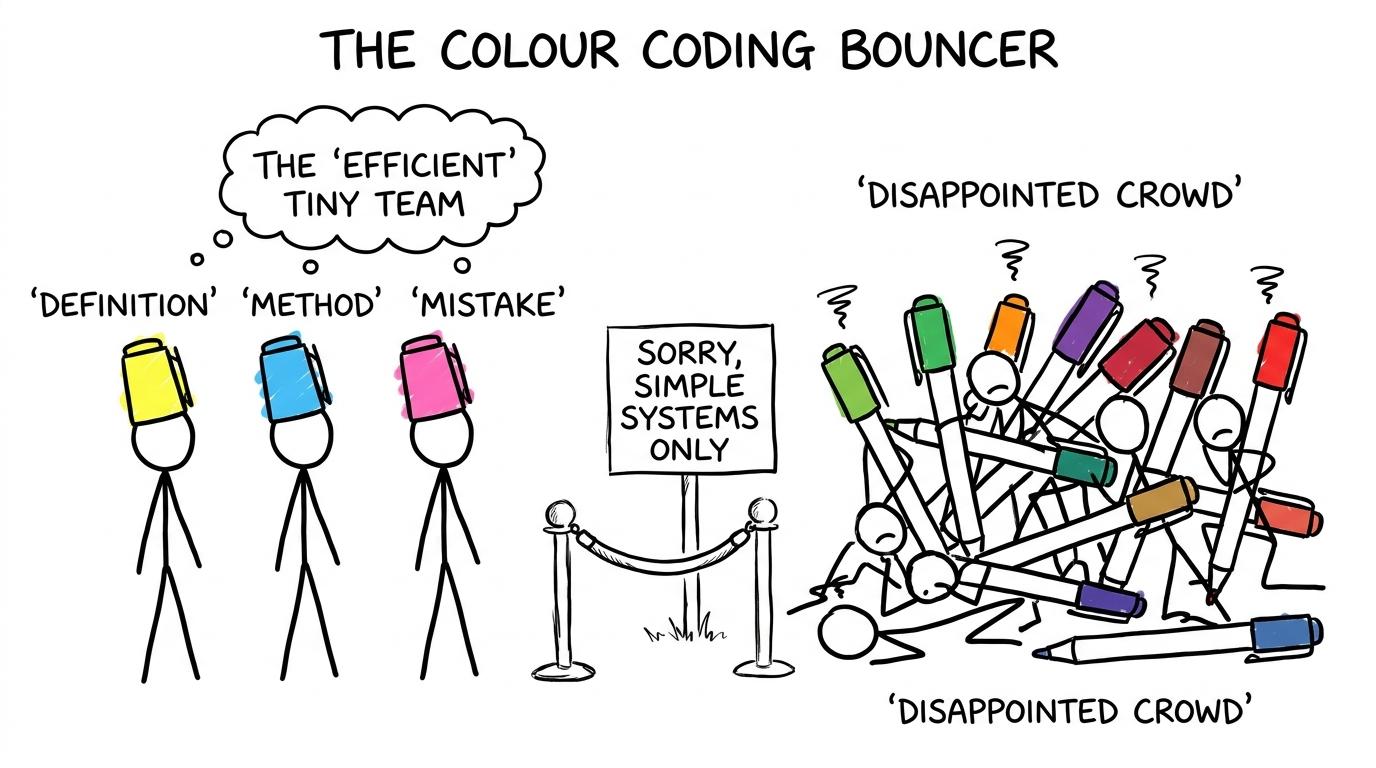 Three useful highlighters keep an unnecessary crowd of colours outside
Colour the thinking, not every line
Highlighting a complete solution can make the page attractive but mathematically flat. Instead, mark the decision points: the condition that changes the method, the line where a restriction matters, or the place where you previously made an error.
Further Maths questions often reward structure. Your notes should therefore explain why a method is appropriate, not simply preserve a finished sequence of algebra that looks familiar.
Build notes from feedback
The strongest notes often grow after practice rather than before it. Complete a question, compare it with the mark scheme or video solution, then record one concise correction.
A useful error note might identify one of three causes:
- Knowledge: the fact or method was not available from memory.
- Process: the right method was chosen but the reasoning broke down.
- Accuracy: the mathematics was understood but an algebraic or arithmetic slip occurred.
Assigning a colour or symbol to these categories makes your notebook a diagnosis tool. It tells you what to do next rather than merely what you did before.
Turn colourful notes into active revision
The practical question is not, “How should I colour this page?” It is, “What will I do after closing it?”
Retrieve before you reread
At the start of a revision session, close your notes and write down the relevant definitions, conditions or method outline from memory. Then open the page and use your colour system to check what was missing.
This gives colour a useful job: feedback. It stops the highlighting from becoming a prompt that makes everything feel easier than it really is.
Move immediately to questions
After reviewing one small section, answer practice questions without looking back. Begin with focused questions, then move towards mixed problems where the required method is not announced.
MathsGenie's AQA Further Maths past papers provide the crucial final test: can you use the knowledge when the page is plain, the topics are mixed and the clock is running?
Mark your attempt carefully. A paper is not complete when you write the final answer; it is complete when you understand why marks were gained or lost.
Revisit the topic after a delay
One successful session can create temporary confidence. Return to the same idea later and attempt a fresh question without the notes. This is more informative than rereading the page several times in one evening.
If you need a repeatable schedule, adapt the structure in the GCSE maths revision timetable guide. Short sessions can also work well: the 20-minute GCSE revision routine combines recall, questions and quick feedback without leaving much room for decorative procrastination.
Remove the colour cues gradually
Start with organised notes if they help you understand a difficult idea. Next, use a brief uncoloured summary. Finally, answer an unseen question with no notes.
This fading process matters because independent recall is the destination. Colour is temporary scaffolding.
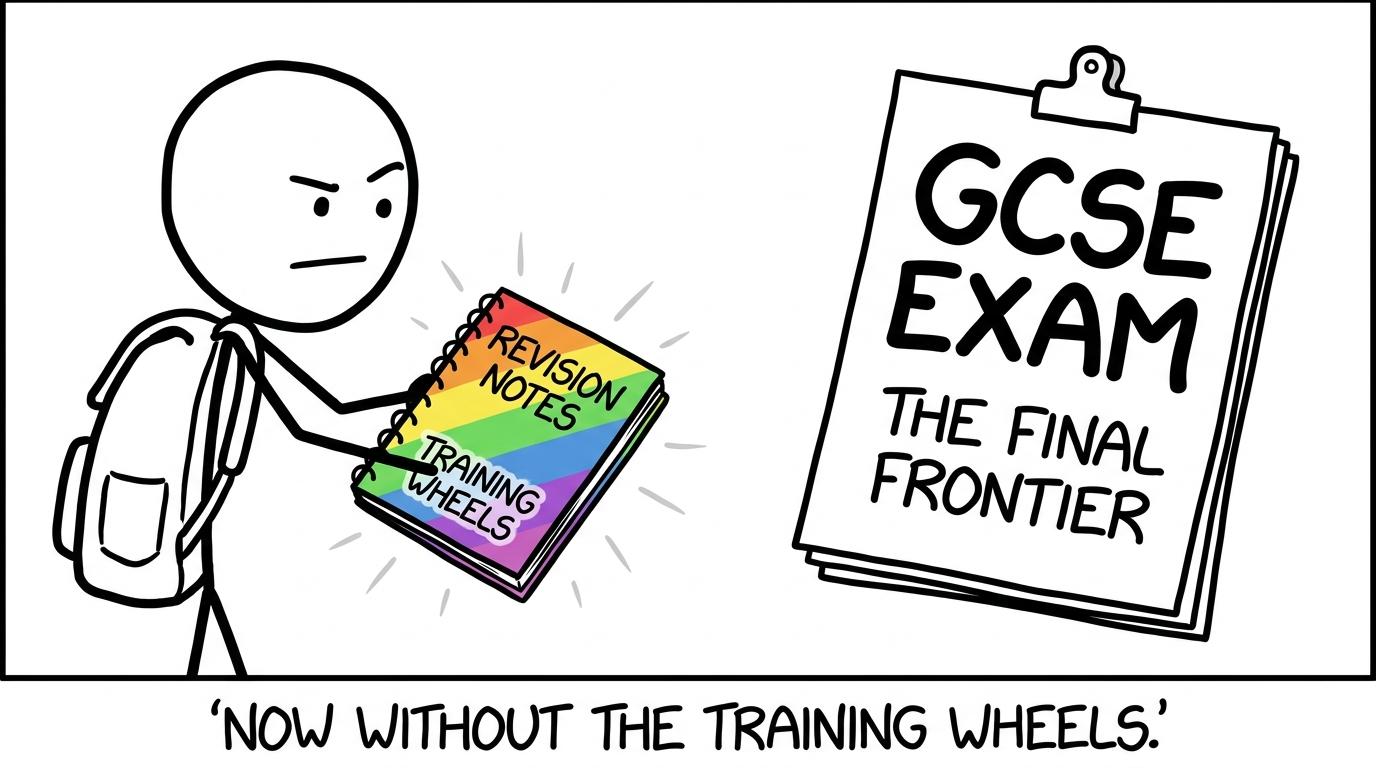 A student leaves colourful notes behind to face a plain examination paper
How to decide whether colour-coding works for you
Do not judge the method by how calm or productive it feels. Test it.
Choose two comparable Further Maths topics. For one, use your restrained colour system. For the other, use a plain summary. Keep the amount of question practice similar. A few days later, test both topics without notes and compare:
- how many questions you could start independently;
- whether you selected suitable methods;
- the types of mistakes you made;
- how accurately you explained your reasoning;
- how much revision time each approach required.
This is metacognition in practical form: plan a strategy, monitor the result and adjust. If colour improves organisation without taking time away from practice, keep it. If it mainly makes revision satisfying, simplify it.
It also helps to revise topics in a deliberate sequence. The best order to learn GCSE Maths topics explains how core skills support later work, while the GCSE topics by exam board and tier guide can help you distinguish ordinary higher-tier content from your additional Further Maths course. Always check the specification and qualification named by your school rather than assuming every board offers an identical course.
Common colour-coding mistakes
Recopying entire chapters
Copying notes can feel active because your hand is moving. Unless you are selecting, explaining or retrieving information, much of the thinking has already been done for you. Condense instead: keep the condition, the decision and the warning.
Treating colour as evidence of learning
Recognition is not recall. A highlighted method may look familiar while it is visible, yet remain unavailable when the notebook closes. Test yourself on a blank page.
Using too many categories
A complicated key adds another system to remember. Three dependable categories are usually more useful than ten subtle ones.
Highlighting before understanding
You cannot reliably identify the crucial idea until you understand the topic. Learn the method first, attempt questions and then annotate the parts that genuinely matter.
Avoiding weak topics because the notes are untidy
Revision should follow lost marks, not aesthetics. A messy error log built from honest practice may be more valuable than a perfect set of notes on a topic you already know.
Never practising under examination conditions
Colour-coded notes are a learning environment, not the final performance. Use timed, unprompted papers to find out whether the knowledge transfers.
Make colour serve the mathematics
Colour-coding can make GCSE Further Maths notes clearer. It may direct attention, separate ideas and make recurring mistakes easier to spot. But it is not a shortcut to durable recall, and the pleasure of organising a page can disguise the absence of challenging practice.
Keep the system small. Retrieve before looking. Answer questions without prompts. Mark your work, record precise errors and return after a delay.
Then let MathsGenie carry the process forward. Begin with the free AQA Further Maths revision lessons and practice, use mark schemes and video solutions to correct your reasoning, and finish with past papers under realistic conditions. For your main GCSE Maths course, MathsGenie also brings together mini tests, practice questions, predicted papers and board-specific resources.
Your notes do not need to look like you have mastered Further Maths. They need to help you prove that you can do it.