

AI Tools to Revise GCSE Dance: A Safe Guide
AI tools to revise GCSE Dance can improve recall and planning, but not replace practice. Learn safe prompts, key limits and how to avoid false answers.
Revision can feel hardest when a subject asks you to think in several different ways. GCSE Dance requires physical performance, creative decisions, precise terminology and written analysis. Meanwhile, your maths papers still demand regular practice. It is tempting to ask whether AI tools revise GCSE Dance more quickly than traditional methods.
The short answer is yes, but only in a supporting role. ChatGPT and similar tools can quiz you, organise notes, generate retrieval questions and challenge your explanations. They cannot reliably judge your performance, replace knowledge of the set works or produce assessed material that you can submit as your own.
Used well, AI removes some of the friction from revision. Used carelessly, it can give you polished inaccuracies and a false sense of progress.
A quick checklist for using AI safely
Before opening an AI tool, remember these principles:
- Use it to test your knowledge, not replace your thinking.
- Check factual claims against your teacher’s resources and the current specification.
- Never submit AI-generated writing or choreography as your own assessed work.
- Do not enter personal information, assessment material or identifiable videos.
- Ask focused questions rather than requesting an entire revision session.
- Finish by recalling or applying the material without AI support.
- Keep practical rehearsal at the centre of Dance revision.
The most useful distinction is simple: AI can be a practice partner, but it should not become the performer, choreographer or candidate.
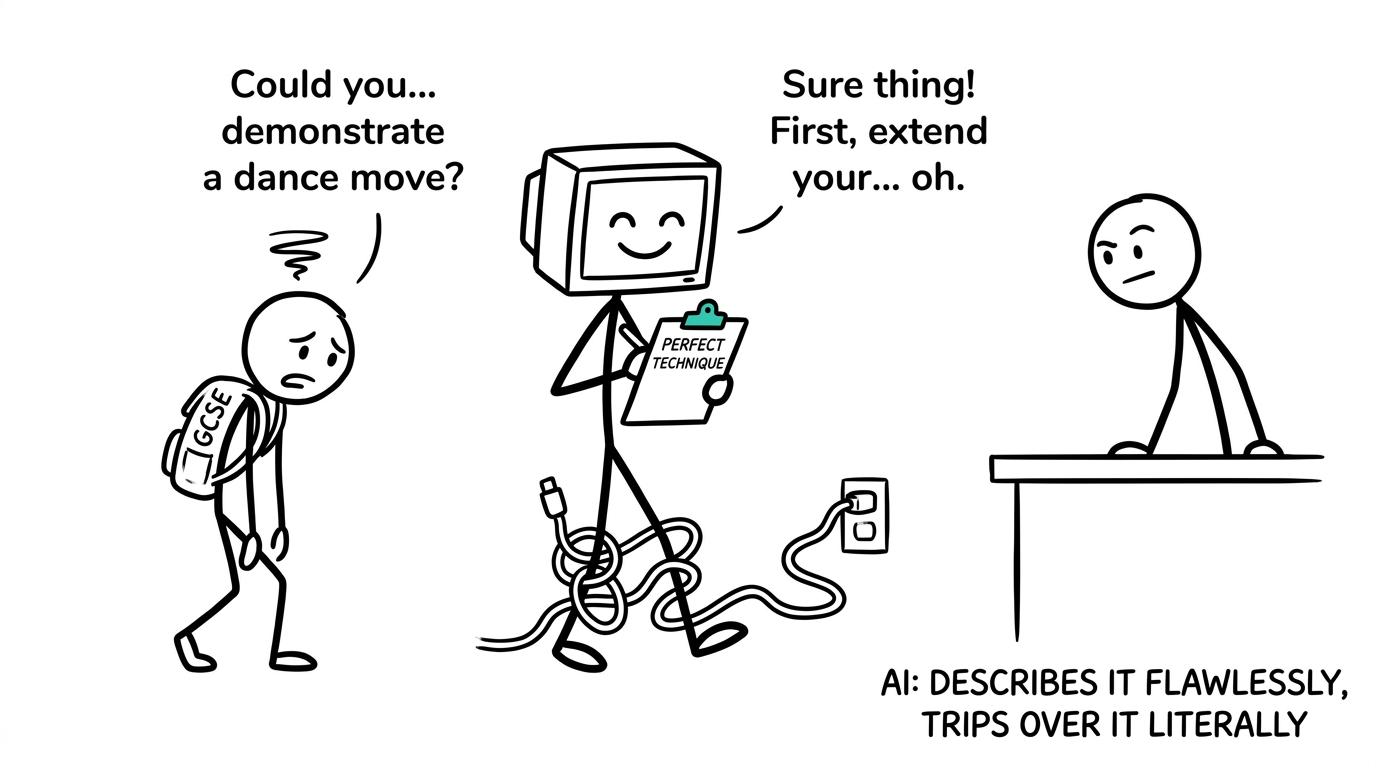 A laptop robot attempts to demonstrate perfect dance technique while tangled in its charging cable
What GCSE Dance actually assesses
Your revision method should reflect the qualification rather than the technology available. Under the current AQA GCSE Dance specification, Component 1 covers performance and choreography and contributes 60%60\%60% of the qualification. Component 2 is Dance appreciation, a written examination contributing 40%40\%40%.
The written component examines knowledge of choreographic processes and performing skills, critical appreciation of your own work, and critical appreciation of the six professional works in the GCSE Dance Anthology. Students need to describe, analyse, interpret, evaluate and reflect. Those command words require different kinds of thinking.
This matters because a chatbot is much better at producing a terminology quiz than observing whether you maintain alignment, control, timing or projection. It can discuss expressive skills. It cannot experience your performance from inside the studio or replace feedback from a qualified teacher.
Always follow the specification and instructions provided by your school. GCSE Dance is currently associated with AQA, so references to imaginary Dance requirements from Edexcel, OCR or Eduqas should be treated as a warning that an AI answer may be unreliable. Those exam boards are relevant to subjects such as GCSE maths, but that does not make their terminology interchangeable with AQA Dance.
Where AI tools genuinely help with GCSE Dance revision
Turning notes into retrieval questions
Rereading notes feels productive because everything looks familiar. The problem appears when the notes close. Can you still retrieve the choreographer, intention, production features and relevant movement content?
Give an AI tool a small set of teacher-approved notes and ask it to produce questions using only that information. Request a mixture of definitions, short-answer questions and comparison prompts. Answer without looking, then check against the original notes rather than trusting the AI’s marking automatically.
This follows the same active-revision principle that works in maths. A short test reveals more than another passive read. Maths students can use GCSE mini tests for that purpose, while Dance students can ask AI to transform verified notes into a temporary quiz.
Practising command words
AI can help you distinguish between instructions such as describe, explain, analyse and evaluate. Ask it to give you one question at a time and withhold hints until you have responded.
You can also ask it to challenge vague answers. For example, request questions such as:
- What evidence supports that interpretation?
- How does the feature communicate the choreographic intention?
- Why is that judgement convincing?
- Which specific movement or production feature should be named?
These questions encourage precision. However, compare any feedback with your teacher’s guidance, official assessment materials and real mark schemes. A chatbot can comment on clarity, but it does not know with certainty what an examiner would award.
Organising the six anthology works
A blank comparison grid can feel surprisingly difficult to begin. AI can suggest neutral headings for organising verified knowledge, such as choreographic intention, movement content, dancers, aural setting, costume, lighting, set and performance environment.
The facts placed under those headings should come from trusted course materials. This is one of the safest uses of AI: let it help create the container, while you provide and verify the content.
You might then ask the tool to choose two headings and prompt you to compare two works. Do not ask it to invent quotations, movement examples or production details. Generative AI can present a fabricated detail in the same confident tone as a correct one.
Building a realistic revision plan
AI can divide a broad goal into manageable sessions if you provide your deadlines, available time and current priorities without sharing sensitive information. A useful Dance plan should balance:
- practical rehearsal;
- anthology recall;
- terminology;
- reflection on your own work;
- timed written responses;
- feedback and correction.
Students balancing Dance with maths can use the free MathsGenie revision planner to protect regular maths practice. The GCSE maths revision timetable guide also explains how to build repeatable sessions rather than creating an ambitious plan that collapses after two days.
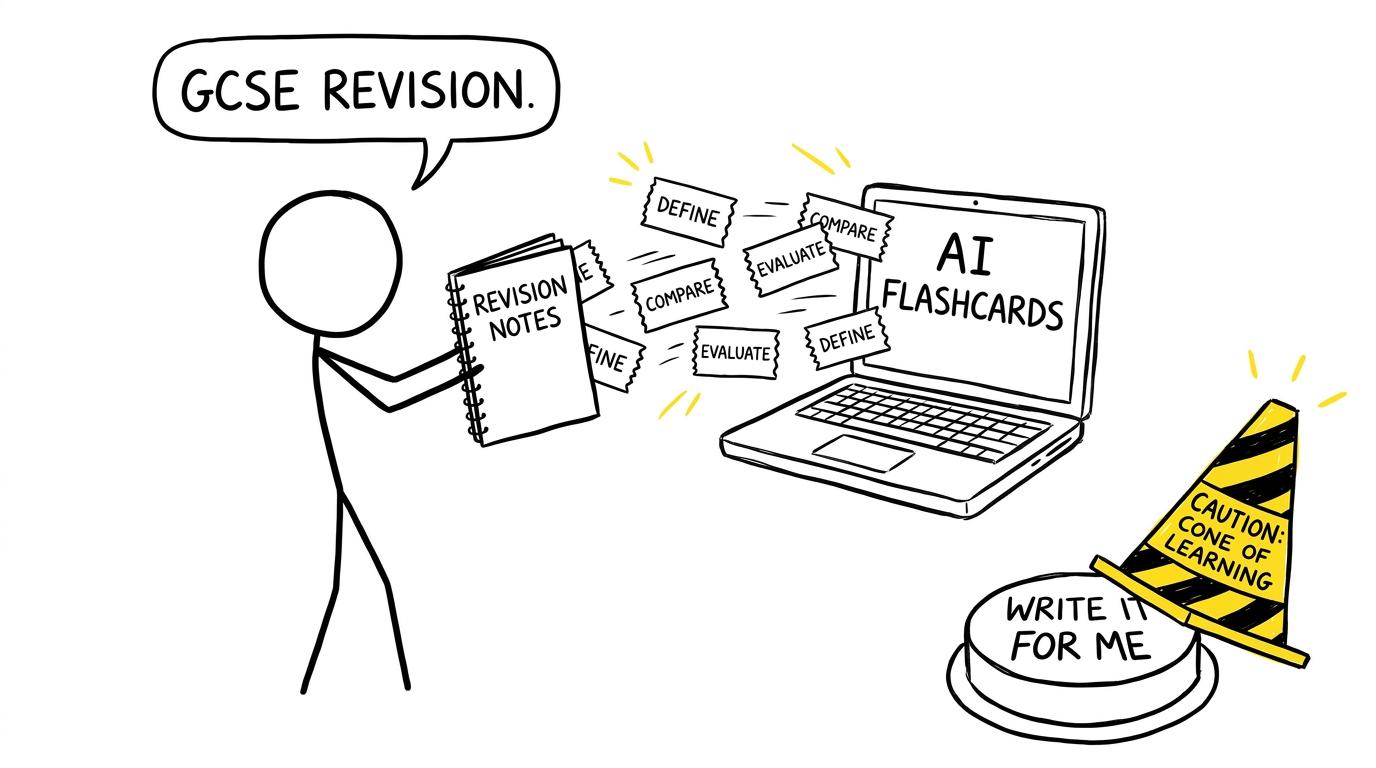 A student catches Define, Compare and Evaluate cards from an AI flashcard partner while avoiding a Write It For Me button
Prompts that make AI more useful
Good prompts set boundaries. Instead of asking, “Teach me GCSE Dance”, tell the tool what role it should perform, what source it may use and what it must not invent.
Useful prompt structures include:
- “Using only the notes I provide, ask me ten retrieval questions one at a time. Do not add outside facts.”
- “Test whether I can distinguish physical, technical, expressive and mental skills. Ask for an explanation after each answer.”
- “Give me an AQA GCSE Dance command word and ask me to explain what the response should do. Do not write the response for me.”
- “Help me organise a weekly plan containing practical rehearsal, anthology recall and timed writing. Leave the content of assessed work to me.”
- “Read this practice paragraph and identify vague claims. Do not rewrite it; ask questions that help me improve it myself.”
The final prompt is particularly valuable. Feedback that makes you think is safer and more educational than a replacement paragraph that merely sounds impressive.
Where AI tools lead GCSE Dance students astray
Confident factual errors
Government guidance on generative AI in education warns that outputs may be inaccurate, biased, out of date, taken out of context or simply fabricated. Dance has specialist vocabulary and work-specific details, so a small invented claim can damage an otherwise strong answer.
Ask for uncertainty to be identified, but do not assume the tool will recognise every uncertainty. Verification remains your responsibility.
Weak judgement of practical performance
A generic description cannot tell you exactly how effectively you demonstrate control, alignment, focus, musicality or communication of choreographic intention. Even video-analysis features may miss context, lack access to the correct assessment criteria or create privacy concerns.
Use teacher feedback, supervised rehearsal and your school’s approved recording arrangements. Do not upload videos containing you or other students unless your school has explicitly approved the tool and process.
Generic analysis that sounds sophisticated
AI often produces fluent paragraphs built from broad phrases. They may discuss atmosphere, intention and audience impact without naming precise evidence. Examiners reward relevant knowledge and developed reasoning, not decorative language.
A useful test is to remove the name of the dance work. If the paragraph could describe almost any performance, it is probably too generic.
Crossing the line into malpractice
JCQ guidance is clear that work submitted for assessment must be the student’s own. Passing AI-generated or AI-paraphrased material off as your independent work can constitute malpractice. Where AI use is permitted as a source, acknowledgement and retained evidence may be required, but identified AI material still does not demonstrate that you independently met the assessment criteria.
Do not ask AI to create choreography, reflective material or written content that you intend to submit for assessment. Speak to your teacher before using AI anywhere near non-exam assessment. Your school’s rules and the current JCQ guidance take priority over advice from a chatbot or blog.
A reliable AI revision routine
The safest routine has five stages:
Start with a trusted source
Choose one small area from your specification, teacher notes or an approved resource. Do not begin with an unrestricted chatbot answer.
Use AI to generate a task
Ask for questions, headings or challenges based only on the verified material. Keep the task narrow enough to check.
Work without assistance
Close the notes and answer independently. For practical content, rehearse away from the screen. Revision only becomes useful when you perform the thinking or movement yourself.
Verify and correct
Check every factual answer against the original source. Record the precise gap rather than writing “revise Dance”. A useful note might identify one confused command word, one missing production feature or one weak comparison.
Return without AI
Revisit the same knowledge later using flashcards, a blank-page recall task or a timed response. The goal is independence. If the tool disappears and the knowledge disappears with it, the session has not yet worked.
This loop also applies to maths. Use the GCSE maths revision hub to learn a method, answer practice questions and check solutions. The best order for learning GCSE maths topics can help if your revision feels scattered across algebra, number, geometry, statistics and probability.
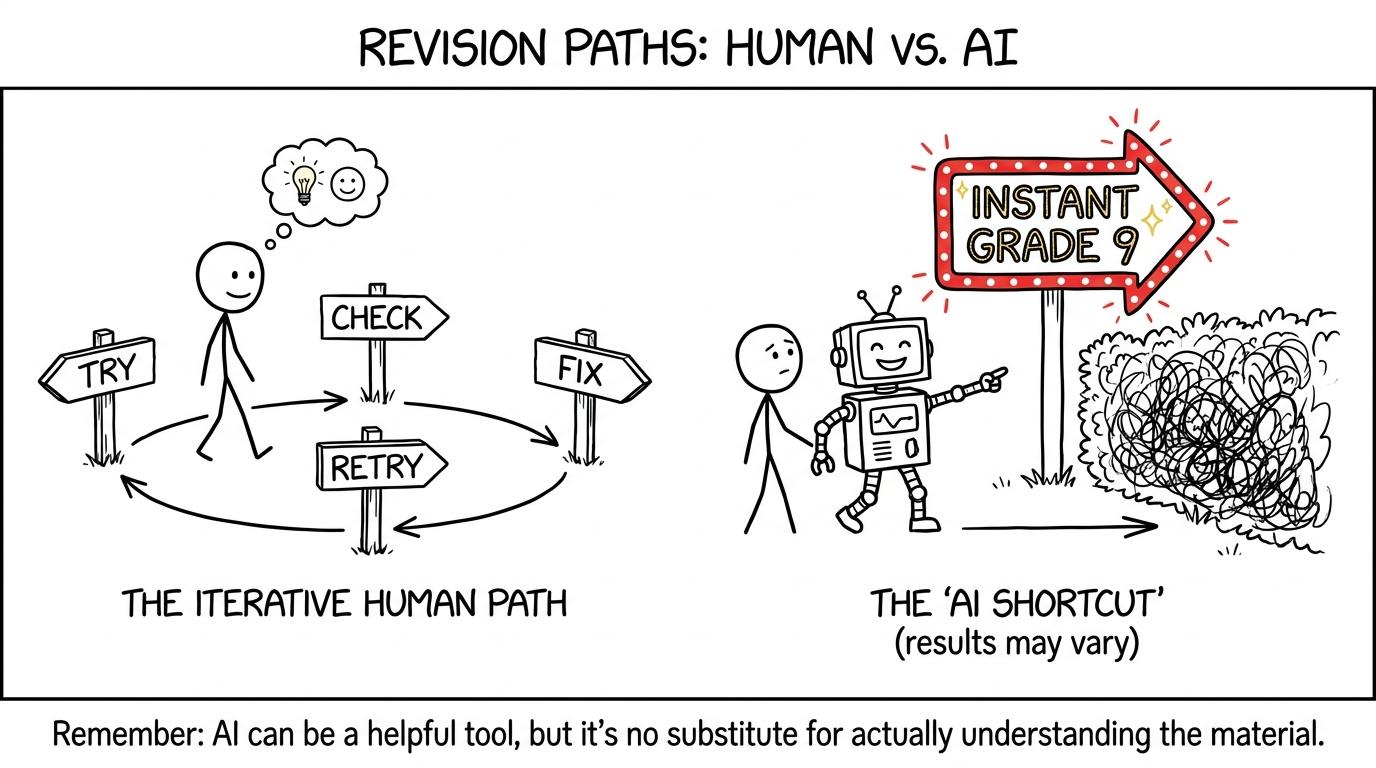 One student follows a Try, Check, Fix and Retry path while another follows an AI towards an Instant Grade 9 hedge
Common mistakes when revising GCSE Dance with AI
Trusting the first answer: Treat every factual output as an unverified draft until you have checked it against course materials.
Asking for complete model answers: This encourages imitation rather than recall and risks producing work that is not genuinely yours.
Letting AI mark too generously: A plausible score from a chatbot is not an official assessment. Use teacher feedback and mark schemes.
Replacing rehearsal with screen time: Knowledge of physical and expressive skills is not the same as demonstrating them safely and effectively.
Uploading personal or assessed material: Avoid names, identifiable videos, private teacher feedback and secure assessment information.
Using the wrong specification: State AQA GCSE Dance and confirm every requirement against the current specification.
Forgetting your other subjects: A long Dance session should not quietly remove maths from the week. If exams are close, the GCSE one-week maths revision plan provides a focused structure, while the guide to starting GCSE past papers helps you introduce timed practice sensibly.
Use AI as scaffolding, not a shortcut
The best AI-supported revision does not look especially futuristic. You retrieve knowledge, receive a prompt, notice a gap, check a trusted source and try again. AI simply makes parts of that loop faster.
For GCSE Dance, keep teacher feedback, specification knowledge, independent analysis and physical rehearsal at the centre. Use AI for low-risk tasks such as questioning, planning and organising verified information. Never let fluent output persuade you that it is automatically correct, or yours.
Then apply the same discipline to maths. Open MathsGenie’s free GCSE revision resources, choose the correct exam board and tier, and work through revision lessons, practice questions, mini tests, past papers, predicted papers, mark schemes and video solutions. Technology is most valuable when it sends you back to the work that earns the marks.











