

Apprenticeship GCSE Dance Requirement: The Facts
Apprenticeship GCSE Dance requirement explained: learn which routes ask for a Dance grade, what employers check and what to do if your grade is lower.
A vacancy can make one GCSE feel as though it controls your whole future. Perhaps you enjoy dance, have found an apprenticeship in the creative sector, and are now wondering whether your result closes the door.
The short answer is reassuring: an apprenticeship GCSE Dance requirement is unusual. Current national apprenticeship standards do not generally prescribe a particular GCSE Dance grade. Employers and training providers set their own entry criteria, however, so an individual vacancy can ask for GCSE Dance, a related qualification, practical experience or evidence of ability.
Maths and English are much more commonly mentioned. That means your maths revision may have a greater effect on your apprenticeship options than your Dance grade.
The apprenticeship GCSE Dance requirement checklist
Before deciding whether you qualify, check five things:
- Is it a genuine paid apprenticeship or a college, conservatoire or teacher-training course?
- Does the vacancy say GCSE Dance is essential, desirable or simply relevant?
- Is the stated grade for Dance, or for GCSE maths and English?
- Will the employer accept an equivalent qualification, experience or an audition?
- Can the employer or training provider confirm the requirement in writing?
The distinction between essential and desirable matters. An essential criterion is normally used to decide whether an application can progress. A desirable criterion strengthens an application but may not exclude you.
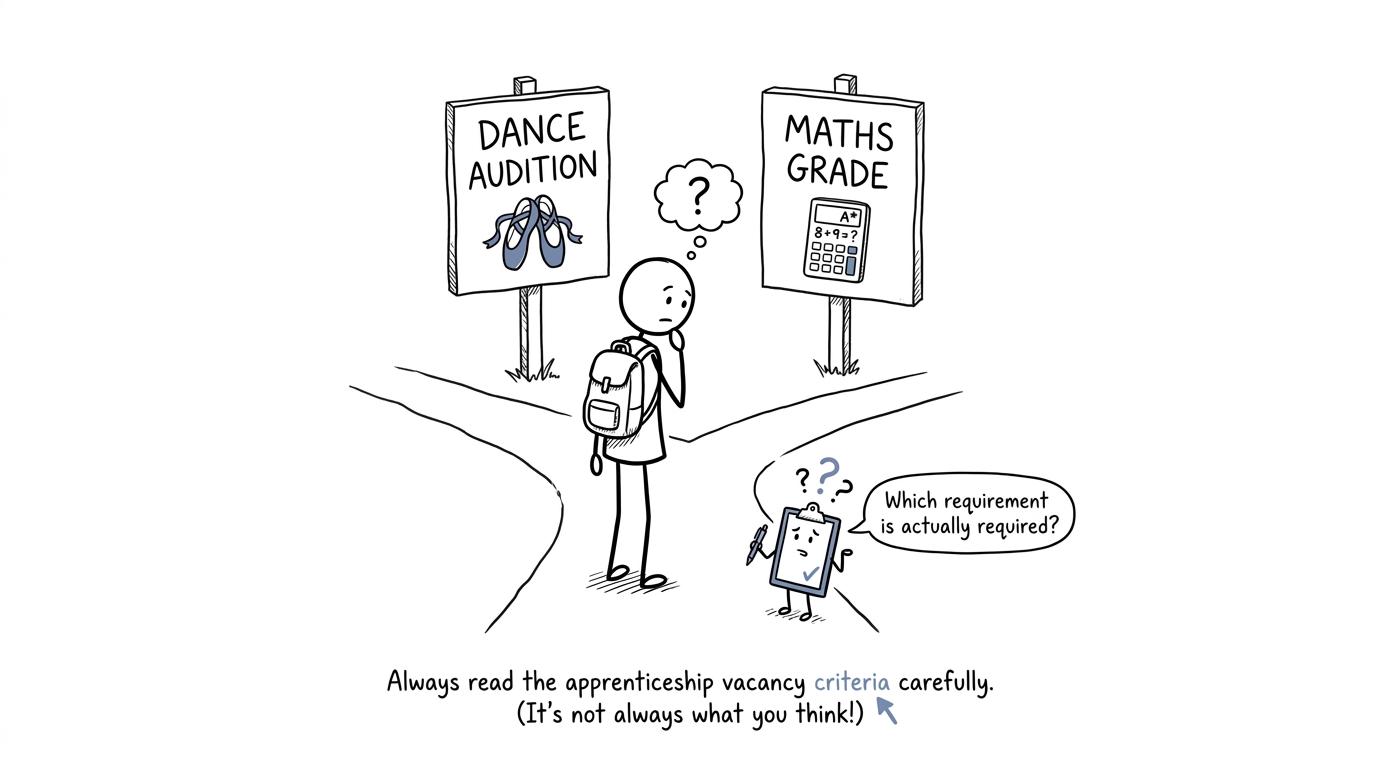 A student choosing between a dance audition and a maths grade while checking the real apprenticeship requirements
Do apprenticeships require a particular GCSE Dance grade?
Usually, no. There is no general rule saying that apprentices must hold GCSE Dance at grade 444, 555 or any other grade.
In England, the basic eligibility rules concern matters such as age, residence, employment and participation in full-time education. The occupational standard describes the knowledge, skills and behaviours needed for the job. Entry requirements are then commonly decided by the employer.
This creates an important difference:
- The apprenticeship standard sets what an apprentice must learn and demonstrate.
- The employer's vacancy sets who the employer wants to recruit.
- The training provider may check whether an applicant can cope with the programme.
Consequently, two employers offering apprenticeships against the same standard may advertise different GCSE expectations. One might ask for GCSE maths and English at grade 444 or above. Another may consider applicants without those grades but expect them to complete appropriate learning during the apprenticeship. A dance organisation could prefer GCSE Dance without making it compulsory.
Always treat the live vacancy as the final source for that particular job.
Which dance-related apprenticeship routes set a minimum grade?
A review of current official apprenticeship information does not identify a mainstream apprenticeship standard with a nationally fixed minimum GCSE Dance grade. Some routes can involve dance organisations or movement-based work, but their standards either leave entry requirements to employers or focus on broader occupational skills.
Cultural learning and participation officer
The Level 333 cultural learning and participation officer apprenticeship can be delivered in arts and cultural organisations. The work may involve organising workshops, education programmes and community engagement projects, potentially including dance.
Its national standard says employers set their own entry requirements. It does not impose a particular GCSE Dance grade. An employer may instead prioritise communication, organisation, safeguarding awareness, experience with young people or enthusiasm for the arts.
Some individual providers or vacancies ask for grade 444 in GCSE maths and English. That is not the same as a grade 444 requirement in Dance.
Sports coaching and physical activity roles
Sports coach and physical activity apprenticeships can occasionally be based in settings where dance, exercise or movement sessions are part of the job. These routes usually assess coaching ability, communication, safety and engagement rather than requiring GCSE Dance nationally.
Be careful with older search results. The former community activator coach standard has been retired, although archived pages may still appear online. A current vacancy should name an active apprenticeship standard and an approved training provider.
Theatre, events and creative production routes
Creative apprenticeships may exist in venues that stage dance, but roles in events, technical theatre, costume, marketing or administration are not apprenticeships in performing dance. Their entry criteria normally relate to the actual occupation.
A theatre employer might value your understanding of dance without requiring the GCSE. Equally, a technical role could care more about practical problem-solving, teamwork and numeracy.
Dance teaching qualifications and vocational courses
This is where confusion often begins. Some dance-teaching qualifications, vocational courses and Level 333 programmes do specify prior dance attainment. They may accept GCSE Dance at grade 444, a graded dance examination or another Level 222 dance qualification.
That does not automatically make the programme an apprenticeship. A course can have a specific GCSE Dance threshold while a related apprenticeship standard does not. Check whether you will be employed, paid and completing formally recognised apprenticeship training.
Why GCSE maths is more likely to appear
Dance is specialised. Maths and English are transferable, so employers use them more frequently when judging readiness for workplace training.
Maths appears in creative work more often than it first seems. Timetables require calculations with time. Budgets involve percentages and totals. Room plans use scale and measurement. Ticketing, attendance data and project reporting all depend on numerical confidence.
For apprentices who begin aged 161616 to 181818, current English apprenticeship rules give English and maths particular importance where suitable prior qualifications are not already held. The precise training and completion arrangements depend on age, prior attainment, approved equivalents and current funding rules. Employers may also set stronger entry criteria than the national minimum.
The practical lesson is simple: never assume that a weak Dance grade matters more than maths. Read the exact wording.
If maths is the gap, begin with the free MathsGenie GCSE maths revision hub. It brings lessons and exam-style practice together rather than leaving you to guess what to revise.
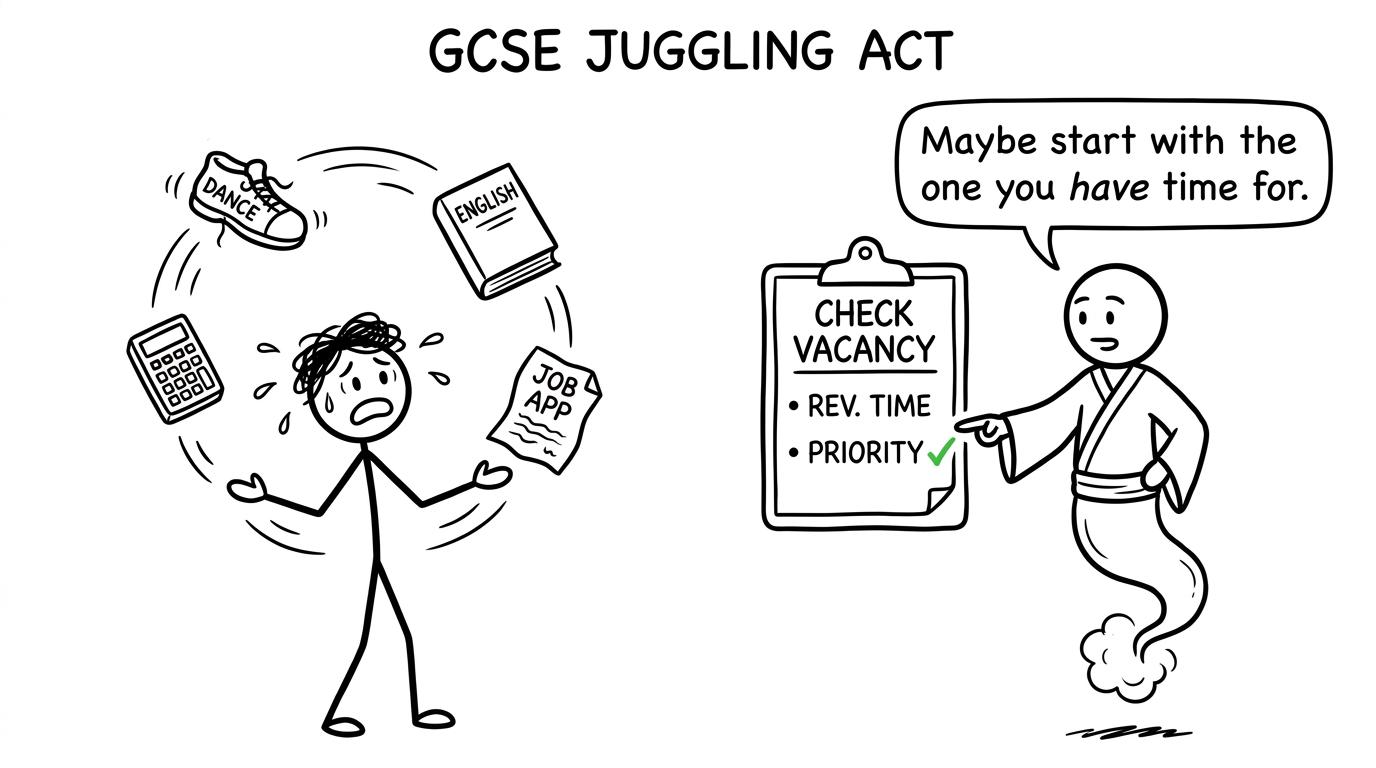 A student juggling a dance shoe, calculator and application while following a simple vacancy checklist
What to do if you are below the requested Dance grade
A lower grade is information, not a verdict. Your response should depend on how the vacancy describes the criterion.
Ask whether the grade is genuinely essential
Contact the named employer or training provider before ruling yourself out. Keep the question precise:
The vacancy asks for GCSE Dance at grade 444. I achieved grade 333 but have continued practical training. Would you consider relevant experience, an audition or an equivalent qualification?
Do not claim that experience is equivalent unless the organisation confirms it. The aim is to discover whether there is flexibility.
Gather evidence of current ability
A GCSE result records performance at one time. An employer may also consider more recent evidence, such as:
- graded dance qualifications;
- participation in properly supervised productions or workshops;
- a portfolio or showreel requested by the employer;
- choreography, leadership or volunteering experience;
- a reference from a teacher or recognised instructor;
- performance at an audition.
Only submit material requested or relevant to the application. Strong evidence is specific and verifiable.
Look for the occupation, not only the word dance
Searching only for “dance apprentice” may hide suitable routes. Search for occupations such as cultural participation, arts administration, coaching, events, community engagement and theatre production. Then inspect the employer and day-to-day duties.
This does not mean abandoning dance. It means recognising that an apprenticeship is built around an occupation, and the organisation employing you may operate within the dance sector.
Improve the qualifications that create the widest access
If several vacancies request grade 444 in maths or English, improving those subjects can widen your options across many sectors. Start by identifying whether you are taking foundation or higher tier and which board you follow, such as Edexcel, AQA, OCR or Eduqas.
A sensible revision cycle is:
- diagnose weak topics;
- use a short revision lesson;
- complete focused practice questions;
- check the mark scheme;
- record the precise error;
- retest the topic later.
The GCSE maths revision timetable guide can help you turn that cycle into a realistic weekly plan. If exams are close, use the one-month GCSE maths revision plan rather than trying to revise everything at once.
How to compare vacancy requirements accurately
Read the person specification separately from the job description. The job description tells you what you would do; the person specification explains what the employer expects from an applicant.
Make three short lists:
- requirements you already meet;
- requirements for which you have an accepted equivalent;
- requirements you need to clarify.
Do not convert grades or qualifications yourself. Ask the provider whether your qualification is accepted as equivalent. This is particularly important for vocational awards, overseas qualifications and graded dance examinations.
Save a copy of the advert because vacancies can be removed after the closing date. Keep any written clarification from the employer with your application notes.
 A student using the small print as a treasure map beside a dance shoe and calculator
Common mistakes when checking apprenticeship requirements
Confusing a course with an apprenticeship
A programme containing workplace practice is not necessarily an apprenticeship. Confirm that it includes employment, wages, structured training and an approved apprenticeship standard.
Reading “GCSEs” as “GCSE Dance”
A request for several GCSEs may specifically require maths and English while leaving the other subjects open. Check every subject named.
Treating a desirable grade as an automatic rejection
If GCSE Dance is desirable rather than essential, apply when you meet the essential criteria and can show relevant evidence elsewhere.
Assuming all employers use the same rules
Entry criteria can vary between vacancies using the same apprenticeship standard. Never rely solely on an old advert, a friend's application or a general careers page.
Neglecting maths while focusing on the creative subject
A secure maths grade may keep more routes open. Use Edexcel GCSE maths mini tests for short checks, then learn how to use GCSE past papers properly. Near the exams, Edexcel predicted papers can add fresh practice, but they should support rather than replace official past papers.
Keep the door open with purposeful revision
For most students, there is no standard apprenticeship GCSE Dance requirement standing between them and every dance-related career. A particular employer may set one, and a non-apprenticeship dance course may have firmer subject-specific criteria, but neither should be mistaken for a universal rule.
Check the live vacancy, distinguish essential criteria from preferences, ask about accepted alternatives and strengthen the qualifications that recur most often. If maths is one of them, use MathsGenie to move from uncertainty to a clear routine: revision lessons first, practice questions next, then mini tests, past papers and predicted papers with mark schemes and video solutions.
Start with one weak topic today. A future route rarely depends on one dramatic leap. More often, it stays open because of many small, well-directed steps.











