Best GCSE Subjects to Pair with French
GCSE subjects to pair with French explained: compare humanities, computing and creative options, balance workload and protect your maths revision time.

Choosing GCSE options can feel strangely permanent. One box on a form seems to carry questions about sixth form, university and work that you may not be ready to answer. If you are looking for the best GCSE subjects to pair with French, the short answer is geography, history, computer science, a second language or a creative subject can all work well. The right combination, however, is the one that fits your interests, future plans and weekly workload while leaving enough time for compulsory subjects such as maths.
There is no officially preferred partner for French. A broad combination is usually more useful than collecting subjects that merely sound impressive. French already requires regular vocabulary retrieval, grammar practice, listening, reading, writing and speaking. Pair it with options whose demands you understand, not simply those your friends choose.
A quick GCSE options checklist
Before comparing individual subjects, ask:
- Do I enjoy the subject enough to practise it for two years?
- Am I reasonably secure in the skills it requires?
- Does it support a possible A Level, apprenticeship or career route?
- Does its workload clash with French speaking preparation or vocabulary revision?
- Will the overall combination preserve time for English, science and maths?
- Is the subject actually available in my school's option blocks?
Your school may also set its own option rules. In England, French can fill the language element of the English Baccalaureate, or EBacc. The remaining EBacc areas include English, maths, science and either geography or history. The EBacc is a subject combination rather than a separate qualification, and arrangements elsewhere in the UK can differ.
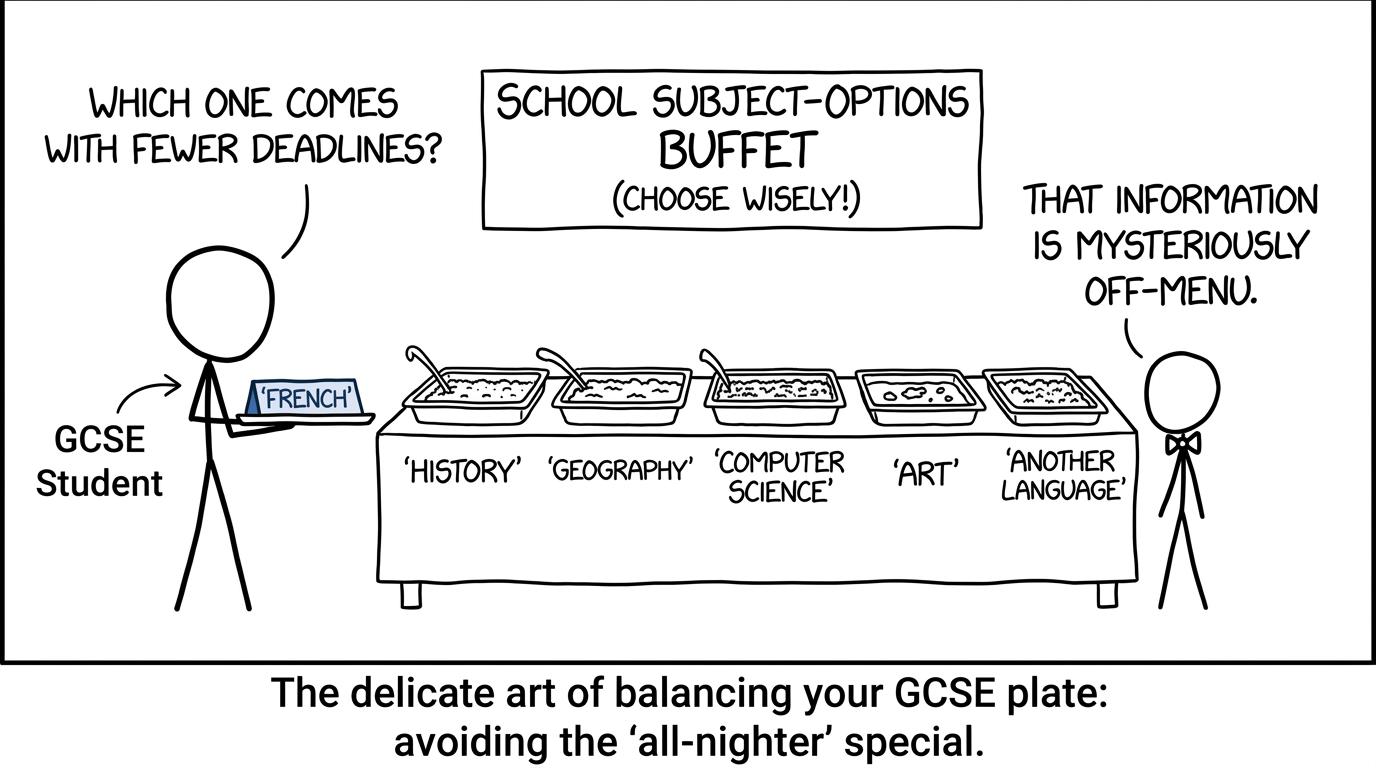 A student discovers that GCSE option workload is mysteriously absent from the menu
Why French changes the shape of your workload
French is not just a written subject. Current GCSE courses assess listening, speaking, reading and writing. For students following the reformed qualifications in England, first examined in summer 202620262026, current AQA and Pearson Edexcel specifications divide the qualification across those four skills, with each contributing 25%25\%25%.
That matters when choosing companion subjects. French improves through frequent, relatively short sessions: vocabulary recall, pronunciation, dictation, translation and spontaneous speaking. Leaving all of it until the night before a test rarely works.
A sensible combination therefore considers the shape of the work. An essay-heavy subject may create regular reading and writing. Art or design may produce extended project deadlines. Computer science can involve precise technical understanding and programming practice. None is inherently too difficult, but several demanding deadlines arriving together can make an otherwise good combination stressful.
Geography: the strongest all-round pairing
Geography is often one of the most practical subjects to take alongside French. It completes the humanities element of the EBacc in England and develops an understanding of places, societies, environments and global connections.
There can be helpful thematic overlap. French courses may explore travel, the environment, communities and the wider world, while geography examines related issues in greater analytical depth. This does not mean that one GCSE gives you answers for the other, but familiar contexts can make ideas easier to discuss.
Geography also mixes extended responses with data, maps and numerical interpretation. That variety can suit students who do not want every option to depend on long essays. The caution is that case studies and geographical processes still require accurate recall. Choose it because you like explaining how places and systems work, not because someone has called it an easy humanities option.
History: excellent for language and argument
French and history form a strong academic combination for students who enjoy reading, interpretation and structured writing. History develops the ability to select evidence, explain causes and consequences, compare interpretations and sustain an argument. Those habits can support careful communication across the curriculum.
The workload is less varied than French plus geography, however. History often involves substantial factual knowledge and extended written responses. French also asks you to retrieve vocabulary and grammar accurately. If memorisation and timed writing already drain your energy, this pairing can feel heavier than it first appears.
History makes sense when you genuinely enjoy constructing explanations. It adds unnecessary stress when it is selected only because it appears prestigious.
Computer science: a useful contrast
Computer science offers a different kind of thinking. Programming, algorithms, data representation and computer systems reward precision and logical problem-solving. That contrast can be refreshing beside the communication and cultural learning involved in French.
It also sits comfortably alongside maths for students considering technical routes after GCSE. Before choosing it, look at your school's specification and teaching approach. GCSE computer science is not simply spending lessons using computers; it includes theory, technical vocabulary and the disciplined practice of tracing or writing algorithms.
If this route interests you, keep your compulsory maths foundation secure through the GCSE Maths revision hub. You can check the full content areas for foundation and higher tier in the GCSE maths topics by exam board guide.
A second language: rewarding but recall-heavy
French with Spanish, German or another available language can be a coherent choice. Grammar awareness, listening habits and confidence speaking aloud may transfer between languages. Students interested in languages, international work or A Level study may value the depth this combination creates.
But shared skills do not halve the work. You still need separate vocabulary, grammatical structures and speaking preparation for each qualification. Similar words can help, yet they can also be confused under pressure.
Two languages make sense if you enjoy frequent recall and are already progressing securely. They are a poor shortcut for someone hoping the courses will be almost identical.
Creative and practical subjects: valuable balance with real deadlines
Art and design, music, drama, design and technology, food preparation and nutrition, or GCSE PE can introduce a different working rhythm. For a student whose week is dominated by written tasks, making, performing or designing can provide meaningful balance.
The word practical should not be mistaken for light. Depending on the subject and specification, there may be portfolios, performances, practical assessments, design development or non-examined assessment. Work can accumulate quietly before a deadline becomes urgent.
A creative subject pairs well with French when you enjoy the process enough to work consistently. It becomes stressful when project work is repeatedly postponed in favour of tests in other subjects.
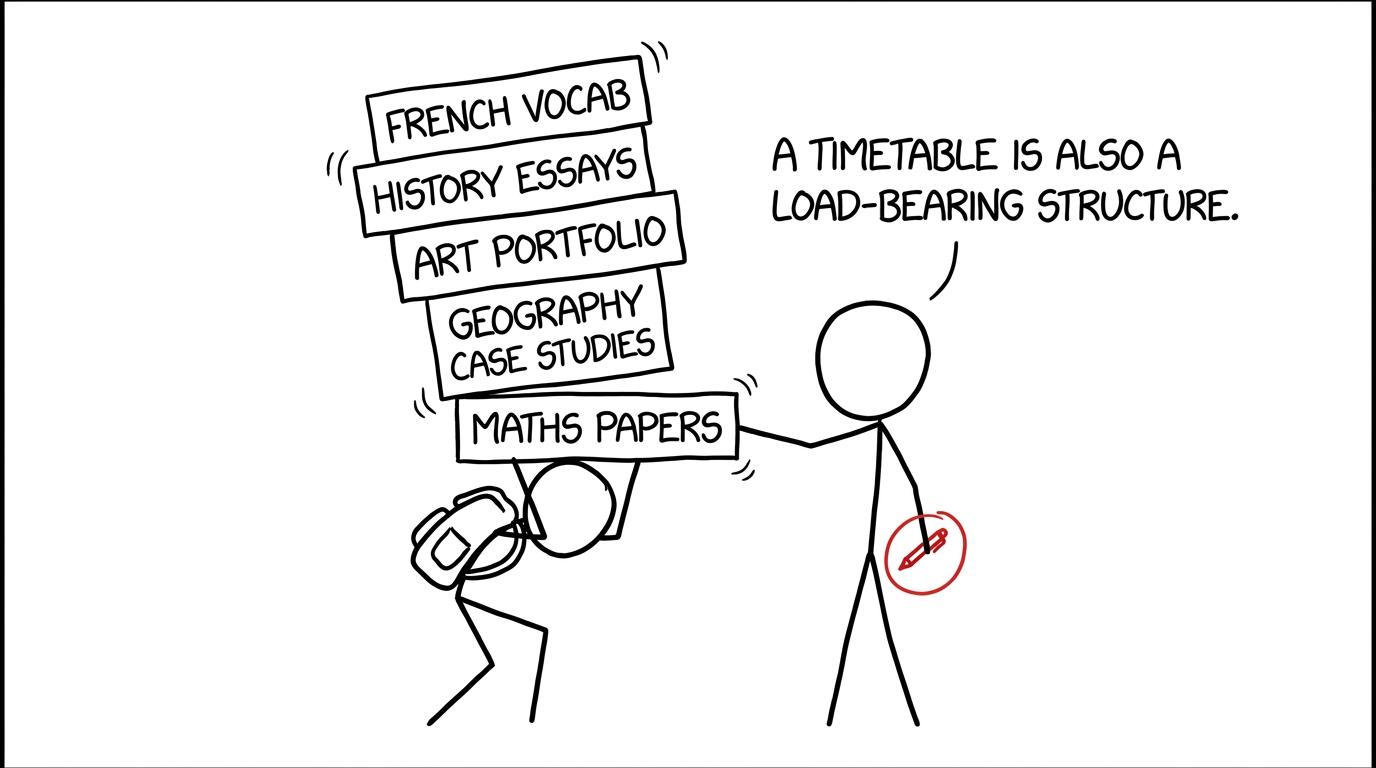 A revision timetable proves to be a load-bearing structure
Triple science and other demanding academic combinations
Separate sciences can support students considering science, engineering, medicine or related A Levels, although school entry arrangements differ. Science also reinforces quantitative reasoning, graph interpretation and problem-solving used in maths.
French and separate sciences are not an unusual or unsuitable combination. The issue is total volume. Adding computer science or another content-heavy option can create a timetable with substantial technical knowledge and frequent tests. This is manageable for an interested student with steady habits, but punishing for someone choosing subjects mainly to keep up appearances.
Religious studies can pair well with French for students who enjoy evaluating ideas and writing reasoned conclusions. Business may offer a blend of concepts, calculations and contextual decision-making. Again, neither is universally easier. Read your school's course outline and ask how each subject is assessed before deciding.
Combinations most likely to create unnecessary stress
No combination is automatically wrong. Stress usually comes from matching several subjects with the same demanding workload pattern.
Too much memorisation and extended writing
French, a second language and history can involve frequent factual or vocabulary retrieval. Add another essay-based option and revision may become difficult to distribute, especially if writing speed is a concern.
Several major project deadlines
Combining art with another portfolio, performance or design subject may produce deadline clusters. This can work for organised students who love practical work, but projects require regular progress rather than a final-week rescue.
A technical combination chosen without technical interest
Separate sciences, computer science and French preserve broad routes, but they do not automatically produce better future opportunities than subjects in which you are engaged and likely to succeed. A demanding combination becomes especially fragile when one option was chosen for status rather than curiosity.
No protected time for compulsory subjects
Maths and English remain central GCSEs. If your options consume every available evening, weakness in a compulsory subject can go untreated. Use the MathsGenie weakest-topics diagnostic to identify where your maths marks are being lost before workload becomes crowded.
How to make the final decision
Write down each possible option and judge it against four separate questions: enjoyment, current attainment, future usefulness and workload pattern. Do not let one factor decide everything.
Then compare the complete timetable. A balanced combination might contain French, one humanities option and one contrasting technical, creative or practical subject. That is a pattern, not a rule. Your school's available blocks may lead to a different but equally sensible result.
Finally, ask teachers specific questions:
- What does independent work look like each week?
- Are there major projects or non-examined assessments?
- Which skills distinguish students who succeed?
- Is prior experience expected?
- Which A Level courses have particular GCSE entry requirements?
If you already have a possible sixth-form direction, check the actual entry requirements published by the school or college. Do not rely on rumours about subjects being compulsory when they may only be recommended.
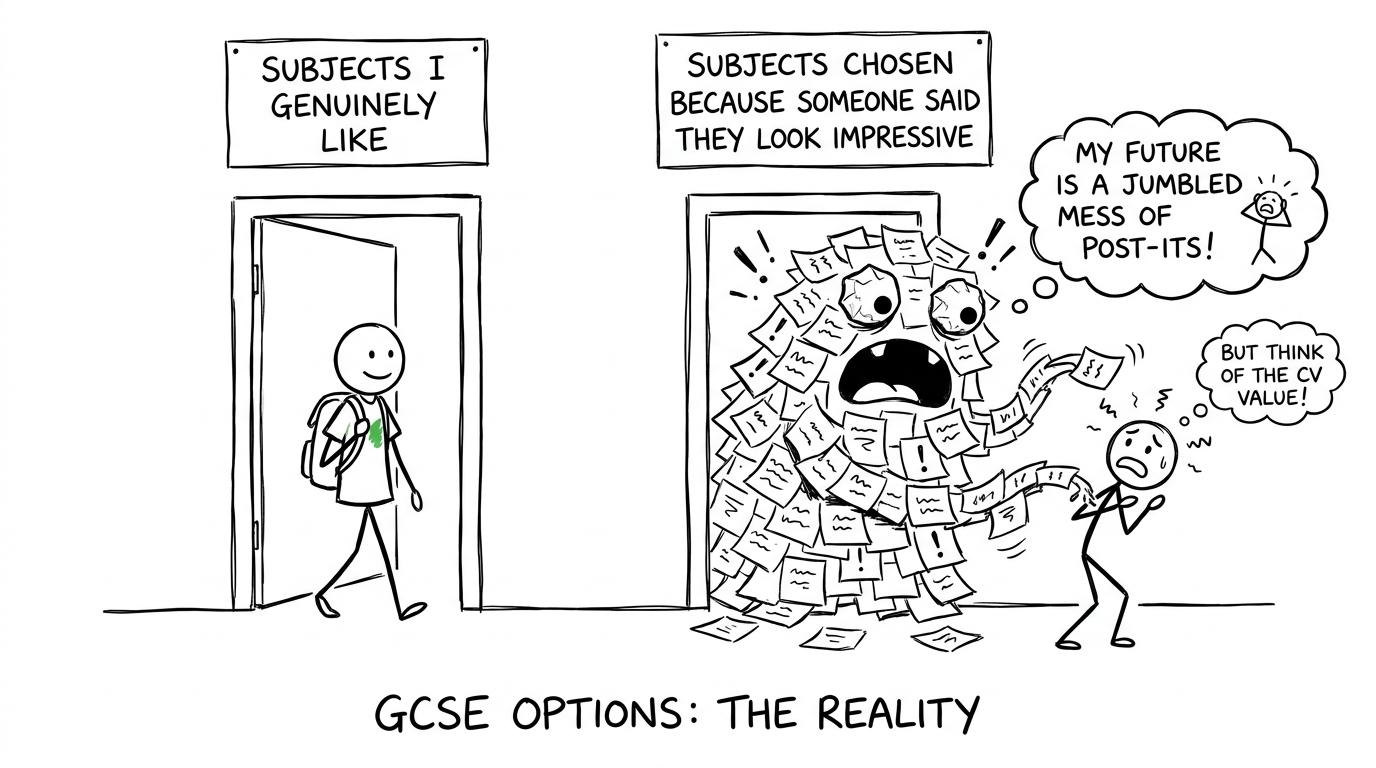 The calm route is choosing subjects for genuine interest rather than imaginary prestige
Protecting maths revision alongside French
The best option combination is one you can sustain in an ordinary week. French benefits from short recall sessions; maths benefits from repeated problem-solving and prompt correction. Neither responds well to passive rereading.
Build a realistic routine with the GCSE maths revision timetable. On crowded school days, the 20-minute maths revision routine offers a manageable structure.
Once you have covered enough content, test your understanding rather than guessing at it. Edexcel GCSE Maths mini tests provide short, focused checks, while Edexcel GCSE Maths past papers build timing and exam familiarity. Students on AQA, OCR or Eduqas can select the appropriate board through the main revision hub.
Common mistakes when choosing GCSE options
- Following friends: option blocks and class groups can change, while you remain responsible for the course.
- Assuming a subject is easy: every GCSE has assessment demands, even when its working style looks enjoyable.
- Choosing entirely for prestige: a subject title cannot compensate for low engagement and inconsistent practice.
- Ignoring deadline patterns: several individually sensible choices can become difficult when projects and assessments collide.
- Forgetting future entry requirements: check sixth-form or college information directly if you have a particular route in mind.
- Neglecting compulsory GCSEs: options should not remove the time needed to improve maths, English and science.
Choose a combination you can live with
The best GCSE subjects to pair with French are not hidden in a perfect list. Geography offers broad global context, history builds argument, computer science provides logical contrast, another language creates depth, and creative subjects can balance written work. Each becomes a poor choice only when its demands conflict with your interests, habits or wider timetable.
Choose with evidence. Understand the assessment. Look at the entire week rather than the option form in isolation.
Then make revision easier to repeat. Use MathsGenie's free revision lessons and practice questions to repair individual maths topics, mark your work with mark schemes and video solutions, and build towards mini tests, past papers and predicted papers. Start at the GCSE Maths revision hub, choose your exam board and tier, and turn a complicated subject choice into a calm revision plan.