Best GCSE Food and Nutrition Revision Apps for 2026
Best GCSE food and nutrition revision apps for 2026, plus trusted free resources, useful channels and a practical plan for exam and NEA preparation.
Revision apps make an attractive promise: open your phone, complete a few questions and watch your confidence rise. The difficulty is that downloading resources can feel remarkably similar to using them.
The best GCSE food and nutrition revision apps are not necessarily the ones with the most videos, streaks or colourful dashboards. They are the resources that match your exam board, make you retrieve knowledge and help you apply it to exam questions. For most students in 2026, the strongest combination is Seneca for structured coverage, BBC Bitesize for concise explanations, Quizlet or Anki for retrieval, YouTube for difficult processes, and official exam-board materials for accurate past-paper practice.
You do not need every platform. You need a small revision system you will repeat.
The quick revision resource checklist
Before committing time to an app, ask five questions:
- Does it cover your exact specification and exam board?
- Does it require you to answer questions rather than merely read?
- Can you identify and revisit weak topics?
- Does it include food science, nutrition, safety, provenance and practical skills?
- Can you combine it with genuine past questions and mark schemes?
In England, GCSE Food Preparation and Nutrition is offered by boards including AQA, OCR and Eduqas. WJEC qualifications in Wales may use different titles and assessment arrangements. Always confirm the qualification code with your teacher rather than assuming that similarly named courses contain identical material.
For example, AQA’s published structure divides the qualification equally between the written paper and non-exam assessment, with each contributing 50%50\%50%. Eduqas also publishes a 50%50\%50% written examination and 50%50\%50% non-exam assessment structure. The detailed tasks and content organisation still differ, which is why specification matching matters.
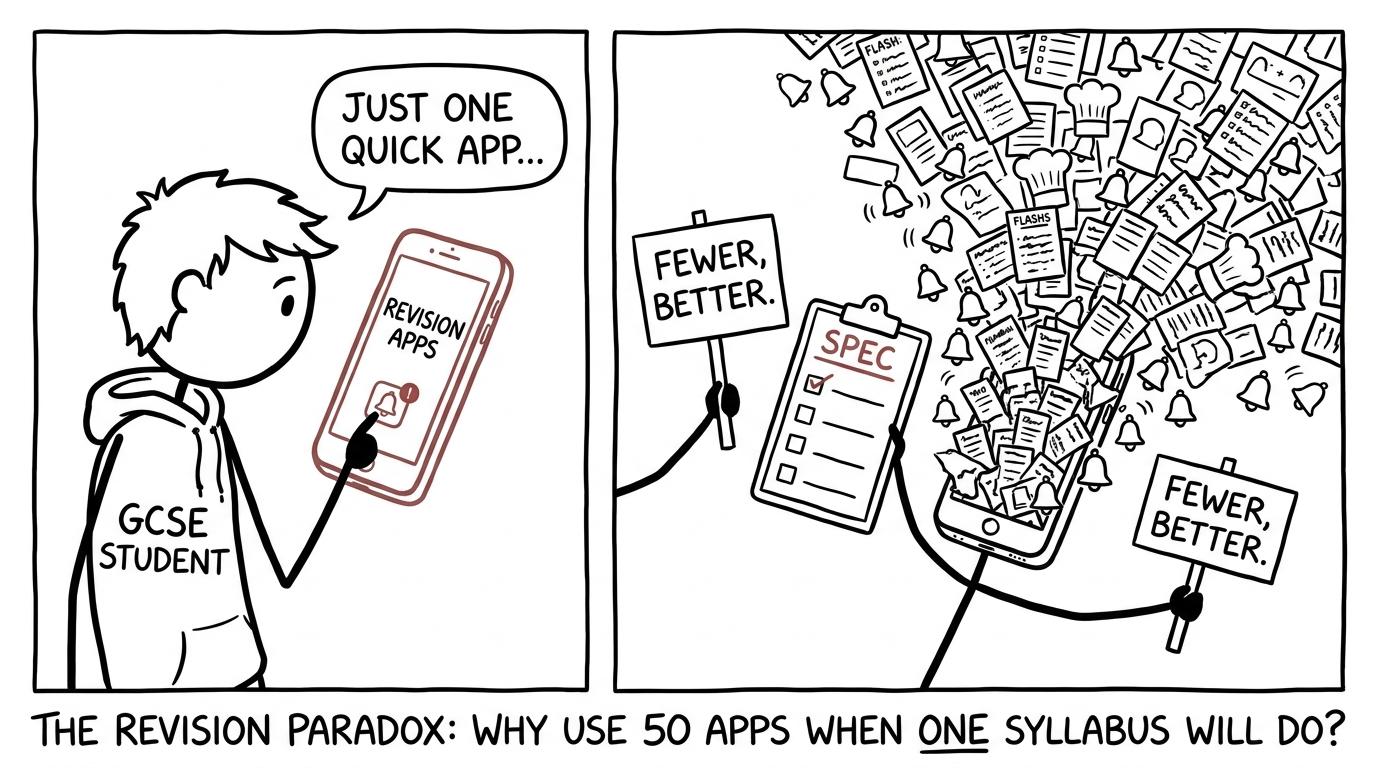 A student calmly chooses a specification checklist while revision apps spill from a phone
Best GCSE Food and Nutrition revision apps
Seneca Learning for structured course coverage
Seneca is a useful starting point when you want content divided into manageable sessions. Its mixture of short explanations and questions can help with topics such as nutrients, food safety, dietary needs and functional properties.
Its main strength is structure. On an evening when deciding what to revise feels harder than the revision itself, a defined course removes one decision.
The limitation is equally important: completing an online section does not prove that you can construct an extended exam response. Use Seneca to learn and retrieve content, then answer questions away from the screen. Course availability and free or paid features can change, so check that the current course names your board and specification.
BBC Bitesize for clear explanations
BBC Bitesize remains one of the most accessible free starting points for UK students. It is particularly helpful when you need a straightforward explanation of a topic before testing yourself.
Use it selectively. Search for the precise idea you cannot explain, perhaps protein denaturation, gelatinisation, food miles or bacterial growth, rather than reading an entire section without a purpose.
Bitesize is strongest as a teaching resource, not as your only source of exam practice. Follow each reading or video session with closed-book recall and board-specific questions.
Quizlet for quick retrieval
Quizlet can make terminology practice fast. This matters in a subject containing many definitions, including micronutrients, complementary proteins, enzymic browning and cross-contamination.
The risk is quality control. Many sets are created by users, so wording may be incomplete, outdated or matched to another board. Compare any public set with your specification and class notes before learning it. Better still, edit the cards or build a smaller personal set from questions you have answered incorrectly.
Do not mistake recognition for recall. Seeing the correct definition and thinking “I knew that” is weaker than producing it before revealing the answer.
Anki for long-term memory
Anki is valuable for students who want greater control over spaced retrieval. You create cards, rate how well you remembered them and allow the software to schedule future reviews.
It works well for nutrient sources, functions, deficiency conditions, food poisoning bacteria and scientific vocabulary. It is less suitable for practising extended evaluation or planning an investigation.
The setup takes longer than opening a ready-made deck, and availability or cost differs by platform. That effort is worthwhile only if you keep cards concise and review them regularly.
Educake and school-provided platforms
Some schools provide Educake or another teacher-managed learning platform. These services can be particularly useful because your teacher may assign work that follows the order of your course and can see where misconceptions are developing.
Treat school access as an advantage, but check the feedback. A score alone tells you how a session ended; the corrected answers tell you what to do next. Subscription access usually depends on your school, so it is not a universal free option.
Which free channels are worth watching?
YouTube is useful when a static diagram does not quite explain a process. Channels and playlists associated with BBC Teach, Food Tech Teachers, teachers, publishers and exam boards may cover food science demonstrations, practical techniques and revision summaries.
Three filters protect your time:
- Check that the video matches GCSE Food Preparation and Nutrition rather than an older catering course.
- Prefer videos that explain why a process occurs, not only what to memorise.
- Write a short retrieval summary afterwards without replaying the video.
Video is excellent for visualising dextrinisation, coagulation, emulsification or safe knife technique. It cannot replace practical experience, your teacher’s NEA guidance or written exam practice. Avoid copying another person’s investigation or portfolio wording: submitted NEA work must be your own and completed under the required supervision and authentication arrangements.
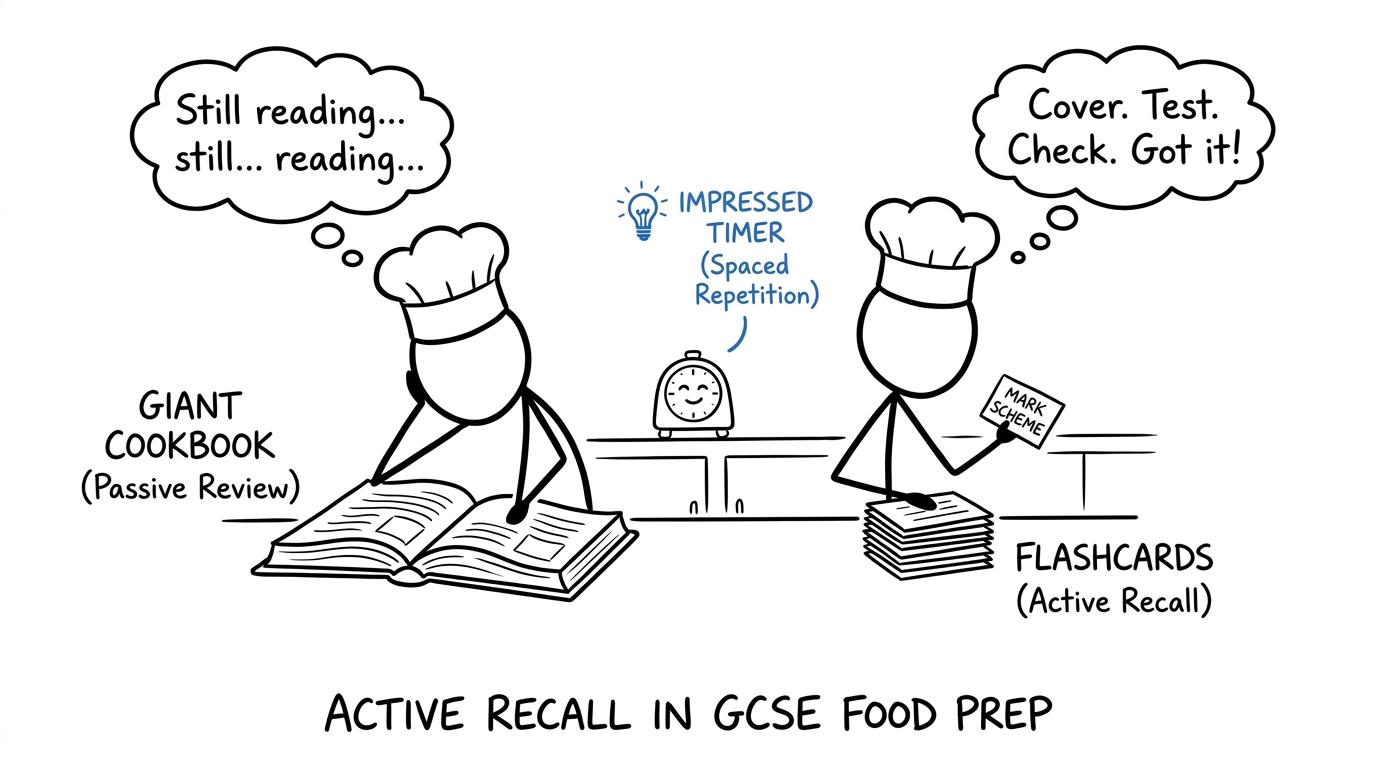 Two revision chefs compare passive reading with active self-testing
Official resources should anchor every app
An app can make revision convenient. Your specification tells you whether that revision is relevant.
Download or consult the current specification from your board and turn each content statement into a checklist. Then use official past papers, mark schemes, specimen materials and examiner reports where available. These show the language, command words and level of application expected in the real assessment.
For AQA, the published content includes food, nutrition and health; food science; food safety; food choice; and food provenance. OCR and Eduqas organise their content differently, so do not rely on an app merely because its title contains “GCSE food”.
A sensible resource order is:
- specification for scope;
- lesson, app or video for understanding;
- flashcards for retrieval;
- past questions for application;
- mark schemes and examiner feedback for correction.
This is the same principle behind effective maths revision. MathsGenie’s guide to the best order for learning GCSE maths topics explains why learning, targeted practice and paper practice perform different jobs.
Do not overlook the maths in Food and Nutrition
Food Preparation and Nutrition includes quantitative skills. Nutritional data, recipe quantities, costs, temperatures, graphs and investigation results all require calm handling of numbers.
Useful relationships include:
percentage=partwhole×100\text{percentage} = \frac{\text{part}}{\text{whole}} \times 100percentage=wholepart×100and
mean=sum of the valuesnumber of values.\text{mean} = \frac{\text{sum of the values}}{\text{number of values}}.mean=number of valuessum of the values.Recipe scaling depends on proportional reasoning, while comparisons of products may involve values per 100 g100\text{ g}100 g, portion sizes or unit cost. Measurements may require conversions such as:
1 kg=1000 g1\text{ kg} = 1000\text{ g}1 kg=1000 gand
1 litre=1000 ml.1\text{ litre} = 1000\text{ ml}.1 litre=1000 ml.If these skills feel uncertain, use MathsGenie alongside your subject resources. The GCSE topic checklist by board and tier helps you locate ratio, percentages, averages and unit conversion. You can also review the wider GCSE maths revision resources for topic questions and solutions.
The aim is not to turn food revision into a maths lesson. It is to prevent a sound nutritional explanation being weakened by an avoidable calculation or unit error.
A revision routine that makes the apps useful
Choose one main content platform, one retrieval tool and one source of exam questions. More choice usually creates more switching, not more learning.
A focused session might contain:
- 101010 minutes of closed-book flashcard retrieval;
- 151515 minutes repairing one weak concept;
- 202020 minutes answering written questions;
- 101010 minutes marking and recording corrections.
Revisit the same weakness after a short gap. MathsGenie’s one-month GCSE revision plan offers a useful framework for retrieval, focused practice and weekly testing, even when you adapt the subject content for Food and Nutrition.
Keep an error log with three headings: topic, what went wrong, next action. “Revise nutrition” is too broad. “Confused the functions of iron and calcium; make and test four comparison cards” gives tomorrow a clear starting point.
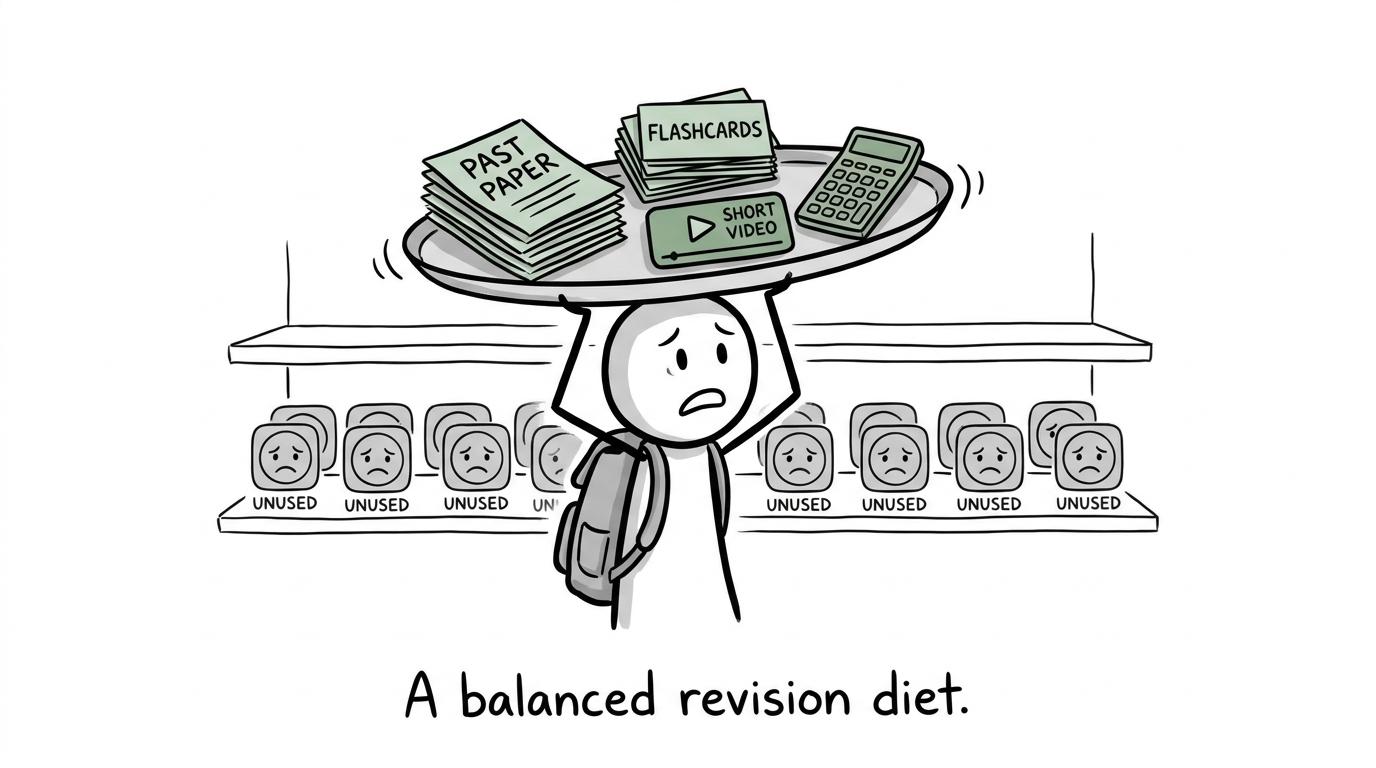 A student carries a balanced revision tray while unused apps wait on a shelf
Common mistakes when choosing revision resources
Downloading too many apps
Five dashboards do not create five times the progress. Keep the smallest combination that covers teaching, retrieval and exam practice.
Trusting user-made cards without checking them
A polished flashcard can still contain the wrong definition or belong to another specification. Check cards against board materials and your teacher’s guidance.
Watching without retrieving
Pause before an explanation and predict what comes next. Afterwards, close the resource and write what you remember. The effort is the useful part.
Ignoring command words
Knowing content is not enough if you answer “evaluate” as though it means “state”. Use mark schemes to notice how explanations, comparisons and judgements are rewarded.
Revising theory but neglecting numerical skills
Practise percentages, proportional scaling, averages, graphs and conversions. MathsGenie’s guide to GCSE topics that frequently recur can help you prioritise these foundations for your maths papers too.
Using predicted material as a substitute for coverage
No app can reliably tell you every question that will appear. Cover the specification first. The same warning applies to maths: predicted topics should guide practice rather than replace complete revision.
Build a small system and keep using it
The best resource is not the one that makes revision look effortless. It is the one that makes your next action obvious.
Choose a specification-matched platform, test yourself with a reliable flashcard system, watch videos only when they clarify a process, and return repeatedly to official questions and mark schemes. Then strengthen the numerical layer beneath the subject.
MathsGenie is the free revision base for that part of the journey. Use revision lessons and practice questions to repair percentages, ratio, averages and units. Build exam stamina with GCSE predicted papers, mini tests, past papers, mark schemes and video solutions, and organise the work with the revision planner.
A balanced revision plan is much like a balanced diet: enough variety to cover what matters, but not so much that nothing gets finished.