

Best GCSE English Language Revision Apps 2026
Best GCSE English Language revision apps for 2026, including free resources, YouTube channels, past papers and practical advice on what works.
The hardest part of revising English Language is often deciding what revision actually means. There is no list of quotations to memorise and no single formula that unlocks every question. Faced with that uncertainty, it is easy to download five apps, watch several videos and still avoid writing an answer.
The best GCSE English Language revision apps for 2026 are BBC Bitesize for reliable exam-board guidance, Seneca Learning for structured recall and Quizlet for personalised flashcards. YouTube channels such as Mr Bruff and First Rate Tutors can explain exam technique, while official exam-board past papers remain essential for practising the skill that ultimately earns marks: writing independently under time pressure.
For students balancing English with GCSE maths, the aim is not to build a larger collection of resources. It is to create a smaller, repeatable system.
Your English Language revision checklist
A useful resource should help you do at least one of these things:
- confirm the format of your exam board's papers
- understand a reading or writing assessment objective
- recall terminology, command words or writing techniques
- practise planning and writing timed responses
- compare your work with a mark scheme or model answer
- turn teacher feedback into a specific next action
No single app does all six equally well. A sensible toolkit contains one resource for learning, one for recall and official materials for written practice.
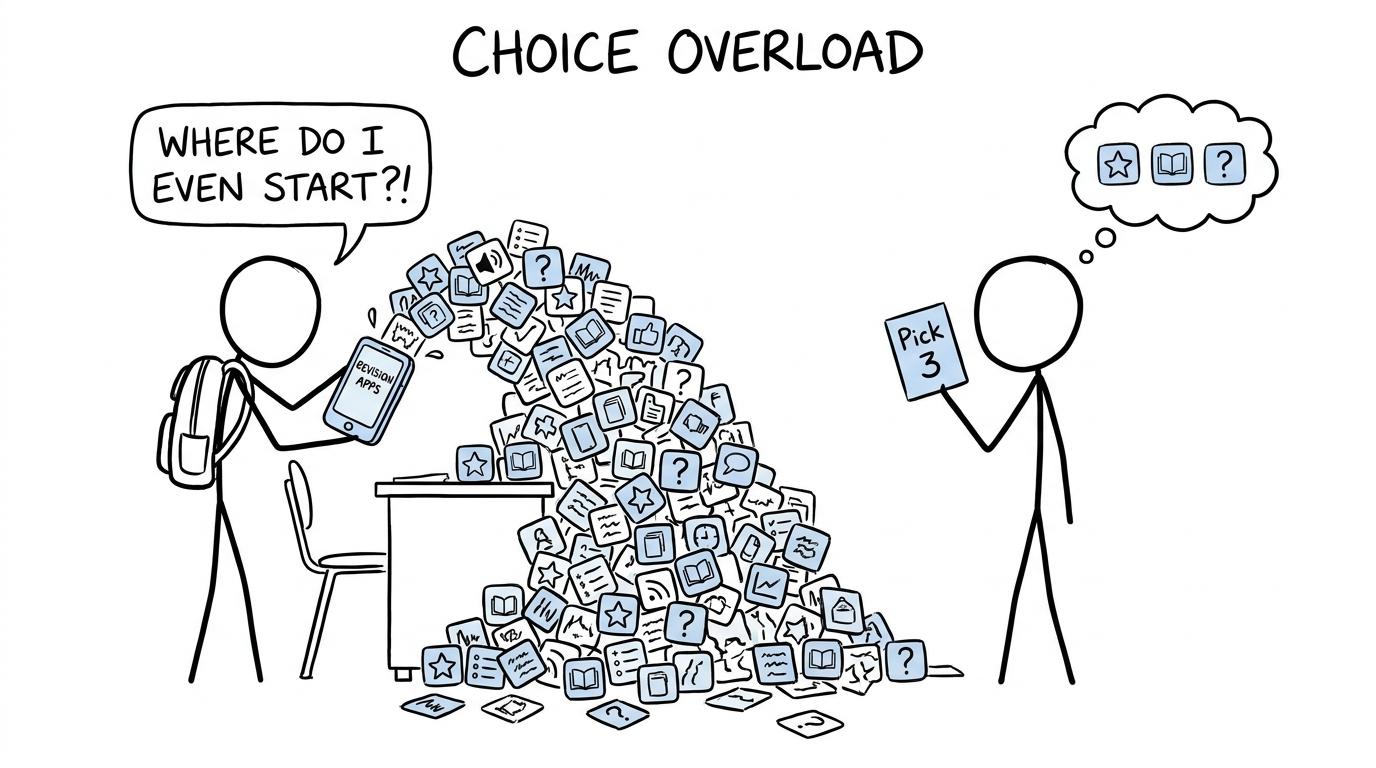 A student faces an avalanche of revision apps while another advises them to pick three
The best GCSE English Language revision apps for 2026
BBC Bitesize: best free all-round starting point
BBC Bitesize is the strongest first choice for most students because its GCSE content is free and organised by subject and exam board. Its Exam Revision app includes revision guides, quizzes, videos, audio and saved resources. The BBC states that the app has no in-app purchases.
For English Language, Bitesize is useful when you need a clear explanation of skills such as analysing language, comparing viewpoints or adapting writing for a particular audience. It is also a good way to check terminology without disappearing into an unverified social-media explanation.
Its limitation is depth. A short quiz can test whether you recognise a technique, but it cannot prove that you can construct a developed analytical paragraph. Use Bitesize to understand the task, then close the app and write.
Seneca Learning: best for structured, interactive revision
Seneca offers free access alongside optional paid features. Its English Language courses cover areas including fiction, non-fiction, comparison, writing, spelling, punctuation and grammar. Short explanations are followed by interactive questions, which makes the platform particularly helpful when starting revision feels difficult.
Choose the course matching your exam board where one is available. Seneca is most valuable for frequent sessions on weak areas, not for clicking quickly through material to increase a progress score.
Like Bitesize, it cannot replace extended writing. Being able to identify personification in an interactive question is different from explaining how a writer's choice influences the reader within a coherent response.
Quizlet: best for your own terminology and feedback cards
Quizlet lets students create digital flashcards or use sets made by other users. Its core flashcard tools can be used free, although some advanced or unlimited features may require a subscription.
English Language flashcards work well for:
- assessment objectives and command words
- structural and language terminology
- punctuation rules
- vocabulary for comparison and evaluation
- features of articles, speeches and letters
- personal targets taken from teacher feedback
The final category is the most powerful. A card saying “use better vocabulary” is vague. A card asking “What should I check before finishing a writing response?” can prompt a useful checklist covering paragraphing, sentence control, punctuation and register.
Treat public sets cautiously. They are often created by other students and may refer to another exam board, an older paper format or a teacher-specific method. Check important details against your specification and official materials.
Anki: best for disciplined long-term recall
Anki uses spaced repetition, showing cards again according to how confidently you recalled them. It suits students who are prepared to build a small, accurate deck and review it regularly.
It is less immediately friendly than Quizlet, and platform availability or cost can vary. More importantly, English Language does not require hundreds of cards. A compact deck based on recurring weaknesses is better than trying to convert every lesson into isolated facts.
Use Anki for knowledge that supports performance. Do not mistake remembering terminology for being able to analyse an unseen text.
The best video channels and free resources
Mr Bruff and First Rate Tutors
Mr Bruff has extensive GCSE English Language playlists, while First Rate Tutors publishes exam-focused walkthroughs and question guidance. Both can be useful when a written explanation has not clicked or when you want to see how someone approaches a paper.
Before watching, check three things:
- Is the video for your exam board?
- Does it reflect the paper used from 2026 onwards?
- Will you complete a question immediately afterwards?
This matters especially for AQA students. AQA's official materials confirm updated questions for first examination in 2026. Paper 1 Question 1 uses four multiple-choice items, while changes also affect the framing of Question 4 and the Paper 1 writing choices. Older videos can still teach analytical skills, but their description of a question may no longer be exact.
Edexcel, OCR and Eduqas students must follow their own specifications and paper structures rather than borrowing AQA timings or question numbers.
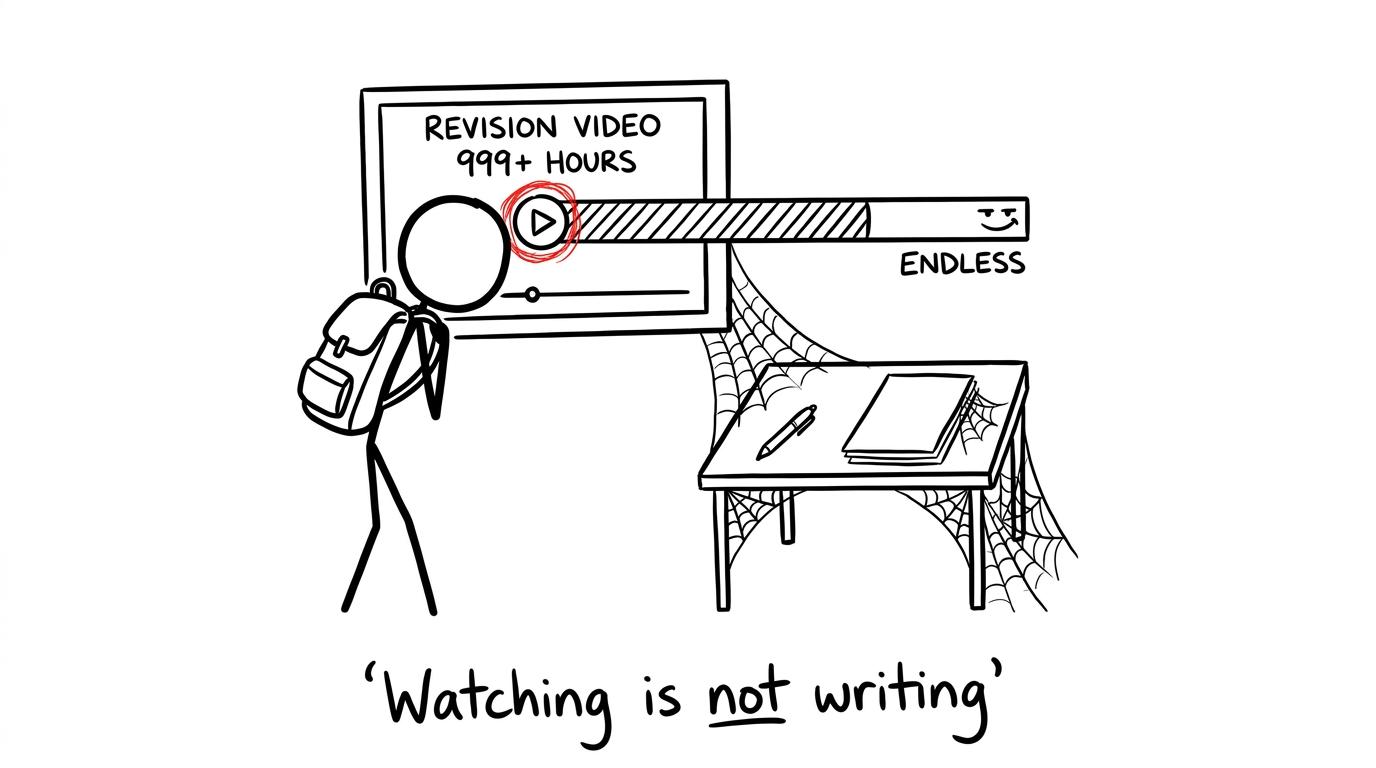 A student watches an endless revision video while their untouched writing paper gathers cobwebs
Official exam-board materials
Your exam board's website is less entertaining than an app, but it is the authority on what you will sit. Use the specification, sample assessment materials, past papers, mark schemes and examiner guidance provided by AQA, Pearson Edexcel, OCR or Eduqas.
The assessment objectives across GCSE English Language cover retrieving and interpreting information, analysing language and structure, comparing perspectives, evaluating texts, communicating effectively and writing accurately. The precise questions used to assess those skills vary by board.
Read model answers actively. Identify what earns credit, then apply the principle to a different extract. Copying a polished paragraph into notes creates the appearance of revision without the decision-making demanded by an unseen paper.
Your teacher's marked work
An app gives general advice. Your marked work reveals your particular pattern.
Collect recent responses and group comments into three categories:
- knowledge: terminology, forms or punctuation you do not understand
- development: ideas that need clearer evidence or explanation
- exam technique: timing, planning or failure to address the question
This is the English equivalent of diagnosing lost marks in maths. MathsGenie's guide to finding your weakest GCSE topics explains the same principle: evidence is more useful than instinct.
How to combine apps without wasting revision time
A strong session moves from input to output. Try this sequence:
- Learn: spend a short period on BBC Bitesize, Seneca or a focused video.
- Recall: close the explanation and write down the key idea from memory.
- Apply: answer part of an official or teacher-provided paper.
- Review: use the mark scheme and your teacher's success criteria.
- Record: add one precise correction to a feedback deck or notebook.
This resembles the learn, practise, mark and fix cycle in MathsGenie's guide to efficient GCSE maths revision. The subjects look different, but improvement follows the same rhythm.
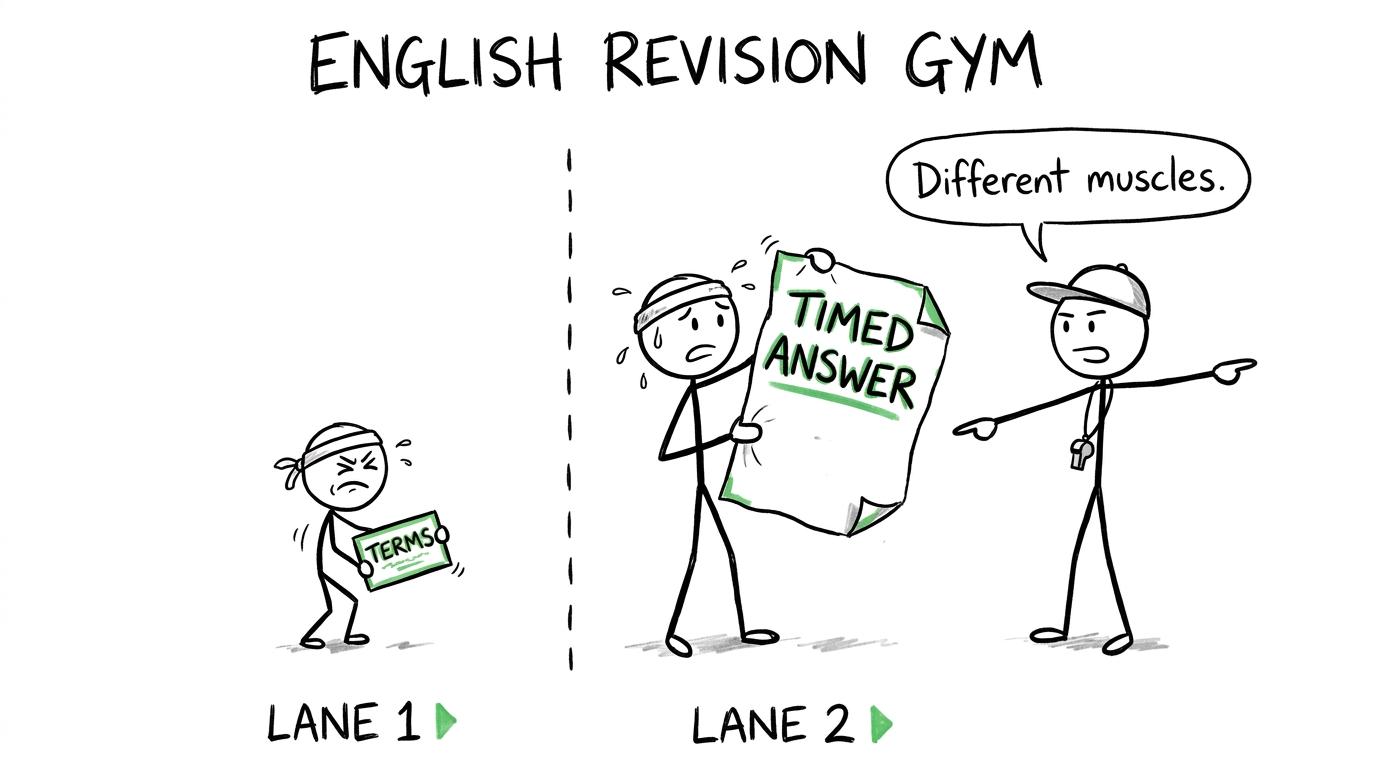 Two students train different revision muscles with flashcards and a timed written answer
Build a balanced weekly routine
English Language improves through repeated writing, so give it a regular place beside maths rather than waiting for a long, perfect afternoon. You can organise both subjects with the free MathsGenie revision planner.
A balanced week might include short terminology or technique reviews, one timed reading response, one writing task and a review of previous feedback. Add longer paper practice as the examination approaches. The advice in when to start GCSE past papers can help you move gradually from individual questions to complete timed papers.
For maths sessions, return to the GCSE maths revision hub, where you can choose your exam board and work through revision lessons, questions and papers. Keeping each subject in its proper resource system reduces tab-switching and decision fatigue.
Common mistakes when choosing revision resources
Downloading too many apps
Each new app feels like progress because choosing is easier than practising. Select no more than three core tools: one learning platform, one recall system and your official papers.
Watching without writing
Videos can clarify a method, but English Language is assessed through your own reading decisions and written communication. Follow every useful video with a question, plan or paragraph completed without guidance.
Revising English Literature instead
English Literature flashcards often dominate search results. Quotations about a set text do not prepare you to analyse unseen English Language extracts. Check the subject label before saving a deck or playlist.
Using the wrong exam board or outdated format
A technique may transfer across boards, but question numbers, timings and structures do not always transfer. Confirm your board with your teacher and check 2026 materials against its official specification.
Ignoring mark schemes and feedback
Completing an answer is only half a revision cycle. Review why marks were earned or missed, then repeat the skill. MathsGenie's one-month GCSE revision plan shows how regular marking and targeted correction can structure a wider revision timetable.
Make the app serve the practice
The best revision app is not necessarily the one with the brightest interface or longest feature list. It is the one that helps you notice a weakness and then moves you towards deliberate practice.
Start with BBC Bitesize or Seneca to refresh a skill. Use Quizlet or Anki for a small set of accurate prompts. Watch a focused video when you need another explanation. Then spend the largest share of your effort on official questions, timed writing, mark schemes and teacher feedback.
And while English revision develops your reading and writing, keep your maths preparation equally organised. Explore MathsGenie's free GCSE revision resources for revision lessons, practice questions, mini tests, past papers, predicted papers, mark schemes and video solutions. Plan the work, practise it and learn from what the paper tells you next.










