

Best GCSE Combined Science Revision Guide Checklist
Best GCSE combined science revision guide: check board and tier fit, maths practice, explanations, answers, practical coverage and exam usefulness today.
A revision guide can look reassuring long before it becomes useful. The cover is polished, every topic appears to be colour-coded, and the word “complete” is printed somewhere prominent. Then you try to revise from it and discover that the explanations are too brief, the questions are too easy, or it does not match your exam board.
The best GCSE combined science revision guide is not necessarily the thickest, newest or most expensive. It is the guide that matches your specification and tier, explains unfamiliar ideas clearly, makes you retrieve knowledge, covers practical and mathematical skills, and lets you check your answers properly.
Here is the quick test:
- Confirm the exact exam board, qualification and tier.
- Compare its contents with the current specification.
- Look for explanations, not compressed lists of facts.
- Check the quality and range of practice questions.
- Inspect the answers before buying.
- Make sure required practicals and maths skills are covered.
- Check whether time-sensitive information is current.
- Choose something you will genuinely use.
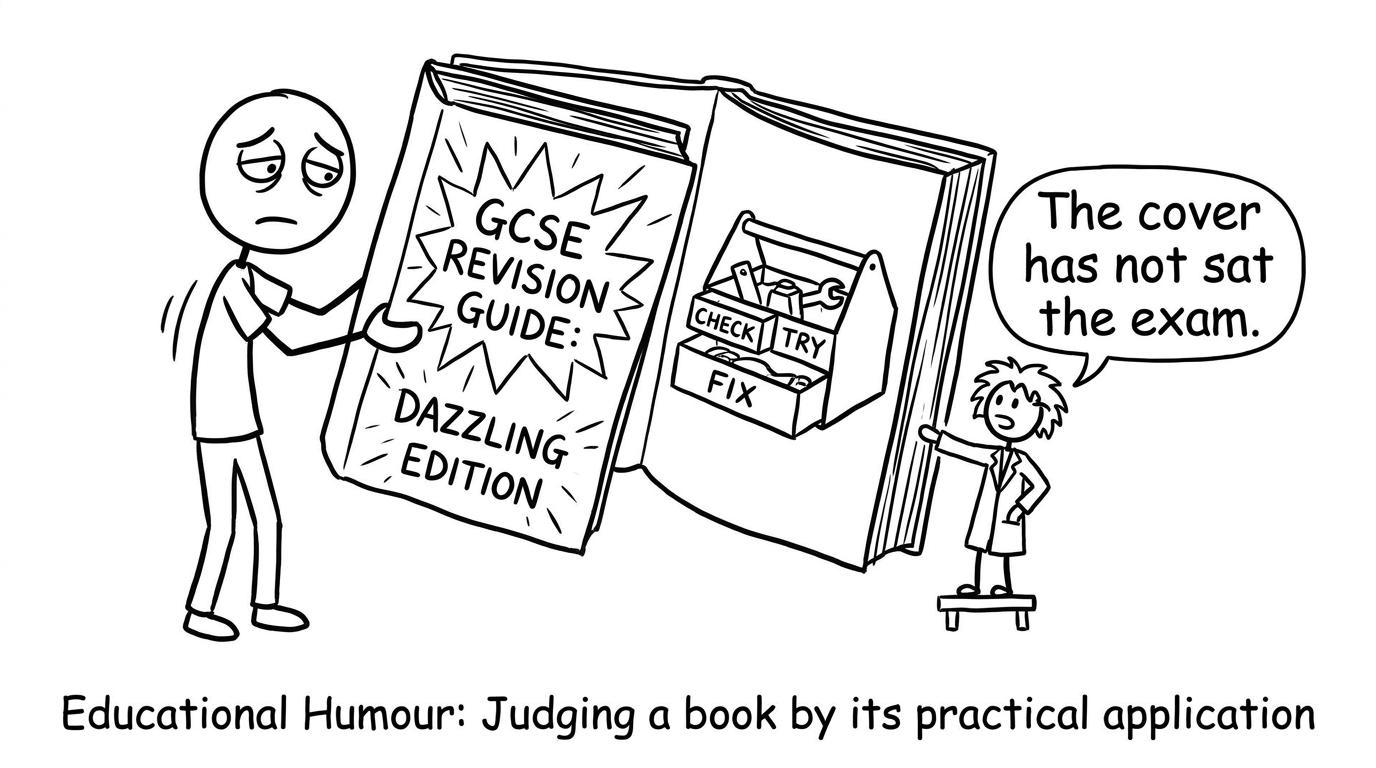 A student discovers that the useful revision guide is a toolbox rather than the one with the shiny cover
Start with the exam board, qualification and tier
A good guide must first be the right guide.
GCSE Combined Science is offered through boards including AQA, Pearson Edexcel, OCR and Eduqas. The national subject content has substantial common ground, but boards organise topics, practical requirements and assessments differently. AQA Trilogy and Synergy are not interchangeable, while OCR has Gateway Science and Twenty First Century Science routes.
Check the specification code on your school documents or ask your teacher. Do not rely on recognising the board logo alone. Also check whether the book covers Combined Science rather than separate Biology, Chemistry and Physics qualifications.
Your tier matters too. A guide should identify foundation and higher material without making the distinction confusing. If higher-only content is mixed invisibly into every page, a foundation student may spend valuable time learning material that will not be assessed. A higher-tier student needs enough depth to prepare for the more demanding application and analysis questions.
Publication date is useful, but specification alignment matters more. An older guide can remain relevant if the specification has not changed; a newer-looking book can still be unsuitable if it covers the wrong course.
Compare the contents with the official specification
The word “complete” is a marketing claim until you check it.
Open the contents page and compare it with your exam board’s current specification. Look beyond broad headings such as biology, chemistry and physics. A credible guide should map onto the actual content statements, including scientific ideas, techniques, practical work and mathematical requirements.
Official assessment objectives also tell you what the guide should prepare you to do. GCSE Combined Science assessment is designed around approximately 40%40\%40% knowledge and understanding, 40%40\%40% application, and 20%20\%20% analysis and evaluation. A book made almost entirely of definitions may support knowledge, but it cannot prepare you fully for unfamiliar contexts, conclusions, evaluations and extended reasoning.
The best guide therefore moves through three levels:
- Know: accurate facts, terminology and processes.
- Apply: using knowledge in an unfamiliar scientific situation.
- Analyse: interpreting evidence, evaluating methods and drawing justified conclusions.
If every question can be answered by copying the sentence immediately above it, the book is testing eyesight more than understanding.
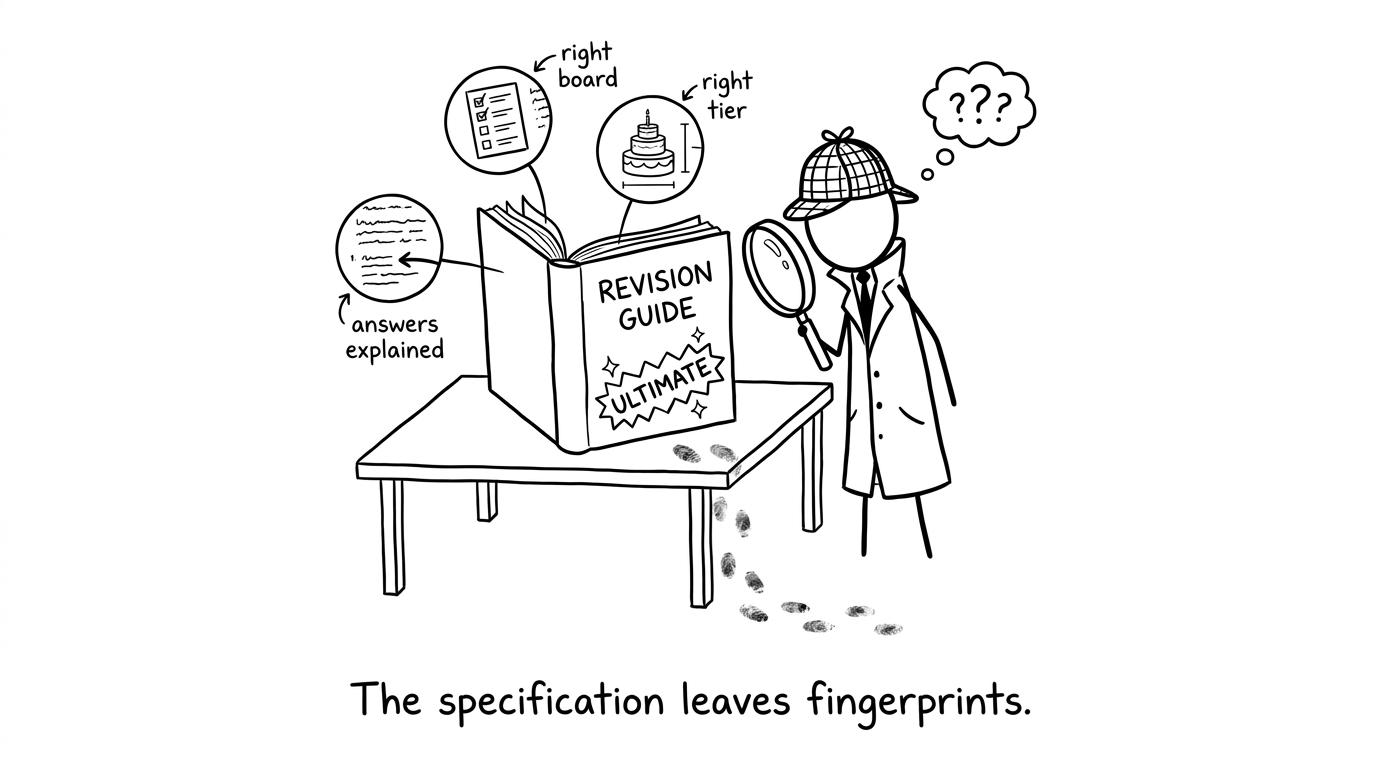 A student detective checks a revision guide for specification fingerprints
Look for explanations that reduce confusion
Revision guides have limited space, so concise writing is sensible. But concise is not the same as incomplete.
A strong explanation should define essential terms, connect cause and effect, distinguish ideas students often confuse, and make diagrams meaningful. It should help you answer “why?” as well as “what?”. Dense paragraphs full of unexplained terminology are not made clearer by adding fluorescent boxes.
Test a guide on a topic you currently find difficult. Read one section, close the book and ask yourself:
- Can I explain the central idea without looking?
- Can I connect it to an experiment or observation?
- Could I recognise it in a different context?
- Do I understand the diagram rather than merely remember its shape?
If the answer remains no, the guide may be a useful checklist but not a sufficient teaching resource. That distinction matters. A checklist is excellent after you understand a topic; it is frustrating when you are meeting the idea properly for the first time.
Check whether it teaches the maths inside science
This is where a glossy science guide often reveals its weaknesses.
Ofqual’s requirements mean that mathematical skills account for at least 20%20\%20% of the marks across GCSE Combined Science. Those marks are distributed across biology, chemistry and physics in the ratio 1:2:31:2:31:2:3. Maths is therefore not an optional appendix. It is part of the qualification.
A worthwhile guide should provide practice with:
- ratios, fractions and percentages;
- means and appropriate significant figures;
- standard form and order-of-magnitude reasoning;
- substituting into and rearranging equations;
- unit conversions;
- gradients and intercepts;
- drawing and interpreting graphs;
- rates of change, areas and volumes.
Look closely at how the guide handles calculations. Does it explain which quantities are needed, draw attention to units and show how an answer should be presented? Does it include questions where you must select the relevant information rather than simply substitute numbers into a formula printed beside the question?
For extra support, MathsGenie’s free ratio revision guide and rearranging harder formulae guide help strengthen two skills that regularly appear in scientific contexts. You can also use the AQA GCSE Maths worksheets for printable topic practice.
A science guide should teach the scientific context. MathsGenie can help make the calculation itself dependable.
Inspect the questions and answers before buying
Questions are not an extra feature added after the notes. They are where revision becomes visible.
A useful guide should mix short recall prompts with calculations, data interpretation, practical questions, unfamiliar contexts and longer written responses. The difficulty should develop rather than remain flat. It should also be clear which questions are relevant to foundation tier, higher tier or both.
The answers matter just as much. A single word or final numerical answer tells you whether you were wrong, but not why. Better answer sections show the expected reasoning, acceptable scientific vocabulary, important units and enough intermediate detail to diagnose an error.
Try this simple shop test: find a multi-mark question, then turn to its answer. Could that answer help you improve your next attempt? If it only states the final conclusion, the feedback loop is incomplete.
This same principle applies to maths revision. GCSE Maths mini tests can reveal whether a skill survives without prompts, while MathsGenie’s GCSE maths topic guide by exam board and tier helps you identify the mathematical content that needs attention.
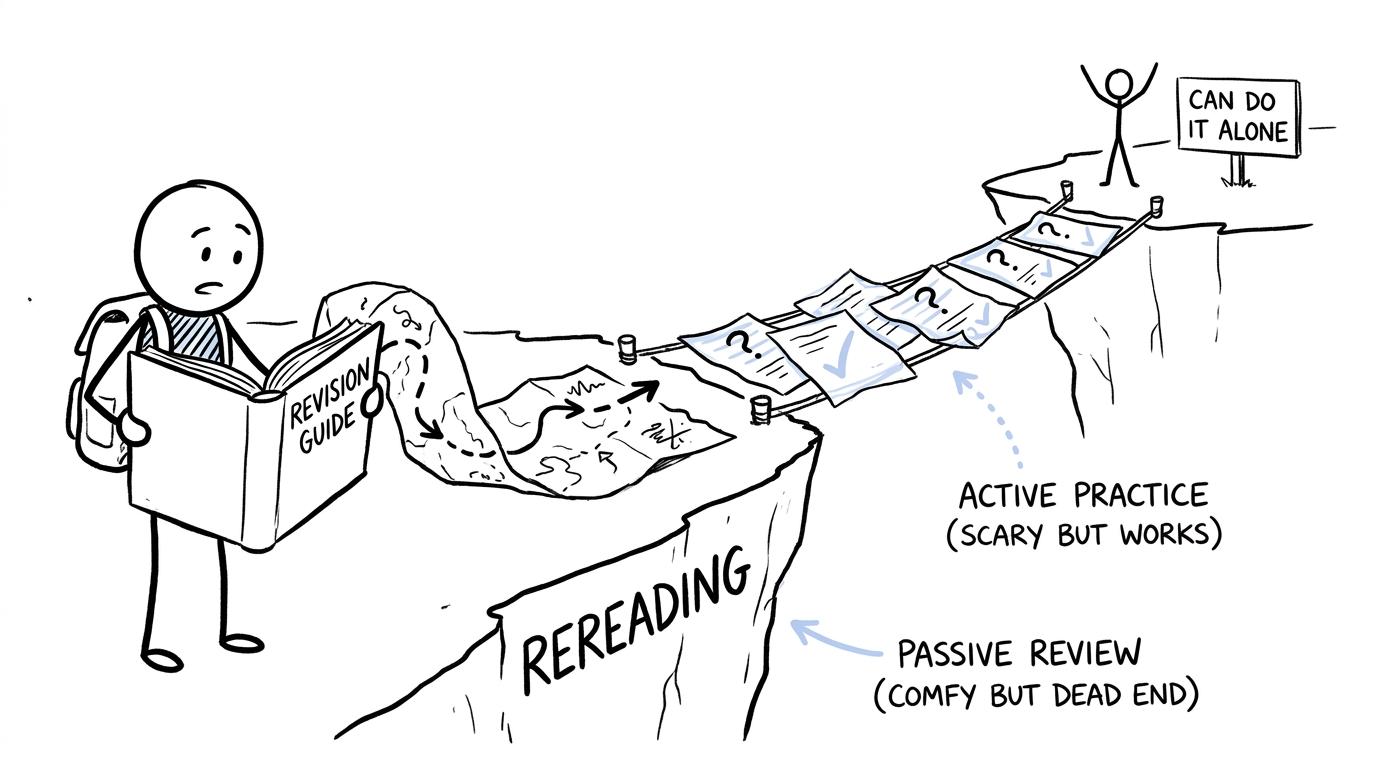 A map made from rereading ends at a cliff while practice questions form a bridge
Make sure practical science is treated seriously
A weak guide presents practical work as a list of apparatus to memorise. A strong one explains the scientific decisions behind the method.
Look for coverage of variables, controls, hazards, measurement, repeat readings, anomalies, accuracy, precision, uncertainty, graph choice, conclusions and improvements. You should be asked to interpret results and evaluate a method, not simply name laboratory equipment.
Practical knowledge is assessed through written examinations, so the book should connect experiments to exam questions. Helpful diagrams are valuable, but they should show how an investigation works rather than decorate the page.
The guide should also distinguish a genuine improvement from a vague instruction. “Take more care” is rarely useful. Better guidance explains how a change improves measurement quality, control or reliability.
Check whether current exam support is represented accurately
Some details change more quickly than the underlying science.
For the 202620262026 and 202720272027 exam series, students taking GCSE Physics and Combined Science receive revised equation sheets containing the physics equations specified under the current arrangements. That does not make calculation practice unnecessary. Students must still identify quantities, choose and use equations, convert units, rearrange where required and interpret results.
A good current guide should not build its entire approach around memorising equations that will be supplied. Equally, it should not imply that having the sheet removes the need to understand them. Before relying on any printed claim about equation sheets, assessment formats or permitted materials, check the latest information from your own exam board and teacher.
This is one reason no book should be your only revision source. Printed pages are fixed; official guidance and digital resources can be updated.
Judge the guide by how you will use it
There is no universal winner because students need different kinds of support. One student may need spacious explanations and diagrams. Another may already understand the course and need a compact summary with demanding questions.
Before buying, decide what job the guide must do:
- Learn: fuller explanations for weak or missed topics.
- Condense: short summaries for content you already understand.
- Practise: plentiful exam-style questions and useful answers.
- Organise: clear specification order and progress tracking.
Whenever possible, inspect sample pages. Choose one explanatory page, one calculation page, one practical page and one answer page. This reveals more than the cover, online rating or number of pages.
The real test comes after purchase. Use the guide in a short cycle: retrieve what you know, read only what repairs the gap, answer questions without notes, mark them and revisit the error later. Maths students can see the same approach in MathsGenie’s 20-minute GCSE revision routine.
Common mistakes when choosing a revision guide
Buying for the cover or price alone
A premium finish does not guarantee specification accuracy, strong questions or useful answers. A cheaper guide is not automatically better value if it leaves important gaps.
Choosing the wrong course
Separate sciences, Combined Science, AQA Trilogy, AQA Synergy and the different OCR routes are not identical products. Verify the exact qualification before paying.
Mistaking short notes for complete revision
Summary pages feel fluent because they are easy to reread. Exams require independent recall and application. Pair every reading session with questions.
Ignoring the answer section
Students often inspect the colourful notes and never examine the answers. Yet the quality of feedback determines whether mistakes become useful.
Avoiding mathematical topics
Calculations can feel like a separate subject, but they contribute substantially to Combined Science assessment. Use MathsGenie’s GCSE mini tests to diagnose weak skills, then return to focused lessons and practice questions.
Treating one book as the entire plan
No revision guide can reproduce the full experience of timed papers, mark schemes and unfamiliar questions. For maths preparation, learn how to introduce papers gradually with MathsGenie’s guide to when you should start GCSE past papers. Nearer the exams, use Edexcel GCSE Maths predicted papers where appropriate to test your preparation against fresh questions.
Choose usefulness over appearance
The best revision guide is a bridge between not knowing and being able to answer independently. It matches your board and tier, covers the specification honestly, explains difficult ideas, treats practical and mathematical skills as essential, and gives you questions with feedback you can act upon.
Choose the guide by opening it, testing it and asking what it will help you do. Then use it actively rather than reading it from beginning to end like a novel.
For the maths within science, and for your GCSE Maths papers themselves, make MathsGenie your free revision base. Use revision lessons to rebuild a method, practice questions and mini tests to make it reliable, then mark your work carefully. Finish with past papers, predicted papers, mark schemes and video solutions so that each mistake points clearly towards your next revision task.











