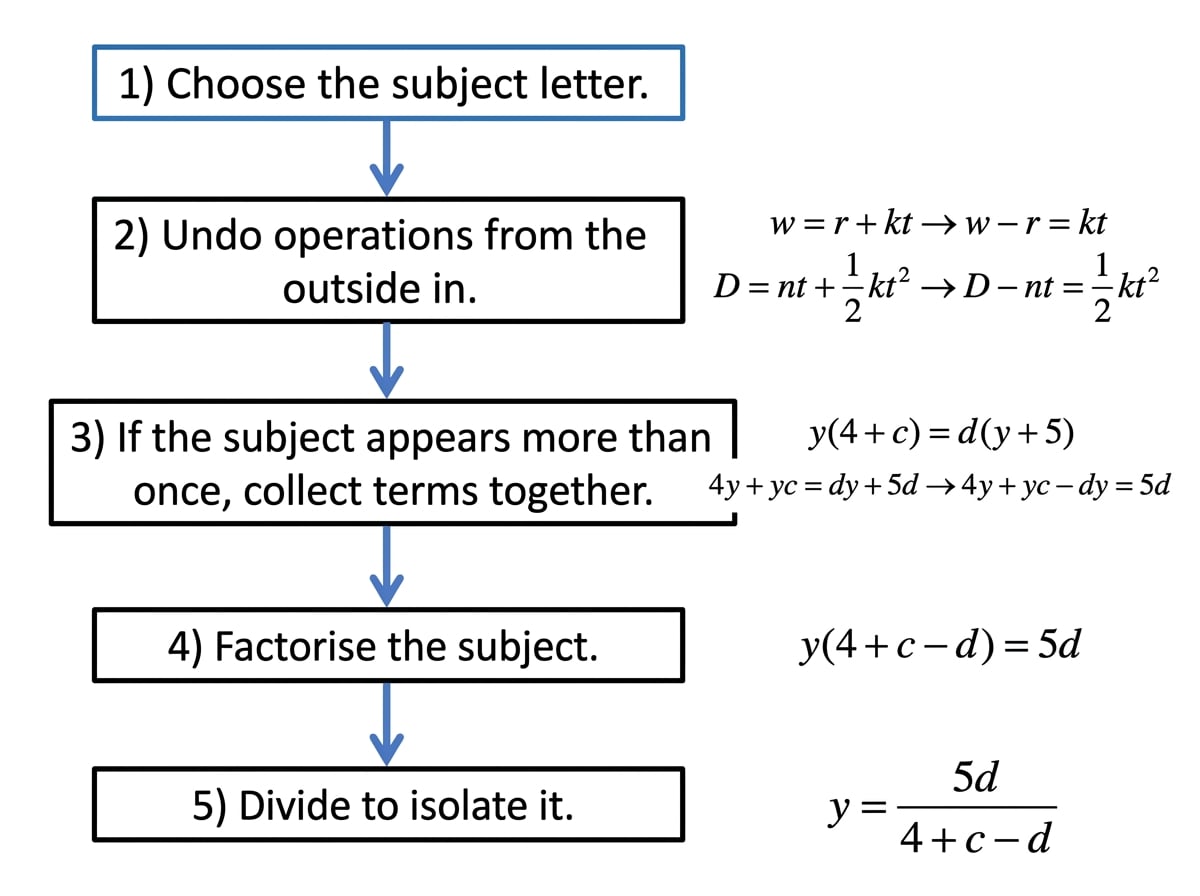
What you'll learn
- How to make a chosen letter the subject of a formula.
- How to undo brackets, powers and fractions in the right order.
- How to handle formulae where the subject appears more than once.
- How to spot common traps in Grade 7 rearranging questions.
1. Start with the subject
When you rearrange a formula, your aim is to get one chosen letter on its own.
All the other letters are treated like numbers. For example, if you are making xxx the subject, then aaa, bbb and ccc are just constants.
Subject of a formula
The subject of a formula is the letter that is on its own on one side of the equals sign. In A=πr2A = \pi r^2A=πr2, the subject is AAA.

The balance rule
Whatever you do to one side of the equation, you must do to the other side as well.

Make the subject of

-
Start with the formula.
w=r+ktw = r + ktw=r+kt -
The term ktktkt is being added to rrr, so subtract ktktkt from both sides.
w−kt=rw - kt = rw−kt=r -
Write the answer with rrr on the left.
r=w−ktr = w - ktr=w−kt
2. Use inverse operations
An inverse operation is the operation that undoes another operation. Adding is undone by subtracting. Multiplying is undone by dividing. Squaring is undone by square rooting.
If the subject is inside several operations, undo them from the outside in.
Make the subject of

-
Start with the formula.
w=r+ktw = r + ktw=r+kt -
Subtract rrr from both sides to isolate the term containing kkk.
w−r=ktw - r = ktw−r=kt -
Divide both sides by ttt.
k=w−rtk = \frac{w - r}{t}k=tw−r
Treat letters like numbers
If you are making kkk the subject, then rrr and ttt behave like fixed numbers. Do not be put off just because they are letters.
3. Rearranging with squares and roots
A square root undoes a square. If you have p2p^2p2, square rooting gives ppp.
Be careful: in pure algebra, square rooting can give a positive or negative answer.
Square roots can have two signs
If the formula is about a length, speed or other quantity that cannot be negative, you usually take the positive square root. Without context, write ±\pm±.
Make the subject of

-
Start by isolating p2p^2p2. Subtract 5rs5rs5rs from both sides.
q2−5rs=p2q^2 - 5rs = p^2q2−5rs=p2 -
Square root both sides.
p=±q2−5rsp = \pm\sqrt{q^2 - 5rs}p=±q2−5rs
4. Fractions attached to terms
A coefficient is a number or expression multiplying a variable. In 12kt2\frac{1}{2}kt^221kt2, the coefficient of kkk is 12t2\frac{1}{2}t^221t2.
To remove a fraction like 12\frac{1}{2}21, multiply by 2.
Make the subject of
-
Subtract ntntnt from both sides.
D−nt=12kt2D - nt = \frac{1}{2}kt^2D−nt=21kt2 -
Multiply both sides by 2.
2(D−nt)=kt22(D - nt) = kt^22(D−nt)=kt2 -
Divide both sides by t2t^2t2.
k=2(D−nt)t2k = \frac{2(D - nt)}{t^2}k=t22(D−nt)
Forgetting the whole coefficient
In 12kt2\frac{1}{2}kt^221kt2, the letter kkk is multiplied by both 12\frac{1}{2}21 and t2t^2t2. You must undo both parts.

5. When the subject appears more than once
Sometimes the letter you want appears in two places. You cannot make it the subject until you have collected all those terms together.
To factorise means to take out a common factor. For example, 4y+cy−dy4y + cy - dy4y+cy−dy becomes y(4+c−d)y(4 + c - d)y(4+c−d).

Make the subject of
-
Expand the brackets.
4y+cy=dy+5d4y + cy = dy + 5d4y+cy=dy+5d -
Move all the yyy terms to one side.
4y+cy−dy=5d4y + cy - dy = 5d4y+cy−dy=5d -
Factorise by taking out yyy.
y(4+c−d)=5dy(4 + c - d) = 5dy(4+c−d)=5d -
Divide by 4+c−d4 + c - d4+c−d.
y=5d4+c−dy = \frac{5d}{4 + c - d}y=4+c−d5d
Cancelling too early
Do not cancel the subject letter from both sides if it appears in separate added or subtracted terms. Collect and factorise first.
6. Algebraic fractions
A denominator is the bottom part of a fraction. In x+1x−3\frac{x + 1}{x - 3}x−3x+1, the denominator is x−3x - 3x−3.
To remove an algebraic fraction, multiply both sides by the denominator. This is often called clearing the fraction.
Make the subject of
-
Multiply both sides by 3y−23y - 23y−2.
a(3y−2)=5+3cya(3y - 2) = 5 + 3cya(3y−2)=5+3cy -
Expand the left-hand side.
3ay−2a=5+3cy3ay - 2a = 5 + 3cy3ay−2a=5+3cy -
Collect the yyy terms on one side.
3ay−3cy=5+2a3ay - 3cy = 5 + 2a3ay−3cy=5+2a -
Factorise and divide.
y(3a−3c)=5+2ay=5+2a3a−3c\begin{aligned} y(3a - 3c) &= 5 + 2a \\ y &= \frac{5 + 2a}{3a - 3c} \end{aligned}y(3a−3c)y=5+2a=3a−3c5+2a
Check denominators
Original denominators cannot be zero. In the example above, 3y−2≠03y - 2 \neq 03y−2=0, so any final answer must respect that restriction.
7. Reciprocal formulae
The reciprocal of a number or expression is 1 divided by it. For example, the reciprocal of qqq is 1q\frac{1}{q}q1.
For reciprocal formulae, a reliable method is to multiply every term by all the denominators.

Make the subject of
-
Start with the formula.
1p=1q+1r\frac{1}{p} = \frac{1}{q} + \frac{1}{r}p1=q1+r1 -
Multiply every term by pqrpqrpqr.
qr=pr+pqqr = pr + pqqr=pr+pq -
Collect the terms containing qqq.
qr−pq=prqr - pq = prqr−pq=pr -
Factorise and divide.
q(r−p)=prq=prr−p\begin{aligned} q(r - p) &= pr \\ q &= \frac{pr}{r - p} \end{aligned}q(r−p)q=pr=r−ppr
In the exam
-
Circle the letter you are making the subject before you start.
-
Clear brackets and fractions early if they are blocking the subject.
-
If the subject appears more than once, collect those terms, factorise, then divide.
-
Check your answer by seeing whether the subject is completely alone on one side.
Check yourself
-
Can you explain why x(a+b)x(a + b)x(a+b) cannot usually be changed into xa+bxa + bxa+b?
-
If xxx appears on both sides of a formula, what three actions should you try?
-
When rearranging a formula with v2v^2v2, when might you need a ±\pm± sign?