Apprenticeship GCSE History Requirement: The Facts
Apprenticeship GCSE History requirement explained: discover which routes may ask for a grade, how to check vacancies and what to do if yours is lower.

A list of apprenticeship requirements can feel like a locked door. You notice one grade that is lower than you hoped, then quietly assume the whole route is closed.
The reassuring answer is that an apprenticeship GCSE History requirement is unusual. There is no general rule requiring apprentices to hold GCSE History, and the national standards for history-related occupations normally allow individual employers and training providers to decide their entry requirements. English and maths are much more commonly specified.
A particular employer can still make GCSE History essential or desirable for an individual vacancy. That is why the advert matters more than a general careers summary, and why being short of a preferred grade does not automatically mean you should abandon the application.
The short answer
Here is the practical position for students considering apprenticeships in England:
- There is no universal minimum GCSE History grade for apprenticeships.
- National apprenticeship levels do not create a standard History requirement.
- Even heritage, museum, archive and conservation routes do not normally impose one national GCSE History threshold.
- An individual employer may request GCSE History, especially where historical knowledge is directly relevant.
- Essential and desirable qualifications mean different things.
- English and maths requirements appear far more often and may affect training or completion arrangements.
- If your History grade is too low, contact the employer or training provider before ruling yourself out.
Apprenticeship systems and funding rules differ across England, Scotland, Wales and Northern Ireland. The detailed guidance in this article mainly reflects the apprenticeship system in England, so always check the rules and vacancy service for the nation where you intend to work.
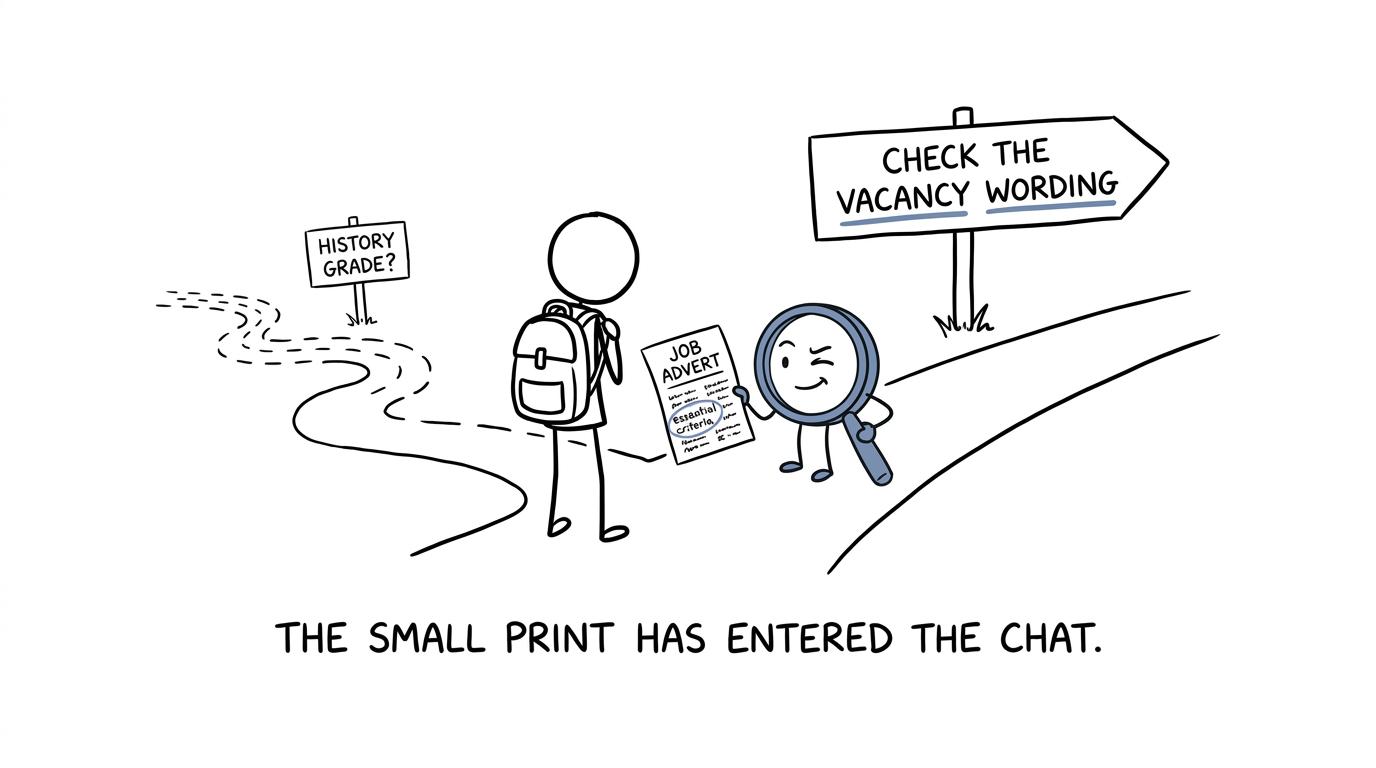 A student discovers that the small print matters more than assumptions about History grades
Is GCSE History required for apprenticeships?
Usually, no.
To begin an apprenticeship in England, a person generally needs to meet the relevant age, residency, employment and education-status conditions. The vacancy may then add qualifications selected by the employer and training provider. These conditions vary with the occupation, apprenticeship level and role.
This distinction matters: an apprenticeship standard describes the occupation and what an apprentice must learn, while a vacancy describes what one employer wants from applicants. A standard may leave entry requirements to employers even when a specific advert asks for several GCSEs.
In other words, two employers recruiting for the same apprenticeship standard can publish different criteria. One might ask for English and maths at grade 444 or above. Another might list those grades as desirable. A third may use an assessment rather than insisting on prior GCSE results.
GCSE History can therefore appear in an advert, but that does not turn it into a requirement across the entire route.
Which apprenticeship routes set a minimum GCSE History grade?
Current national information does not identify a mainstream apprenticeship standard with a universal, mandatory minimum GCSE History grade. Where such a threshold exists, it is normally attached to a particular employer's vacancy rather than the route itself.
Museums, galleries and cultural organisations
Museum roles may involve collections, visitors, administration, learning activities or digital content. History is clearly useful, but usefulness is not the same as a compulsory grade.
Current museum apprenticeship listings illustrate the variation. One employer may ask for English, maths and additional GCSE subjects without naming History. Another arts or archives employer may specify English while assessing applicants through their interests, communication and organisational skills.
Read the exact qualifications section rather than assuming that every museum position demands GCSE History.
Archives and records management
The Level 333 Library, Information and Archive Services Assistant route is relevant to students interested in records, libraries and archives. National sector guidance indicates that prior subject qualifications are rarely a universal prerequisite, although employers can set their own recruitment criteria.
At higher levels, an Archivist and Records Manager apprenticeship may expect advanced study, experience or other qualifications. That is different from creating a national minimum GCSE History grade.
Archives work can reward historical curiosity, but it also depends on information management, accuracy, confidentiality, digital skills and communication. An applicant should demonstrate the whole skill set rather than relying on one subject result.
Heritage and conservation
Historic Environment Advice Assistant, Cultural Heritage Conservation Technician, Cultural Heritage Conservator and related routes sound as though History must be compulsory. Their published standards, however, generally leave entry decisions to employers and training providers.
Typical requirements can include English, maths, science, humanities, design subjects, A Levels, a relevant degree or professional experience, depending on the level. GCSE History may strengthen an application, but the national route does not ordinarily prescribe a particular History grade.
Heritage engineering makes the distinction especially clear. It concerns historic vehicles, machinery or structures, yet vacancies are likely to emphasise practical engineering ability, English and maths rather than GCSE History.
Teaching and public-sector routes
A school, council, heritage body or government organisation can recruit through broader apprenticeship standards such as business administration, customer service or teaching-related routes. The workplace may have a historical setting, but the apprenticeship standard itself may not be a history qualification.
A role supporting a school History department could conceivably request the subject. If it does, that is the employer defining the job, not a nationwide rule covering every apprentice in education.
How to read the qualifications section properly
Small words can make a large difference in an apprenticeship advert.
Essential
An essential qualification is part of the employer's stated minimum criteria. If the advert says GCSE History at grade 444 or above is essential and you hold grade 333, you do not formally meet that criterion.
You can still ask whether an equivalent qualification, predicted grade, resit or relevant experience will be accepted. Do this before investing hours in an application.
Desirable
Desirable means preferred, not automatically compulsory. You may remain a credible candidate if other parts of your application are strong.
Show evidence of relevant interest: volunteering, school projects, responsible use of historical sources, visits to heritage organisations or research completed as part of your course. Describe only experiences you genuinely have.
GCSE or equivalent
The words “or equivalent” create an important question: which equivalents will that employer accept? Do not guess. Ask the employer or training provider and obtain the answer in writing where possible.
Predicted and achieved grades
Students often apply while still at school, so an employer may consider predicted grades and make an offer conditional on final results. Check whether the vacancy asks for achieved qualifications, predicted results or both.
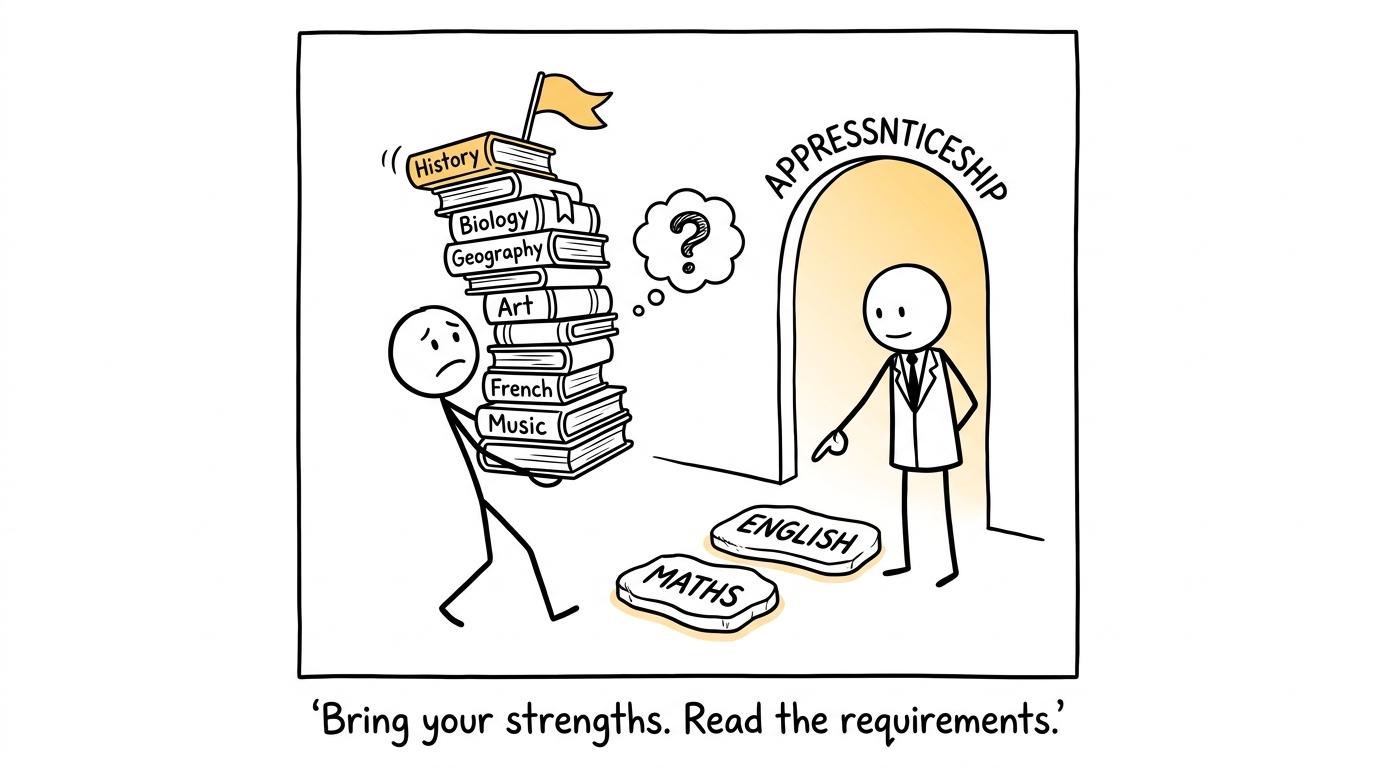 An apprentice carries every GCSE book before learning to focus on the actual entry requirements
Why maths deserves particular attention
Even if your intended career involves museums or archives, GCSE Maths may have more formal significance than GCSE History.
Current apprenticeship funding guidance in England gives English and maths a specific role. Arrangements depend on the apprentice's age, prior qualifications, apprenticeship level and any mandatory occupational requirements. For apprentices aged 161616 to 181818 who begin without suitable English or maths qualifications, further study in those subjects may form part of the programme. Rules for apprentices aged 191919 or over are more flexible in many cases, although a standard, employer or mandatory qualification can still impose requirements.
The safest strategy is to protect your options now. Begin with the GCSE Maths revision hub, where you can choose resources for boards including Edexcel, AQA, OCR and Eduqas. If you are unsure what belongs on your paper, use the GCSE maths topics by exam board and tier guide.
A grade is not improved by worrying about it in the abstract. It improves through a repeatable process:
- identify a weak topic;
- revisit the revision lesson;
- answer practice questions;
- check the mark scheme or video solution;
- record the exact error;
- return to the skill later.
Short GCSE maths mini tests can reveal gaps without demanding a whole evening. When your exam is approaching, the GCSE one-month maths revision plan provides a clearer weekly structure.
What to do if you are short of the required History grade
A lower grade calls for investigation, not immediate surrender.
Confirm whether the grade is genuinely essential
Read the complete advert and person specification. Look for “essential”, “desirable”, “preferred”, “equivalent” and “working towards”. Save a copy because vacancies can close or disappear.
Contact the named person
Ask a precise question. State your achieved or predicted grade, then ask whether relevant experience, another humanities qualification or a planned resit would be considered.
Avoid asking, “Can I apply anyway?” without context. Give the recruiter enough information to answer usefully.
Explain relevant evidence
If the requirement is desirable, use your application to demonstrate the ability behind it. History develops research, source evaluation, structured writing and the comparison of interpretations. Give truthful evidence showing where you used those skills.
Consider a resit where it has real value
A History resit may be worthwhile if several carefully researched routes repeatedly request that grade. It may be less useful if one isolated vacancy lists it as desirable while your broader route values other qualifications more strongly.
Make the decision from real adverts, not from fear.
Search adjacent routes
The occupation you want may be accessible through more than one standard. A museum might recruit business administration, customer service, content creation, data or facilities apprentices as well as museum-specific staff.
An adjacent route is not necessarily a compromise. It can provide paid experience inside the organisation while developing transferable skills.
Build a stronger application while revising
Recruiters assess more than a row of GCSE grades. Follow instructions exactly, tailor your evidence to the role and show that you understand the organisation's work.
At the same time, keep your maths preparation steady. The best order for learning GCSE maths topics can help if revision feels scattered. Once topic skills are secure, learn when to start GCSE past papers and use them to practise timing, interpretation and accuracy.
If you are deciding between foundation and higher tier, read the guidance on moving from foundation to higher maths. Your school makes the final entry decision, but evidence from mini tests and timed papers can support a sensible conversation.
Common mistakes when checking apprenticeship requirements
Treating a typical requirement as a fixed rule
“Typically” describes what often happens. It does not necessarily establish a mandatory national condition.
Confusing the route with one vacancy
A rejected application does not prove that the whole occupation is unavailable. Another employer using the same standard may set different entry criteria.
Ignoring essential and desirable labels
Students sometimes withdraw because they lack a desirable subject. Others apply despite missing several essential conditions and never ask whether alternatives are accepted. Read each label carefully.
Assuming a heritage role must require History
Heritage organisations need practical, technical, administrative, digital and customer-facing skills. The setting may be historical while the job is not primarily academic history.
Neglecting English and maths
A History grade may attract your attention because it feels unusual. Yet English and maths are more frequently named and can affect apprenticeship training arrangements. Keep revising both while researching your route.
Using old vacancy information as a promise
Employer criteria and apprenticeship rules can change. Check the live advert, current standard and current guidance rather than relying on an old screenshot or forum answer.
Keep the door open
The central fact is simple: there is not normally a national apprenticeship GCSE History requirement, even for many history-related routes. A specific employer can ask for one, but you must distinguish that vacancy-level decision from the rules of the occupation as a whole.
Check the wording. Ask a precise question. Show relevant evidence. Search adjacent opportunities if necessary.
And while you do that, strengthen the qualification that appears across far more apprenticeship adverts. Use MathsGenie's free revision lessons and practice questions to repair weak maths topics, then test your progress with mini tests, past papers, predicted papers, mark schemes and video solutions. Start at the MathsGenie GCSE maths revision area and turn uncertainty into a practical next step.