GCSE: Can You Move from Foundation to Higher?
GCSE foundation to higher: learn when you can move, what to master first, and how to use Maths Genie lessons, mini tests and predicted papers to step up.

The question everyone asks when results start to matter
At some point in your GCSE maths journey, someone says it out loud: “Can I move from foundation to higher?” It usually happens after a mock, or after a single lesson where something finally clicks. You look at the grade caps on foundation tier, you think about sixth form or college entry requirements, and suddenly it feels less like a paper choice and more like a door you might be locked out of.
The truth is: moving tier is possible for many students. But it’s rarely about “being a higher student” overnight. It’s about building a small set of non-negotiable skills, then proving you can handle higher-tier questions under exam conditions.
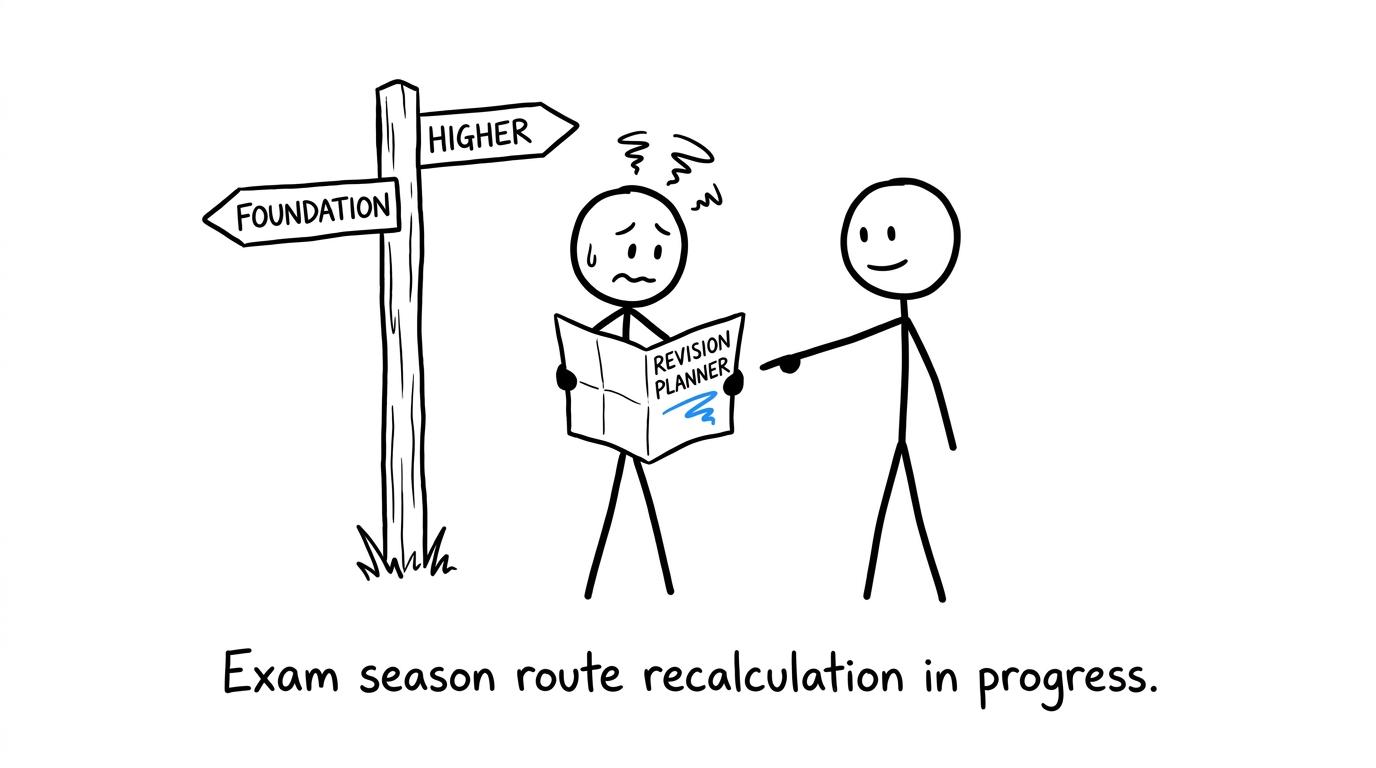 Student at a signpost choosing Foundation or Higher
Foundation vs higher tier in GCSE maths (what really changes)
Most UK exam boards (Edexcel, AQA, OCR, Eduqas) offer two tiers for GCSE Maths:
- Foundation tier: targets grades 1-5 (with grade 5 as the top).
- Higher tier: targets grades 4-9 (with access to the top grades).
The content overlaps heavily. The jump isn’t “new maths only”; it’s the depth and linking of topics. A foundation paper might ask you to use one idea at a time. A higher paper often asks you to combine ideas: algebra + geometry, ratio + percentages, graphs + interpretation.
That’s why the decision isn’t just about ambition. It’s about whether you can reliably pick up marks on the shared core, and whether you’re ready to start collecting marks on the higher-only topics too.
Helpful starting points on Maths Genie:
- Edexcel GCSE Maths Learning Journey: stages 1-10 cover foundation, stages 11-14 are higher-only.
- GCSE Target Tests: quick papers by grade range.
A quick checklist: are you ready to move to higher?
Before you ask to switch tier, you want evidence (for yourself and your teacher). Here’s a practical GCSE checklist.
Your foundation core is secure
You can do these quickly and accurately:
- Fractions, decimals, percentages (including reverse percentages)
- Ratio, proportion, best buys
- Linear graphs and rearranging formulae
- Area, perimeter, volume basics
- Angles facts and simple reasoning
Your algebra isn’t fragile
Higher tier is basically “algebra under pressure”. You should be confident with:
- Expanding and factorising
- Solving linear equations and inequalities
- Substitution into formulas
- Sequences and nth term (at least the basics)
Your mock scores suggest a safe move
Teachers differ, but for GCSE higher tier, you typically want your foundation mocks to show you’re comfortably at grade 4/5 level on foundation content.
On Maths Genie, you can test this quickly using:
- GCSE Target Tests (try Grades 4-6 then 7-9 when ready)
- Predicted Papers (Edexcel) (use as timed practice)
The hidden risk: higher tier gives you access, not guarantees
There’s a quiet misunderstanding in GCSE maths: that moving to higher tier automatically boosts your grade. It doesn’t.
Higher tier gives you access to grades 6-9, but it also contains questions where marks are harder to earn quickly. If your basics are wobbly, you can lose the easy foundation marks you used to rely on, and then you’re gambling on questions you can’t yet complete.
A sensible switch is not “hope”. It’s a plan:
- Lock down the crossover content.
- Add higher-only topics in layers.
- Practise with mark schemes and timed papers until your marks stabilise.
A practical 4-week plan to move from foundation to higher
This plan is written for a typical student who is currently foundation tier and wants to switch for their GCSE Maths.
Week 1: rebuild the core you can’t afford to drop
This is where most students waste time: they chase flashy higher topics while still losing marks on percentages and rearranging.
Use Maths Genie revision lessons and practice questions to tighten fundamentals, then check with short tests.
Good resources:
- GCSE Target Tests (Foundation and Grades 4-6)
- GCSE Statistics Revision (useful if you do statistics as well)
Week 2: begin the “higher habits” (algebra and reasoning)
Higher tier rewards students who show steps. Even if you can’t finish, method marks matter.
Start practising multi-step problems. Aim to write a line of algebra even when you feel unsure.
Week 3: timed practice with feedback
This is where confidence becomes real. Do a paper, mark it harshly, learn from it, repeat.
Use:
- Predicted Papers (Edexcel)
- OCR GCSE Maths Papers (if you’re OCR, or as extra practice)
Week 4: focus on high-value higher topics
Choose topics that appear often and connect to lots of questions: Pythagoras, trigonometry, graphs, algebraic manipulation.
Geometry and measures practice can help build that “I can reason” skill:
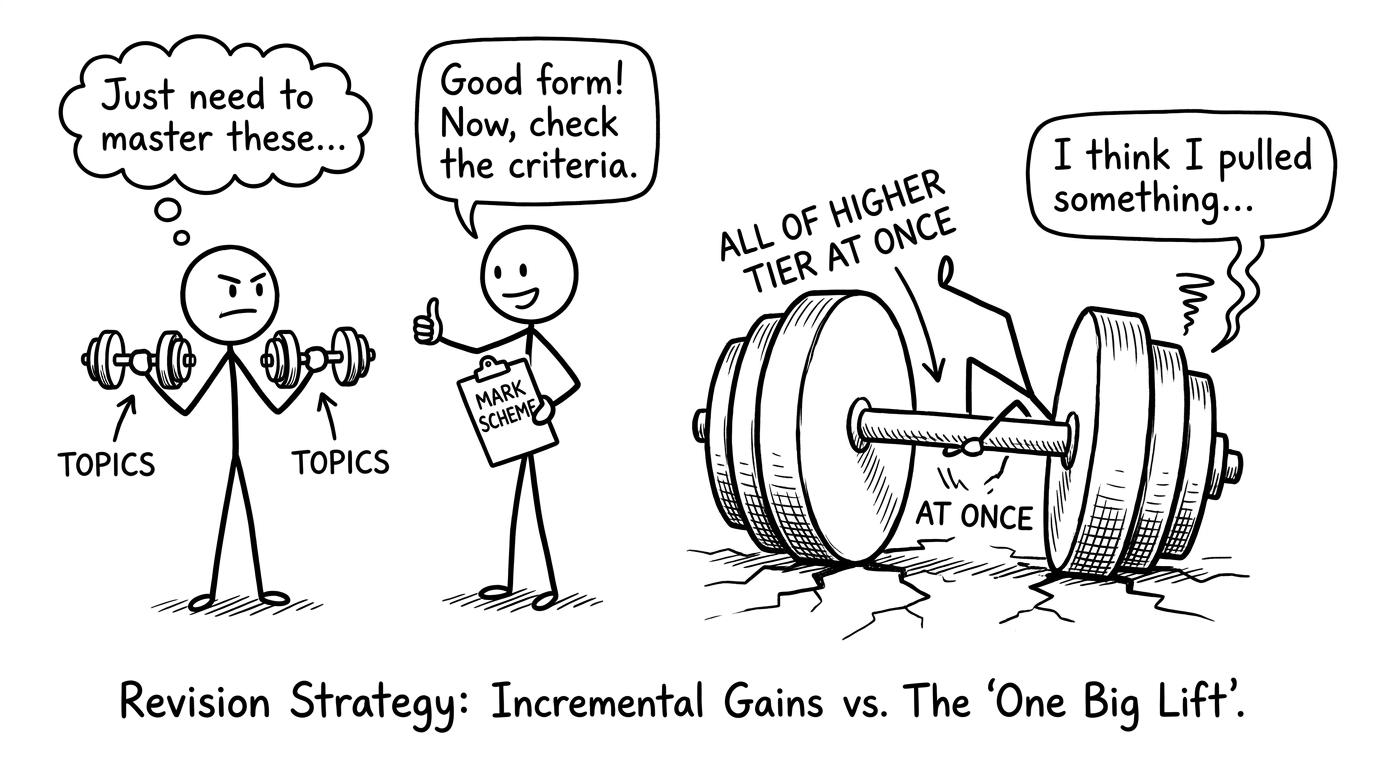 Revision weights joke about lifting all of Higher at once
Worked examples that bridge foundation to higher
The fastest way to move tier in GCSE maths is to take foundation skills and practise them in higher-style questions.
Worked example 1: reverse percentages (foundation skill, higher pressure)
A jacket costs £48 after a 20%20\%20% discount. What was the original price?
If the original price is xxx, then after a 20%20\%20% discount you pay 80%80\%80% of it:
0.8x=48 0.8x = 48 0.8x=48Solve:
x=480.8=60 x = \frac{48}{0.8} = 60 x=0.848=60So the original price was £60.
Why this matters for GCSE higher: reverse percentage questions often sit inside longer multi-step problems (profit, VAT, repeated changes), so you need the method automatic.
Worked example 2: algebraic rearranging (the higher tier gatekeeper)
Make xxx the subject of:
y=3x−7 y = 3x - 7 y=3x−7Add 777 to both sides:
y+7=3x y + 7 = 3x y+7=3xDivide by 333:
x=y+73 x = \frac{y+7}{3} x=3y+7Now a higher-tier twist: make xxx the subject of
y=3x−74 y = \frac{3x-7}{4} y=43x−7Multiply both sides by 444:
4y=3x−7 4y = 3x - 7 4y=3x−7Add 777:
4y+7=3x 4y + 7 = 3x 4y+7=3xDivide by 333:
x=4y+73 x = \frac{4y+7}{3} x=34y+7This is classic GCSE higher: not harder maths, just more steps, where missing one line costs marks.
Worked example 3: Pythagoras into a real problem
A right-angled triangle has legs 6 cm6\text{ cm}6 cm and 8 cm8\text{ cm}8 cm. Find the hypotenuse.
Use Pythagoras:
c2=62+82=36+64=100 c^2 = 6^2 + 8^2 = 36 + 64 = 100 c2=62+82=36+64=100So:
c=100=10 c = \sqrt{100} = 10 c=100=10On a GCSE higher paper, this might then feed into perimeter, area, or a trig ratio, which is why your basics must be reliable.
Common mistakes when trying to move from foundation to higher
Moving tier in GCSE maths isn’t only about learning new topics. It’s about stopping predictable mark losses.
- Rushing past the crossover content. If you can’t reliably score on percentages, ratio, and basic algebra, higher tier becomes stressful and inconsistent.
- Not showing steps. Higher tier mark schemes reward method. A correct final answer without a method can still lose marks if you make a slip elsewhere.
- Only doing questions you like. Everyone has comfort topics. Higher requires you to face the awkward ones too.
- Ignoring non-calculator fluency. Paper 1 style arithmetic and algebra can decide your grade early.
- Treating predicted papers like magic. Predicted papers are practice, not promises. Use them to diagnose weaknesses, not to guess the exam.
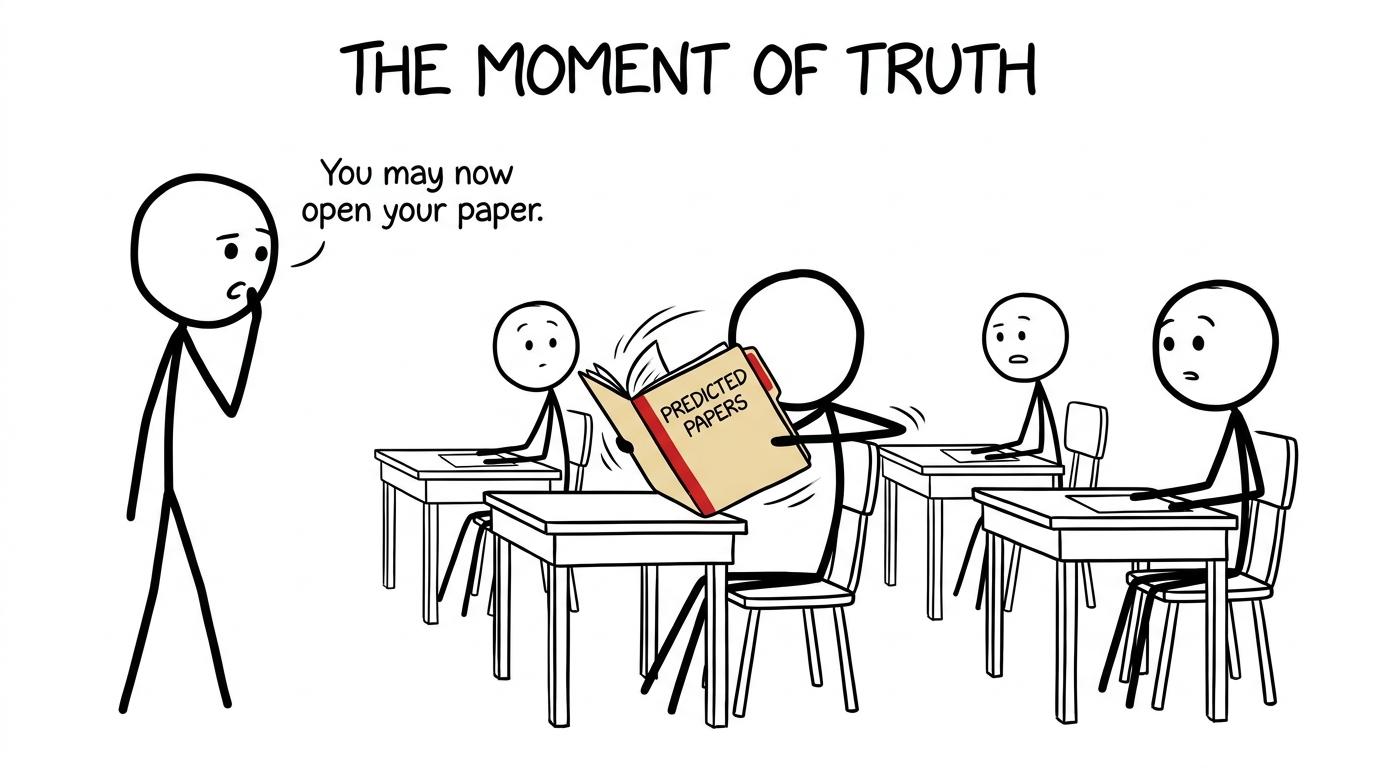 Student opens predicted papers like a spy dossier
Closing thoughts: the move is possible, but it needs proof
If you’re asking whether you can move from foundation to higher, you’re already thinking like a serious GCSE student. You’re noticing that grades are not only about effort, but about strategy: the right work, at the right time, with honest feedback.
The move is absolutely possible. The students who do it best don’t “switch identity” from foundation to higher in a week. They build a track record: strong crossover skills, improving timed scores, and a calm familiarity with mark schemes.
Your next step is simple: use Maths Genie as your evidence machine. Work through revision lessons, practise exam questions, and prove progress with mini tests and predicted papers. Start here:
- Edexcel GCSE Maths Learning Journey
- GCSE Target Tests
- Predicted Papers (Edexcel)
- OCR GCSE Maths Papers
If you do the work, you’ll stop asking “Can I move?” and start asking the better GCSE question: “How high can I go?”