Apprenticeship GCSE Arabic Requirement Explained
Apprenticeship GCSE Arabic requirement explained: discover which roles may ask for Arabic, how to check vacancies and what to do if your grade falls short.
A GCSE result can feel strangely powerful. One number on a page seems capable of opening a route or closing it. If you are searching for an apprenticeship GCSE Arabic requirement, the direct answer is reassuring: mainstream UK apprenticeship routes do not normally require a particular GCSE Arabic grade.
Arabic may matter for a rare language-focused vacancy, but the employer must state that in its entry requirements. More commonly, apprenticeships specify GCSE English and maths, accepted equivalents, or broader academic requirements. Even roles involving languages may test your aptitude or fluency rather than insist on GCSE Arabic.
The practical lesson is simple: read the individual vacancy, separate essential requirements from desirable ones, and ask the employer or training provider when the wording is unclear.
The quick apprenticeship requirement checklist
Before worrying about your Arabic result, check these details:
- Is GCSE Arabic listed as essential, desirable, or not mentioned?
- Does the advert ask for Arabic specifically, or any modern foreign language?
- Is a minimum grade stated?
- Does it say “GCSE or equivalent”?
- Are English and maths separate requirements?
- Will language ability be assessed through an interview or aptitude test?
- Does the role have nationality, residency, security clearance, medical or fitness conditions?
- Are the requirements set by the employer, training provider or apprenticeship standard?
Requirements can change between recruitment rounds. Save the vacancy and confirm important details directly rather than relying on an old advert, a careers forum or a screenshot shared by someone else.
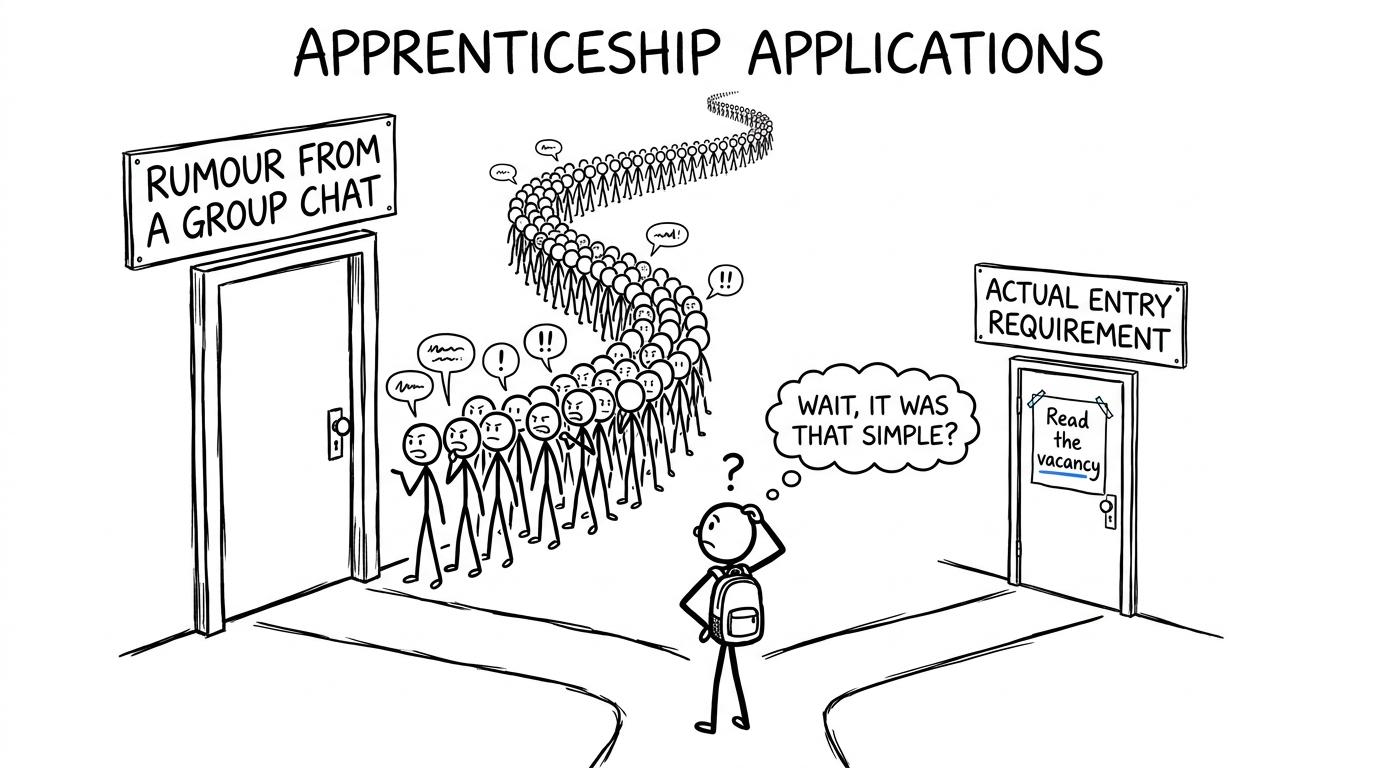 A student chooses between reading an apprenticeship vacancy and following a group-chat rumour
Do apprenticeships require a specific GCSE Arabic grade?
In general, no. Current apprenticeship rules in England concentrate on occupational training and, where applicable, English and maths. They do not create a universal GCSE Arabic threshold.
Entry requirements for a vacancy can still be set by the recruiting employer. That means an employer could request GCSE Arabic at grade 444, grade 555 or another level if the qualification were genuinely relevant. However, this would be a vacancy-specific condition, not a standard rule applying to apprenticeships as a whole.
There is also an important distinction between these statements:
- “Arabic GCSE at grade 444 or above” names a subject and grade.
- “A modern foreign language at grade 444 or above” may allow Arabic, but is not Arabic-specific.
- “Arabic language ability is desirable” may not require a certificate.
- “Language aptitude will be assessed” focuses on potential rather than an existing GCSE.
Small differences in wording can determine whether you meet the criteria. Read the qualifications section alongside the full role description.
Which apprenticeship routes actually set an Arabic minimum?
A review of current official apprenticeship guidance and publicly available recruitment information does not reveal a mainstream apprenticeship standard with a nationally prescribed minimum GCSE Arabic grade. In other words, there is no broad “Arabic apprenticeship route” for which every applicant must hold the same Arabic result.
A requirement is most plausible in a narrow group of vacancies, but even there it should not be assumed.
Intelligence and defence language roles
Military intelligence and linguist careers are the most obvious place to look. Yet their requirements illustrate why checking the exact role matters.
Some RAF linguist recruitment information refers to GCSE English and maths, followed by language aptitude testing and specialist language training. A separate aircrew linguist role has previously specified a GCSE in a modern foreign language at grade 444 alongside English, maths and other subjects. That is a language requirement, but it is not necessarily a requirement for Arabic itself.
Arabic may be one of the languages relevant to defence work, depending on operational recruitment needs. The employer may teach the required language or assess existing ability. These roles can also have conditions involving age, nationality, residency, security clearance, fitness and medical eligibility. A good Arabic grade cannot replace those requirements.
Recruitment criteria are especially changeable in this area, so treat the current role page and vacancy notice as authoritative for the application you are making.
Translation, interpreting and language-service roles
An employer recruiting for translation, interpreting, localisation or multilingual customer support may value Arabic. However, language competence can be demonstrated in several ways: a qualification, bilingual experience, an assessment, an interview or evidence of professional-level communication.
A vacancy might set a specific Arabic grade, but that is an employer choice. It is not an automatic feature of the apprenticeship route. Pay close attention to the form of Arabic required too. Spoken dialect knowledge and formal written Arabic are not identical skills, and a role may need one more than the other.
International business, travel and customer-service roles
Arabic can strengthen an application where an employer serves Arabic-speaking customers or operates internationally. It is normally an additional asset rather than a compulsory GCSE threshold.
Do not reject yourself because the advert says Arabic is “desirable”. That word usually means the employer would value it, not that every successful applicant must possess a certain GCSE grade. Your communication skills, motivation and ability to learn may still make you a credible candidate.
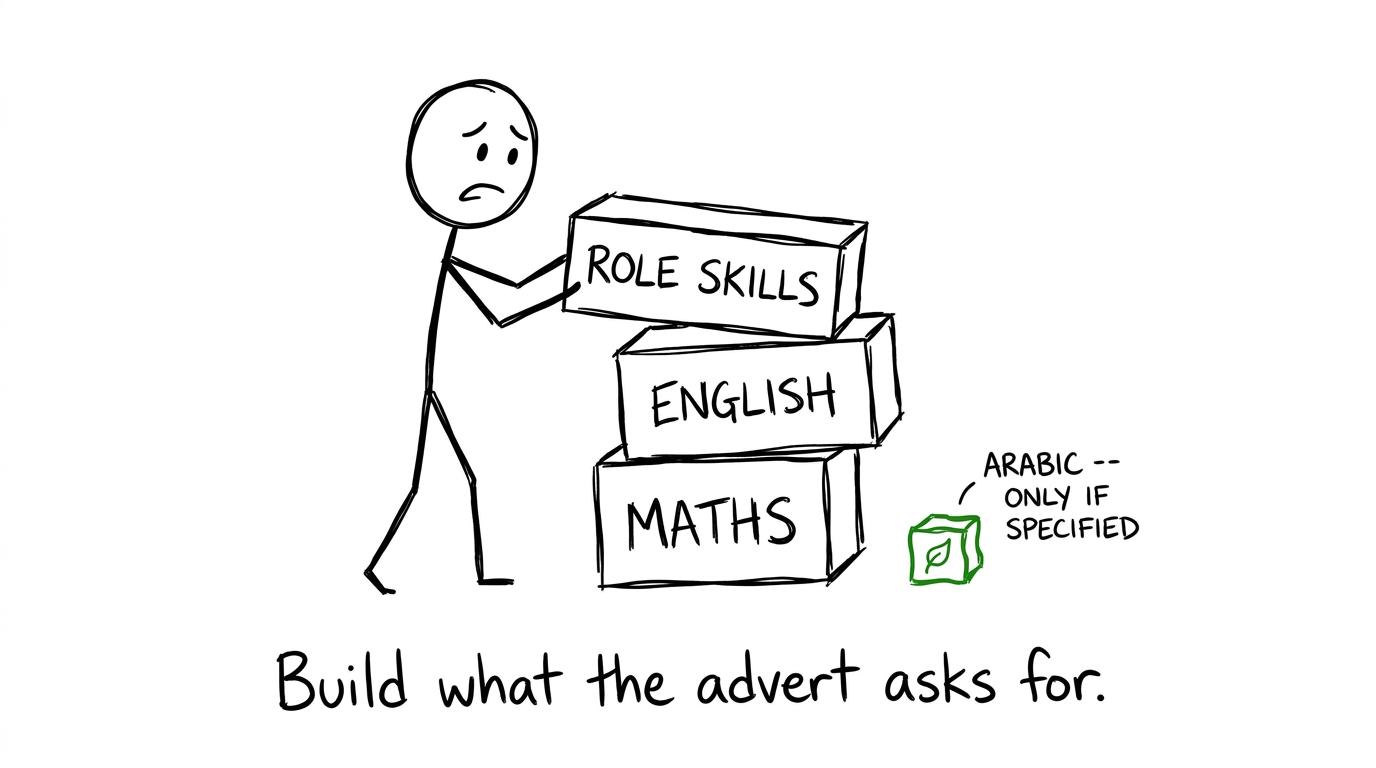 A student builds an apprenticeship application from maths, English and role skills
Why GCSE maths is more likely to affect your options
For students aged 161616 to 181818 starting an apprenticeship in England, current government guidance makes English and maths part of the programme when suitable equivalent qualifications are not already held. The precise completion requirements depend on the apprenticeship level and the learner’s circumstances. Rules for adults aged 191919 and over offer more flexibility, while employers can still set their own recruitment criteria.
The arrangements differ across England, Scotland, Wales and Northern Ireland, so check the rules for the nation in which the apprenticeship is delivered.
Many vacancies ask applicants to have GCSE maths and English at grade 444 or above, or an accepted equivalent. Others allow apprentices to continue working towards the relevant qualification. This is why improving maths can protect far more apprenticeship options than worrying about a subject that most adverts never mention.
Start with the free GCSE Maths Revision hub, where you can choose your board and work through material for Edexcel, AQA, OCR or Eduqas. Foundation and higher tier students should revise for the specification and tier they are actually taking.
Short practice is useful when exams and applications are competing for your attention. The GCSE Target Tests let you practise focused skills, then use the mark schemes and available solutions to find where marks are being lost.
What to do if your Arabic grade is below the requirement
A low result is information, not a final verdict. Your next move depends on the wording of the vacancy.
Confirm whether the condition is truly essential
Contact the employer or training provider and ask a precise question:
The vacancy lists GCSE Arabic at grade 444. Would you accept an equivalent qualification, a language assessment or other evidence of Arabic proficiency?
Also ask whether the grade is needed when applying, before enrolment or before completing the apprenticeship. Do not claim an equivalence yourself. The employer and provider must confirm what they accept.
Provide other evidence of language ability
If the employer permits alternatives, you might be able to demonstrate speaking, listening, reading or writing ability through its selection process. Be accurate about what you can do. Conversational confidence does not automatically prove the formal written standard needed for translation or intelligence work.
If Arabic is only desirable, explain relevant ability clearly in your application. Mention the qualification and grade honestly, then add any genuine experience that helps the employer understand your current level. Never inflate fluency or hide a requested result.
Consider improving or replacing the qualification
If GCSE Arabic is explicitly essential and no alternative is accepted, ask your school, college or an accredited exam centre about a resit or another recognised qualification. Check availability, specification, assessment arrangements, fees and dates before committing. Not every centre offers Arabic, and the arrangements can vary.
You can also search for related vacancies without the same subject condition. A different employer may assess language aptitude, accept another modern foreign language or provide specialist training after recruitment.
Strengthen the requirements you can control now
Protect your English and maths results while investigating the language condition. If maths is the immediate concern, use the one-month GCSE maths revision plan to create a manageable routine.
A sensible cycle is to learn one method, complete practice questions, mark them, and revisit mistakes. If you are unsure where to begin, use the guide to finding your weakest GCSE maths topics. This turns an unclear goal such as “get better at maths” into a list of specific actions.
How to read an apprenticeship advert carefully
The qualifications panel is important, but it is not the whole application. Look for these labels:
- Essential: you are normally expected to meet the condition, although confirmed equivalents may be allowed.
- Desirable: it can support your application but should not automatically prevent you from applying.
- Or equivalent: ask which qualifications the provider accepts.
- Training provided: you may be recruited for aptitude and taught the specialist skill.
- Assessment required: passing a language, aptitude or occupational test may matter more than your GCSE grade.
Check whether English and maths are required by the employer at entry or can be completed during the programme. Then read the duties. If the job barely uses Arabic, an apparent subject requirement is worth querying politely rather than interpreting for yourself.
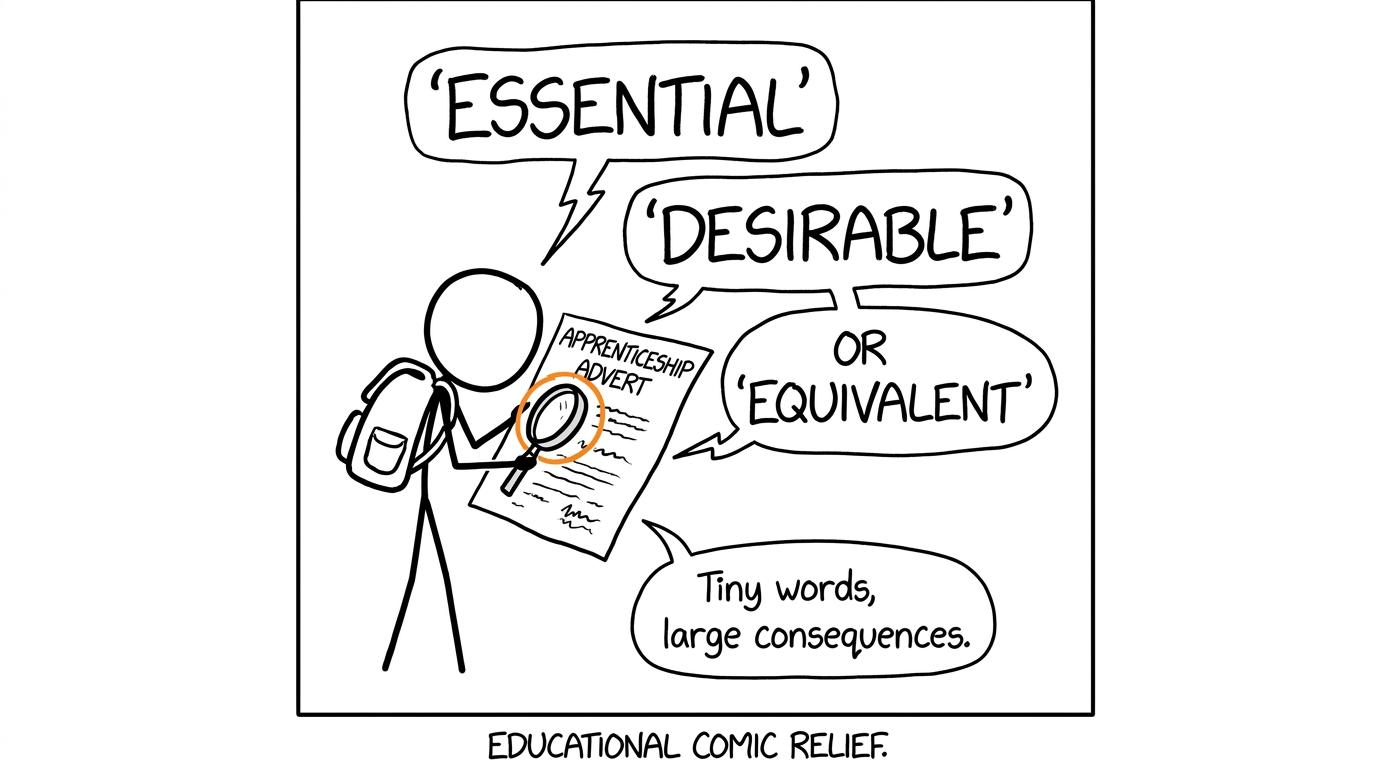 A student studies the words essential, desirable and or equivalent in a vacancy
Common mistakes when checking apprenticeship requirements
Assuming Arabic can count as English
GCSE Arabic is a valuable language qualification, but it does not normally satisfy a requirement for GCSE English Language. They are separate subjects. Only the employer or provider can confirm accepted equivalents.
Treating a desirable grade as an absolute barrier
If Arabic is desirable rather than essential, consider applying. Show how your actual skills fit the role and be honest about the grade achieved.
Confusing a language requirement with an Arabic requirement
An advert asking for any modern foreign language may accept Arabic. Equally, it may define which subjects or qualifications count. Confirm rather than assume.
Reading an old vacancy as a permanent rule
An employer can alter requirements between recruitment campaigns. Language priorities can also change. Always use the live advert for the intake you want.
Neglecting maths while chasing a rare condition
Students sometimes spend days researching an unusual requirement while avoiding the GCSE that appears across far more vacancies. Keep revising. Use Edexcel GCSE Maths past papers if that is your board, or select the relevant exam board through the main revision hub.
Past papers become valuable when you mark them and repair the weaknesses they expose. The guide to using Edexcel past papers properly explains how to turn lost marks into targeted practice. If you are planning ahead, read when to start GCSE past papers rather than saving every paper for the final week.
Keep the rare requirement in perspective
A specific apprenticeship GCSE Arabic requirement is possible, but it is unusual and normally belongs to one employer’s vacancy rather than a national apprenticeship route. Even language-heavy careers may request any modern foreign language, test aptitude, assess fluency or teach the required language after recruitment.
Your best response is calm and practical: read the live advert, identify what is essential, ask whether equivalents are accepted, and make an alternative plan if the requirement is firm.
Meanwhile, keep strengthening the qualifications that appear most often. MathsGenie gives you free revision lessons, practice questions, mini tests, past papers, predicted papers, mark schemes and video solutions. Open the GCSE Maths Revision hub, choose your exam board and tier, and turn today’s uncertainty into one useful revision session.