

GCSE Chemistry Revision Without Wasting Time
GCSE Chemistry revision without wasting time: a simple plan built around practice, mark schemes, and maths skills so you gain marks fast.
GCSE Chemistry revision has a special way of stealing your evening. You open a textbook for “five minutes”, end up rewriting the whole page in neat colours, and somehow finish with the comforting feeling of having worked hard and the slightly alarming truth that you still wouldn’t back yourself on a six-mark question. If that sounds familiar, this guide is about revising GCSE Chemistry without wasting time, using the same principle that drives high grades in maths: practise what gets marks, check it against the mark scheme, then fix the mistake properly.
You’re here as a UK GCSE (or A Level) maths student, so we’ll lean into what you already know: maths revision works when it is specific, test-based, and honest. Chemistry is the same. And when it isn’t, it’s usually because revision time is being spent on tasks that feel productive but don’t transfer to the exam.
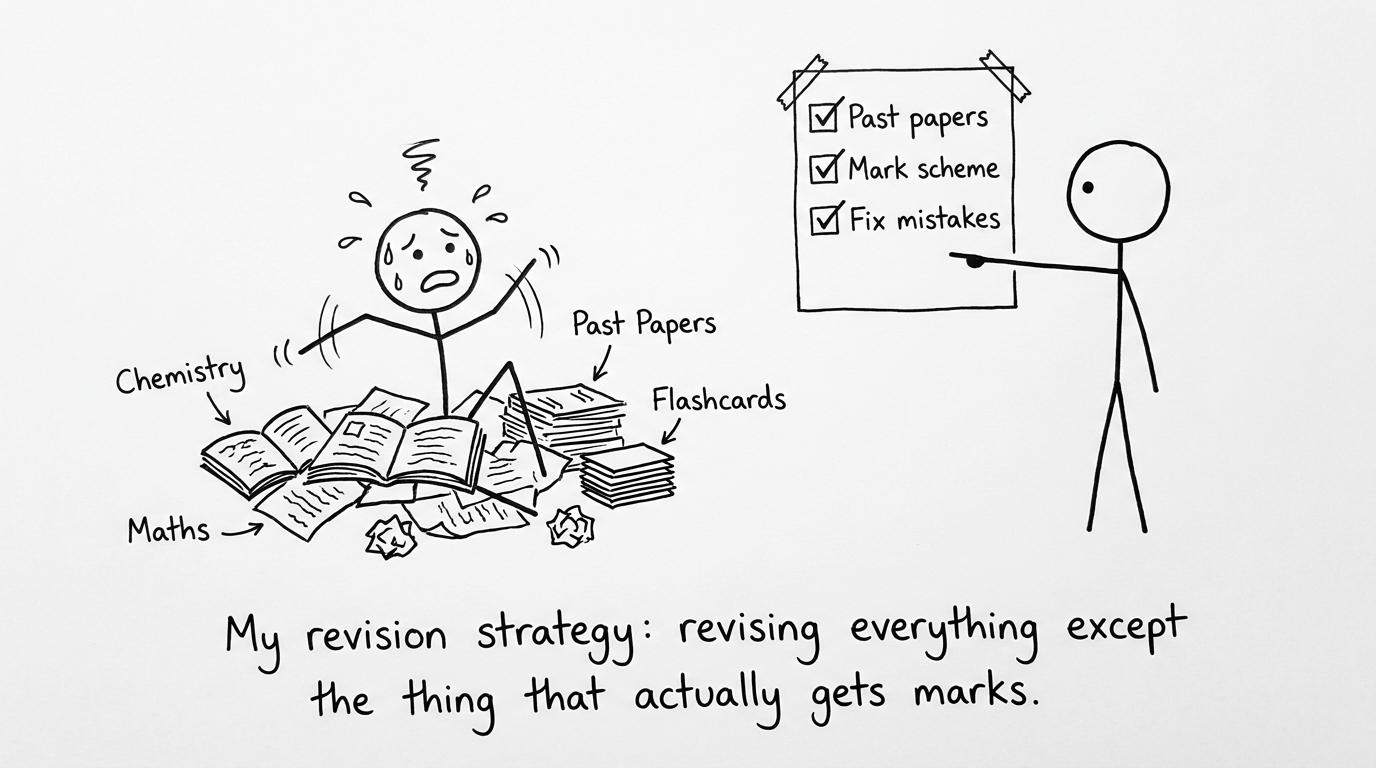 A stressed student revises everything except what gets marks
The no-waste GCSE Chemistry checklist
Keep this short list next to you. It’s the quickest way to keep GCSE revision from drifting.
- Know your exam board and tier: AQA, Edexcel, OCR, Eduqas; foundation or higher.
- Revise by question-type, not by chapter.
- Use mark schemes early, not just at the end.
- Track errors as “skills”, not “topics”.
- Do timed practice weekly, even in small chunks.
- Protect maths marks inside Chemistry: units, rearranging, graphs, proportionality.
When you need a maths reset between Chemistry blocks, use YesGenie’s GCSE Subjects hub to jump into targeted maths practice fast.
Why GCSE Chemistry revision wastes time (and how to notice it)
Most wasted GCSE Chemistry revision time comes from confusing effort with feedback. Neat notes feel like effort. Watching videos feels like effort. Re-reading feels like effort. But in exams, marks come from doing something under pressure: recalling, applying, calculating, explaining.
A simple rule: if a revision method does not create a clear right-or-wrong outcome, it’s probably low value.
In maths, you know this instinctively. You don’t get better at solving simultaneous equations by reading five worked examples. You get better by attempting one, getting it wrong, and then doing the next one with the mistake removed.
That’s why it helps to anchor your week around practice questions and mark schemes. On YesGenie, that same engine exists for maths via GCSE Past papers, Edexcel GCSE Maths Predicted Papers, and short, focused Edexcel GCSE Maths Mini Tests. Even if your immediate goal is GCSE Chemistry, your revision habits improve when your system is built on feedback.
Build a GCSE Chemistry plan like a maths plan
A good GCSE plan isn’t “revise Topic 4”. It’s “earn marks on the questions I currently lose”. That shift is the difference between busy and effective.
Step one: turn the spec into question-types
For GCSE Chemistry, common question-types include:
- Calculate moles, concentrations, gas volumes
- Balance equations and explain conservation of mass
- Required practicals (method, variables, improvements)
- Electrolysis predictions (products, half-equations)
- Rate graphs, energy profile diagrams, collision theory
Instead of writing “Rates of reaction” on a to-do list, write “rate graph interpretation + required practical 6-mark”. It forces exam thinking.
Step two: schedule short timed blocks
Chemistry revision works well in 252525 minute blocks:
- 101010 minutes: attempt questions (no notes)
- 101010 minutes: mark with mark scheme, annotate missing phrases
- 555 minutes: write one corrective card: “Next time, I must include…”
Then switch to maths for a clean mental break: a mini test, a few topic questions, or a single past-paper section. YesGenie’s Resources page is useful here because it offers different formats (mini tests, predicted papers, and more) depending on your energy level.
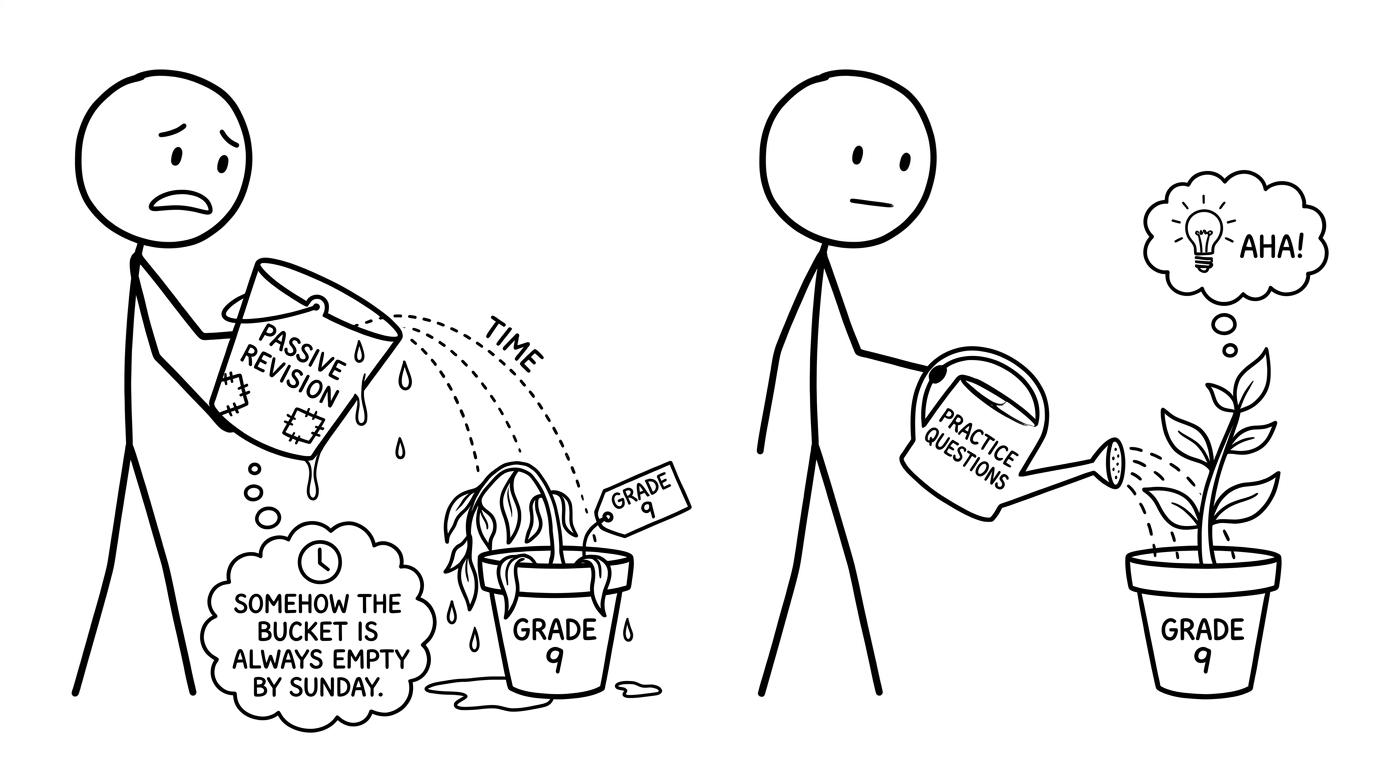 Passive revision leaks time; practice grows marks
The hidden advantage: GCSE Chemistry is full of maths marks
A surprisingly large chunk of GCSE Chemistry marks are “quiet maths marks”: unit conversions, rearranging formulae, proportional reasoning, and interpreting graphs. If you’re also revising maths, this is good news: you can recycle skills.
Here are a few worked examples in the style examiners like.
Worked example: concentration and rearranging
A solution has concentration c=0.50 mol dm−3c = 0.50\ \text{mol dm}^{-3}c=0.50 mol dm−3. The volume is V=250 cm3V = 250\ \text{cm}^3V=250 cm3. Find the number of moles nnn.
Use c=nVc = \frac{n}{V}c=Vn but make units consistent. Convert 250 cm3250\ \text{cm}^3250 cm3 to dm3\text{dm}^3dm3:
250 cm3=2501000 dm3=0.250 dm3 250\ \text{cm}^3 = \frac{250}{1000}\ \text{dm}^3 = 0.250\ \text{dm}^3 250 cm3=1000250 dm3=0.250 dm3Rearrange:
n=cV=0.50×0.250=0.125 mol n = cV = 0.50 \times 0.250 = 0.125\ \text{mol} n=cV=0.50×0.250=0.125 molWhat this teaches: most lost marks here are not “chemistry knowledge”; they are unit conversion and calm rearranging.
If rearranging is a weak spot, build it in maths revision too. A fast way is to practise formula manipulation questions (and mark scheme phrasing) using a targeted topic page like Simplifying Algebra and then step up to rearranging-style questions in algebra topics on your exam board lesson list.
Worked example: percentage yield (structured like a mark scheme)
The theoretical yield is 12.0 g12.0\ \text{g}12.0 g. The actual yield is 9.0 g9.0\ \text{g}9.0 g. Find the percentage yield.
percentage yield=actual yieldtheoretical yield×100 \text{percentage yield} = \frac{\text{actual yield}}{\text{theoretical yield}}\times 100 percentage yield=theoretical yieldactual yield×100 =9.012.0×100=0.75×100=75% = \frac{9.0}{12.0}\times 100 = 0.75\times 100 = 75\% =12.09.0×100=0.75×100=75%What this teaches: show the formula, substitute clearly, and only round at the end. That’s how you make the marker’s job easy.
Worked example: reading a rate graph without guessing
A reaction produces 48 cm348\ \text{cm}^348 cm3 of gas in 60 s60\ \text{s}60 s. Estimate the mean rate.
mean rate=change in volumetime=4860=0.8 cm3 s−1 \text{mean rate} = \frac{\text{change in volume}}{\text{time}} = \frac{48}{60} = 0.8\ \text{cm}^3\ \text{s}^{-1} mean rate=timechange in volume=6048=0.8 cm3 s−1What this teaches: even “graph” questions are often arithmetic plus units.
If rates or units feel slippery, it’s the same skill family as GCSE maths rate questions. You can reinforce this with maths topics like Speed and Density (scroll the lesson list for the topic), then return to Chemistry with stronger instincts.
Use mark schemes like a coach, not a judge
Mark schemes are not just for scoring. They are a map of what the examiner rewards.
A practical way to use them:
- After each question, highlight the first missing mark you lost.
- Write one sentence: “I lost this mark because…”
- Convert it into a rule you can follow next time.
In maths, this is exactly what happens when you use worked solutions. YesGenie makes that loop easy with video walk-throughs for papers, like November 2020 Paper 2: Video Solutions. The principle transfers directly to GCSE Chemistry: don’t just see the right answer, learn the specific step that would have earned you the mark.
A weekly structure that actually fits real life
Most GCSE students don’t fail because they lack motivation. They fail because they build a plan that only works on perfect weeks.
Try this:
Weekdays (small, reliable)
- 222 blocks of 252525 minutes (one Chemistry, one maths)
- Each block ends with: one mistake noted, one fix written
Weekend (one longer session)
- One timed Chemistry paper section + one timed maths paper section
- Mark both the same day
For maths, keep your timed practice close to your exam board. Useful starting points include:
That way, your “system” stays consistent even while you switch subjects.
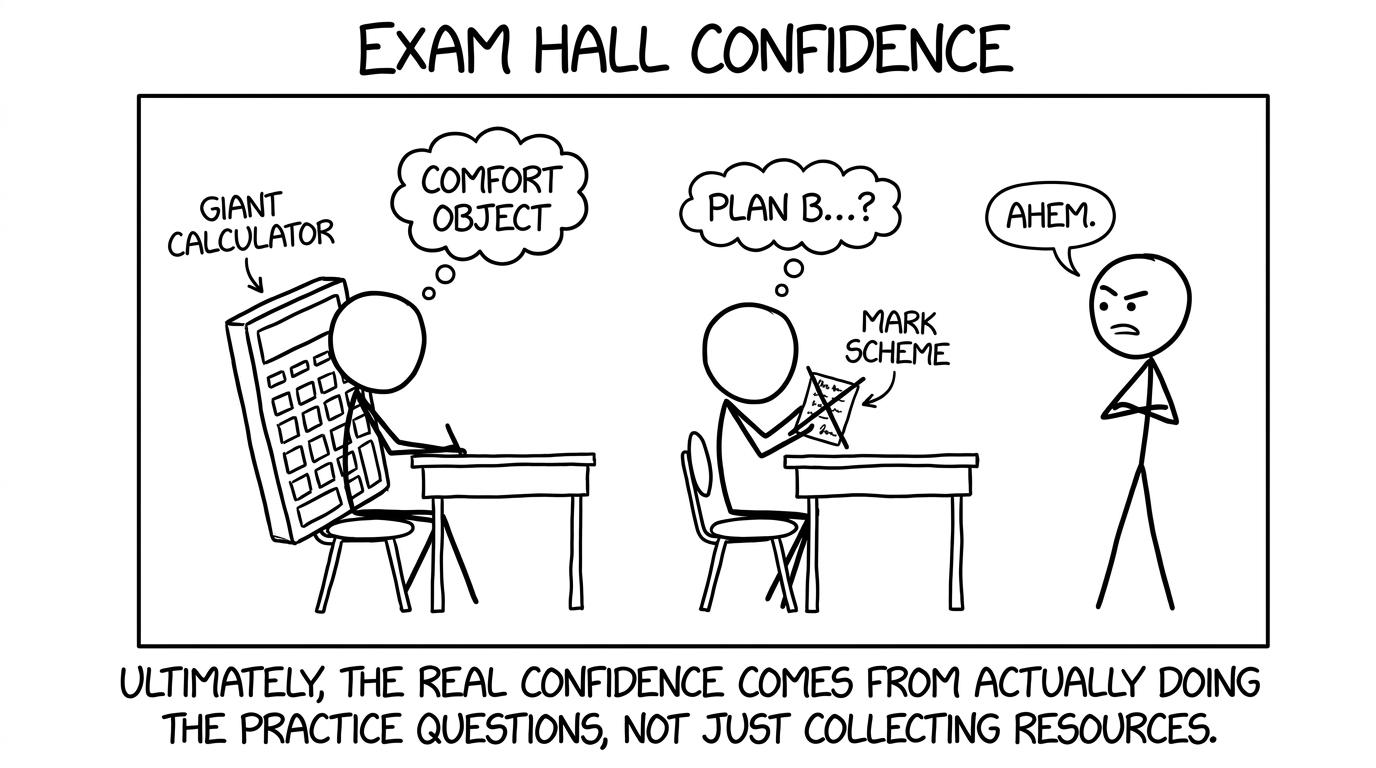 Confidence comes from doing questions, not collecting them
Common mistakes that waste GCSE Chemistry revision time
- Making notes as the main activity. Notes are a reference, not training. If you have 606060 minutes, at least 404040 should be attempting questions and marking them.
- Ignoring tier and exam board. Foundation and higher tier expectations differ, and AQA vs Edexcel vs OCR vs Eduqas wording can change what earns marks.
- Marking but not fixing. If you mark a question, feel annoyed, and move on, you’ve paid for feedback and thrown it away.
- Learning facts without practising explanations. GCSE Chemistry requires short, precise sentences. Practise writing them under time.
- Dropping easy maths marks. Losing marks on cm3\text{cm}^3cm3 to dm3\text{dm}^3dm3 or rearranging is painful because it’s fixable.
- Cramming without a loop. Cramming can feel intense, but without repeated retrieval and correction, it fades quickly.
Bring it back to GCSE marks (and make your time count)
The students who improve fastest at GCSE Chemistry aren’t necessarily the ones who revise the most. They’re the ones who stop negotiating with themselves about what “counts as revision”. They do questions. They mark them honestly. They fix one thing at a time.
If you want that same reliability in your maths revision (and you do, because it keeps your whole week organised), use YesGenie as the backbone: GCSE Past papers, exam-board practice like Edexcel GCSE Maths Lessons or AQA GCSE Maths Lessons, and quick confidence builders like Edexcel GCSE Maths Mini Tests. Then apply the same system to GCSE Chemistry: practise, mark, correct, repeat.
Your time is limited. Treat it like it’s valuable, because it is. And let your GCSE revision be the kind that changes your mark, not just your mood.










