

AI Quiz GCSE Latin: A Safe, Productive Guide
AI quiz GCSE Latin advice for productive self-testing, reliable prompts and spotting bad information, while keeping your GCSE maths revision on track.
There is a particular kind of revision frustration that arrives when you want to test yourself but nobody is available to ask the questions. Your vocabulary list sits open. The answers are visible. Every attempt at self-testing quietly becomes another round of rereading.
An AI quiz GCSE Latin session can solve that practical problem. You can ask an AI tool to question you on vocabulary, grammar, translation choices, set-text content or literary techniques, one item at a time. It can respond immediately and adapt the next question to your mistakes.
But there is an important condition: treat AI as a quiz partner, not an authority. It can invent translations, misidentify grammatical forms and confidently introduce material outside your specification. Productive use therefore depends on giving it verified source material and checking its feedback.
The same lesson applies to maths revision. A tool can generate questions, but improvement comes from attempting, checking, correcting and returning later. That is why MathsGenie's GCSE maths revision hub is built around lessons, questions, papers and solutions rather than passive reading alone.
Your quick AI Latin quiz checklist
Before opening an AI tool, use this checklist:
- Confirm your exam board, specification and examination year.
- Choose one narrow target, such as vocabulary or noun endings.
- Supply a trusted vocabulary list, extract or teacher-approved notes.
- Ask for one question at a time without showing the answer.
- Answer from memory before requesting a hint.
- Make the AI explain its marking briefly.
- Check disputed feedback against an official or teacher-approved source.
- Record weak areas and test them again on another day.
- Never enter personal information or another student's work.
- Do not submit AI-generated writing as your own assessed work.
The checklist matters because convenience can disguise uncertainty. An instant answer feels authoritative. It is not necessarily accurate.
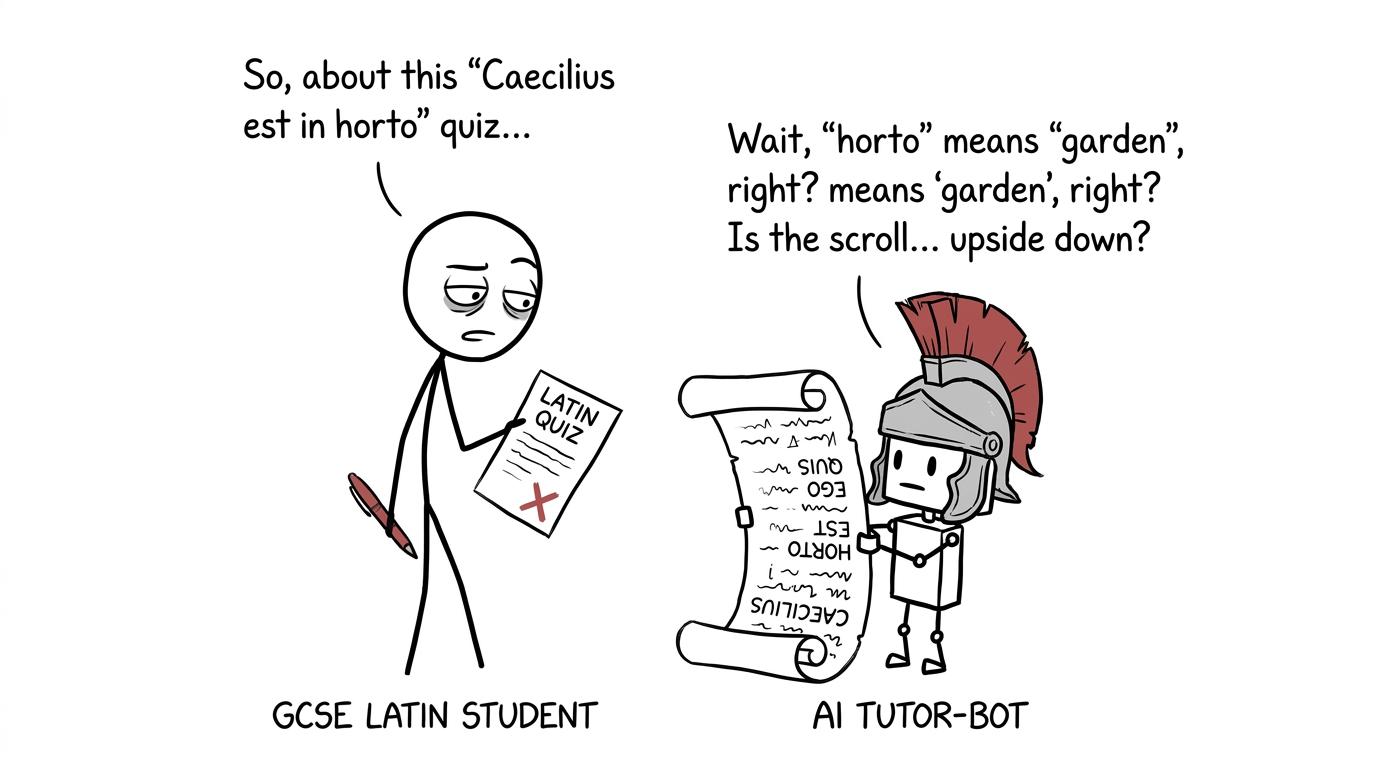 A student cautiously checks a Latin-quizzing robot wearing a Roman helmet
What can an AI tool quiz you on in GCSE Latin?
Current OCR GCSE Latin requires students to develop knowledge of vocabulary, accidence and syntax, read Latin passages, and study ancient literature or cultural sources depending on their selected components. The compulsory Language component includes translation and comprehension, followed by either grammar questions or short English-to-Latin sentences.
That gives an AI tool several useful but distinct jobs.
Defined vocabulary
You can provide words from the official Defined Vocabulary List and ask the tool to test Latin-to-English meanings, English-to-Latin recall or principal parts. Supplying the list yourself is safer than asking the model to decide what belongs on it.
Useful instructions include:
- accept only meanings shown in the supplied list;
- randomise the order;
- keep a list of errors;
- repeat missed words later;
- distinguish a spelling error from an incorrect meaning.
This turns a static list into a responsive quiz while keeping the source under your control.
Accidence and syntax
AI can ask you to identify case, number, gender, person, tense, voice or mood. It can also quiz you on constructions named in your specification.
Keep the task tightly bounded. Instead of requesting “hard GCSE Latin grammar”, provide the exact grammar points you have covered. Otherwise, the tool may introduce an advanced construction, use inconsistent terminology or present an ambiguous form as though only one analysis were possible.
Translation and comprehension
An AI tool can reveal a passage sentence by sentence, ask comprehension questions or invite you to justify a translation choice. This can be useful for practice, but generated Latin is a higher-risk area. A sentence may look convincingly classical while containing awkward or incorrect usage.
Prefer passages supplied by your teacher, official sample materials or authorised past-paper resources. Ask the AI to quiz you about that text rather than compose unlimited unseen passages of its own.
Literature and culture
For set texts, AI can test factual recall, themes, characterisation and literary techniques. However, OCR set texts and prescribed sources can change between examination cycles. Always tell the tool your examination year and provide the correct approved material.
Do not trust it to identify your set text from memory. A polished quiz on the wrong text is still the wrong revision.
How to create a productive AI quiz GCSE Latin session
The quality of the session depends less on the brand of tool than on the instructions and evidence you provide.
Start with a verified source
Paste only material you are permitted to use, such as your own notes or an extract from an official list. Do not upload a complete copyrighted textbook or personal school documents. Remove names, email addresses, candidate details and teacher comments.
Department for Education guidance warns that generative AI output may be inaccurate, biased, out of date or taken out of context. It also recommends keeping personal data out of these tools. Follow your school's AI and safeguarding policies, particularly if an account has an age requirement.
Give the tool a narrow role
A useful reusable prompt is:
Act as a GCSE Latin quiz partner. Use only the source material I provide. Ask one question at a time and do not reveal the answer until I respond. Mark my answer against the supplied source, explain any correction briefly, record the topic of each error, and finish with a short list of areas to revisit. If the source does not establish an answer, say that you cannot verify it.
Then add the skill you want to practise and your exam board. This is not a guarantee of accuracy, but it gives the model fewer opportunities to wander.
Answer before seeing help
The useful moment is the struggle to retrieve an answer. If the tool displays the translation immediately, the session becomes recognition rather than recall.
Ask for hints in stages. The first hint might identify the relevant grammatical feature; the second might narrow the meaning. Only then reveal the answer. This keeps the thinking with you.
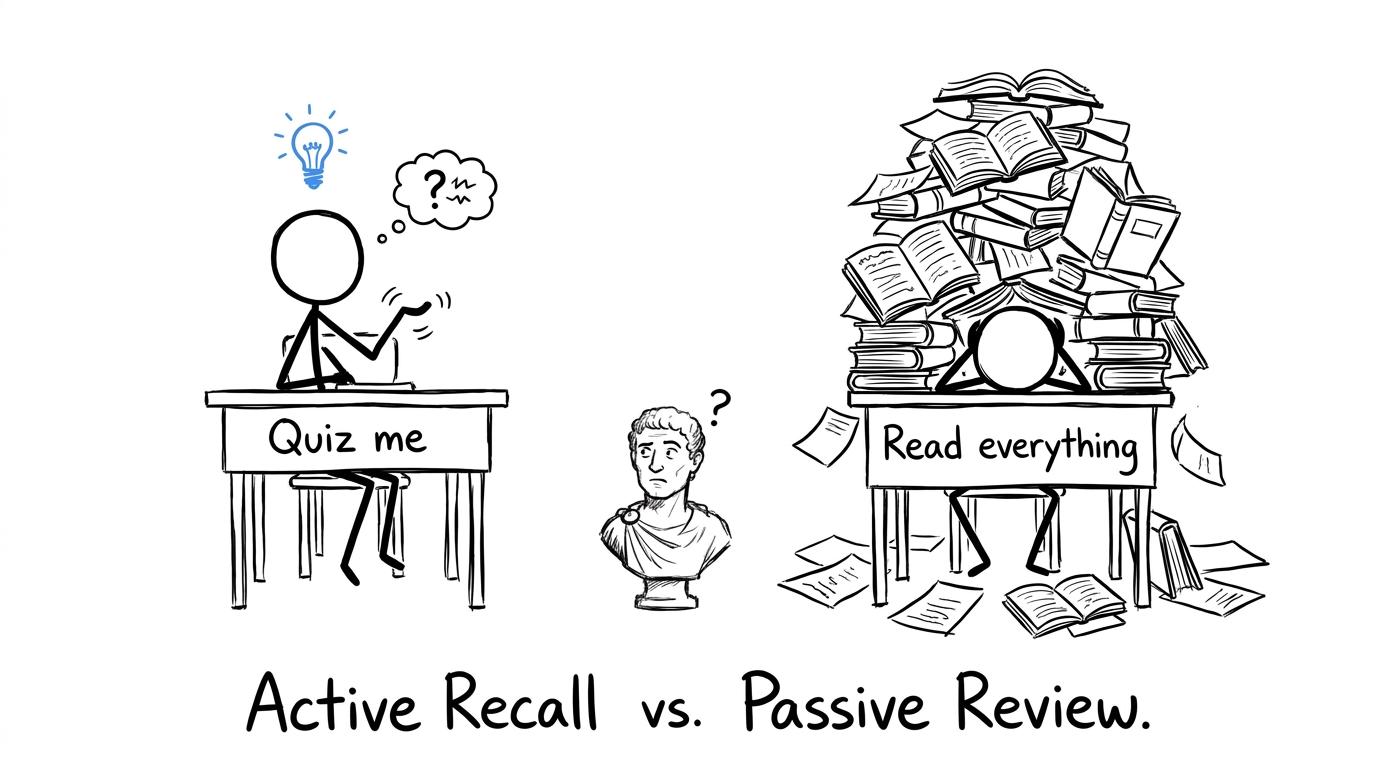 Active recall defeats a mountain of passive revision notes
Keep an error log
After the quiz, separate mistakes into categories:
- vocabulary not remembered;
- form recognised incorrectly;
- construction misunderstood;
- translation too literal or too loose;
- set-text detail confused;
- AI feedback requiring verification.
This is the same diagnostic habit that makes maths practice effective. MathsGenie's guide to finding your weakest GCSE topics explains why a mistake should become a specific next action rather than a vague judgement about ability.
Schedule another test instead of assuming the correction will stick. The MathsGenie revision planner can help you protect time for maths while spacing Latin recall across the week.
Where AI tends to give bad information
AI tools generate plausible responses from patterns. They do not consult your specification automatically, and confident wording is not evidence.
Alternative translations
Latin words can have several valid meanings, and the best translation depends on context. An AI marker may reject a defensible answer because it expected one phrase. It may also accept an English sentence that conveys the general idea but misses an important grammatical relationship.
Tell the tool to allow alternatives supported by your source. If marks could depend on nuance, ask your teacher rather than arguing with a chatbot.
Ambiguous grammatical forms
Some forms can be analysed in more than one way without context. AI may select one interpretation and label every alternative wrong. Require it to mention ambiguity and justify its decision from the surrounding sentence.
Invented quotations and literary devices
A model may produce a quotation that resembles the set text but is not actually present. It can also attach a literary label to almost any phrase and then build a persuasive explanation around it.
Check every quotation against the prescribed text. Analysis should begin with words that are genuinely on the page.
Outdated examination content
OCR's set texts change periodically. An AI system may combine resources from different cycles or confuse GCSE content with AS or A Level Latin. Verify your examination year, component and prescribed material before using any generated quiz.
Unreliable marking
Government research into educational AI has documented models making errors when correcting questions they generated, including finding mistakes that were not present. This is why AI should not be the final judge of your performance.
For maths, reliable checking means using board-specific papers and mark schemes, such as MathsGenie's Edexcel GCSE maths past papers or AQA GCSE maths past papers. For Latin, apply the same principle: official source first, generated feedback second.
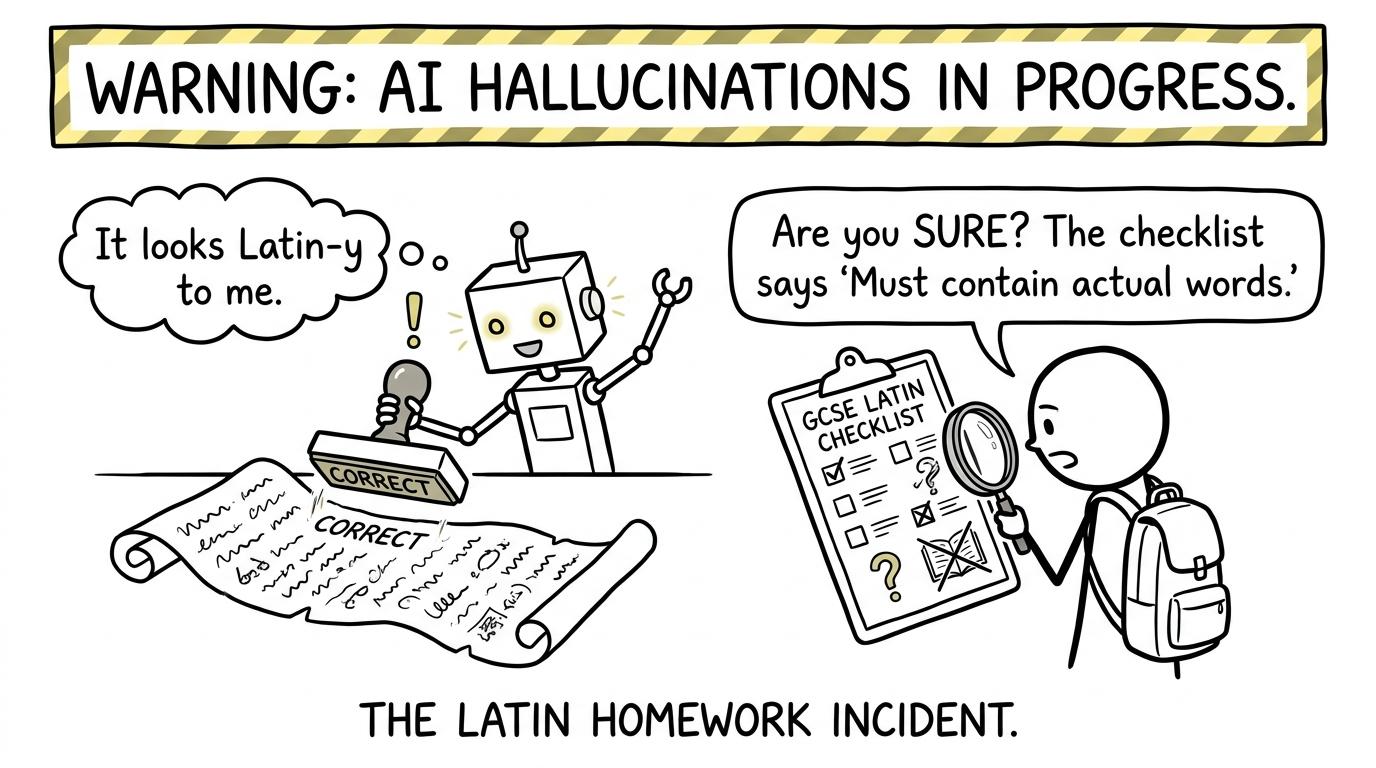 A confident robot marks a suspicious answer while a student checks the evidence
Use AI without neglecting GCSE maths
A new revision tool can become a new form of procrastination. You spend longer refining prompts and formatting quizzes than retrieving anything. Meanwhile, the maths paper still requires sustained problem-solving.
Use short Latin sessions inside a wider revision plan. For example, complete a focused quiz, log the errors and stop. Then move to your scheduled maths work rather than asking the tool to generate another elaborate dashboard.
Maths revision benefits from the same cycle:
- retrieve the method;
- attempt questions independently;
- mark honestly;
- identify the precise error;
- practise the weak skill;
- retest later under timed conditions.
You can use GCSE Target Tests for short, focused checks before progressing to full papers. If remembering methods is the problem, the guide to stopping forgotten GCSE maths content offers a practical spacing routine. When you are ready for longer exam practice, read when to start GCSE past papers.
The subjects differ, but the habit is identical: test memory, seek dependable feedback and revisit what failed.
Common mistakes when using AI for Latin revision
Asking for a quiz without naming the specification. “GCSE Latin” is too broad when set material and component choices matter.
Allowing the AI to create the source and mark it. If it invents a flawed question, its explanation may reinforce the same flaw. Anchor the quiz to trusted material.
Accepting one translation as the only answer. Context and idiom can permit alternatives. Ask for justification and verify disputed decisions.
Reading hints too quickly. Immediate help feels productive but removes the retrieval effort that makes a quiz worthwhile.
Uploading personal or protected material. Do not share names, candidate information, private teacher feedback or complete copyrighted resources.
Using generated work in assessment. Current JCQ guidance requires submitted assessment work to be the student's own. Misuse of AI can constitute malpractice and lead to serious sanctions. Follow your teacher's instructions and your centre's policy.
Letting Latin consume the maths timetable. A balanced GCSE plan needs defined sessions. Use the GCSE maths topics by board and tier to check that foundation or higher-tier skills are receiving enough attention.
Make the tool useful by keeping authority elsewhere
Yes, you can use an AI tool to quiz yourself on GCSE Latin. It is particularly useful for delivering one-at-a-time questions, varying recall direction, tracking mistakes and making a short revision session easier to begin.
Its weakness is equally clear. It can sound certain while being wrong. Keep the official specification, prescribed sources, teacher guidance and authorised mark schemes above the chatbot in your chain of trust.
Then carry the strongest habit back into maths: attempt first, check carefully and turn every error into another piece of practice. Start at the MathsGenie GCSE maths revision hub, choose your board and tier, and combine free revision lessons with practice questions, mini tests, past papers, predicted papers, mark schemes and video solutions. AI may help ask the questions. Your progress still comes from answering them.










