Can Adults Retake GCSE Geography? How It Works
Adults retake GCSE Geography through a college or as private candidates. Learn about exam centres, fieldwork, fees and building a revision plan.
A GCSE result can feel permanent long after the exam hall has been forgotten. It is not. Adults retake GCSE Geography for many reasons: to meet an entry requirement, change career direction, return to education or finish something that still feels incomplete.
The short answer is yes. There is no general upper age limit for taking a GCSE. You can study through an adult education provider, attend an evening class, use a distance-learning course or prepare independently and enter through an approved exam centre as a private candidate. The detail that needs attention is Geography's fieldwork requirement, so confirm the specification and centre arrangements before paying for a course.
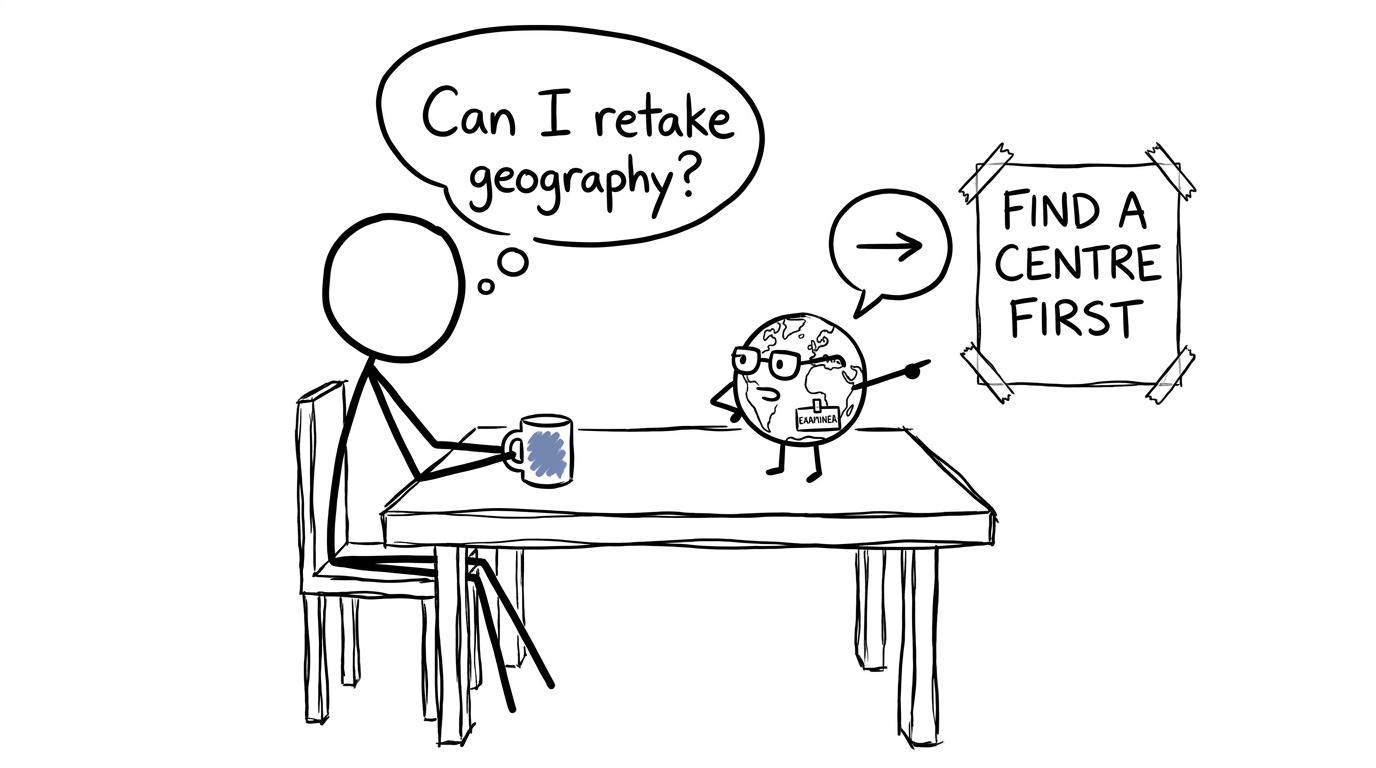 An adult learner asks a globe how to retake GCSE Geography
Your GCSE Geography retake checklist
Before opening a textbook, settle the practical decisions:
- Decide why you need the qualification and whether a particular grade is required.
- Find a school, college, adult learning provider or private exam centre.
- Confirm the exam board and exact specification before buying resources.
- Ask how the compulsory fieldwork requirements will be met and verified.
- Check the examination series, entry deadline and all fees in writing.
- Discuss access arrangements early if you require them.
- Build a realistic revision timetable around work and family commitments.
- Use specification-matched past papers and mark schemes.
If you have recently received a result, the GCSE Geography resit results-day plan provides a useful starting sequence for making these decisions.
How adults retake GCSE Geography
There are two main routes. Neither is automatically better; the right choice depends on how much teaching, structure and administrative support you need.
Join an adult course or evening class
Further education colleges and adult learning providers may offer GCSE Geography, although it is less widely available than GCSE English Language or Maths. Courses can include daytime teaching, evening classes, online lessons or blended learning.
A taught course may provide:
- a fixed weekly timetable;
- teacher feedback on extended answers;
- organised fieldwork opportunities;
- internal mock examinations;
- exam entry through the provider;
- support with access arrangements.
Availability varies considerably by area. Ask whether the advertised course leads to a regulated GCSE rather than a general geography certificate, and whether examination and fieldwork costs are included.
Funding also varies across the UK and between providers. In England, the broad adult entitlement that can make some English and Maths qualifications fully funded does not automatically apply to GCSE Geography. Do not assume that an adult course will be free: ask the provider for a written breakdown of tuition, examination, administration and fieldwork charges.
Enter as a private candidate
A private candidate studies independently, with a tutor or through distance learning, but enters the examinations through an approved centre. The centre makes the official entry with the awarding organisation and tells you when and where to sit each paper.
The Joint Council for Qualifications maintains a private-candidate centre search facility. However, appearing in a search does not guarantee that a centre accepts every subject or specification. Geography can be more complicated than a wholly written subject because the centre must be satisfied that the relevant fieldwork conditions have been met.
Contact potential centres before committing to learning materials. Ask:
- Do you accept adult private candidates for GCSE Geography?
- Which exam board and specification do you offer?
- Can you support and verify the required fieldwork?
- Which papers and components must I take?
- What are your internal booking and payment deadlines?
- What is included in the total fee?
- Can you process access arrangements where evidence supports them?
The exam centre chooses which entries it is willing to administer. In practice, this may mean taking the board supported by the nearest suitable centre rather than automatically returning to the board you took at school.
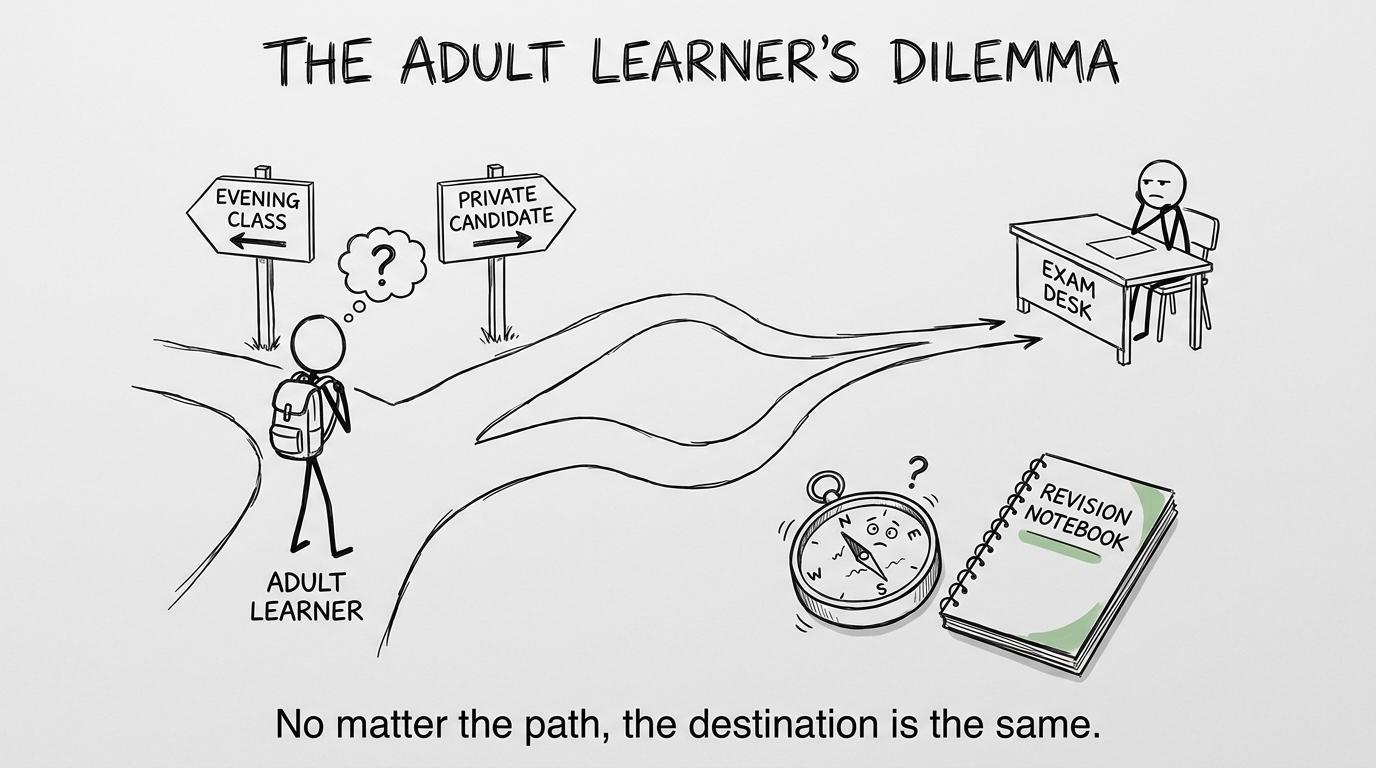 Evening class and private candidate paths leading to the same exam desk
Choosing an exam board and specification
GCSE Geography is offered through boards including AQA, Pearson Edexcel, OCR and Eduqas in England, with WJEC qualifications relevant in Wales. Specifications are not interchangeable. Their content, paper structure, case-study expectations and fieldwork assessment can differ.
Do not revise from a mixture of specifications simply because the resources all say “GCSE Geography”. First obtain the current specification code from your centre. Then check:
- the physical and human geography content;
- the number and length of written papers;
- geographical skills and data-response requirements;
- fieldwork topics and declarations;
- any pre-release or resource-booklet arrangements;
- the current examination timetable.
GCSE Geography is normally untiered, unlike GCSE Maths, where candidates are entered for foundation or higher tier. Geography retakes are generally linear, meaning the required components are taken together in the relevant examination series rather than carrying forward one successful written paper from an earlier attempt.
Geography is normally available in the summer GCSE series rather than the November series used for GCSE English Language and Maths. Exact availability and dates can change, so rely on written confirmation from the centre and the current timetable for your board. The GCSE Geography results-day questions guide explains why early planning matters.
Why fieldwork must be settled early
Fieldwork is the part most likely to surprise an independent adult learner. GCSE Geography specifications require opportunities to undertake geographical fieldwork outside the classroom and school grounds. Current requirements commonly involve fieldwork on at least two occasions and experience of contrasting environments, including physical and human geography.
The exact administration depends on the board and specification. For example, AQA requires private candidates to meet its fieldwork conditions and the entering centre to make the appropriate declaration. A centre may verify evidence and question a candidate about an enquiry, or it may require fieldwork to be supervised through its own arrangements.
This is why “I will organise a trip myself later” is not a safe plan. Ask the centre what evidence it accepts before carrying out any investigation. Keep whatever it requests, which might include dates, locations, enquiry questions, risk planning, data-collection records and evidence of participation.
Fieldwork understanding is assessed through written examination questions. You therefore need more than proof that you visited a location. You should be able to explain the enquiry process: selecting a question, collecting primary data, choosing a sampling method, presenting results, identifying anomalies, reaching a conclusion and evaluating reliability.
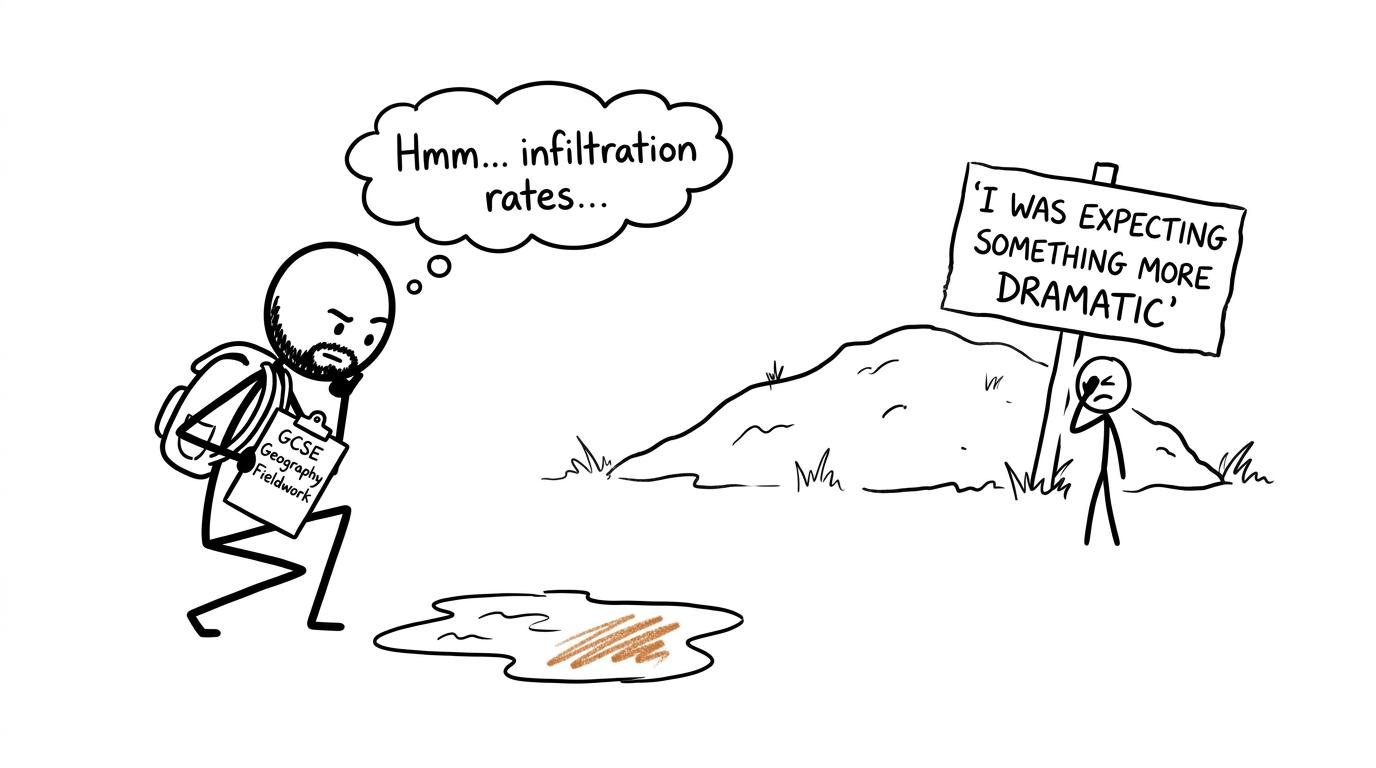 An adult learner conducts surprisingly dramatic puddle fieldwork
Building a revision plan around adult life
Adult revision usually fails for a practical reason rather than an intellectual one: the plan assumes every evening will be quiet. Work runs late. Children need attention. Energy changes from day to day.
Build a smaller plan that survives real life. A useful weekly rhythm is:
- two short content sessions;
- one session for geographical skills and data interpretation;
- one extended-answer or past-paper session;
- one brief review of mistakes.
Start with the specification, not the textbook contents page. Mark each topic as secure, developing or unfamiliar. Put the unfamiliar material into a revision planner, but keep fieldwork and geographical skills running throughout the course rather than leaving them until the end.
Maths students will recognise the same principle. A paper exposes the gap; improvement happens when you repair it. The guide to using GCSE past papers properly explains the paper, mark, fix and retest cycle. It works in Geography too, especially for command words, data interpretation and extended responses.
Keep your mathematical skills active
Geography papers can require calculations, graph interpretation, scale, percentages, averages, proportional symbols and the handling of fieldwork data. You should practise the methods named in your chosen specification, but do not turn your Geography retake into a second full Maths course.
Use the GCSE Maths revision hub to repair a specific weakness when it appears. Revision lessons, practice questions and video solutions are more efficient than vaguely “revising numeracy”. If you are resitting both subjects, use the GCSE maths resit revision plan to keep the two workloads organised.
A shared timetable can help. The GCSE maths revision timetable guide shows how to combine short topic sessions with timed paper practice. The subjects differ, but the habit is the same: diagnose precisely, practise deliberately and record what needs another attempt.
What to expect from the examinations
The exact paper structure depends on your board. Across specifications, expect a combination of physical geography, human geography, geographical skills, fieldwork understanding and questions requiring the interpretation of unfamiliar resources.
Past papers should be introduced in stages. Begin with individual questions while rebuilding knowledge. Move to timed sections once most of the course has been covered, then complete full papers under the published conditions.
Mark schemes are especially valuable for longer responses. They reveal whether an answer needs developed reasoning, case-specific evidence, evaluation or a balanced judgement. Record why marks were lost rather than merely writing down the total.
If your longer-term plans include a numerate A Level or a return to formal education, MathsGenie's free A Level Maths revision resources can help you preview the next stage without distracting from your immediate GCSE goal.
Common mistakes adult private candidates make
Booking a course before finding an exam centre
A distance-learning provider may teach one specification while nearby centres accept another. Confirm the centre, board and fieldwork arrangements first.
Assuming Geography has a November retake
Geography is generally examined in the summer series. November GCSE opportunities are normally focused on English Language and Maths.
Treating fieldwork as ordinary coursework
Fieldwork requirements, centre declarations and written assessment arrangements are specification-specific. Do not assume that an old project can simply be submitted again.
Buying resources for the wrong board
A generic guide may omit case studies or topics required by your specification. Check the title, board and specification code.
Leaving access arrangements until exam season
Extra time, a reader or other approved arrangements require evidence and centre processing. Raise the issue when registering, not shortly before the paper.
Completing papers without reviewing them
A score tells you where you are. The mark scheme tells you what to do next. Keep an error log covering missing knowledge, weak evidence, command-word errors, timing and data skills.
Your next step
An adult GCSE retake is not a journey back to school. It is a new arrangement made with clearer motives and, usually, less spare time. Begin with the administrative facts: find a centre, confirm the specification, settle fieldwork and obtain the total cost. Only then build the revision plan.
If Maths is part of your return to education, make MathsGenie your free revision base. Use revision lessons to rebuild methods, practice questions and mini tests to develop fluency, and past papers, predicted papers, mark schemes and video solutions to prepare for exam conditions. Open the GCSE Maths hub, choose your board and turn the next small revision session into the start of a workable plan.