

GCSE Geography Resit: Your Results Day Plan
GCSE geography resit advice for after results day, with clear milestones for reviewing marks, rebuilding knowledge and preparing for next summer.
Results day can turn two years of work into one small number on a screen. If that number was lower than you expected, the useful question is not whether you are “bad at geography”. It is what you will change before your GCSE geography resit.
In England, geography retakes are normally taken in the next summer exam series, rather than the November series available for GCSE English language and maths. Contact your school, college or private exam centre promptly to confirm entry arrangements, costs, deadlines, specification and fieldwork requirements. Then build revision around evidence: your exam performance, the specification and properly marked practice.
Your GCSE geography resit checklist
Before serious revision begins, make sure you can answer these questions:
- Which exam board and specification will you take: AQA, Edexcel, OCR, Eduqas or WJEC?
- Will your centre enter you for every required paper?
- Has the specification or paper structure changed?
- How will the centre confirm that fieldwork requirements have been met?
- Which topics and question types cost you the most marks?
- When will you begin timed past-paper practice?
Start with the GCSE Geography revision hub, where resources are organised by exam board. A resit should not be a vague repeat of Year 11. It should be a more accurate second attempt.
The first week after results day
Ask for evidence before making a plan
Request your component marks from your school or college. If available, discuss whether access to scripts, a review of marking or a resit is the most appropriate route. Deadlines apply to post-results services, so do not leave the conversation until autumn.
Separate your lost marks into four categories:
- Knowledge: missing facts, processes, terminology or case-study detail.
- Application: knowing content but not using it in the context provided.
- Skills: difficulty with maps, graphs, data, calculations or sources.
- Exam technique: weak judgements, incomplete explanations or poor timing.
This distinction matters. Rereading a textbook may repair knowledge, but it will not automatically improve an evaluative answer or teach you to interpret an unfamiliar resource.
Confirm your entry and fieldwork position
GCSE Geography qualifications are linear, so resitting generally means taking the required written components in the same exam series. Exact arrangements depend on your specification and centre.
Fieldwork also deserves an early conversation. Current GCSE specifications assess geographical enquiry and fieldwork through written examinations, while centres must meet formal fieldwork requirements. Official specifications commonly require opportunities for fieldwork outside the classroom in contrasting human and physical contexts. A private candidate should therefore ask the centre what evidence or participation it requires before paying an entry fee.
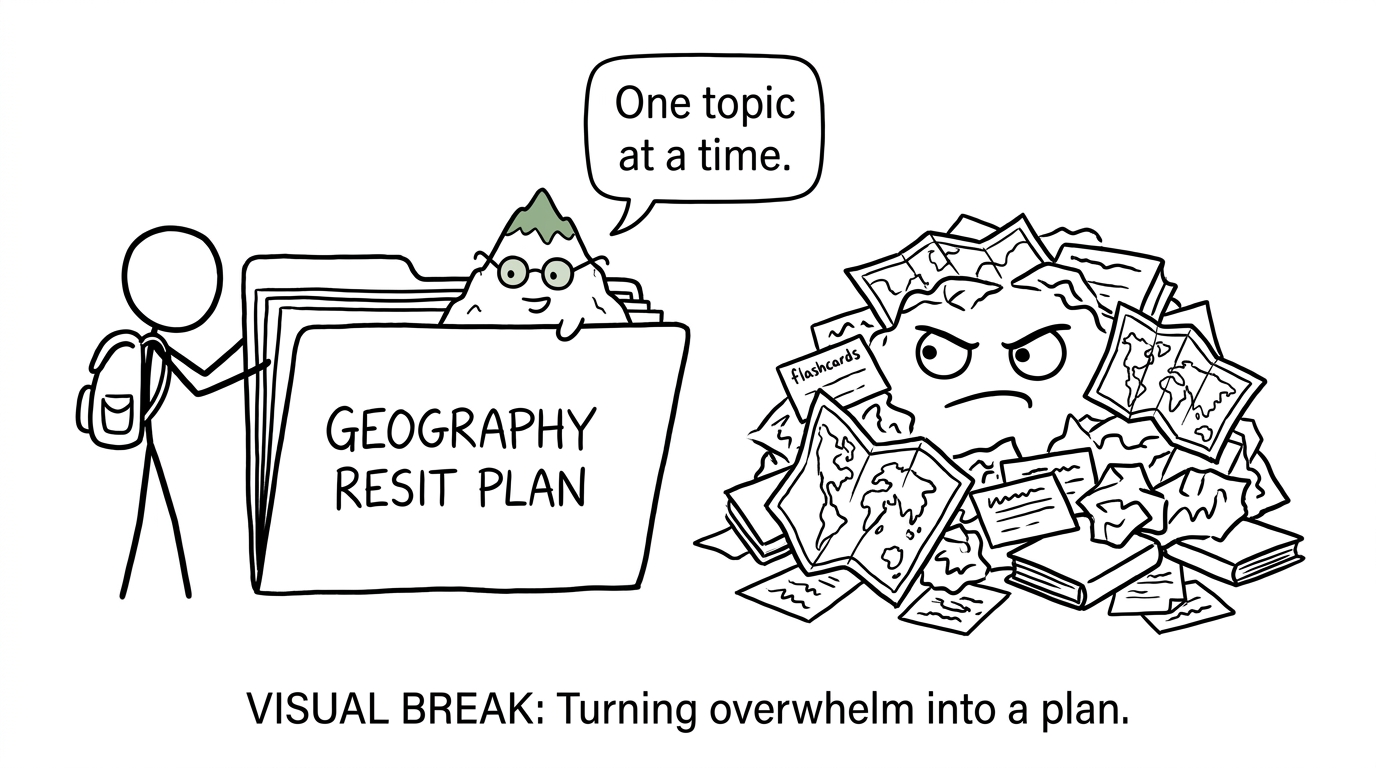 A student discovers that a friendly mountain prefers one geography topic at a time
A milestone plan for resitting GCSE Geography
A long runway is helpful only when it is divided into visible stages.
| Milestone | Main task | Evidence of progress |
|---|---|---|
| Results day to early autumn | Confirm entry, specification and fieldwork arrangements | Written confirmation and a topic audit |
| Autumn term | Rebuild weak physical and human topics | Completed retrieval questions and corrected worksheets |
| January to February | Strengthen case studies, fieldwork and geographical skills | Concise case-study sheets and improving topic scores |
| March to April | Combine topics through mixed exam questions | A mistake log showing fewer repeated errors |
| Final six weeks | Complete timed papers and practise decisions under pressure | Stable scores, better timing and complete extended answers |
Autumn: rebuild the foundations
Work from your board’s current specification, not an old folder or a generic checklist. Students following AQA can use the AQA GCSE Geography revision hub, while Edexcel A students can organise their work through the Edexcel A Geography revision hub.
Use a simple weekly rhythm:
- one physical geography session;
- one human geography session;
- one skills or fieldwork session;
- one short retrieval review of older material.
Each session should move through three stages: recall without notes, check what was missing, then answer exam-style questions. Worksheets and question banks are more revealing than highlighting because they force you to retrieve and apply knowledge.
January to February: connect knowledge to questions
Case studies should be usable, not merely memorable. For each one, know its location, relevant processes, significant impacts, responses and enough precise evidence to support an argument. Avoid collecting impressive facts that cannot answer a specification question.
Geographical skills need regular attention too. AQA students can review statistical skills for GCSE Geography and numerical geography skills. These support work with averages, percentage change, graphs, scale and data interpretation. If source evaluation is weaker, the OCR A visual and source skills guide shows how specification-specific revision can connect evidence, interpretation and judgement.
March onwards: let papers direct the revision
Past papers become most valuable when you treat them as diagnostic tools. AQA candidates can use the AQA GCSE Geography past papers with their mark schemes.
Begin with individual sections, then progress to complete timed papers. After marking, record:
- the topic and question type;
- why each mark was lost;
- the correction required;
- when you will attempt a similar question again.
A score tells you where you are. A mistake log tells you where to go next.
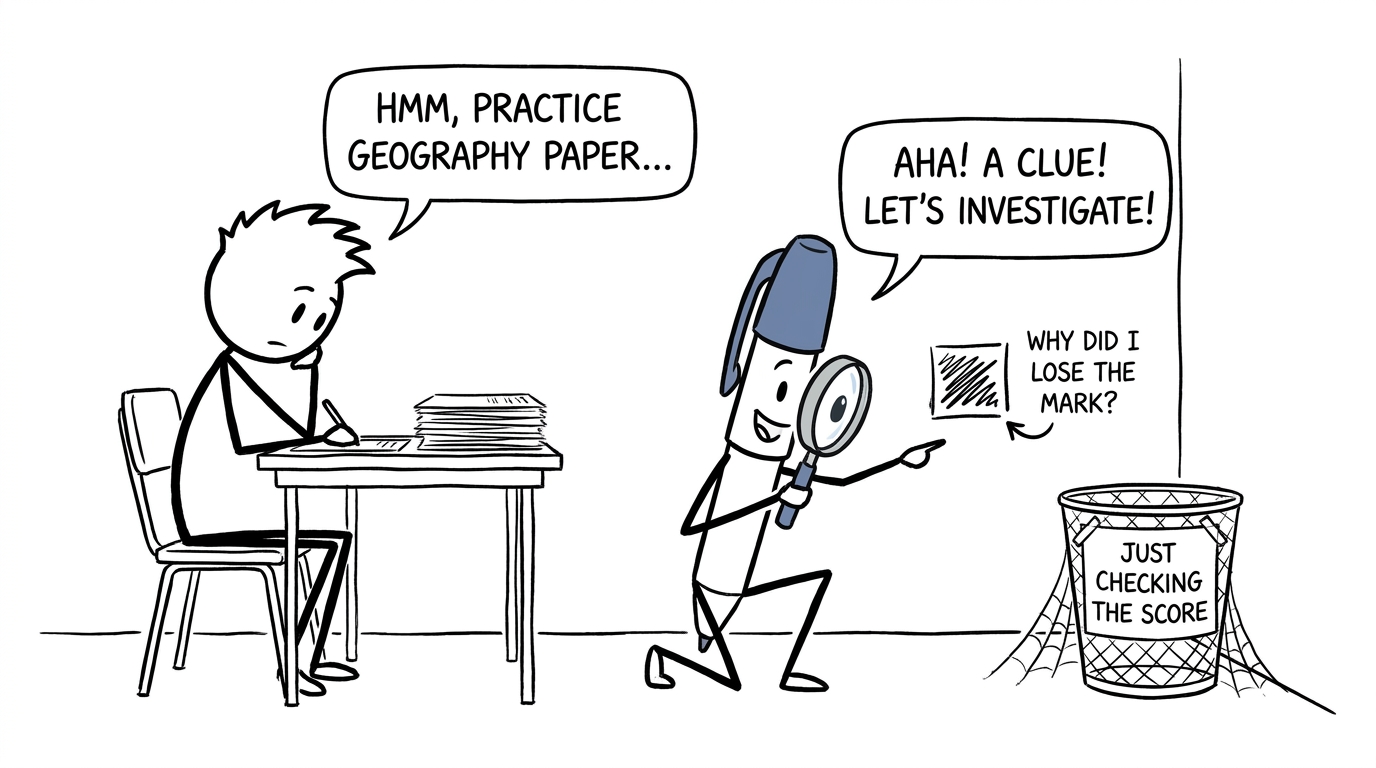 A detective red pen investigates why a mark disappeared from a geography practice paper
How to improve extended geography answers
Many resit candidates know more geography than their answers reveal. Train yourself to identify the command word before writing.
A strong extended response usually needs relevant knowledge, clear chains of reasoning, evidence from any supplied resource and a conclusion that answers the precise question. For “assess” or “evaluate”, consider more than one side and explain why one factor, impact or strategy matters most in that context.
Topic knowledge still anchors the argument. For example, the AQA urban issues and challenges guide can help rebuild content before you practise applying it to longer responses.
Common GCSE geography retake mistakes
- Revising the wrong specification: board content and paper structures are not interchangeable.
- Waiting to arrange the entry: centres set their own administrative deadlines and may charge fees.
- Ignoring fieldwork: enquiry methods, conclusions and evaluation remain examinable.
- Memorising case studies without application: facts earn little when they do not address the question.
- Completing papers without reviewing them: improvement happens during correction and reattempts.
- Avoiding maps, data and calculations: geographical skills appear across the assessment, not in a separate revision universe.
- Writing conclusions that merely repeat: a judgement should weigh evidence and answer the question.
Make the second attempt more deliberate
Resitting GCSE Geography is not about repeating every hour of your original course. It is about noticing where marks escaped, repairing those weaknesses and returning to them until the improvement survives timed conditions.
Begin at the MathsGenie GCSE Geography hub. Choose your exam board, use the free revision lessons and guides to rebuild knowledge, complete worksheets and practice questions, then test yourself with past papers, predicted papers, mini tests and mark schemes. The goal is not to feel busy. It is to arrive next summer able to prove what you know.











