Adult GCSE Maths Resit: A Back-to-Basics Guide
Adult GCSE maths resit guide for returning learners. Understand grades 9 to 1, choose a tier and follow a realistic plan with free MathsGenie resources.
Returning to maths can feel personal. An apprenticeship, university course or career change may bring back a subject you thought you had left behind.
An adult GCSE maths resit is not about recreating school. It is a structured route towards a recognised qualification, approached with the patience and perspective you have gained since leaving. Begin by confirming your exam board and tier, assess the basics without judgement, then follow a manageable weekly routine combining topic revision with exam practice.
Your back-to-basics checklist
Before opening a textbook or attempting a full paper, establish the practical details:
- Confirm which exam board your college or exam centre uses.
- Check whether you will enter foundation or higher tier.
- Find out your examination series and registration deadline from the centre.
- Complete a diagnostic paper or topic assessment.
- Rebuild number skills before rushing into advanced algebra.
- Keep a record of mistakes and revisit them.
- Introduce timed past papers gradually.
The MathsGenie GCSE maths revision hub organises free resources by exam board, helping you find the correct revision lessons, exam questions and papers rather than revising at random.
What has changed in GCSE maths?
If you left school before the current qualifications were introduced in England, the most obvious change is the grading scale. GCSEs in England now use grades 999 to 111, with 999 as the highest grade. Grade 444 is generally described as a standard pass, while grade 555 is a strong pass.
Grade 444 broadly aligns with the bottom of the former grade C. However, choose your target using current course or employer requirements because old grades do not convert perfectly.
Arrangements are not identical across the UK. Wales and Northern Ireland have different qualification systems, and paper formats also vary between exam boards. Always use the specification and instructions provided by your college or registered exam centre.
Foundation and higher tier
For GCSE mathematics qualifications in England, foundation tier targets grades 111 to 555. Higher tier targets grades 444 to 999, although a grade 333 may be awarded in limited circumstances when a candidate narrowly misses grade 444.
Foundation is not an easier certificate or a lesser GCSE. It assesses a more focused range of content and caps the available grade at 555. If your requirement is grade 444, foundation may provide the most appropriate route. If you need a grade above 555, you must take higher tier.
Choose your tier using assessment evidence and your required grade. Discuss the decision with your tutor or exam centre.
Papers and calculators
Many widely taken English specifications, including AQA, Edexcel and OCR, use three written papers: one non-calculator paper followed by two calculator papers. However, formats can differ by exam board, so confirm yours before planning revision.
For example, the AQA GCSE maths revision page shows the assessment format alongside topics organised by grade. MathsGenie also covers Edexcel, OCR, Eduqas, WJEC and other boards through its main GCSE area.
Where should an adult returning to maths start?
Start below the level at which you hope to finish.
That can feel slow, especially when the examination date is visible on the calendar. Yet weak foundations make every later topic more expensive. If fractions are uncertain, ratio, probability, percentages and algebraic fractions all demand more effort. Repairing the foundation is often the quickest route forward.
Begin with these connected areas:
- place value and the four operations
- negative numbers and order of operations
- fractions, decimals and percentages
- ratio and proportion
- estimation and rounding
- basic algebraic notation
- units, perimeter, area and volume
- interpreting tables, charts and averages
The fractions, decimals and percentages lesson is a useful starting point for AQA learners. If you use another board, select the corresponding topic from its MathsGenie revision page.
Returning to maths is partly an exercise in recovering vocabulary. Words such as factor, multiple, coefficient and reciprocal may initially seem less familiar than the calculations themselves. Keep a small glossary and add one plain-English explanation for each term.
Find your actual starting point
Do not judge your ability from memory. Attempt a short diagnostic assessment or the opening questions of a foundation paper without revision. Mark it carefully, then divide each question into one of three groups:
- secure and accurate
- familiar but unreliable
- unfamiliar
Familiar but unreliable topics often need clarification and repetition, making them useful early revision priorities.
When marking, identify the reason for each lost mark. Was the mathematical method missing? Did you misread the question? Did you make an arithmetic error, forget a unit or round too early? These problems require different responses.
The guide to finding weak GCSE maths topics explains how past papers, mini tests and mark schemes can turn a vague feeling of weakness into a focused revision list.
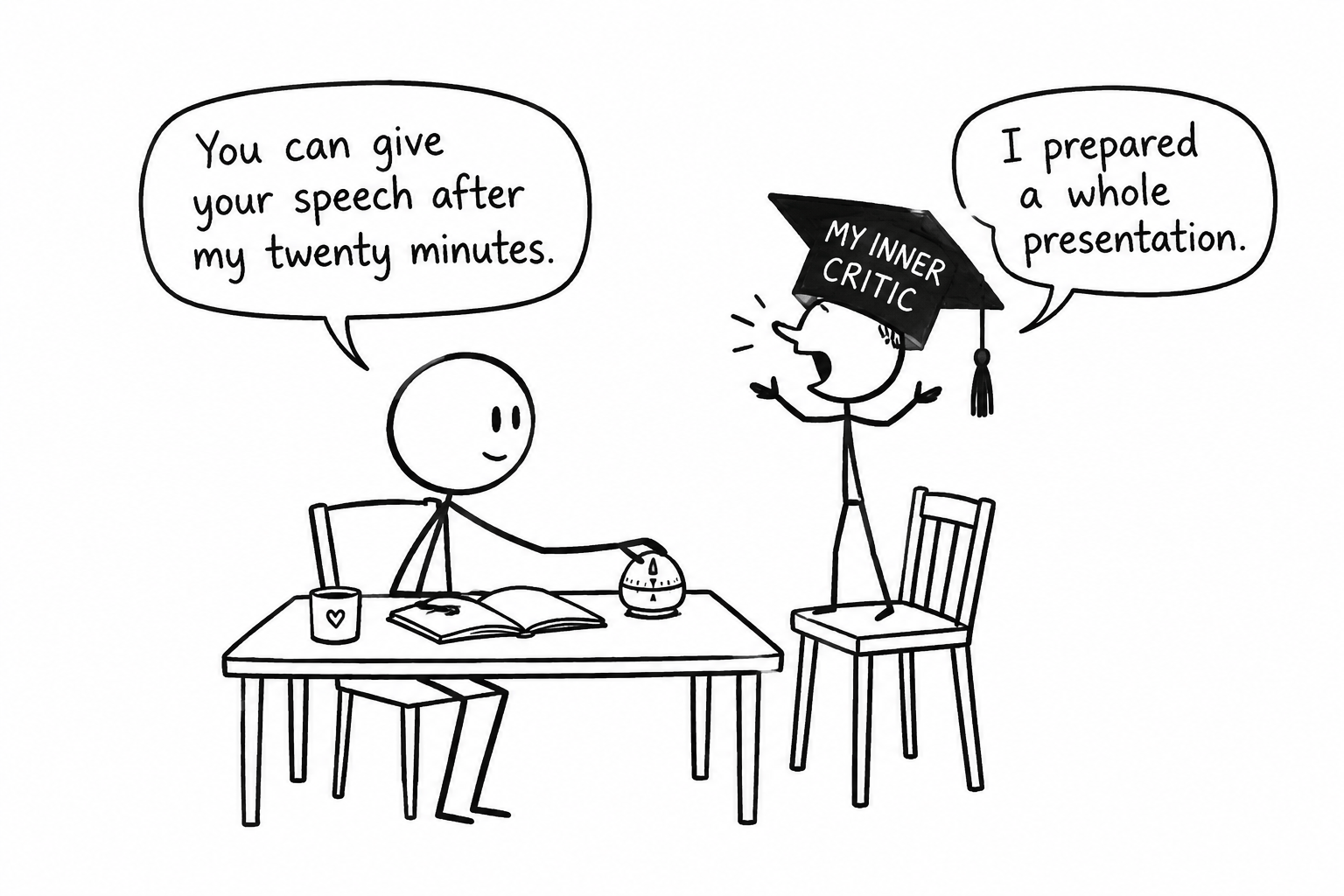 An adult learner calmly studies while their inner critic prepares an oversized presentation
A realistic adult GCSE maths resit plan
Work, caring responsibilities and tiredness make elaborate timetables fragile. Your plan must survive a difficult week.
Aim initially for three sessions of 303030-454545 minutes and one slightly longer session each week. If that is unrealistic, use focused 202020-minute blocks. The MathsGenie 20-minute revision routine offers a compact structure for busy days.
Weeks one to four: rebuild the core
Choose two related foundation topics each week. Use a revision lesson or video solution, complete practice questions and mark them immediately. Finish the week with a mini test that mixes current and earlier material.
Do not erase every mistake and move on. Write a brief correction explaining what should have happened. This turns the error into revision material.
Weeks five to eight: connect the topics
Move into algebra, geometry, probability and statistics while continuing short reviews of number skills. At this stage, include mixed questions because examinations do not announce which method is needed.
Use the GCSE topics by exam board and tier guide to check that your plan reflects the correct specification. Avoid spending weeks on a favourite topic while quietly ignoring a weaker one.
Weeks nine to twelve: develop exam technique
Begin with individual paper sections rather than immediately sitting full papers. Practise identifying command words, showing working and checking whether an answer is sensible. Then progress to complete papers under timed conditions.
Mark each paper using the official mark scheme supplied with it. Record the topic behind every lost mark, return to the relevant lesson and attempt similar questions. Past papers are diagnostic tools, not merely scores.
As the examination approaches, combine past papers with predicted papers for additional practice. Predicted papers can reflect likely styles and topic coverage, but they cannot guarantee what will appear. Cover the full specification.
The MathsGenie revision planner can turn deadlines and topic goals into a realistic weekly schedule. MathsGenie's revision lessons, practice questions, mini tests, mark schemes and video solutions then provide the material for each session.
How to practise effectively
Reading a solution can create recognition without creating independence. The method looks obvious while it is on the screen, then disappears when the page is blank.
A stronger routine has four stages:
- Review a short explanation or video.
- Attempt questions without looking at the method.
- Mark the work and correct mistakes.
- Return to a few similar questions several days later.
Keep calculator and non-calculator skills separate when necessary. Learn how to enter fractions, powers and brackets on the calculator you will use, but maintain written arithmetic and estimation. An estimate can expose a mistyped calculator answer before it costs a mark.
Common mistakes when returning to maths
Beginning with full papers too soon
A complete paper can be demoralising when several core topics are still missing. Use it initially as a diagnosis, then step back into topic practice before returning to timed papers.
Revising only by watching
Videos are useful explanations, not substitutes for written practice. Pause, attempt the question yourself and compare your reasoning with the solution.
Avoiding non-calculator work
Calculator confidence cannot replace fluency with fractions, negative numbers, estimation and written methods. Give these skills a regular place in your plan.
Treating every error as carelessness
Repeated mistakes are information. Look for patterns such as misunderstood vocabulary, missing working, weak arithmetic or confusion about which operation to use.
Using the wrong board or tier resources
A question can be mathematically useful while still sitting outside your required route. Confirm the exam board and tier before building your topic list.
Your next step
The first goal is not to feel confident about the whole GCSE. It is to complete one honest session and know what comes next.
Confirm your exam board and tier, choose one foundational topic, then attempt and mark a small set of questions. Use the MathsGenie GCSE resit revision guide alongside the free GCSE revision hub to build from topic lessons towards mini tests, past papers and predicted papers.
Returning to maths does not require you to become the student you once were. It asks you to become a learner again, one manageable piece at a time.