Active Recall GCSE Computer Science: Does It Work?
Active recall GCSE Computer Science revision can beat rereading. Learn to recall facts, trace code, use feedback and build an exam-ready routine for GCSE.
A page of highlighted notes can create a comforting feeling: I recognise all of this. Then the notes close, the question appears, and the knowledge seems to disappear.
If you searched for active recall GCSE Computer Science, the short answer is yes, it tends to work better than repeatedly reading the same material. Active recall means deliberately retrieving knowledge without looking at the answer first. Research on retrieval practice consistently finds benefits for long-term learning, particularly when recall is repeated after a delay and followed by accurate feedback.
But Computer Science is not only a memory subject. You must also apply concepts, trace algorithms, reason about systems and design or refine solutions. Active recall works best as the first part of a wider revision cycle, not as a replacement for programming and exam questions.
The active recall checklist
A useful GCSE Computer Science routine looks like this:
- Choose a small specification area, such as networks or data representation.
- Put your notes away before attempting to remember it.
- Retrieve knowledge through questions, diagrams, explanations or code tracing.
- Check your response against reliable notes or a mark scheme.
- Correct errors immediately and precisely.
- Return to the same material after a delay.
- Finish with an exam-style question that requires application.
The crucial moment is the attempt. Looking at an answer and thinking I knew that is recognition. Producing it independently is retrieval.
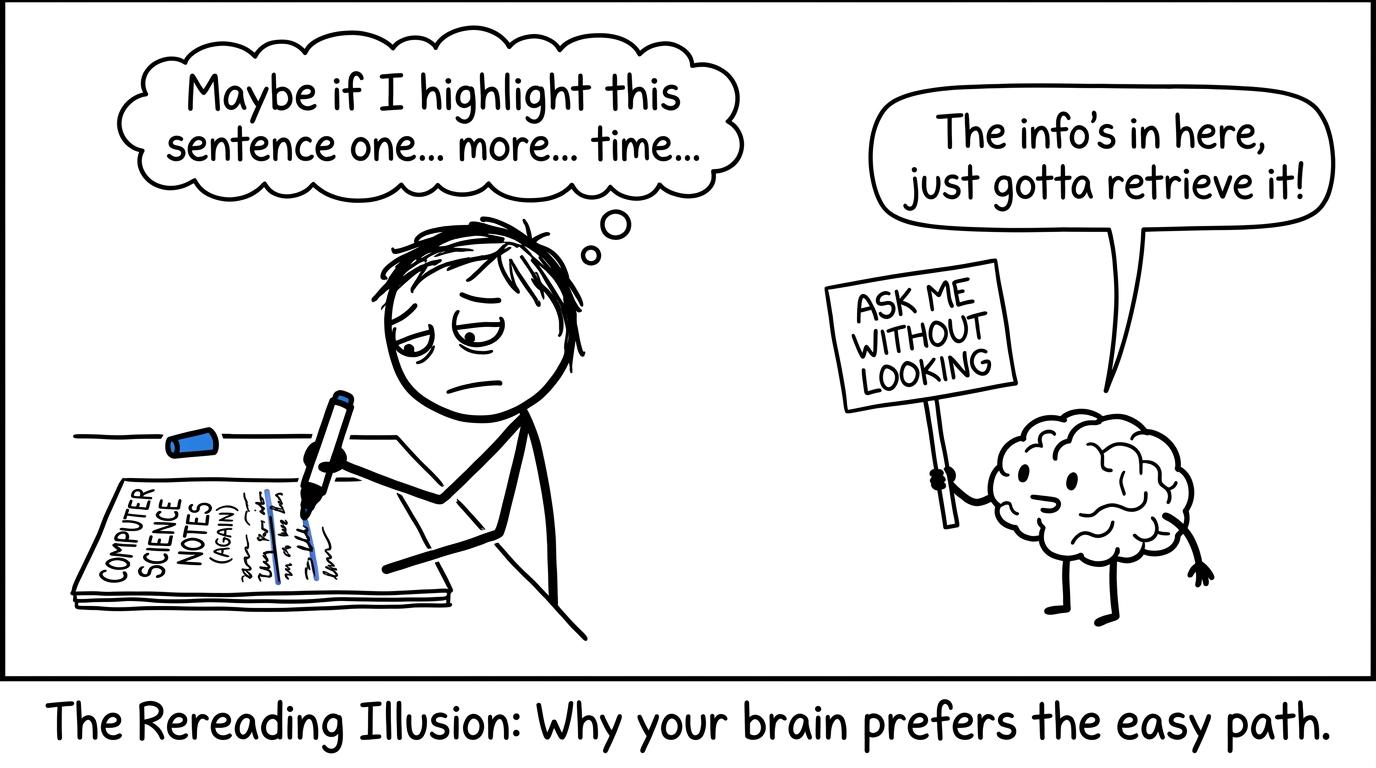 A student rereads highlighted notes while their brain asks to be tested without looking
Why active recall tends to beat rereading
Rereading is not useless. It can introduce unfamiliar content, restore context and help you notice how ideas fit together. The problem is that familiarity can be mistaken for mastery.
Computer Science makes that illusion particularly easy. Terms such as cache, protocol, encryption and iteration may look obvious on a page. In an examination, however, you must produce a precise definition, apply it to a scenario or explain why one choice is suitable.
Retrieval practice changes the task. Instead of asking whether the material looks familiar, it asks whether you can access and use it without support. That effort strengthens later access while exposing gaps early enough to fix them.
The Education Endowment Foundation's discussion of classroom research highlights several conditions that matter: retrieval should involve a genuine attempt, contain an appropriate level of challenge, recur after a delay and include feedback. Feedback is essential because repeatedly recalling an incorrect idea can reinforce a misconception.
This does not mean active recall always defeats every other good revision method. Its advantage depends on the task and how well it is implemented. Complex programming still requires practical experience. Extended answers still require planning and evaluation. The sensible conclusion is narrower and more useful: active recall usually beats passive rereading for securing knowledge, and that secure knowledge gives application somewhere to begin.
Why it suits GCSE Computer Science
Across GCSE Computer Science specifications, students are assessed on three broad kinds of performance: demonstrating knowledge and understanding, applying that knowledge, and analysing problems computationally to make judgements or develop solutions. The exact paper structure and content depend on your exam board and examination year, so check the specification used by your school.
Active recall directly supports knowledge and understanding. It can also prepare you for application when prompts require more than isolated definitions.
For example, a weak prompt asks you merely to name a network protocol. A stronger prompt asks you to retrieve its purpose, identify where it would be used and distinguish it from a similar protocol. Nothing is visible until you commit to an answer.
That distinction matters. A flashcard containing one word on each side may help with terminology, but GCSE questions often demand connected reasoning. Your recall practice should therefore move from facts to relationships, then from relationships to unfamiliar contexts.
How to apply active recall to each topic type
Definitions and factual knowledge
Use short-answer prompts for terminology, hardware, legislation, security threats and network concepts. Write or say the answer before turning the card over.
Keep each prompt precise. “Tell me about storage” is too broad to diagnose a gap. Better prompts separate purpose, characteristics, advantages, disadvantages and suitable uses.
After checking, label your response:
- secure and precise;
- partly correct;
- confused with another concept;
- not recalled.
Only the first category should leave the frequent-review pile. A vague answer that happens to contain a keyword is not yet exam-ready.
Processes and system relationships
For the fetch-decode-execute cycle, network layers, data transmission or defensive measures, use a blank-page reconstruction. Draw the stages or relationships from memory, then compare them with your source.
The aim is not artistic notes. It is to retrieve sequence, purpose and connection. Afterwards, explain the process aloud without reading. If the explanation collapses halfway through, you have found the point that needs attention.
Algorithms and code tracing
Flashcards alone are too limited here. Recall the meaning of programming constructs, but then trace short algorithms with the code and any support hidden where appropriate. Predict variable values, outputs and control flow before checking.
You can also reconstruct a familiar pattern from memory, such as validation, counting or searching, provided it belongs to your specification and chosen language. Then test it. The feedback comes from both expected behaviour and careful comparison with a correct solution.
Retrieval should not become a memory contest about punctuation. The more important questions are why a construct works, what changes during execution and how an error affects the result.
Data representation and computer-related maths
Topics such as binary, hexadecimal, file size and Boolean logic need recall plus calculation. Start by retrieving the rule or method without notes. Then complete fresh questions rather than repeatedly reading a completed solution.
For instance, recognising 101121011_210112 as a binary value is not the same as being able to convert, compare or use it accurately under time pressure. The same principle applies in GCSE maths: knowing a formula exists is different from selecting and applying it. MathsGenie's guide to turning GCSE maths notes into active recall develops this notes-closed habit further.
Longer explanations and evaluation
Use “because” prompts. Retrieve a claim, then justify it with a consequence linked to the scenario. For ethical, legal, environmental or security questions, practise retrieving contrasting considerations rather than memorising one rigid paragraph.
A useful self-check is whether your answer contains specific Computer Science reasoning. Generic statements such as “it is faster” or “it is safer” often need a mechanism, comparison or consequence before they become convincing.
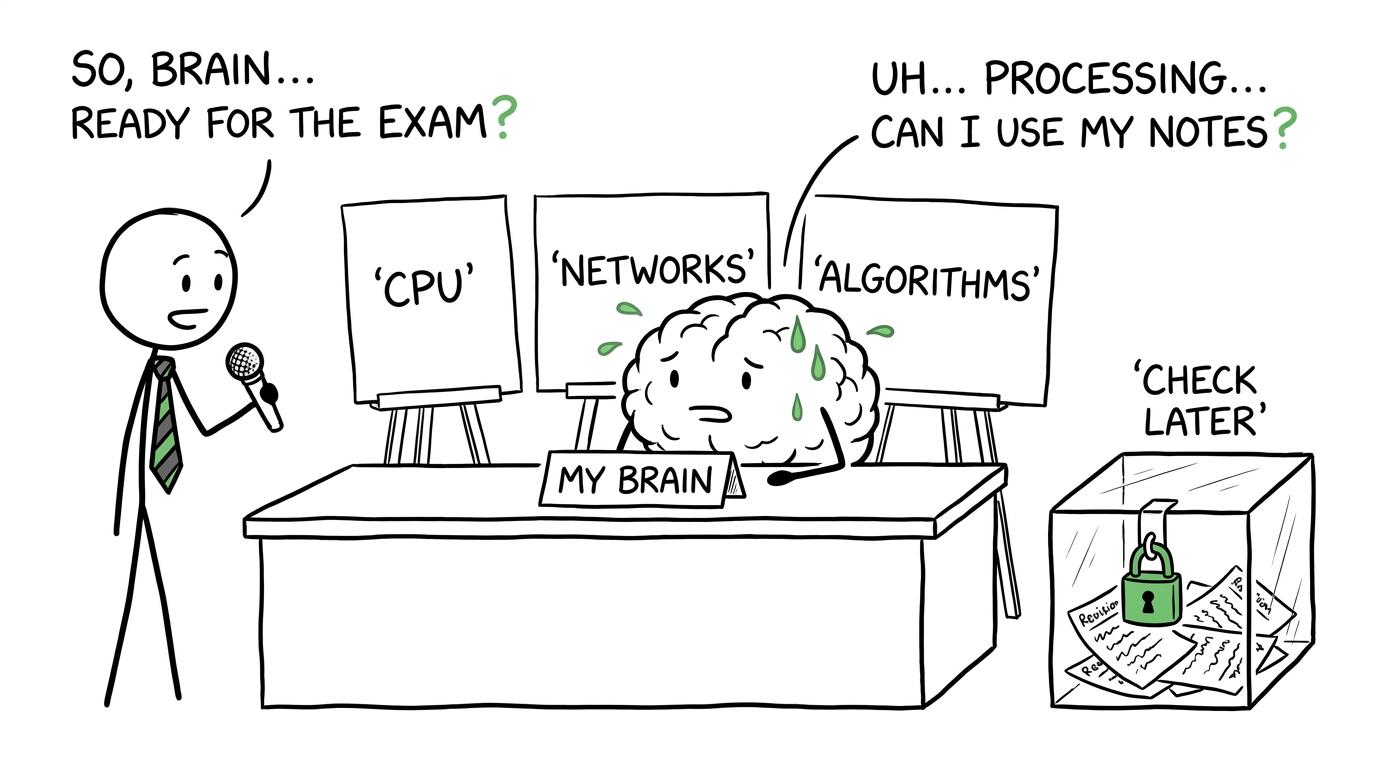 A student holds a mock press conference for their brain about CPU, networks and algorithms
Build a recall session that produces evidence
A calm session can fit into roughly half an hour:
| Phase | What to do |
|---|---|
| Retrieve | Answer several prompts with all notes closed. |
| Check | Compare every response with trusted material. |
| Repair | Rewrite only what was missing or inaccurate. |
| Apply | Attempt one relevant exam-style question. |
| Schedule | Record when the topic will be retrieved again. |
Do not spend most of the session manufacturing beautiful flashcards. The cards are equipment; attempting them is revision.
Spacing also matters. Instead of exhausting one topic in a single evening, revisit it on different days. There is no universally perfect interval for every student or concept. Return sooner when recall is weak and extend the gap when answers remain accurate.
This approach can sit inside a broader timetable. MathsGenie's one-month GCSE revision plan shows how short retrieval, focused teaching and exam practice can coexist without every session becoming a full paper.
Combine recall with past-paper practice
A Computer Science examination does not present a neat stack of flashcards. It mixes command words, contexts and levels of demand. That is why retrieval must eventually meet exam questions.
Use this cycle:
- retrieve the relevant knowledge without notes;
- answer a question under controlled conditions;
- check the mark scheme carefully;
- record whether the problem was knowledge, application, reasoning or wording;
- repair that specific weakness;
- reattempt a different question later.
Maths students can use exactly the same architecture. The MathsGenie GCSE maths revision hub brings together revision lessons, flashcards, practice questions, mini tests and papers. The guide to using GCSE past papers properly explains how to turn each lost mark into a targeted next action.
If maths is part of the same week's revision, choose resources matching your board and tier. AQA GCSE Maths past papers provide real-paper practice with mark schemes, while Edexcel GCSE Maths predicted papers offer fresh exam-style material. Predicted papers are practice tools, not guarantees about future questions.
Common active recall mistakes
Looking too soon
A few seconds of discomfort is not evidence that recall has failed. Give yourself a genuine attempt before checking. If you reveal the answer immediately, the notes are still doing the thinking.
Recalling isolated words only
One-word answers may support basic vocabulary but rarely prepare you for application. Add prompts about purpose, comparison, consequence and suitable context.
Never checking the answer
Confidence is not feedback. Compare responses with dependable course material, teacher guidance or an appropriate mark scheme. Correct misconceptions clearly rather than putting a small tick beside them.
Using flashcards for everything
Code, algorithms and calculations require performance. Trace, write, test and debug. For longer responses, plan or write answers and examine how the mark scheme rewards reasoning.
Repeating only easy cards
Fast, familiar cards feel productive. Weak cards create progress. Keep a record of uncertain answers and return to them more frequently.
Revising outside the specification
Computer Science content and assessment arrangements can vary between AQA, OCR, Pearson Edexcel and Eduqas, and specifications can change. Confirm your board, qualification code and examination year before building a large question bank.
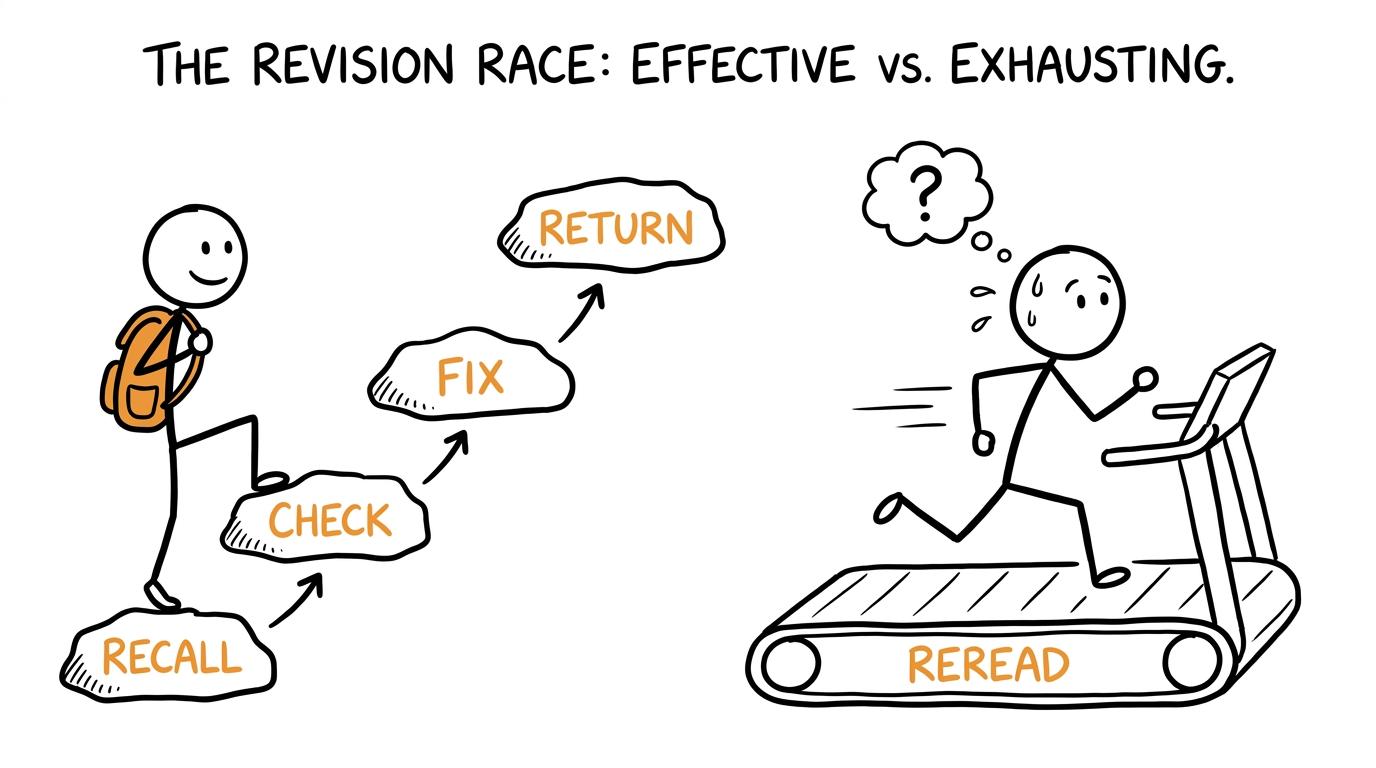 One student climbs Recall, Check, Fix and Return stepping stones while another runs on a Reread treadmill
Make retrieval part of a complete revision system
Active recall works because it replaces a comforting question, does this look familiar?, with a demanding one: can I produce and use it? That makes revision less decorative and more honest.
For GCSE Computer Science, retrieve definitions, rebuild processes, trace code, recall methods and practise linked explanations. Then move into specification-matched exam questions. Check every response, repair errors and revisit the topic after a gap.
Bring the same discipline to maths. Start with the GCSE maths topics by exam board and tier, select a weak skill and try to recall the method before opening the lesson. Use MathsGenie's free revision lessons and practice questions to repair it, mini tests to check it, then past papers and predicted papers to test whether it survives under exam conditions. Mark schemes and video solutions complete the feedback loop.
Do not aim to feel as though you have revised. Aim to leave evidence that you can remember, apply and improve.