Skip to content
MathsGenie logo
Quick links
Open app

Course home

  1. IGCSE
  2. Physics Edexcel
  3. Question bank

Light and sound

EasyMediumHard
123456789101112131415161718192021222324252627282930313233343536373839404142434445464748495051525354555657585960616263646566
Question 64
a.

State the typical range of frequencies that a healthy human can hear.

[1]
b.

The student uses an oscilloscope to display the sound wave from a tuning fork.

Name the piece of apparatus that must be connected to the oscilloscope to detect the sound wave and convert it into an electrical signal.

[1]
c.

Describe how the student should use the oscilloscope to determine the frequency of the sound wave.

[3]
d.

The student obtains the trace shown on the grid below.
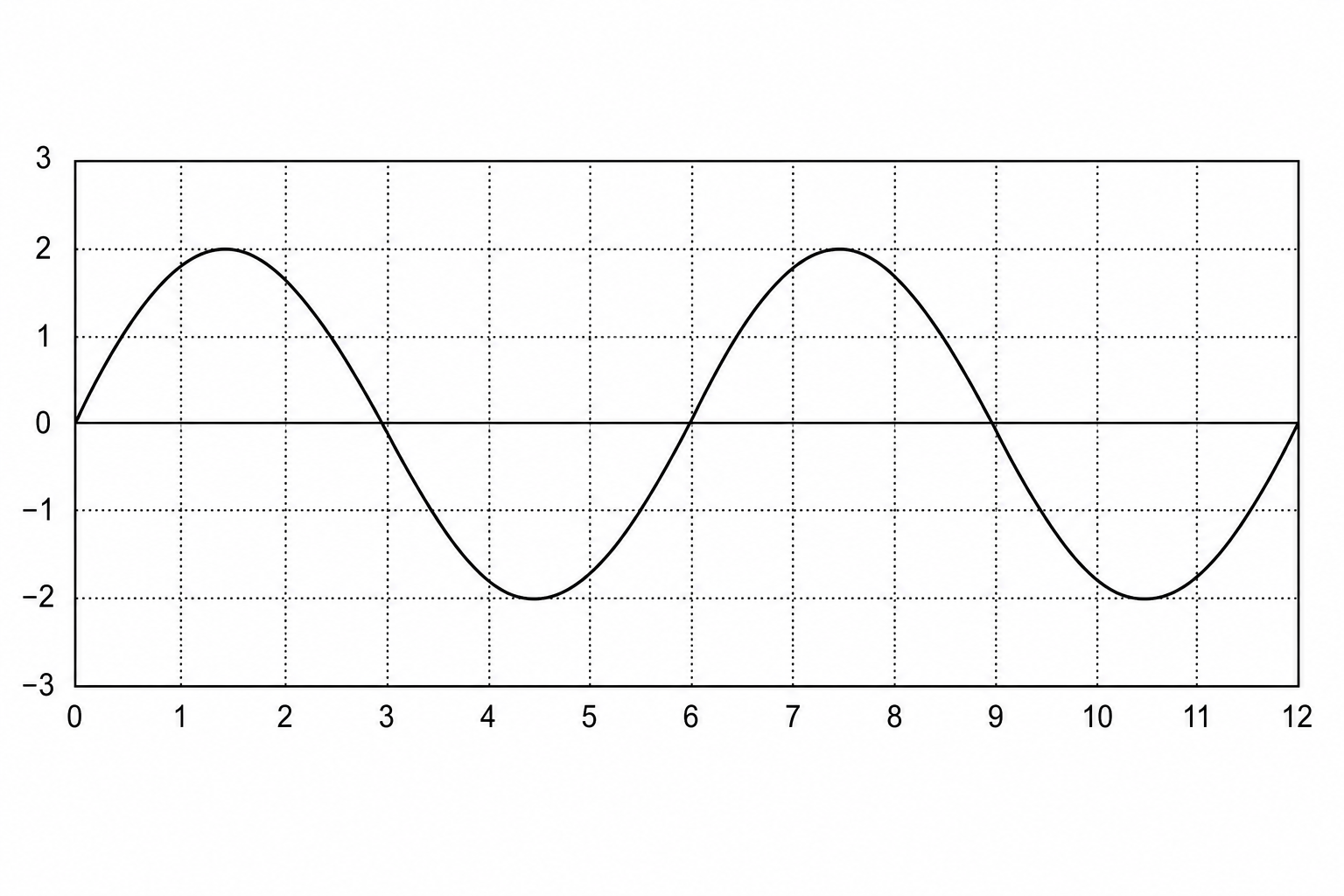
An oscilloscope screen represented as a grid of 12 squares horizontally by 6 squares vertically. A horizontal center line divides the grid vertically. A sinusoidal wave representing a sound wave is shown on the grid. The wave starts at the left edge on the center line (0, 0), rises to a peak 2 squares above the center line at 1.5 squares, crosses the center line at 3 squares, falls to a trough 2 squares below the center line at 4.5 squares, and completes its first cycle back at the center line at 6 squares. A second identical cycle is shown from 6 to 12 squares, with a peak at 7.5 and a trough at 10.5, ending at the right edge of the grid at 12.0.

Describe how the trace on the grid would change if the student plays a sound that is louder and has half the frequency of the original sound. Reference specific grid division measurements in your answer.


[2]

Light and sound Questions

  1. IGCSE
  2. /Physics
  3. /Light and sound