An engineer wants to determine the specific heat capacity of a newly developed metal alloy.
A spherical sample of this alloy is heated in an oven until it reaches a steady, uniform temperature of 195∘C195^{\circ}\text{C}195∘C.
The engineer then quickly transfers the heated sample into an insulated calorimeter containing a low-viscosity oil initially at 20∘C20^{\circ}\text{C}20∘C, as shown in the diagram below.
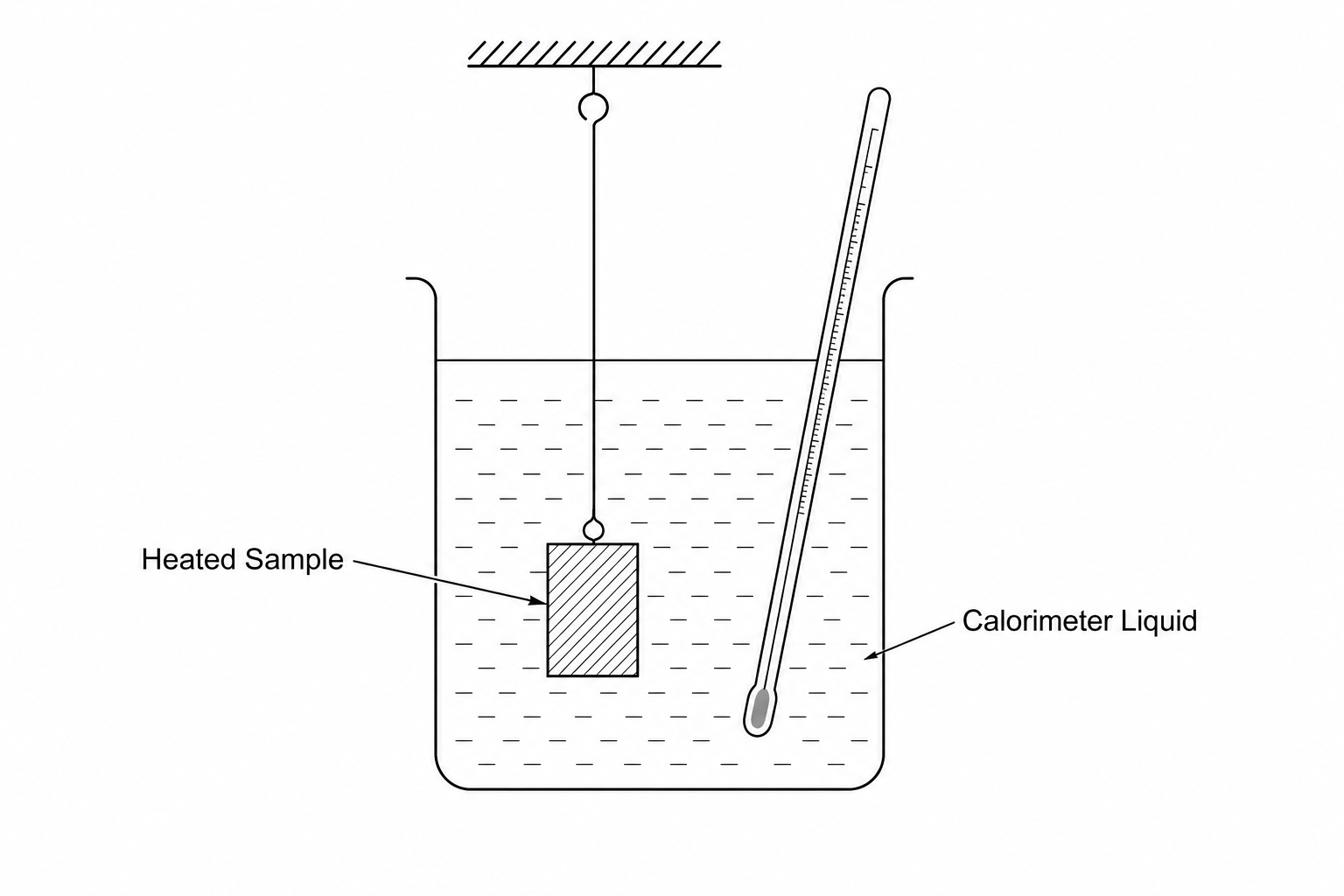
Assuming there is no heat loss to the calorimeter vessel or the surrounding air, the thermal energy gained by the oil equals the thermal energy lost by the alloy sample.
The oil and the alloy sample both reach a final steady temperature of 35∘C35^{\circ}\text{C}35∘C.
The oil gains 28 000 J28\,000\text{ J}28000 J of thermal energy.
The mass of the alloy sample is 0.350extkg0.350 ext{ kg}0.350extkg.
Calculate a value for the specific heat capacity of the metal alloy, using these results.
Use the equation:
ΔQ=m×c×Δθ \Delta Q = m \times c \times \Delta\theta ΔQ=m×c×Δθ