Question 20
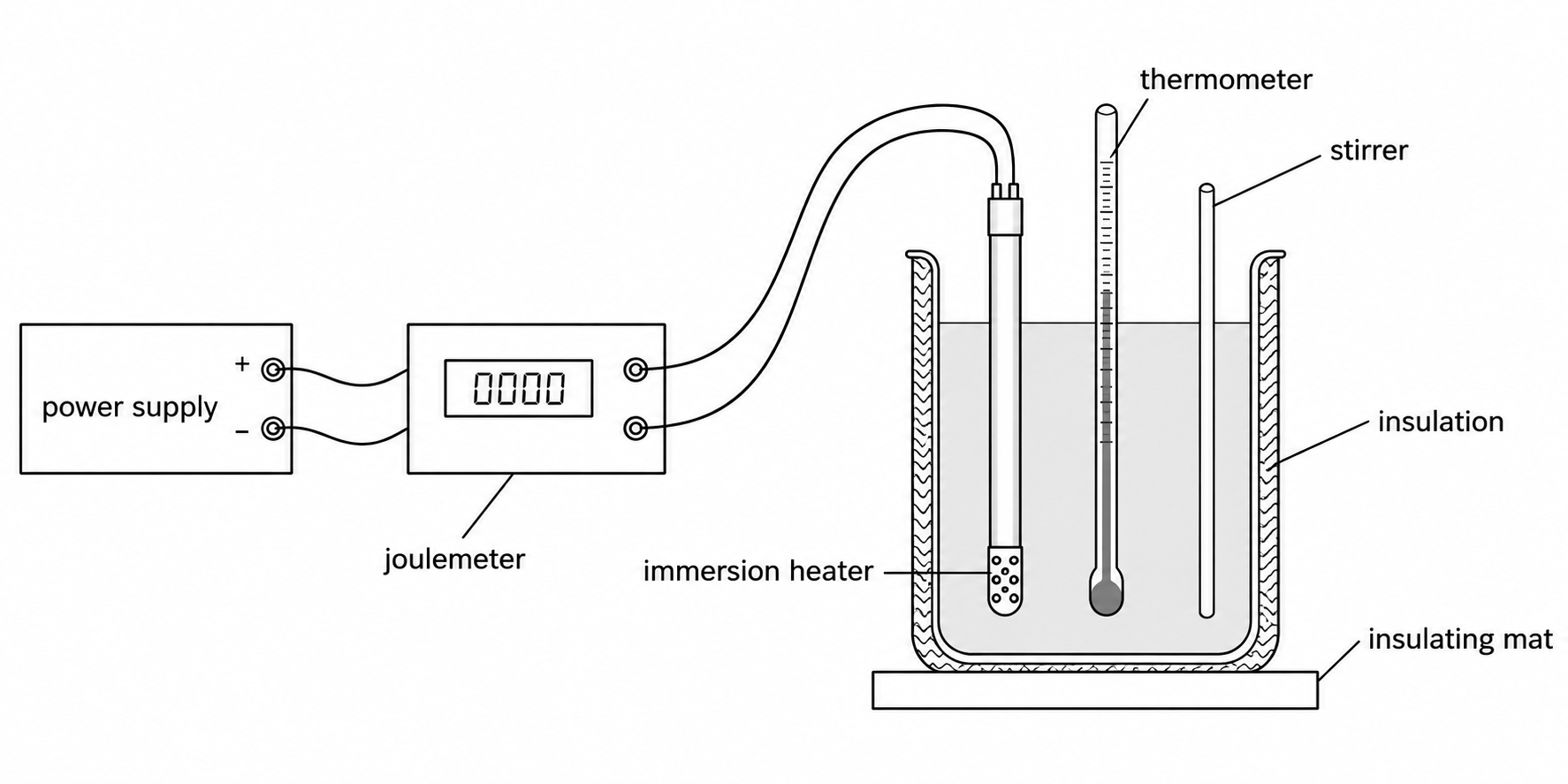
FA student investigates the specific heat capacity of water.
The Figure shows the apparatus.
Figure
a.[1]
Give the reason the beaker is wrapped in insulation.
b.[3]
The student records these results.
mass of water = 0.40 kg
starting temperature =21.0 ∘C= 21.0\ ^{\circ}\text{C}=21.0 ∘C
final temperature =33.0 ∘C= 33.0\ ^{\circ}\text{C}=33.0 ∘C
energy transferred, from the joulemeter =21 600 J= 21\,600\ \text{J}=21600 J
Calculate the specific heat capacity of water from these results.
Use the equation
ΔQ=m×c×Δθ\Delta Q = m \times c \times \Delta \thetaΔQ=m×c×Δθ
c.[2]
The accepted value for the specific heat capacity of water is 4200 J/kg ∘C4200\ \text{J/kg}\ ^{\circ}\text{C}4200 J/kg ∘C.
Explain why the student's value is higher than the accepted value.
d.[1]
Give one reason why the student stirs the water before reading the thermometer.
e.[1]
The student switches off the heater. The temperature of the water continues to rise for a short time.
Suggest why.
14.2 Specific heat capacity and latent heat Questions
110 exam-style questions on Edexcel GCSE Physics 14.2 Specific heat capacity and latent heat, covering 14.2.1 Heating, temperature and changes of state, 14.2.2 Specific heat capacity and specific latent heat, 14.2.3 Specific heat capacity calculation, 14.2.4 Specific latent heat calculation, and 14.2.5 Reducing energy transfer through thermal insulation. Each one has a worked solution and a mark scheme showing where the marks go.