A student wants to determine the specific heat capacity of iron.
Figure 1 shows a piece of iron, with a thin wire tied around it, in a glass beaker of boiling water.
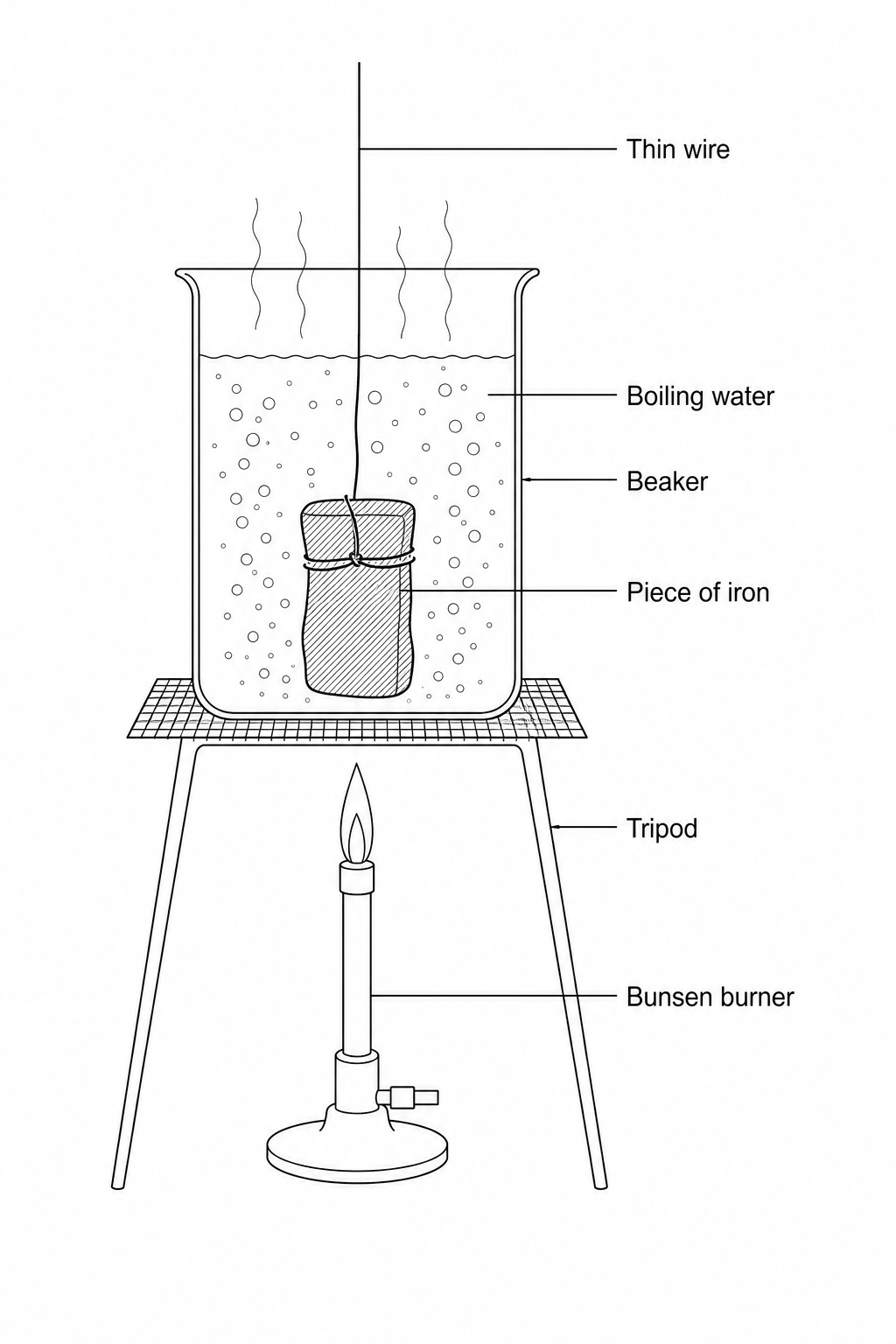
The student leaves the piece of iron in the boiling water so that the iron reaches a temperature of 100∘C100^{\circ}\text{C}100∘C.
The student uses the wire to quickly transfer the piece of iron out of the boiling water.
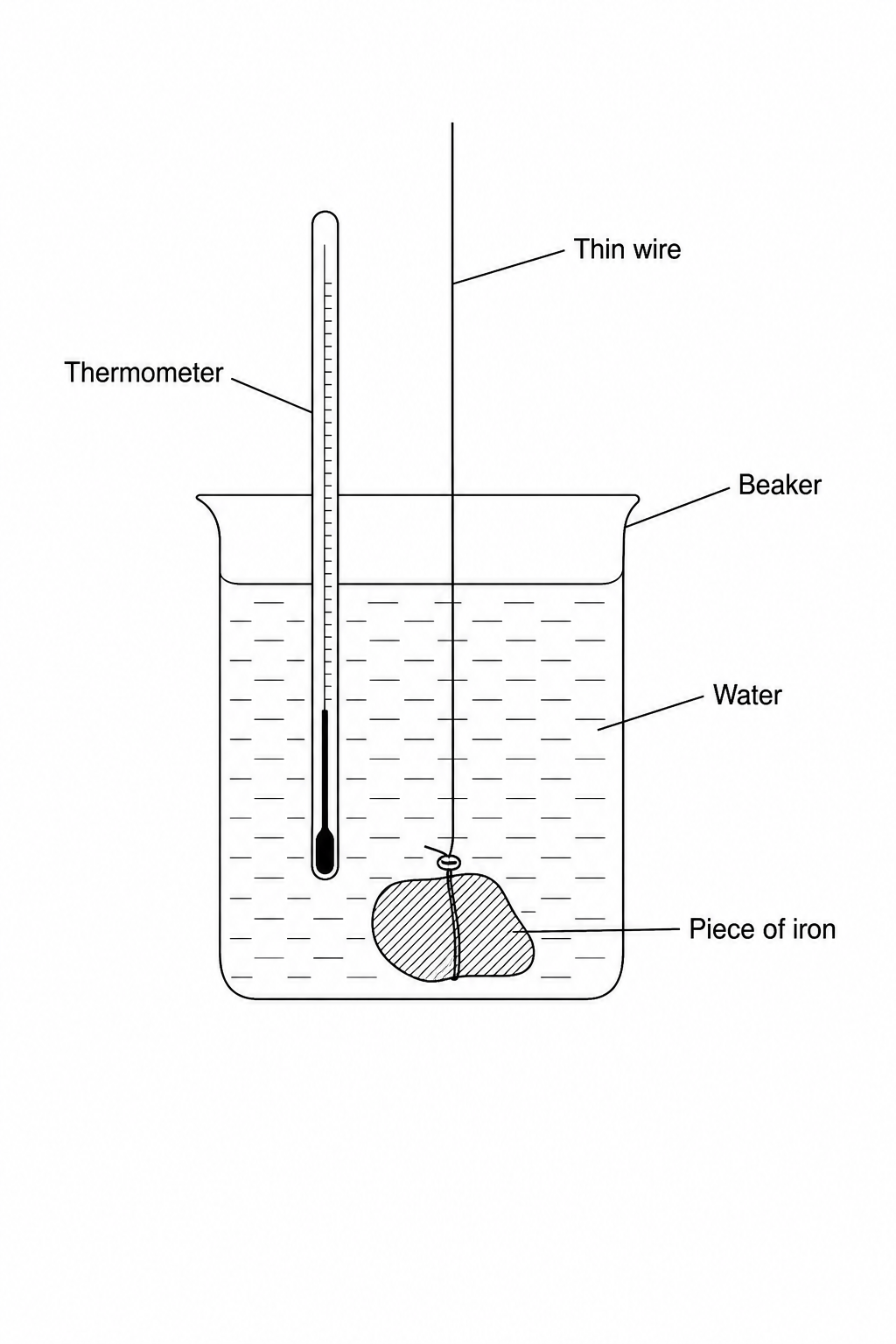
The student puts the hot piece of iron into a different beaker of cold water at 18∘C18^{\circ}\text{C}18∘C.
The apparatus is shown in Figure 2.
The student assumes that the thermal energy gained by the water equals the thermal energy lost by the piece of iron.
The water and iron both reach a maximum temperature of 24∘C24^{\circ}\text{C}24∘C.
The cold water gains 2900 J of energy.
The mass of the piece of iron is 0.085 kg.
Calculate a value for the specific heat capacity of iron, using these results.
Use the equation:
change in thermal energy=mass×specific heat capacity×change in temperature \text{change in thermal energy} = \text{mass} \times \text{specific heat capacity} \times \text{change in temperature} change in thermal energy=mass×specific heat capacity×change in temperature ΔQ=m×c×Δθ \Delta Q = m \times c \times \Delta\theta ΔQ=m×c×Δθ