Purity and separating mixtures

EasyMediumHard
12345678910111213141516171819202122232425262728293031323334353637383940414243
Question 42
Medium

A forensic scientist is investigating the ink used to write a threatening note. She uses paper chromatography with ethanol as the solvent to compare the ink from the note with four different black gel pens (W, X, Y, and Z).

a.

What is the stationary phase in this paper chromatography experiment?

[1]
b.

Explain how the components of a mixture are separated using paper chromatography.

[3]
c.

The diagram below shows the results of her chromatogram. The distance from the pencil baseline to the solvent front is measured to be 8.0 cm8.0\text{ cm}8.0 cm.
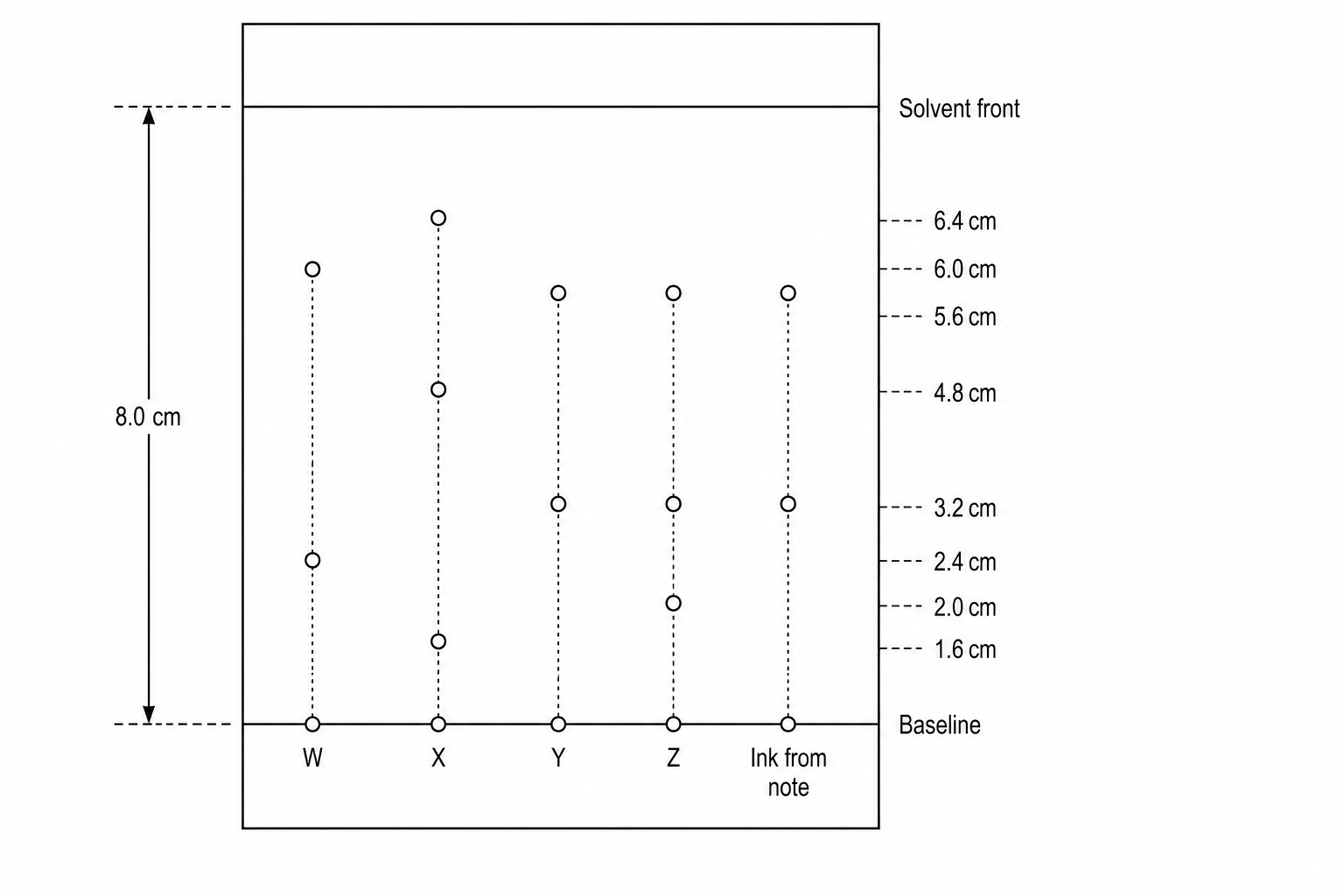
A paper chromatogram with a pencil baseline at the bottom and a solvent front at the top. The distance from the baseline to the solvent front is 8.0 cm. Five sample starting positions are marked on the baseline: W, X, Y, Z, and 'Ink from note'. Above W, there is a blue spot at 2.4 cm and a yellow spot at 6.0 cm. Above X, there is a red spot at 1.6 cm, a blue spot at 4.8 cm, and a yellow spot at 6.4 cm. Above Y, there is a red spot at 3.2 cm and a blue spot at 5.6 cm. Above Z, there is a red spot at 2.0 cm, a blue spot at 3.2 cm, and a yellow spot at 5.6 cm. Above 'Ink from note', there is a red spot at 3.2 cm and a blue spot at 5.6 cm. All heights are measured vertically from the baseline.

Calculate the RfR_fRf​ value of the blue spot in ink Y. Show your working.

[2]
d.

Which ink (W, X, Y, or Z) was used to write the threatening note? Explain how you can tell.

[2]

Purity and separating mixtures Questions

  1. GCSE
  2. /Chemistry
  3. /Purity and separating mixtures